

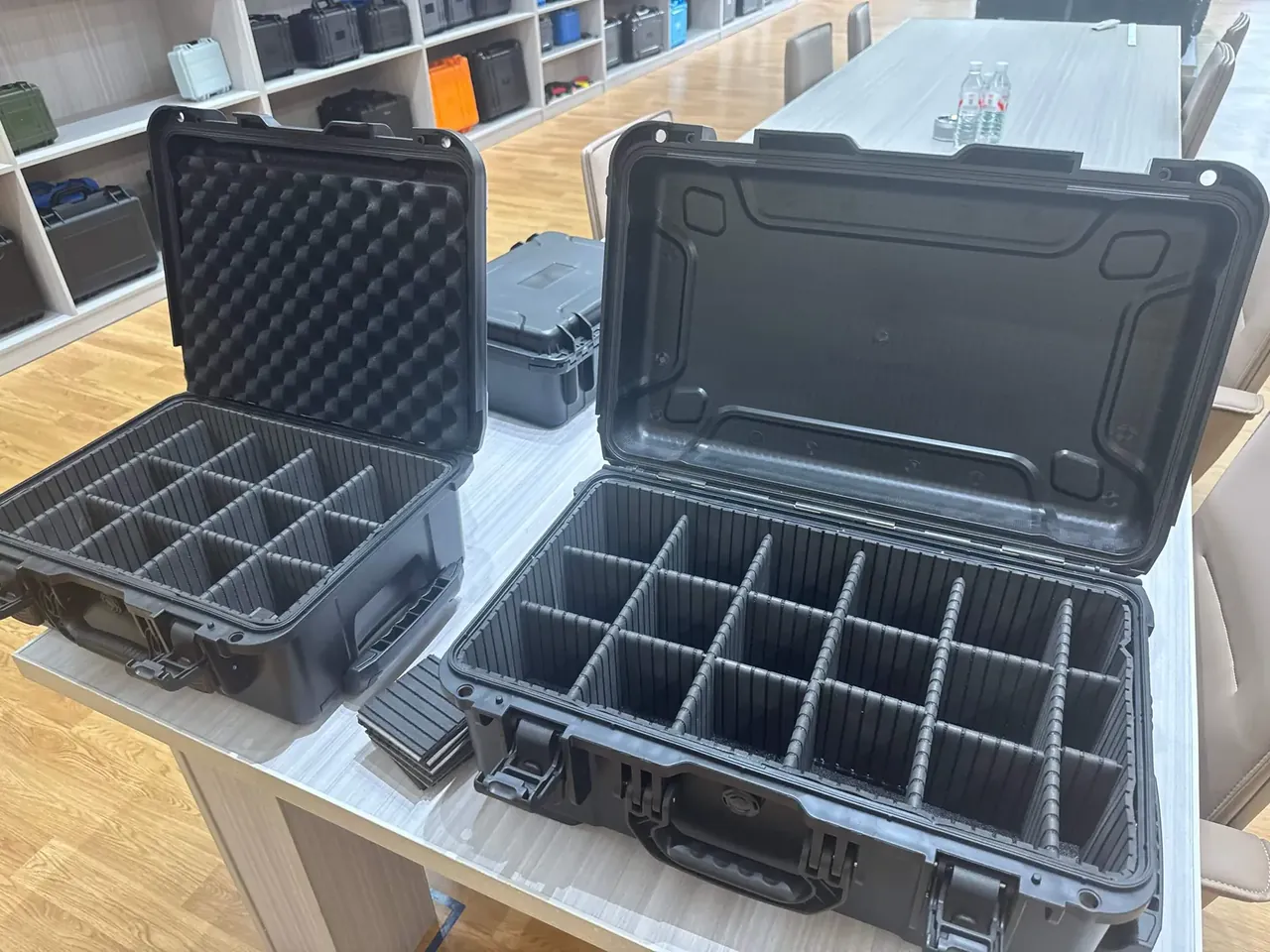
Quick answer: Military packing box procurement rests on three numbers: how the quote is built, what triggers a minimum order, and how lead time splits across process steps. Break the price into four blocks, derive MOQ from changeover downtime, then compress each segment on its own.
Table of contents
- Four Cost Blocks Behind a Quote
- Where the Minimum Order Quantity Sits
- Lead Time Broken Into Process Segments
- Three Gates Between Sample and Mass Production
- Six Clauses to Fix in the Contract
- FAQ
1. Four Cost Blocks Behind a Quote
A military packing box quote breaks into four blocks that react differently to volume.
| Cost block | Share | Response to volume |
|---|---|---|
| Resin | 48% | Small, follows grade and weight |
| Molding | 25% | Large, tied to tonnage and cycle |
| Foam | 17% | Medium, depends on cutting |
| Assembly and packing | 10% | Medium, follows labor hours |
Resin is the largest block and the most misread. Price follows shot weight, which follows wall and rib design: trimming 0.3 mm off a main wall saves about 4 percent resin.
Tooling needs its own line: about 48,000 RMB for a new structure, spreading to 16 per unit across 3000 pieces; at 500 pieces the same mold loads 96 onto every box. Quotes hold only 30 days, so fix the amortization base in writing.
2. Where the Minimum Order Quantity Sits
The military packing box MOQ is not a round number chosen for the negotiation. It comes from three changeover actions: color purge, mold change and resin pack size.
Color costs the most time. Dark to light means purging the screw and barrel, 2.5 hours in practice, and a poor purge scraps the batch. Standard color starts at 200 pieces; a color change needs 500. A structure change means mold change, 3.5 hours plus 5 to 8 scrapped parts, setting 1000 pieces and 3000 for a new mold.
Resin has a floor too. Modified polypropylene ships in 500 kg packs, roughly 400 boxes, so a smaller military packing box order buys a full pack into stock.
| Change type | MOQ | Effect on delivery |
|---|---|---|
| Standard size and color | 200 | Shortest |
| Color change | 500 | Plus 1 day |
| Structure change | 1000 | Plus 5 days |
| New mold | 3000 | Plus 25 days |
3. Lead Time Broken Into Process Segments
The 38 days quoted for a military packing box is an aggregate. Split it and slack appears: material 12 days, molding 8, foam 10, assembly 5, inspection and dispatch 3.
Only two segments compress. Material falls to 5 days if resin is bought against a forecast; foam falls to 7 by switching from hand to die cutting. Molding has little room: press scheduling is serial.
Once the cavity is frozen, foam runs parallel with molding. Many plants still place foam after molding and lose 10 days. Compress everything and the chain reaches 24 days, but 28 to 30 is realistic.
4. Three Gates Between Sample and Mass Production
Sampling has three gates: hand model, T1 trial, sealed sample.
The hand model takes 4 days in 3D print or CNC and proves cavity and access. T1 runs in production tooling for 6 days and exposes sink marks, warpage and latch fit. The sealed sample follows correction in 2 days, signed by both sides, 2 sets kept.
The gate most often skipped is the sealed sample: without it, a color or fit difference has no arbiter. Mark it with mold number, grade, lot and date.
5. Six Clauses to Fix in the Contract
Price is only the opening in military packing box procurement. Six clauses decide whether the order comes back for rework.
| Clause | How to write it | Cost of leaving it out |
|---|---|---|
| Acceptance | Judge against specification fields | Returns to opinion |
| Inspection | AQL 2.5 major, 4.0 minor | Arguments over sampling |
| Tooling ownership | Buyer owns once paid | Cannot move suppliers |
| Late delivery | Daily penalty with a cap | Delay is free |
| Payment | 30% deposit, 70% before shipment | Balance loses leverage |
| Change control | Change note signed by three parties | Specification drifts |
Tooling ownership is missed most often. Once the invoice is settled, ownership, storage and handover belong in writing.
Tie payment to inspection: 30 percent locks material, 70 percent falls due after the report.
Conclusion
Military packing box procurement is not a haggling exercise. Split the quote into four blocks, derive MOQ from changeover time, compress lead time segment by segment and run foam parallel to molding. With the three gates and six clauses fixed, price and delivery become predictable together.
This article discusses only the container (case body) side of specifications and design intent, and does not cover any handling, loading or use of the contents.
Related Reading
- How to set military packing box specifications: size, wall and load
- Materials for military packing boxes: wood, corrugated, plastic and metal
- Replying to a protective case inquiry: what a quote should contain
- Auditing a protective case supplier: capacity and traceability
Related Products
- 8 Series — Gun Cases; Military Equipment Cases; Camera Equipment Cases; Drone Cases; Watch Cases; Knife Cases; First Aid Cases; Electronics Equipment Cases
- WL8-2812 PP Gun Case — model WL8-2812
- All protective cases and toolboxes: 7 series, 158 models