

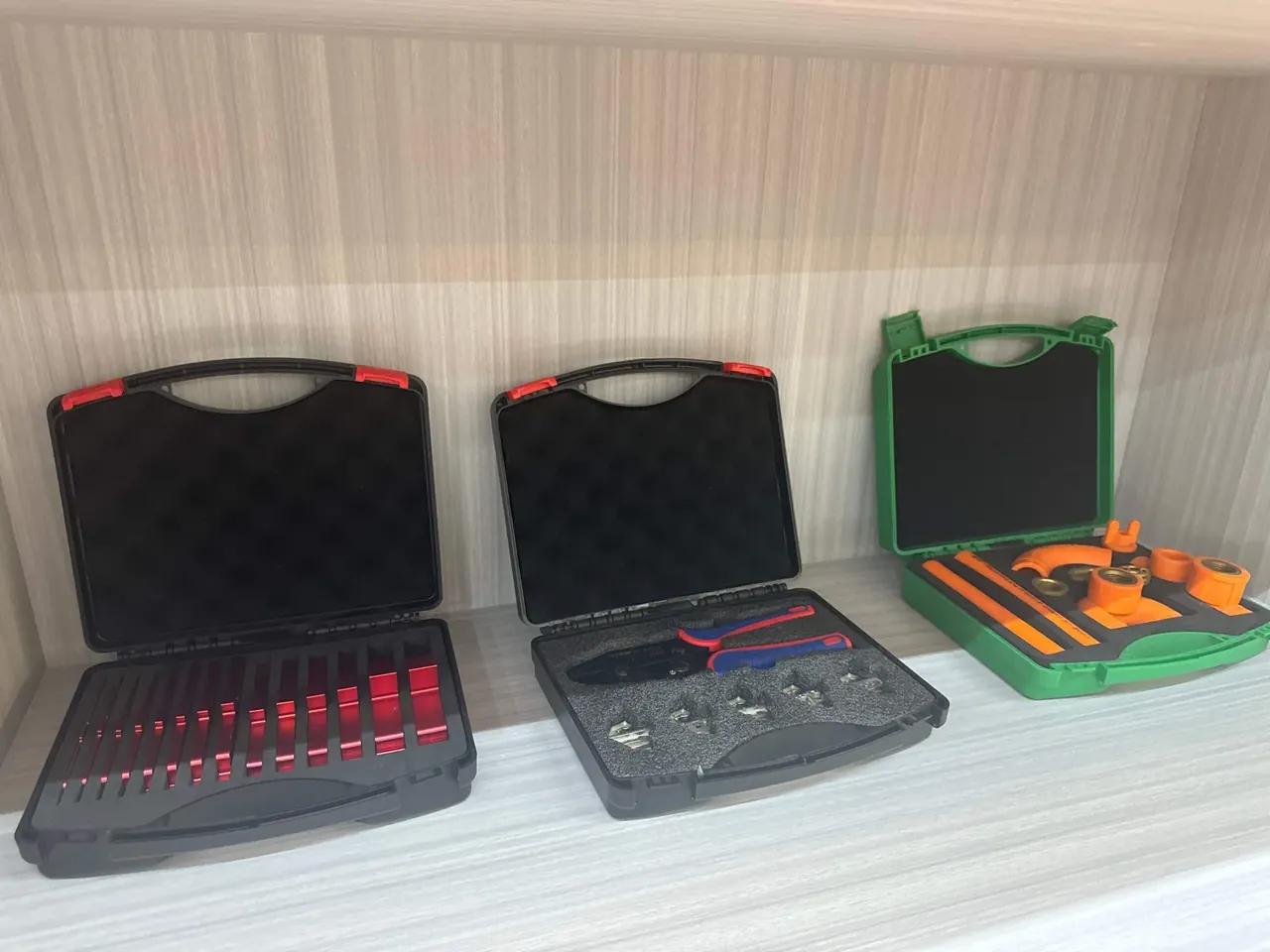
Quick answer: Choosing a military packing box is less about comparing spec sheets than about answering five questions in order: how high it will be stacked, how much compression the foam needs, whether the body must breathe, how often it is opened, and how many years it must serve. Each answer becomes a number that sets wall thickness, clearance, seal design and latch count.
Table of contents
- Five Criteria for Choosing a Military Packing Box
- Criterion One: Working Back from Stack Height
- Criterion Two: Internal Clearance and Foam Compression
- Criterion Three: Sealing Against Breathing
- Criteria Four and Five: Latches and Service Life
- FAQ
1. Five Criteria for Choosing a Military Packing Box
A military packing box is usually specified by comparing tables, yet the work is a sequencing exercise. Load comes first, because stack height decides wall thickness. Clearance comes second, because thickness eats internal volume. Seal and latch layout follow, since gasket and latches share one stepped lip. Service life comes last and decides what must be replaceable.
2. Criterion One: Working Back from Stack Height
Load comes not from what sits inside but from how many boxes sit on top, and for how long. Take a 600 × 400 × 220 mm body at a 16 kg gross weight: at four tiers the bottom lid carries three boxes for months.
| Tiers | Boxes above | Added static load | Suggested wall |
|---|---|---|---|
| 2 | 1 | 16 kg | 2.2 mm |
| 3 | 2 | 32 kg | 2.5 mm |
| 4 | 3 | 48 kg | 2.8 mm |
| 5 | 4 | 64 kg | 3.2 mm |
Added load is only a start, because plastic creeps: a four-tier stack at 25 °C for six months sags under 1.5 mm at mid-wall, while 40 °C for eighteen months can pass 3 mm, since creep doubles every 10 K. A factor of two is common, so four tiers are checked at 96 kg.
3. Criterion Two: Internal Clearance and Foam Compression
Internal size must be calculated: net length is outer length minus two walls and the corner radius. At 600 mm outer and 2.8 mm walls, net length is about 594 mm, and an 8 mm lip leaves 586 mm.
Compression keeps a spring force alive: a cut cavity at 15%–20% holds an item when the case is turned over; below 10% it shifts, above 25% it presses the lid. Handling adds 3 mm per side, 5 mm for handled items.
4. Criterion Three: Sealing Against Breathing
Seal level follows the environment, not a rating ladder. A rubber gasket in the stepped lip is most stable at 25%–30% compression; below 20% water finds a path, above 35% the rubber ages within two years.
A closed body develops negative pressure as temperature falls. Across a -40 °C to 60 °C range the trapped air contracts and the differential can reach 0.05 bar. That harms no shell, but the lid sticks and moisture creeps past the gasket. Two answers exist: fit a vent, or seal fully and control humidity with desiccant at 20 g/m³, rounded to a 5 g sachet for a 30 L body.
5. Criteria Four and Five: Latches and Service Life
Latch count follows body length. Between two latches the lip lifts under gasket rebound, and once spacing grows the seam opens mid-span, losing dust and water protection together.
| Body length | Latches | Hinges | Opening frequency |
|---|---|---|---|
| Under 400 mm | 2 | 2 | A few times a week |
| 400–600 mm | 3 | 2 | A few times a day |
| 600–800 mm | 4 | 3 | Many times a day |
| Over 800 mm | 5–6 | 3–4 | Constant access |
Service life is most often underestimated. Four openings a day across 250 working days for three years is 3000 cycles, and hinges must be checked against that, not 300. Gaskets are replaced every two years, latches stocked at 5% of the total.
Settle all five criteria and quotations become comparable. Two military packing box designs with the same outline differ in latch count and gasket type, and the cheaper unit often costs more across three years.
Conclusion
The sequence runs from stack height to wall thickness, from clearance to foam thickness and finger gap, from environment to seal or vent, and from opening frequency to latch count and spares. Reverse it and failures are predictable: a sagging lid, foam that presses the lid shut, or a gasket that welds itself in place. Fixed as a checklist, the five criteria make every quotation for a military packing box comparable.
This article discusses only the container (case body) side of specifications and design intent, and does not cover any handling, loading or use of the contents.
Related Reading
- Packaging standards and marking rules for military packing boxes
- Setting dimensions and wall thickness for a military packing box
- Material comparison for military packing boxes
- How to choose internal dividers and foam inserts
Related Products
- 8 Series — Gun Cases; Military Equipment Cases; Camera Equipment Cases; Drone Cases; Watch Cases; Knife Cases; First Aid Cases; Electronics Equipment Cases
- WL8-2812 PP Gun Case — model WL8-2812
- All protective cases and toolboxes: 7 series, 158 models