

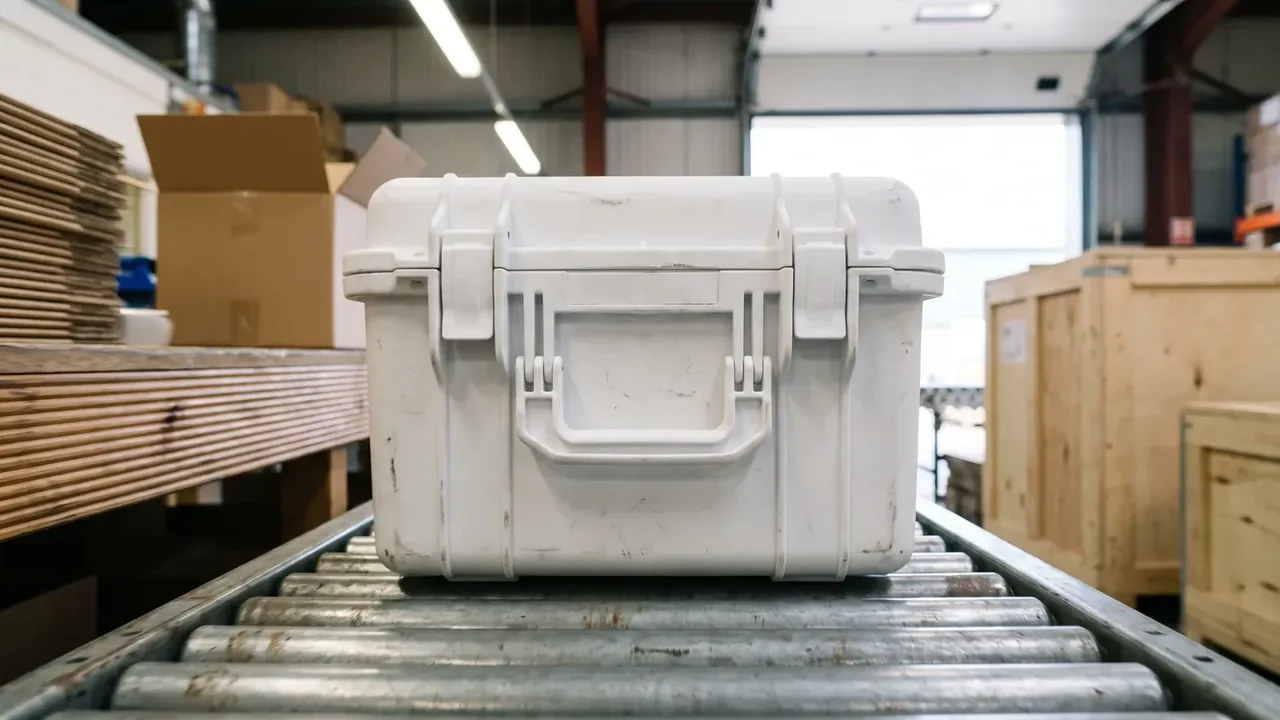
Quick answer: A military rotomolded case is a seamless polyethylene shell formed in a biaxially rotating mould, where charge weight rather than mould clearance sets wall thickness. Five points decide whether it is built well: continuous layers, even heating, ribs on the load path, encapsulated inserts and controlled cooling.
Table of contents
- What a Military Rotomolded Case Is Built From
- Heating, Rotation and Powder Fusion
- Wall Thickness and Where Ribs Carry Load
- Inserts, Latches and the Gasket Groove
- Cooling, Shrinkage and Batch Consistency
- FAQ
1. What a Military Rotomolded Case Is Built From
A military rotomolded case reads as one solid part, yet five zones sit across its wall: outer skin, core, inner skin, rim and base. Powder fuses layer by layer, so the wall grows with no weld line or joined seam, and it dents locally instead of splitting. Sides run 6.0 to 6.5 mm, the base 8 mm, the rim 9 to 10 mm.
The rim seals, takes latch force and passes stacked weight at once. Too thin, it crushes when a latch closes, and the gap stays invisible.
2. Heating, Rotation and Powder Fusion
The mould spins on a major axis while a perpendicular minor axis swings slowly: 280 to 300 °C, 16 to 20 minutes for a 120-litre class case, axes at 9 and 4 rpm.
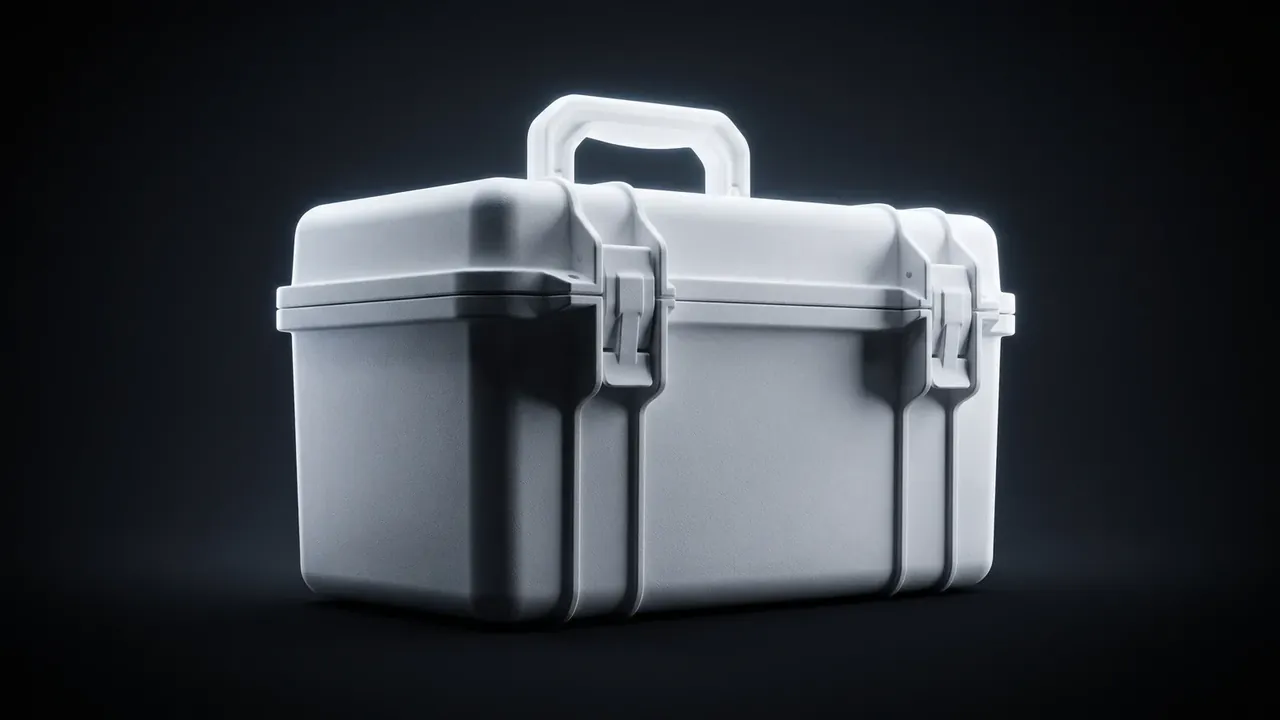
Powder runs about 35 mesh, 0.4 to 0.5 mm a particle. Coarse powder leaves unfused granules inside; fine powder flies out and throws thickness off. Two signals judge the cycle: how long the internal curve takes to peak, and whether unmelted powder remains. An underheated case looks complete while its wall is layered, and it splits between layers on a drop. Overheating yellows the resin and cuts impact strength; the usable window is often three or four minutes.
3. Wall Thickness and Where Ribs Carry Load
Thicker walls are not automatically better: they add weight and cooling time, and slow cooling raises the warp caused by uneven shrinkage. Follow the load path instead, from latch seats along the rim, down the side walls to the corners, then through the base into the stacking surface.
Ribs run perpendicular to the main bending direction, height to pitch kept within about 1 to 10 so roots do not sink.
| Rib parameter | Value | Meaning |
|---|---|---|
| Height | 12 to 14 mm | Low adds nothing, high sinks |
| Pitch | 150 to 180 mm | Matched to lid span |
The base takes almost all stacking weight, so it is moulded with an 8 to 12 mm recess: edges touch down, the centre stays clear. Feet run at least 25 mm tall, leaving room for forklift tines on a military rotomolded case.
4. Inserts, Latches and the Gasket Groove
Metal meets plastic three ways: moulded-in inserts, heat-pressed inserts and bolts backed by a wide plate. Loaded points get a steel insert; evenly clamped points a through-bolt.
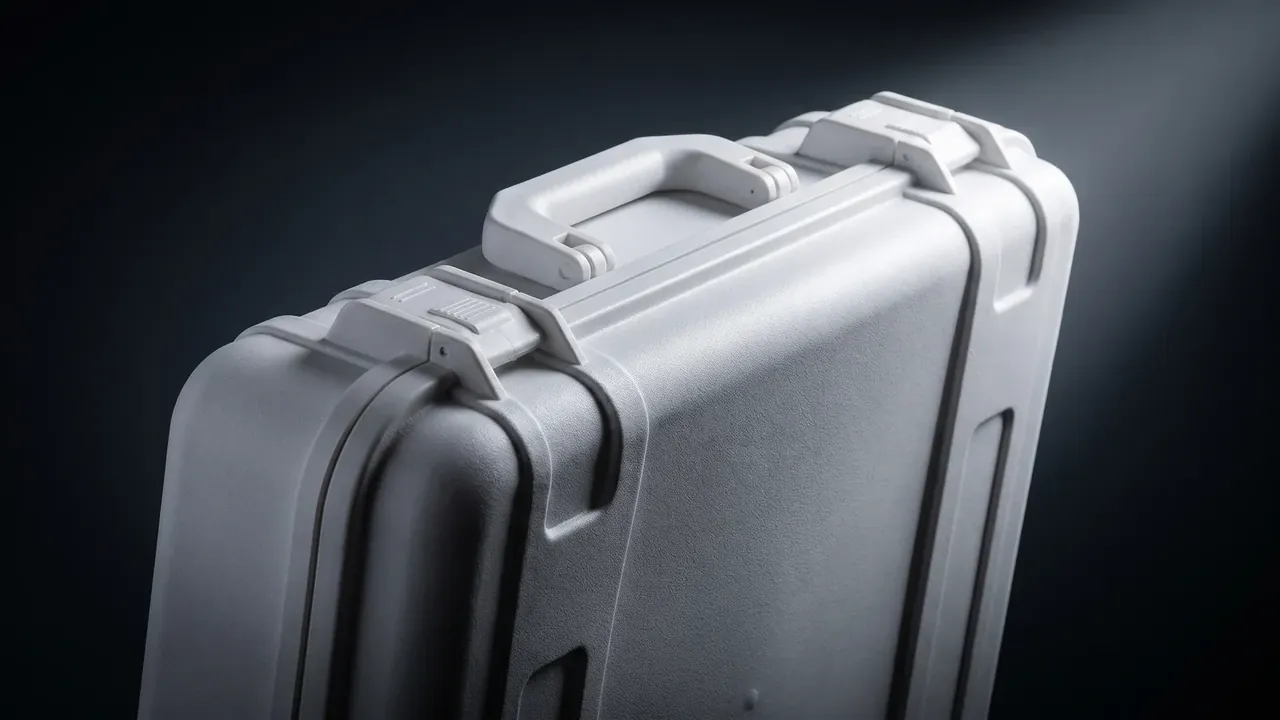
Inserts are fixed to the mould wall before closing, so positional error decides whether assembly lines up. A common choice is an M8 knurled steel insert, pull-out required to reach 3 kN and torque held at 18 Nm; past what the plastic bears, it spins and the sealing face shifts.
The gasket groove is moulded with the body, 8 mm wide and 6 mm deep, its flatness set by the mould surface. A silicone cord sits in it at 25 to 30 percent compression: less weeps, more over-presses the latches.
5. Cooling, Shrinkage and Batch Consistency
The part must fall from above 200 °C to about 60 °C before demoulding, usually with fan air and mist over 20 to 25 minutes. Fast cooling leaves skins at different temperatures, so the case warps; slow cooling raises crystallinity and makes the shell brittle. Polyethylene shrinks 1.5 to 2.2 percent, so moulds are cut at a nominal 2 percent and corrected from the first shot.
| Defect | Cause | Acceptance line |
|---|---|---|
| Pinholes inside | Damp powder, trapped air | Over 3 per part rejected |
| Warped rim | Uneven cooling, hot demould | Flatness over 1 mm rechecked |
Batch consistency rests on one mould, one resin grade and one profile. A grade change needs a fresh first-article check at nine points: four inner corners, four rim midpoints and the base centre of the military rotomolded case.
Conclusion
Most quality differences in a military rotomolded case hide in wall distribution, insert encapsulation and cooling control, not in appearance. Continuous layers set strength, heating decides wall density, ribs place the stiffness, inserts decide whether assembly repeats, and cooling decides dimensional stability. Checking that chain beats judging a sample by eye, and it shows whether a military rotomolded case will last in service.
This article discusses only the container (case body) side of specifications and design intent, and does not cover any handling, loading or use of the contents.
Related Reading
- Field and sea-freight applications
- Sealing and low-temperature problems
- How a rotomolded case is built
- Sizes, wall thickness and load ratings
Related Products
- 8 Series — Gun Cases; Military Equipment Cases; Camera Equipment Cases; Drone Cases; Watch Cases; Knife Cases; First Aid Cases; Electronics Equipment Cases
- WL8-2812 PP Gun Case — model WL8-2812
- All protective cases and toolboxes: 7 series, 158 models