

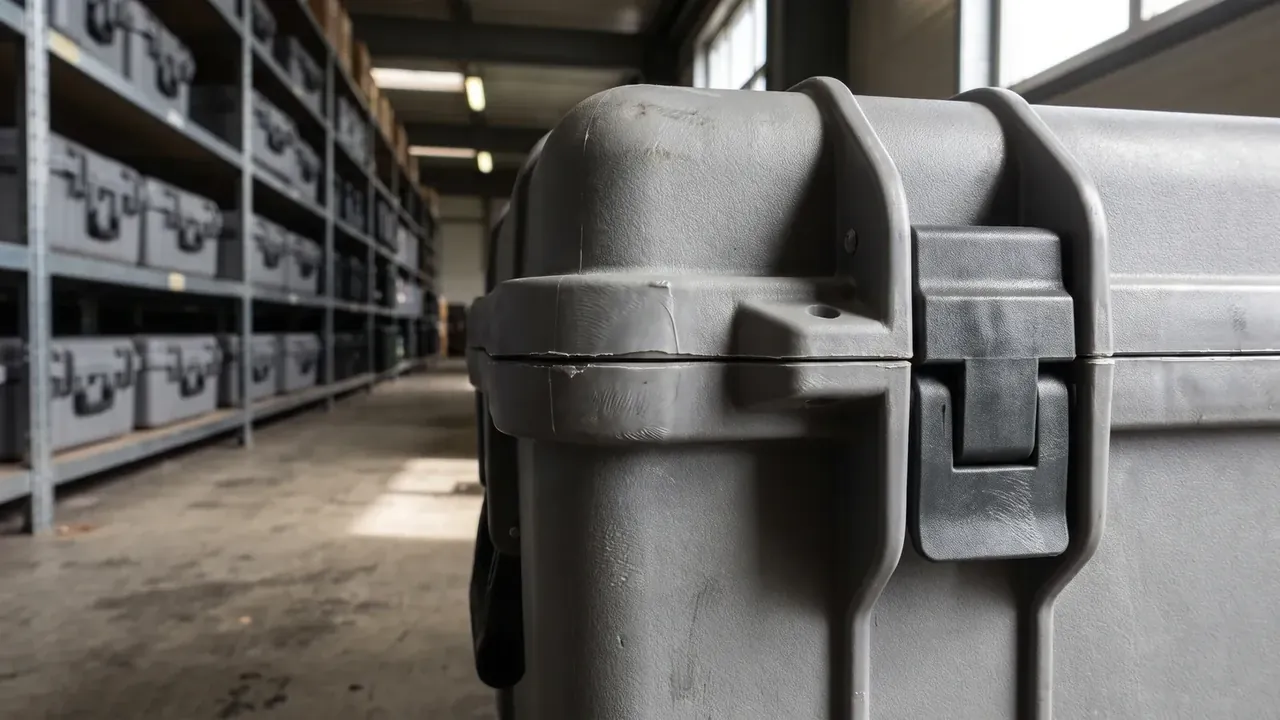
Quick answer: Specify a military rotomolded case from the outside in: fix the equipment outline and transport platform, derive the cavity, reverse the envelope, then commit wall zones, insert torque and load figures.
Table of contents
- Start the Spec from the Equipment Outline
- Cavity Size and Cushion Thickness
- Wall Thickness Zones and Metal Inserts
- Rated Load and Stacking Height
- What the Spec Sheet Must State
- FAQ
1. Start the Spec from the Equipment Outline
Enquiries open with a volume in litres, which is where a military rotomolded case project slips. Geometry starts from the outline with every protrusion, from one- or two-person carry, and from air or road transport. A terminal of 660 × 420 × 240 mm had a handle out 40 mm and an antenna mount 25 mm above the lid; both were missed and the foam pocket was pierced.
The platform sets the ceiling: on a 2680 × 2230 mm deck, an outer length above 893 mm drops three rows to two, and nine cases to six.
| Input | Parameter fixed | Value here |
|---|---|---|
| Equipment 660 × 420 × 240 mm | Cavity clear size | 710 × 470 × 320 mm |
| One-person carry | Length, weight | 800 mm, 19 kg |
| Pallet 2680 × 2230 mm | Length ceiling | 893 mm |
The envelope adds 18 mm of lid rim and 30 mm of feet to twice the wall; hold ±2.5 mm outside, ±1.5 mm inside.
2. Cavity Size and Cushion Thickness
The cavity is equipment plus twice the cushion, not twice the wall. EPE at 35 kg/m³ laid 25 mm per side compresses to 18 mm, about 28 percent, holding the load and leaving drop travel.
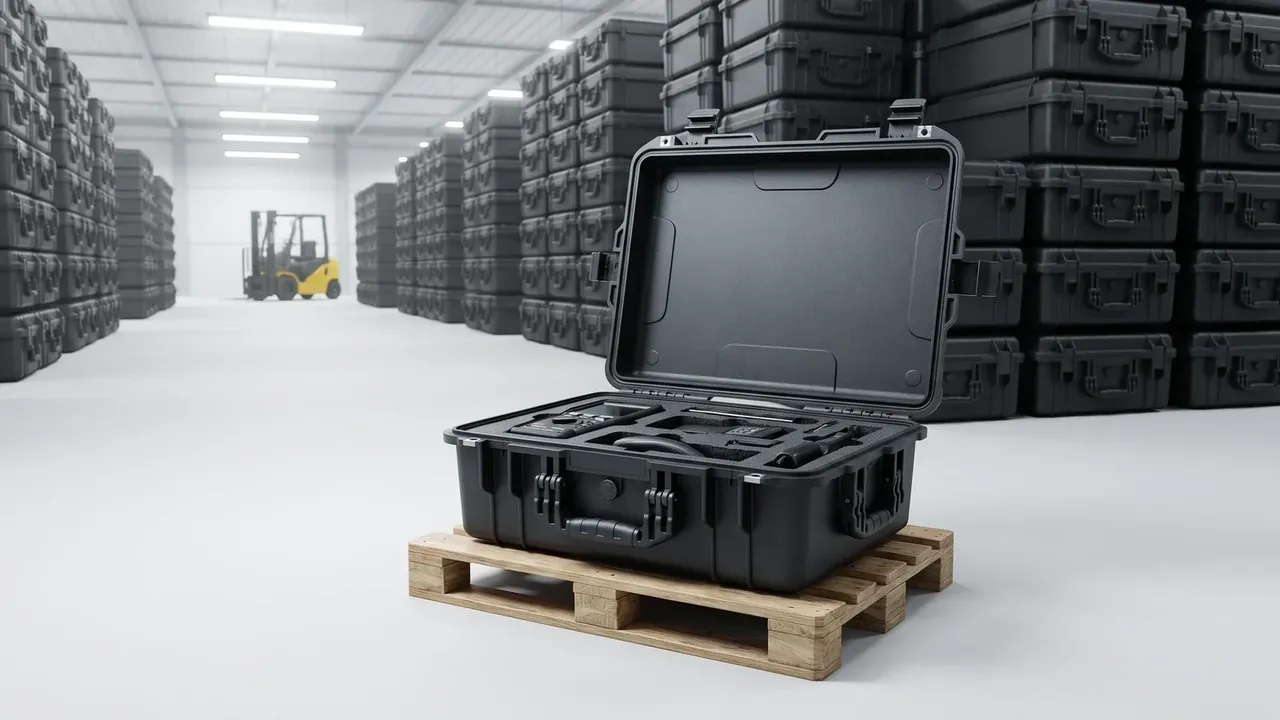
Cold eats that margin. At 1.2 × 10⁻⁴ per °C an 800 mm envelope shrinks 6 mm from 23°C to -40°C and a 710 mm cavity follows by 5 mm, leaving 13 mm of foam; add 6 mm to the cavity or fit a cold-flexible layer.
3. Wall Thickness Zones and Metal Inserts
One wall figure cannot control a military rotomolded case: powder thins at corners, bosses and inserts, so each load path gets its own tolerance.
| Zone | Nominal | Tolerance | Why it is loaded |
|---|---|---|---|
| Side wall | 4.5 mm | ± 0.5 mm | Side squeeze, stacking |
| Base | 7.0 mm | ± 0.8 mm | 85 kg spread load |
| Lid rim | 9.0 mm | ± 0.8 mm | Seal face stiffness |
| Corners, feet | 10.0 mm | ± 1.0 mm | First contact in a drop |
Mould temperature is 245 to 295°C and HDPE shrinks 2.2 to 2.6 percent, so a 710 mm cavity at 2.4 percent needs 727 mm of steel. Stainless M8 inserts hold 1800 N at 8 N·m; past 11 N·m the seat whitens. Ribs on a 90 mm pitch, 8 mm high, carry the stiffness.
4. Rated Load and Stacking Height
The rated load of a military rotomolded case splits into three figures: 85 kg rated, 650 kg top load for 24 hours, five high. The limit may come from strength or from clearance.
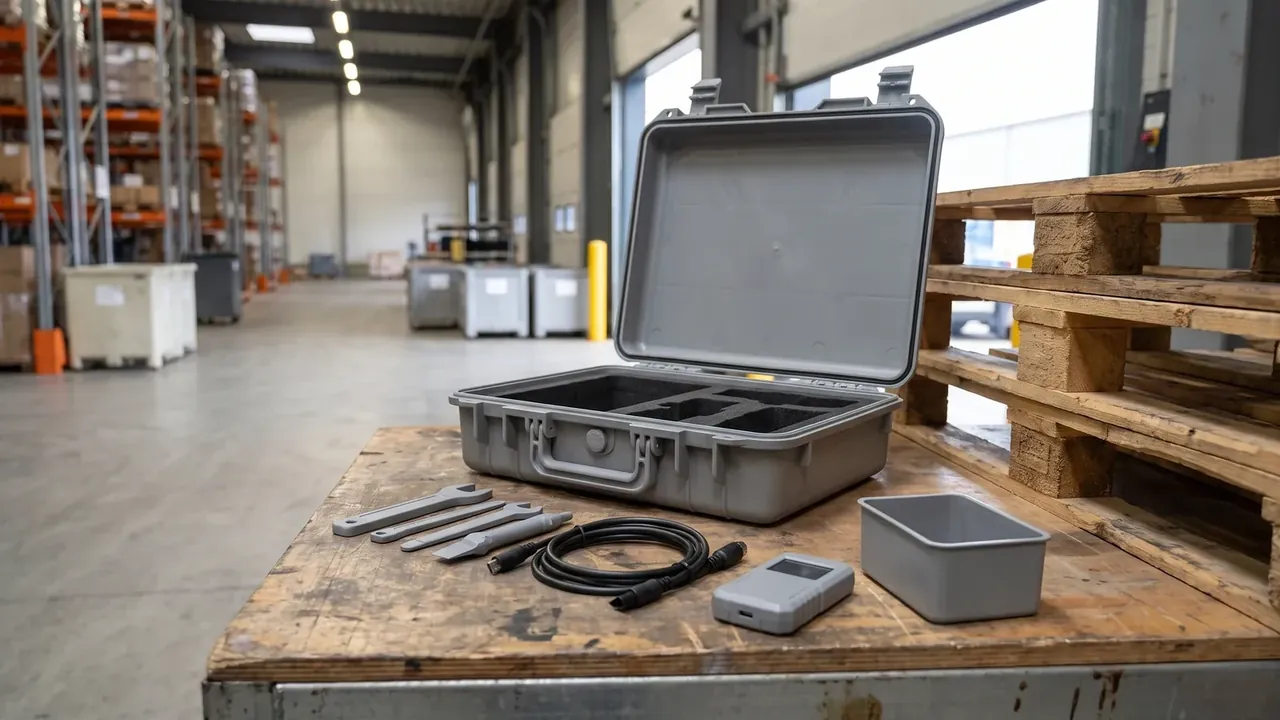
Five is calculated: 390 mm cases on a 150 mm pallet reach 2100 mm inside 2.4 m, and the bottom case carries 340 kg, so 650 kg leaves a factor of 1.9. On 2.7 m racks six fit, but the limit shifts to top load. Four slings stay within 45 degrees, proof-loaded at twice rated load for ten minutes.
5. What the Spec Sheet Must State
A sheet that goes to production carries the essentials, or it comes back as a dispute.
| Item | How to write it | Cost of omitting |
|---|---|---|
| Sizes | 800 × 560 × 390 ± 2.5 mm, cavity ± 1.5 mm | Pallet count wrong |
| Load | 85 kg rated, 650 kg top, five high | Overload or under-stack |
| Seal, valve | 30% compression, opens below 0.25 bar | Lid sucked shut in flight |
| Hardware | M8 inserts, 8 N·m, colour codes | Colour drift, no reorder |
A military rotomolded case needs the pressure valve: at cruise the differential reaches 0.25 bar, about 11 kN across the lid, beyond hand force.
Conclusion
A military rotomolded case is a chain of numbers that restrain each other: cavity follows equipment and cushion travel, envelope follows the platform, wall zones follow load paths, stacking follows top load and clearance. Write those links as tolerances and test conditions. The saving comes from keeping every millimetre on a load path, which is the craft of military rotomolded case specification.
This article discusses only the container (case body) side of specifications and design intent, and does not cover any handling, loading or use of the contents.
Related Reading
- Field and training configurations
- Field problems and how to handle them
- Size selection by equipment
- Foam insert specification
Related Products
- 8 Series — Gun Cases; Military Equipment Cases; Camera Equipment Cases; Drone Cases; Watch Cases; Knife Cases; First Aid Cases; Electronics Equipment Cases
- WL8-2812 PP Gun Case — model WL8-2812
- All protective cases and toolboxes: 7 series, 158 models