

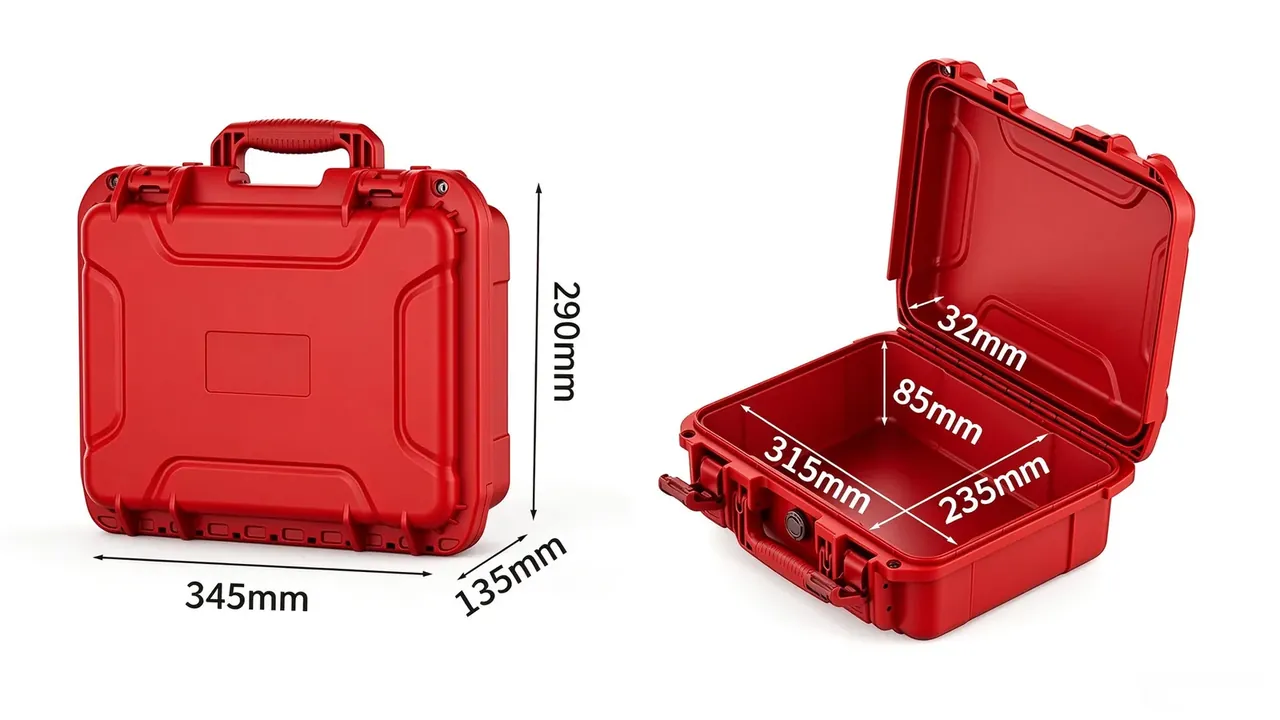
Quick answer: A Military throwable sealed instrument safety box sets a 3.2 mm corner wrap and 21% gasket compression; the drop grades crack and mouth decay.
Table of contents
- Corner wrapping on a Military throwable sealed instrument safety box
- Compression rate of the twin gaskets
- Crack length after the six-face drop
- Mouth decay after warming back
- Wrap setting for the instrument batch
- FAQ
1. Corner wrapping on a Military throwable sealed instrument safety box
Impact reaches a corner first, then runs around the mouth; wrap thickness and twin-gasket compression decide whether a crack or a pressure drop crosses its line first. A Military throwable sealed instrument safety box is 640 by 450 by 260 mm outside, 570 by 385 by 190 mm inside, with a 4.8 mm wall and a 3.2 mm soft wrap over eight corners. A thicker wrap spreads impact wider but leaves less rebound allowance at the lid rim, so the mouth seats worse.
Wrap grade leads the drop ledger, and a change to the mould, stock or corner radius voids that grade. Three wraps run on one rig and one fixture, at 2.6 mm, 3.2 mm and 3.8 mm, with compression held at 21%.
| Wrap grade | Corner wrap | Compression |
|---|---|---|
| Thinner | 2.6 mm | 21% |
| Nominal | 3.2 mm | 21% |
| Thicker | 3.8 mm | 21% |
The 2.6 mm wrap opens a 1.9 mm crack; 3.8 mm pulls it to 0.6 mm but lifts decay to 0.44 kPa / 10 min. Only 3.2 mm holds both. A Military throwable sealed instrument safety box fails at the thin grade because the strike reaches the substrate, not because the resin turns brittle.
2. Compression rate of the twin gaskets
A Military throwable sealed instrument safety box treats 21% as the second grading quantity, measuring how far each gasket is pressed by the lid rim, not how hard the strip is. One ring sits inside, one outside; four latches close at 430 N, the inner taking most of the squeeze, the outer left to make up pressure after warming. Past 21% the lid stiffens, and after 3800 cycles a high decay is wrongly charged to the wrap grade.
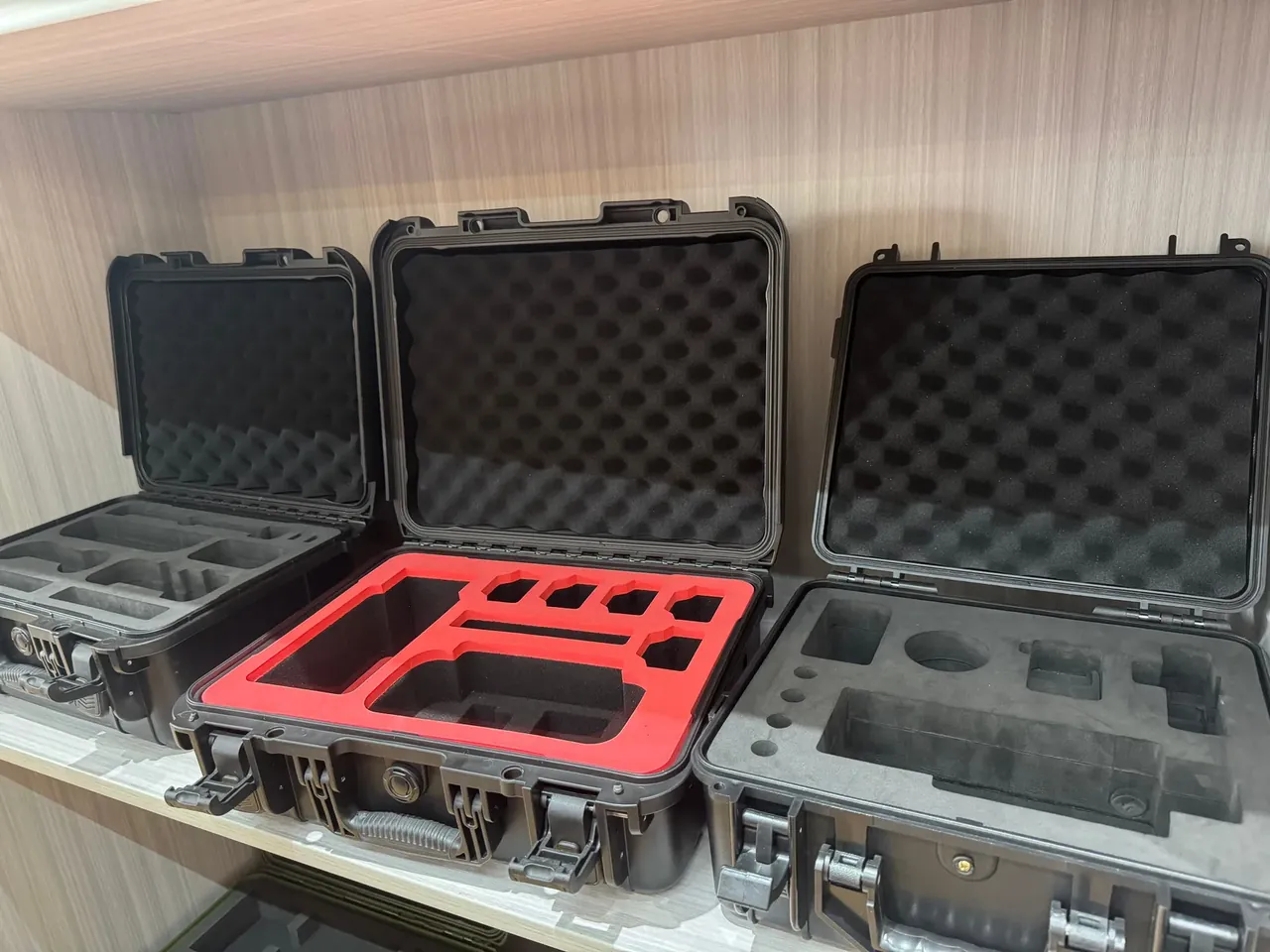
Compression and latch force share one sheet, and a shell missing either stays out of the ledger. Empty 7.9 kg and loaded 19 kg sit in the same cell: new ballast shifts the energy the wrap absorbs, while compression is rechecked alone at 21%.
3. Crack length after the six-face drop
A Military throwable sealed instrument safety box grades on the drop: 1.5 m across six faces at -20 °C, the shell settles, then the corner crack is read to 0.1 mm. The longest crack at the sixth face counts, not a sum over all six, since the criterion asks whether the wrap shields the substrate to the end. Earlier faces are trend only.
| Drop sequence | Landing face | Corner crack |
|---|---|---|
| First | Base | 0.4 mm |
| Third | Long edge | 0.9 mm |
| Sixth | Corner diagonal | 1.5 mm |
The release sheet joins the 1.5 mm sixth-face crack to a 0.35 kPa / 10 min decay: 0.4 mm at the first face, 0.9 mm at the third, with a longer new crack per face later on, so the wrap spends its allowance only after repeated cold strikes. Both cells must be filled; readings past six faces are archived without a grade.
4. Mouth decay after warming back
The shell is not graded off the drop; it warms to room temperature before mouth decay is read again. The figure is the fall over a 10 min hold after charging to a reference, logged to 0.01 kPa. Crack and decay differ: a thinner wrap opens the corner, the rim shifts out of plane, and both gaskets lose squeeze.
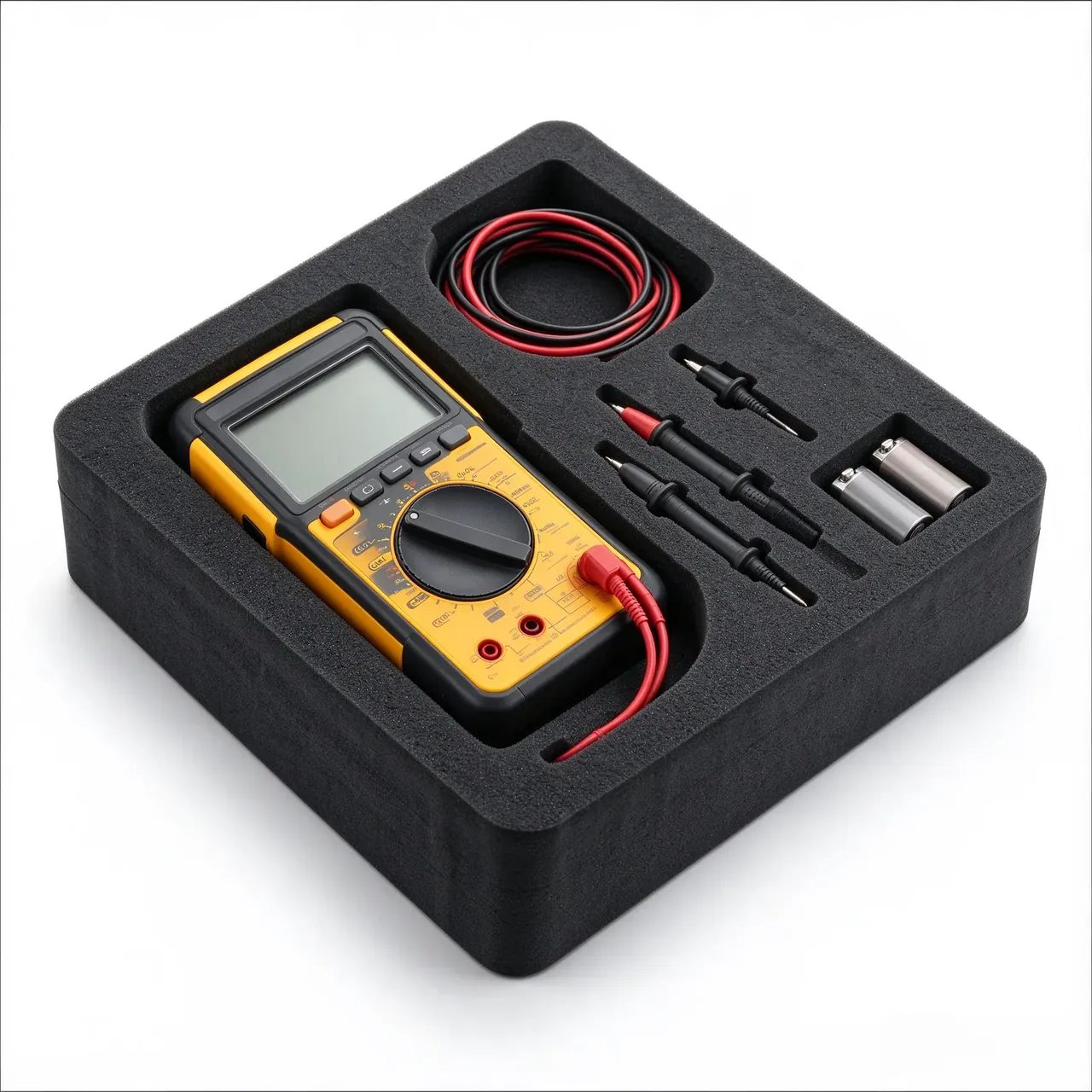
Warming comes first because a strip stiff at -20 °C gives a falsely low decay; the true leak shows at room temperature. The gauge reads three points and keeps the largest, and decay shares the release cell with the crack.
| Crack value | Corner wrap | Mouth decay |
|---|---|---|
| 0.6 mm | 3.8 mm | 0.44 kPa |
| 1.5 mm | 3.2 mm | 0.35 kPa |
| 1.9 mm | 2.6 mm | 0.52 kPa |
At 3.8 mm the crack is 0.6 mm but decay climbs to 0.44 kPa past 0.35 kPa; 2.6 mm crosses both; only 3.2 mm keeps both inside. A Military throwable sealed instrument safety box counts only a decay taken after warming, so a shell never retested earns no grade.
5. Wrap setting for the instrument batch
A Military throwable sealed instrument safety box settles its instrument batch by one rule instead of a face-by-face review: the setting takes the thinnest wrap whose crack after six faces stays no longer than 1.5 mm, and anything thinner is moved as a whole batch to a static-turnover spec. Outside 640 by 450 by 260 mm, cavity 570 by 385 by 190 mm and a 4.8 mm wall are registered as fixed boundary values; a new mould means another full round of six-face drops and warm-back retests.
Each shell keeps its own four-cell record of wrap grade, compression, sixth-face crack and warm-back decay; all four must sit in one grade before that shell enters the instrument spec, and a gap or an over-limit reading sends just it back to the rig, with no pass borrowed from a neighbour. For a Military throwable sealed instrument safety box, moulding conditions and post-drop values are stored apart, drawing tolerances are checked against rig records, and IP67 is kept as a benchmark note.
Conclusion
A Military throwable sealed instrument safety box is graded only when wrap thickness, compression, corner crack and warm-back decay are all in view: a 3.2 mm wrap holds the sixth-face crack to 1.5 mm, 21% compression keeps two gaskets seated after a -20 °C cycle, and warm-back decay stops at 0.35 kPa / 10 min. Any item over its limit sends that one shell back alone, with no margin taken from another. JUNZHIJIA groups drop and warm-back records by batch number into the drawing-tolerance column; Kexin New Materials (Guangdong) Co., Ltd. reopens the file only when moulding parameters change.
Related Reading
- How Outdoor Low-Voltage Boxes Achieve IP67: Four Core Elements of System-Level Protection
- Replacing and Re-Cutting Case Foam: When to Repair and When to Start Over
- Portable spectrum analyzer sealed safety case
- Military Rotomolded Case: Sealing, Impact Resistance, and Low-Temperature Embrittlement Problems
Related Products
- 8 Series — Gun Cases; Military Equipment Cases; Camera Equipment Cases; Drone Cases; Watch Cases; Knife Cases; First Aid Cases; Electronics Equipment Cases
- WL8-2812 PP Gun Case — model WL8-2812
- All protective cases and toolboxes: 7 series, 158 models