

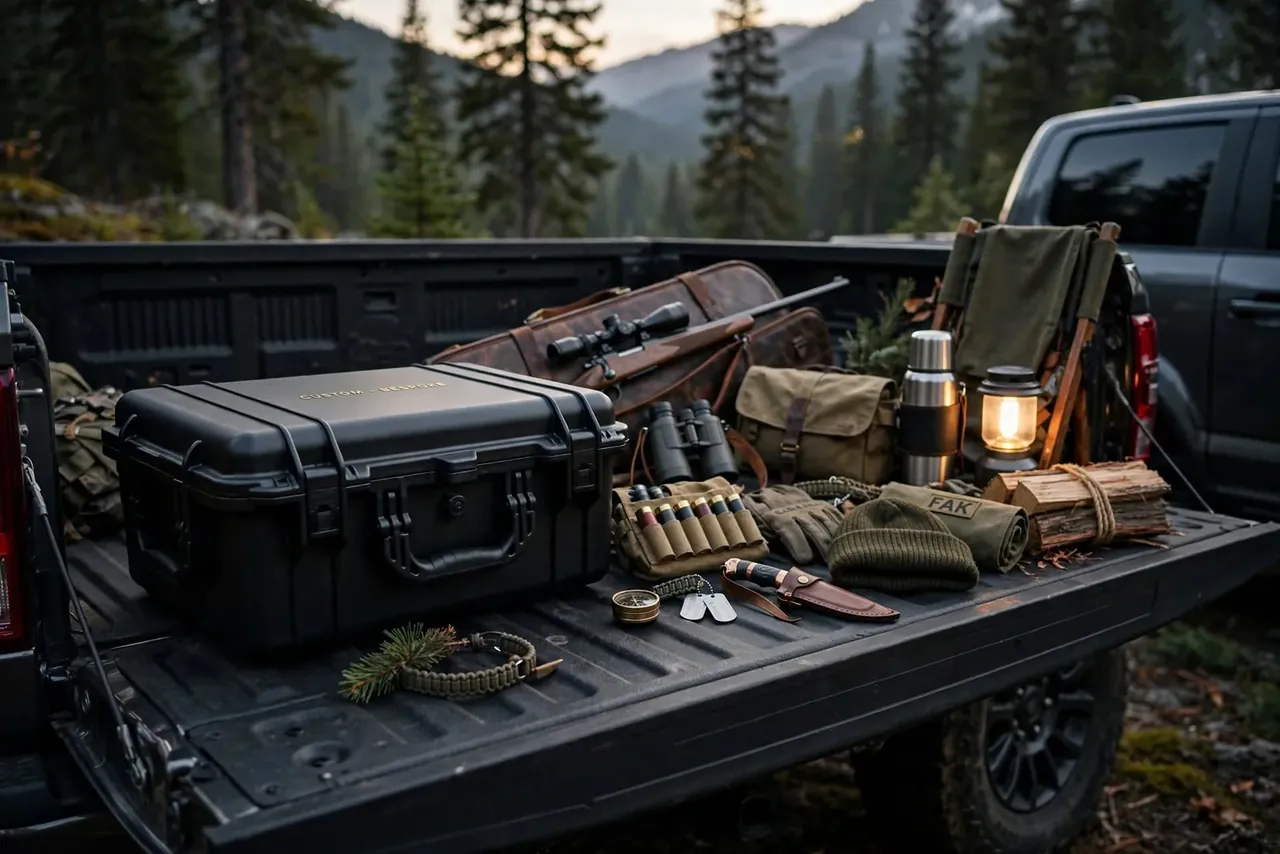
Quick answer: An outdoor camping storage box with lid stackable is judged on 1.2 mm lid flatness and 120 kg static load, plus 3 mm of strap shift over 300 km.
Table of contents
- Lid flatness: why 1.2 mm comes first
- Stacking load: 120 kg on the middle of the lid
- Roof transport: four straps and 3 mm over 300 km
- The lid as a table: 40 kg point load and 0.8 mm ribbing
- Latches at 280 N, cold drop and UV 300 h
- FAQ
1. Lid flatness: why 1.2 mm comes first
Four corners of the upper box must land on the lower lid at once; only then does the weight spread along four edges. An outdoor camping storage box with lid stackable at 560×390×300 mm overall is allowed 1.2 mm of waviness on the lid after moulding. That is the spread between highest and lowest point of the face, not the skirt depth.
Each extra 0.5 mm leaves one corner hanging. Its share of the load moves to the opposite corner, three carry, one lifts, and by the third tier the stack rocks. Four feet under the base and four 0.8 mm recesses on the lid are made as a pair; only a flat lid seats all four at once.
No surface plate is needed: close the lid on glass over newspaper and slide a sheet of A4 under each corner. If it goes in, that corner is high.
2. Stacking load: 120 kg on the middle of the lid
An outdoor camping storage box with lid stackable at 120 kg static load is rated for three tiers: 5.4 kg empty, about 35 kg of gear each, and the top tier landing on the lowest lid. That assumes the worst camp: three boxes full, a crate of drinks set on top.
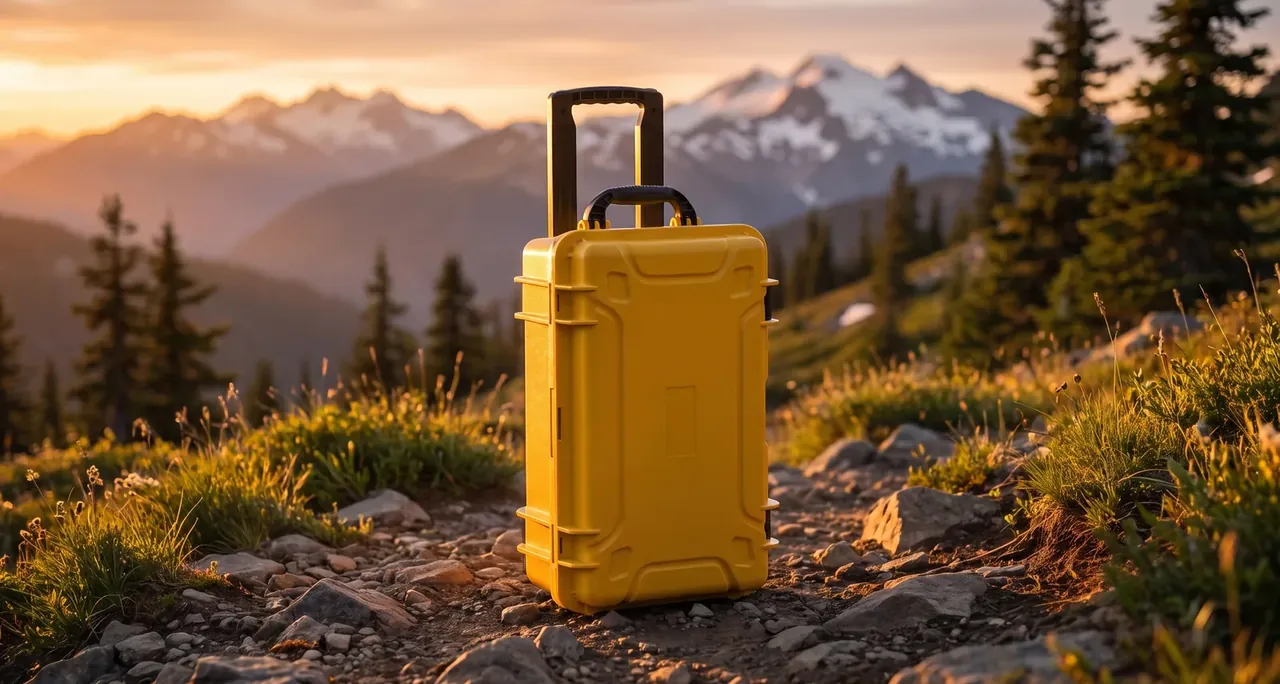
The lid is not one flat plate. A ribbed band runs down the middle. Sealing lips sit along both long sides. Only that middle band touches the base above, so the same load dents it sooner than 60 mm in from the edge, where the wall carries the weight. Support density in that band, not wall thickness, decides whether three tiers hold.
Hold 120 kg for 24 h and the lid must spring back within 1.2 mm; more is creep. After two days at 60 ℃ in a parked car the same box takes about 0.3 mm more set than at 20 ℃.
| Tiers | Static load, kg | Lid deflection, mm | Where it fits |
|---|---|---|---|
| 1 | 40 | 0.3 | Solo, opened often |
| 2 | 80 | 0.7 | Two-person camp |
| 3 | 120 | 1.2 | Short stack |
| Lid deflection, mm | Corner gaps | Stack behaviour | What to do |
|---|---|---|---|
| 0.3 | 0 | All four loaded | Stack three |
| 0.8 | 1 | One corner 0.5 mm clear | Two tiers, shim it |
| 1.2 | 2 | Diagonal rock | Two tiers, by a wall |
3. Roof transport: four straps and 3 mm over 300 km
A roof rack pulls at four points; stacking only presses down.
An outdoor camping storage box with lid stackable on a rack wants four strap points, two per crossbar, threaded through the corner slots. A strap across the lid dents it and still will not hold it, because the lid carries load rather than anchoring.
Over 300 km of mixed road the box may move 3 mm against the crossbar. Past that the strap has gone slack. Chalk a line before leaving and read the offset on arrival.
IP65 on an outdoor camping storage box with lid stackable means dust-tight plus water jets, not immersion. Rain runs down the skirt and leaves through two φ8 mm drain holes; block them and water stands on the seal.
4. The lid as a table: 40 kg point load and 0.8 mm ribbing
Closed, an outdoor camping storage box with lid stackable becomes a camp table. A 40 kg point load is a 100 mm pad pressed anywhere on the lid without collapse; a four-leg stove at 10 kg per leg is easier on it.
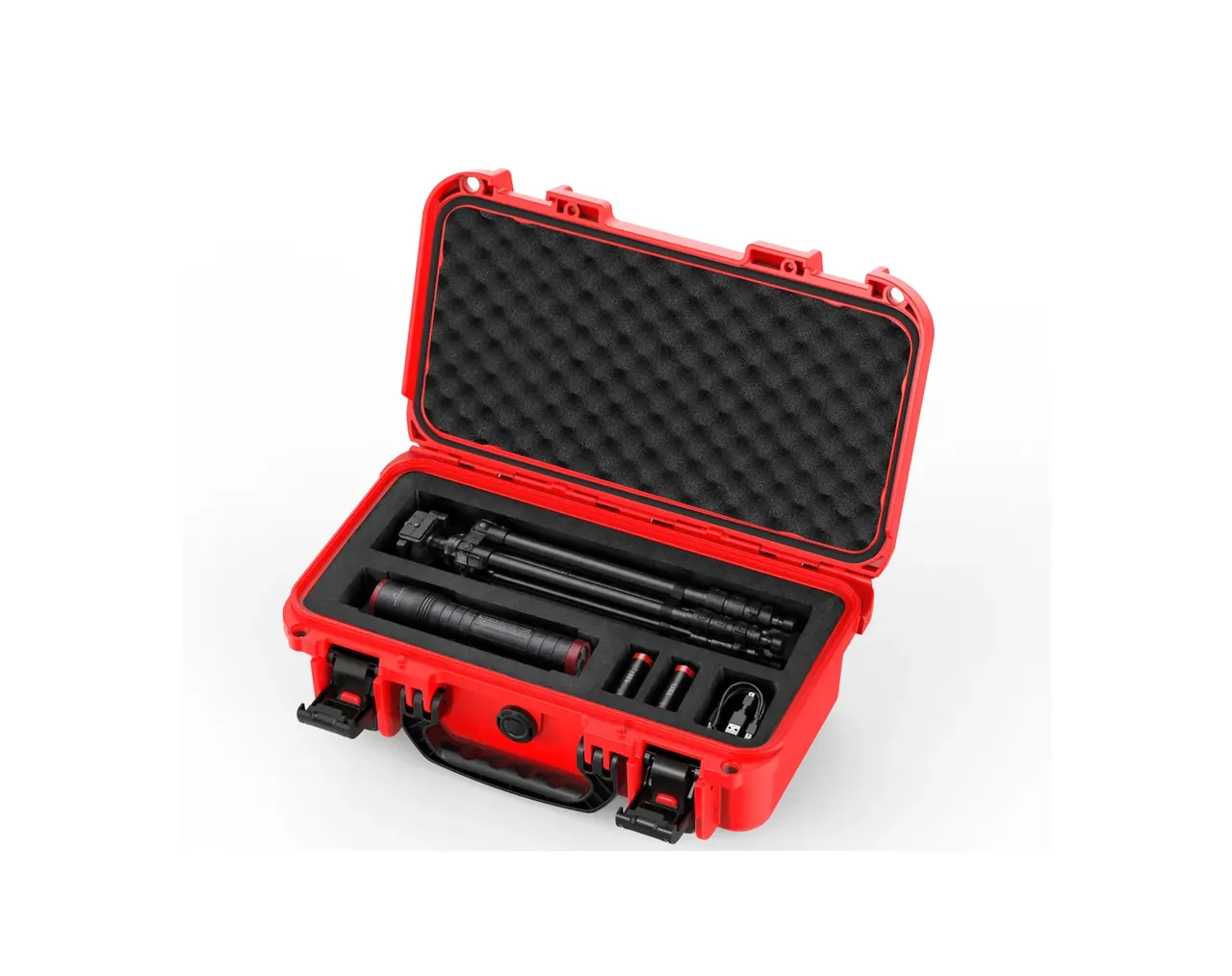
The ribbing is 0.8 mm deep and runs both ways. It stops the upper base sliding, walks rainwater to the edge, and only thirdly matters to the hand. Cut deeper and the lid thins, so point load falls.
The smooth patch in the middle is for sitting: 40 kg is an adult half-seated, not standing.
| Static load, kg | Contact point | Lid deflection, mm | Verdict |
|---|---|---|---|
| 40 | Centre, 100 mm pad | 0.4 | Fine as a table |
| 80 | 60 mm in from the skirt | 0.8 | Fine, pack level |
| 120 | Joint of two upper bases | 1.2 | Limit, short stacks |
5. Latches at 280 N, cold drop and UV 300 h
An outdoor camping storage box with lid stackable carries four latches at 280 N each, two front and two back. All four closed press the lip evenly; two closed lift the other corners past 0.5 mm and the gasket never seats.
The −15 ℃ drop is the cold limit: a head from 300 mm onto a corner, no crack. PP goes brittle, and a box that shrugs off a hit at 20 ℃ keeps about 60% of that at −15 ℃.
UV 300 h is about a year outdoors. No chalking, no white powder on the back of a hand, only a colour shift the eye accepts.
At 5.4 kg empty one person lifts it off a tailgate; loaded at about 40 kg it is a two-person lift at 20 kg each.
Conclusion
An outdoor camping storage box with lid stackable is limited by two measurable lines, 1.2 mm of lid flatness and 120 kg of static load, not by wall thickness. Roof transport is a separate case: four strap points, and 3 mm of shift after 300 km. Latches and the cold drop decide how many seasons it lasts, not how many tiers it carries.
Related Reading
- How to choose a camping storage box
- Why case corners fail first
- Case feet and stacking load
- When to fit a drain valve
Related Products
- 8 Series — Gun Cases; Military Equipment Cases; Camera Equipment Cases; Drone Cases; Watch Cases; Knife Cases; First Aid Cases; Electronics Equipment Cases
- WL8-2812 PP Gun Case — model WL8-2812
- All protective cases and toolboxes: 7 series, 158 models