

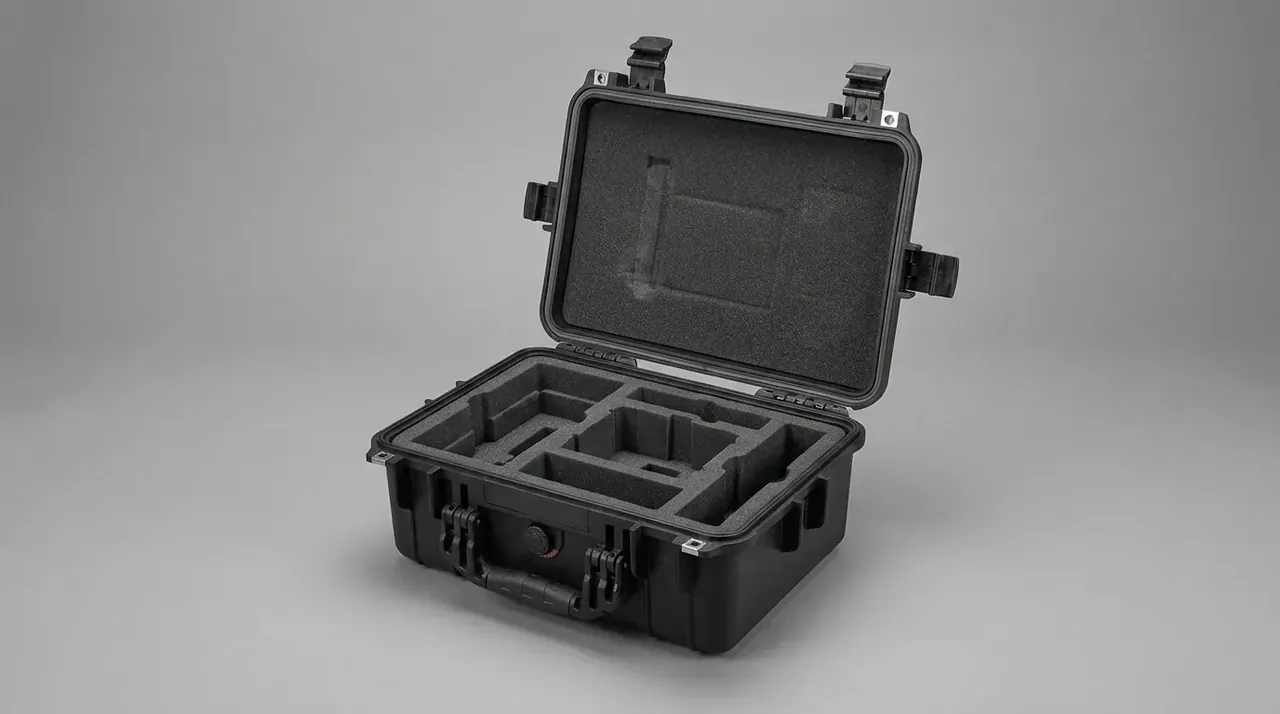
Quick answer: Case stacking feet set the layer limit, not the lid: 988 mm² pads hold five layers at 58 kg, and a 60 mm pallet overhang drops that to four.
Table of contents
- Where Case Stacking Feet Fail First
- How Four Feet Share the Load
- Setting the Layer Limit from Pressure
- Long-Term Creep over Six Months
- FAQ
1. Where Case Stacking Feet Fail First
In June 2025 a warehouse stacked 58 kg cases five high on a pallet overhanging the rack beam by 60 mm. On day 21 the bottom case had sagged 9 mm and the four above leaned 4°. No crack appeared: the damage sat at the joint between foot root and base rib, whitened and wrinkled, the signature of compressive yield. Case stacking feet fail on that ring, not on the lid.
Flush on the pallet the bottom case carried 232 kg, split 58 kg per foot. With 60 mm of overhang the outer two lost contact, so the inner pair took 116 kg each and pressure on a 988 mm² pad rose from 0.58 to 1.15 MPa. The warehouse hit 38 °C that July, and at 0.9 mm of creep per week, 9 mm takes three weeks.
Foot height opens a second path. A 12 mm foot leaves a 380 mm span with nothing under the panel centre; sag measured 1.1 mm at four layers and 2.4 mm at five, which with foot-root compression gives the visible 9 mm.
2. How Four Feet Share the Load
Four-foot design assumes an even split that measurement rarely confirms. Base flatness runs to 0.8 mm and foot height varies by 0.3 mm, so the first two feet take 62% of the weight and the other two 19% each. A rigid part on a rigid surface always ends up on two or three feet, hence a 1.6 factor.
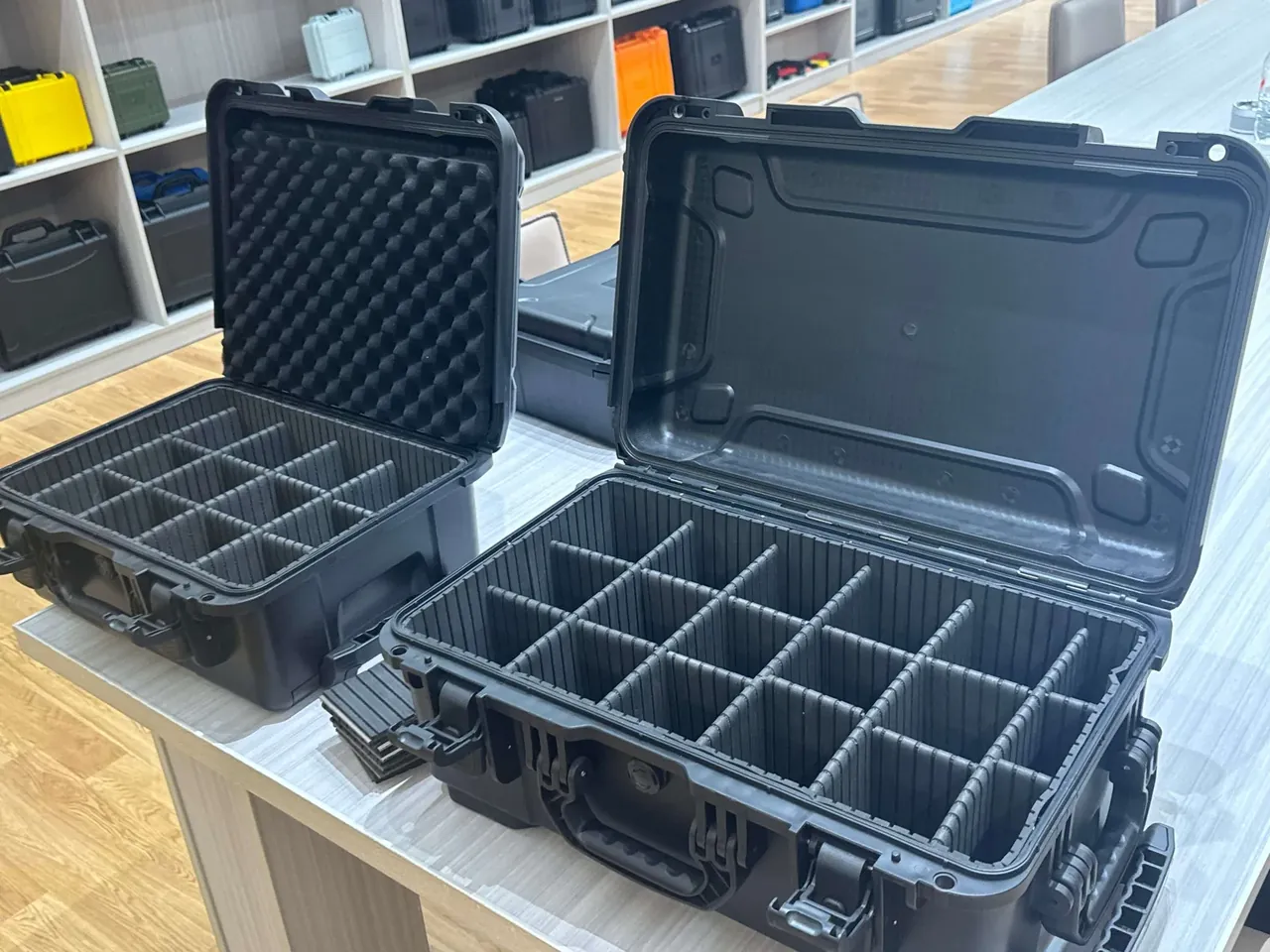
A rib grid cuts the 380 mm span into 95 mm cells, and span enters deflection to the fourth power: 380 mm down to 95 mm cuts sag 256 times, and measured sag fell from 2.4 mm to 0.4 mm. Rib height adds cube-law stiffness, 5 mm to 8 mm giving 4.1 times for 6 g of material.
| Foot type | Pad mm² | Height mm | Rating kg | Layers |
|---|---|---|---|---|
| Tapered round | 615 | 12 | 68 | 3 |
| Square with rib | 988 | 15 | 110 | 5 |
| Bar foot | 1420 | 18 | 158 | 6 |
| Steel insert | 780 | 10 | 240 | 8 |
Ratings multiply a 1.1 MPa long-term stress by pad area: 988 mm² gives 1087 N, or 111 kg, at 23 °C with creep under 1.2 mm in six months. At 40 °C it drops 30% to 0.77 MPa, so five layers becomes four.
3. Setting the Layer Limit from Pressure
The layer limit is one division: 111 kg per foot, 444 kg over four feet, 278 kg after a 1.6 factor, 4.8 cases above the bottom one, five layers.
The load factor drives most field failures: 1.6 flush, 2.4 with 60 mm of overhang because two feet lose contact and their share doubles, 3.2 for a row overhanging on one side.
Floor pressure is a separate check. Five layers weigh 290 kg through 3952 mm² of foot contact, or 0.72 MPa. Concrete at 20 MPa does not care; a timber pallet rated 0.5 MPa takes 2 mm foot pits within three months. A 300 × 200 × 3 mm plywood pad drops it to 0.48 MPa.
| Layers | Per foot kg | Pressure MPa | Sag 23 °C | Sag 40 °C |
|---|---|---|---|---|
| 2 | 14.5 | 0.14 | 0.2 | 0.3 |
| 3 | 29 | 0.29 | 0.4 | 0.7 |
| 4 | 43.5 | 0.43 | 0.7 | 1.2 |
| 5 | 58 | 0.58 | 1.2 | 2.1 |
| 6 | 72.5 | 0.72 | 1.8 | 3.4 |
| 8 | 101.5 | 1.01 | 3.1 | 6.2 |
The six-layer row at 0.72 MPa already sits above a timber pallet rating, and 1.01 MPa at eight layers deforms even a rubber mat on concrete.
4. Long-Term Creep over Six Months
Cases that pass a short compression check still settle by mid-year. Under five layers for six months the same 58 kg cases settled 1.2 mm at 23 °C, 3.1 mm at 40 °C and 8.7 mm at 50 °C. Creep multiplies by roughly 2.5 per 10 °C, which makes warehouse temperature the input worth measuring.
Creep has two stages. The first 30 days decay from 0.05 to 0.01 mm per day and give 60% of the total; the steady stage holds near 0.008 mm per day and adds 5.8 mm over 24 months. Rack safety follows that slope, not the first month.
Past 0.8% of case height, 1.8 mm on a 225 mm case, gaps above 1 mm open between layers and a forklift can pull the stack over. At 1.2 mm per six months a stack is safe about 15 months; at 40 °C, six, so drop to four layers or rotate the stack every five months. A 1.5 mm fillet at the foot root also helps, taking the stress concentration factor from 2.6 to 1.9 and six-month settlement at 40 °C from 3.1 mm to 2.2 mm.
Conclusion
Case stacking feet, not lids, decide how high a warehouse can go. Measure pad contact area, check rib span, then fix the load factor from the real pallet position: 1.6 flush, 2.4 with 60 mm of overhang, 3.2 with one side unsupported. A warehouse holding 40 °C in summer drops allowable stress from 1.1 MPa to 0.77 MPa before any of that is applied. With the three inputs known the rest is one division: layers = 1 + (4 × 1.1 × A) ÷ (K × W × 9.8), where A is one pad area in mm², W is one loaded case in kg and K is the field load factor, rounded down. To gain a layer, raise A or lower K; lid reinforcement will not do it.
This article discusses container-side specifications and design implications only, and does not cover any handling, loading or use of the contents.
Related Reading
- How four-foot case structures carry a stack
- Rib spacing and height in case bases
- Height limits for stackable cases
- Stack testing: 24 hours against 7 days
Related Products
- 8 Series — Gun Cases; Military Equipment Cases; Camera Equipment Cases; Drone Cases; Watch Cases; Knife Cases; First Aid Cases; Electronics Equipment Cases
- WL8-2812 PP Gun Case — model WL8-2812
- All protective cases and toolboxes: 7 series, 158 models