

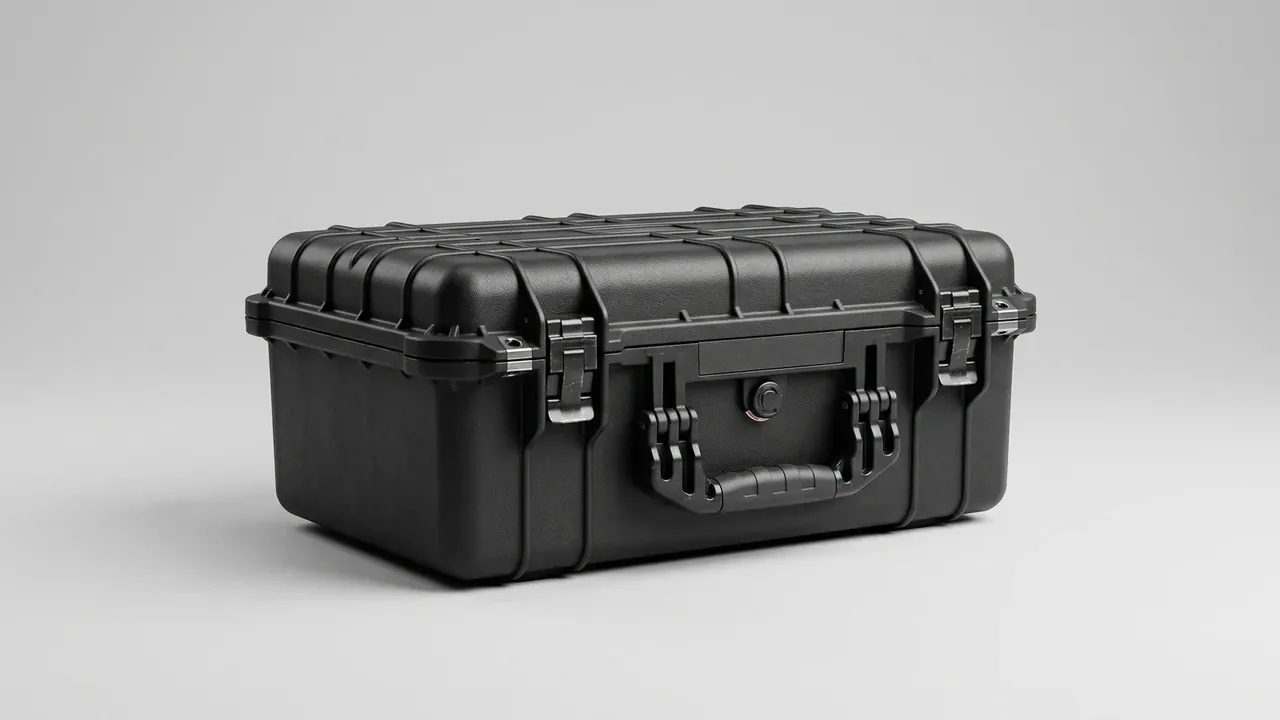
Quick answer: An outdoor equipment case works in one of four settings: a monitoring site, a camp, a vehicle or vessel, or a relay point. Configure in a fixed order: the harshest environment sets the ingress rating, the heaviest lift sets the handle, the longest power run sets the entries.
Table of contents
- Four Application Contexts and Their Configurations
- Field Monitoring Sites: Dust and Pressure Equalisation
- Camps and Forward Posts: Carrying and Stacking
- Vehicle and Vessel Transit: Foam Fixing and Salt Spray
- Relay Posts and Command Points: Cable Entry and Power
- FAQ
1. Four Application Contexts and Their Configurations
No single configuration suits every site: a monitoring site fights condensation and dust, a camp fights lifting and stacking, a vehicle fights vibration and salt, a relay point fights water at the cable entries. One outdoor equipment case of 620 by 420 by 280 mm takes different inserts and fittings in each place.
| Setting | Main pressure | Key configuration | Typical failure |
|---|---|---|---|
| Monitoring site | Condensation, dust | Breather valve, filter pad, down-angled entries | Fogged optics, drifting readings |
| Camp or forward post | Lifting, stacking | Two side handles, corner recesses | Whitening at the handle root |
| Vehicle or vessel | Vibration, salt | Compartment foam, 316 hinge pins | Collapsed foam, stiff hinges |
| Relay point | Water at entries | Glands, blanking plugs, labyrinth vent | Corroded connectors |
Fix the order: rating, then wall and handle, then entries. Reversed, an outdoor equipment case passes every rating and is too heavy to carry.
2. Field Monitoring Sites: Dust and Pressure Equalisation
Monitoring sites leave an outdoor equipment case in one position for a quarter or more; the day-night swing drives moisture onto the inside of the lid. A breather valve opening at 0.2 bar and passing 300 ml per hour equalises pressure slowly, so vapour escapes while liquid water stays out.
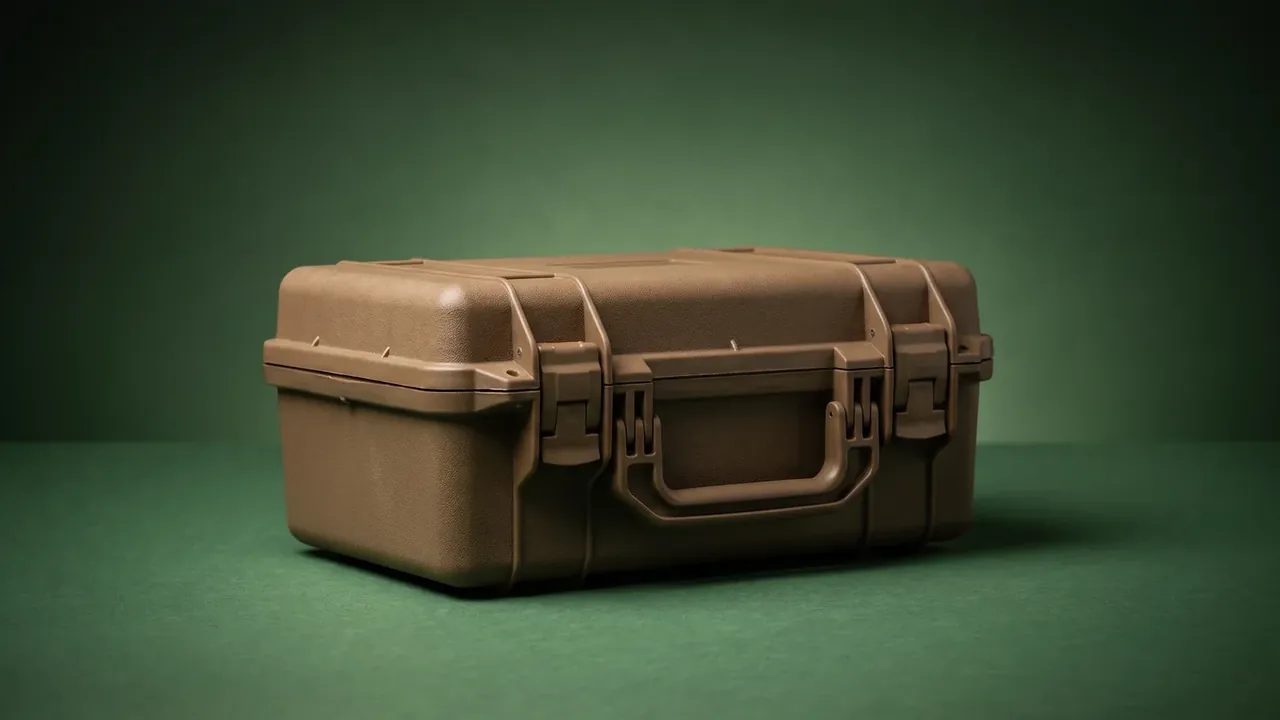
A filter pad behind the intake lasts 90 days, or 45 where sand is airborne; cable entries angle down at 15 degrees so rain drips off before the gland.
A black shell reaches 70 degrees Celsius in sun, the interior 8 to 12 degrees above ambient; a 300 mm shield cuts that by about 6 degrees.
3. Camps and Forward Posts: Carrying and Stacking
At a camp the outdoor equipment case is lifted many times a day, and load concentrates at the handle mounts. At 22 kg two handles carry half each, so the moulded root needs 5 mm of wall and two ribs into the shell. A single handle whitens near ten thousand lifts.
Four units high puts 88 kg on the bottom case, so the lid needs corner recesses where the upper feet land.
Colour is a working decision: sand hides dirt on dry ground, olive in woodland, and most units choose sand with a 50 mm reflective strip.
4. Vehicle and Vessel Transit: Foam Fixing and Salt Spray
In a vehicle both the outdoor equipment case and its contents must stay put. Non-slip feet hold the shell; 5 mm of movement inside rubs panel markings off over 200 km of rough road.
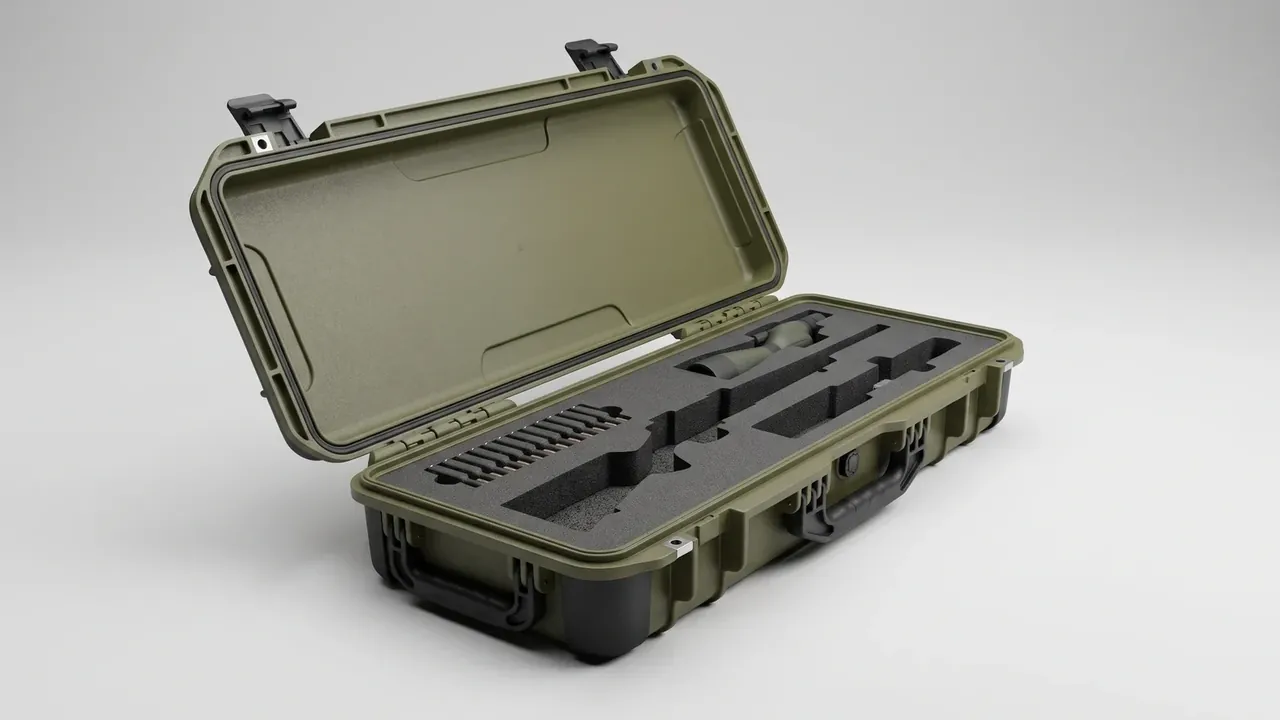
The usual build is 30 kg per cubic metre polyethylene under a 45 Shore A EVA cut-out sized 1 mm under the outline, giving roughly 10 percent compression. Soft foam flattens on the first trip.
Near a deck, 304 stainless pits after 480 hours while 316 stays uniform over the same period; a fresh-water rinse every 30 days is cheaper than descaling.
5. Relay Posts and Command Points: Cable Entry and Power
At a relay post the cable entry is the weakest point on the outdoor equipment case. One M20 gland takes two 8 mm cables, and every unused hole needs a tight blanking plug.
| Setting | Cable entries | Cable diameter | Sealing method |
|---|---|---|---|
| Fixed relay post | 2 x M20 | 8 mm | Gland plus blanking plug |
| Temporary command point | 3 x M25 | 12 mm | Gland plus cable clamp |
| Vehicle transit | 1 x M16 | 6 mm | Quick connector plus dust cap |
A 12 V 100 Ah pack generates heat while charging and a sealed case cannot be vented, so a labyrinth channel sends air around three bends; above 45 degrees, a phase-change pad shaves about 5 degrees.
Conclusion
Four lines cover the applications: monitoring sites need the breather and filter, camps need handles and recesses, vehicles need foam and the right hinge alloy, relay posts need sealed entries. Sharing one case means paying in weight, so cross-setting units keep a fixed case and a carry case. Fix the order as environment, lifting, power, and an outdoor equipment case is hard to specify wrongly.
This article discusses only the container (case body) side of specifications and design intent, and does not cover any handling, loading or use of the contents.
Related Reading
- Multi-purpose outdoor case applications
- Equipment case applications across industries
- Waterproof hard case test standards
- Temperature-controlled case selection
Related Products
- 8 Series — Gun Cases; Military Equipment Cases; Camera Equipment Cases; Drone Cases; Watch Cases; Knife Cases; First Aid Cases; Electronics Equipment Cases
- WL8-2812 PP Gun Case — model WL8-2812
- All protective cases and toolboxes: 7 series, 158 models