

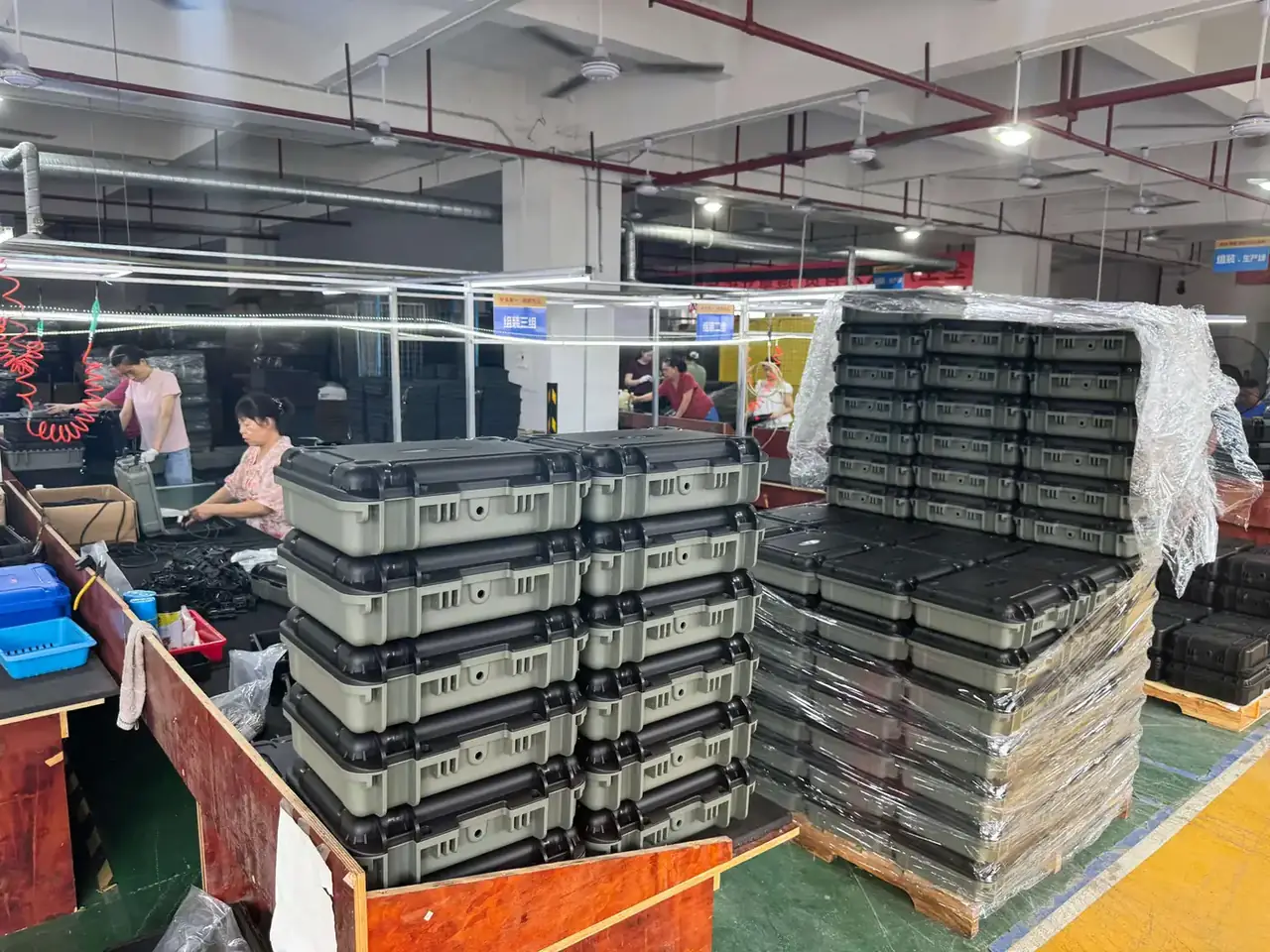
Quick answer: The same multi-purpose outdoor case changes job through its interior and its fixing, not its shell: camping needs damp control and night access, driving needs the case held still, field work needs one-hand opening, emergency needs ninety days of standby and a five-minute lift. Configure by use, not by litre.
Table of contents
- How the Four Uses Split
- Camping: One to Three Nights
- Driving: Boot and Roof Fixing
- Field Work: An Opening Station
- Emergency: Standing By
- FAQ
1. How the Four Uses Split
Split by access rhythm, not by user. Camping loads once and opens at dawn and dusk; driving opens on arrival; field work opens twenty times a day; emergency sits still and moves whole.
Rhythm sets the configuration. Frequent access needs a fixed place for every item. Long vibration needs webbing and feet. Long standby needs a seal that holds and a weight one person can lift. One shell can serve all four; the accessories should not be identical.
| Use | Volume | Interior | Fixing | Access |
|---|---|---|---|---|
| Camping | 45 L | Two dividers | Board off the ground | Under a minute |
| Driving | 65 L | Heavy items low | 25 mm webbing at mid-height | Lift whole case |
| Field work | 25 L | Six upright cells | Strap plus seat mount | Ten seconds |
| Emergency | 65 L | List pouch in lid | Nothing stacked on top | Five minutes |
2. Camping: One to Three Nights
For two or three people over three days, a 45 litre multi-purpose outdoor case takes cookware, plates, fuel, lamp and spare batteries to about 18 kg, carried from car to tent.
Damp and temperature swing are the enemy. A ten degree night drop contracts the air inside, and a poor seal pulls moisture in, so the sleeping bag is damp by morning. Wiping grit off the gasket beats another wrap of tape.
Keep the base off the ground. On grass the wall runs cold, condensation forms outside and water works in at the feet; a board giving 50 mm of clearance is enough. Access clusters after dinner, about six openings a day, so two dividers keep cookware apart from food.
3. Driving: Boot and Roof Fixing
Hours in a vehicle turn a multi-purpose outdoor case from damp control to slip control. A typical SUV boot is about 750 mm high; a 65 litre case at roughly 620 by 420 by 380 mm will not stand under the load cover, so it lies flat.
Fixing rests on friction at the feet and restraint from webbing. Run 25 mm webbing around the middle of the case, not the handle, which deforms under load.
Roof travel is separate. At 80 km/h the dynamic load on the windward face runs about twice static, so leave no half-empty bottle inside and tie to the ribs rather than the middle of the lid.
4. Field Work: An Opening Station
Twenty openings a day shift the priority from capacity to finding. Divide by task: sample bottles upright, one per cell, six cells to a block; tools across the lid side, visible on opening.
Opening must work one-handed, because the other hand holds a ladder or a clipboard. Latch force stays under 30 N, and a damped hinge holds the lid at 90 degrees instead of slamming.
Gloves and wet hands count. Latch faces need texture at least 20 mm wide, the handle needs a recess, and the empty case stays under 8 kg so a loaded 15 kg rides a shoulder strap for two kilometres. Used this way a multi-purpose outdoor case is a workstation, not storage.
5. Emergency: Standing By
Most of the year a standby multi-purpose outdoor case does not move. Readiness is the measure: the seal holds, the batteries hold charge, the label stays legible.
Check the seal quarterly. Trap paper under the lid; if it slides out, compression is gone. A whitened gasket takes silicone grease, never oil. Batteries come out.
Retrieval should take five minutes: by the door, nothing stacked on top, label outward, gross weight under 20 kg. Check every ninety days.
| Check | Fail sign | Action |
|---|---|---|
| Gasket compression | Paper slides out | Adjust latch or replace |
| Battery charge | Below 50 percent | Recharge or store outside |
| Item count | Differs from label | Replace, rewrite label |
| Interior humidity | Condensation | Dry out, add desiccant |
A multi-purpose outdoor case in standby is judged by one number: how long it takes to leave the shelf.
Conclusion
Across four uses the shell stays and the configuration moves: dividers for camping, webbing for driving, six cells for field work, a list and clear access for emergency. Configure by rhythm and the multi-purpose outdoor case earns its name.
This article discusses only the container (case body) side of specifications and design intent, and does not cover any handling, loading or use of the contents.
Related Reading
- Configuring a case for camping and RV trips
- Packing and retrieving field inspection equipment
- A standing list for an emergency kit case
- Tool location and fixing in a vehicle maintenance case
Related Products
- 8 Series — Gun Cases; Military Equipment Cases; Camera Equipment Cases; Drone Cases; Watch Cases; Knife Cases; First Aid Cases; Electronics Equipment Cases
- WL8-2812 PP Gun Case — model WL8-2812
- All protective cases and toolboxes: 7 series, 158 models