

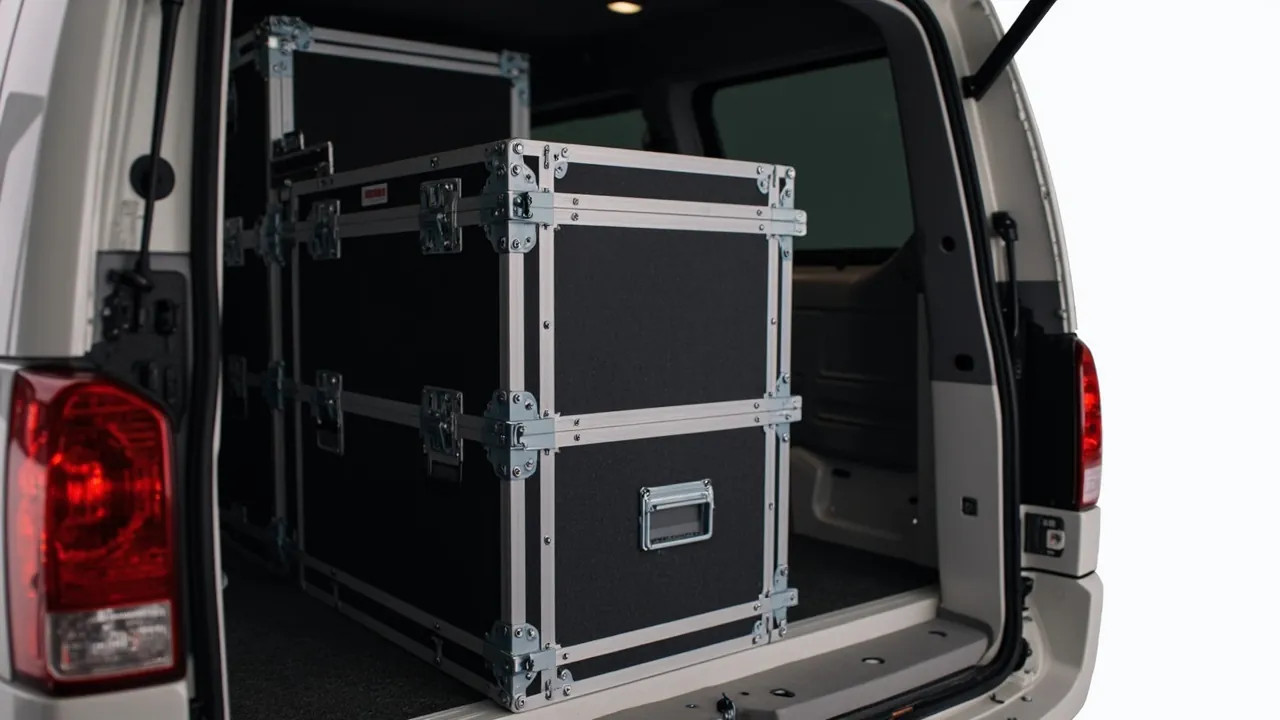
The design objective of an on-board accessory case is not "carry more", but "stay put under vibration, survive heat and sun, stay findable, and never become a projectile when the brakes are slammed." Recreational vehicles and camper vans are subjected, while driving, to a combined load of long-duration low-amplitude random vibration overlaid with occasional high-amplitude shock. Road seams, speed bumps, gravel roads and washboard surfaces apply millions of directionally random micro-impulses to every object in the cabin within just a few hours. A single hard brake or evasive maneuver can generate inertial forces several times an object's own weight, turning an ordinary storage container into a cabin projectile. These two classes of load demand completely different solutions: vibration and shock are solved by case structure, interior cushioning and shock absorption; inertial loads are solved by tie-down systems, anchoring points and restraints. The second category of risk comes from the cabin microenvironment: in summer a sealed cabin can reach interior temperatures far above the outside ambient, and ultraviolet light plus heat accelerate aging of plastics and hardening of seals. Daily temperature swings and high-humidity regions bring condensation and mold risk, while dust and muddy water quickly disable ordinary case opening mechanisms. JUNZHJIA provides modular compartmented storage cases, slide rails and tie-down fittings, stackable case structures, sealing and pressure-equalization configurations, and OEM/ODM support packages for the travel-living and on-board market.
The second defining trait of travel-living equipment storage is extreme mixing of categories and constant switching of usage scenarios. A single case system must simultaneously hold cookware and tableware, food and drinking water, gas cylinders and fuel, power systems and lithium batteries, repair tools and spares, outdoor and sanitation supplies, clothing and bedding, and must repeatedly switch between "driving state" and "parked state" — driving requires compact and secure fixation, parking requires fast deployment and access. This means the case system design must simultaneously satisfy two pulling-apart goals: transport strength and camp convenience, while most storage solutions only achieve one of them. This article is written for RV conversion workshops and vehicle OE procurement, travel-living equipment brands and distributors, rental operators, and procurement and product-engineering staff for self-drive and camping gear. It provides actionable parameters and selection methods along five lines: vibration, fixation, temperature and humidity, zoning, and compliance. All parameters in this article are industry typical or empirical values; in practice they should follow vehicle-manufacturer requirements, case technical documentation, applicable regulations and customer acceptance specifications.
Table of Contents
- 1. Core Risks: Vibration, Shock, In-Cabin Microenvironment and Projectiles
- 2. On-Board Gear & Trip Supplies: Failure Mapping
- 3. Vibration & Shock: Vehicle Load Spectra and Case Design Criteria
- 4. Fixation & Tie-Down: Straps, Anchors and Inertial Loads
- 5. Temperature, Condensation and Pressure Equalization
- 6. Dustproof, Waterproof and Weathering: IEC 60529 and GB/T 4208 in the On-Board Context
- 7. Zoned Storage System: Modular, Stackable and Visual Identification
- 8. Equipment Sub-Categories: Kitchen, Water, Power, Tools and Outdoor
- 9. Scenario-to-Case Selection Reference Table
- 10. Materials & Liners: Anti-Mold, Anti-Odor and Washable
- 11. Loading Fixation SOP and Pre-Trip Inspection
- 12. On-Board Regulations and Compliance Notes
- 13. OEM/ODM Customization and Supplier Evaluation
- FAQ
- Conclusion and Related Reading
1. Core Risks: Vibration, Shock, In-Cabin Microenvironment and Projectiles
Risk one: vibration — the most persistent and most hidden source of damage. Driving vibration is broadband random vibration, characterized by small amplitude but extremely long duration, random direction and a very wide frequency band. This load damages different equipment in different ways: for electronic devices and connectors it causes fretting wear at solder joints and plug-in contacts; for fasteners it causes slow back-off ("self-loosening"); for liquid containers it causes micro-motion at sealing faces and slow leakage; for powders and granular materials it causes compaction, segregation and dusting; for tools and metal parts it causes mutual friction and edge blunting. The trouble with vibration damage is that it is cumulative: one trip shows no problem, but after dozens of trips it manifests as "screws that will not tighten, lids that will not close, blades that have dulled, and hinges that grow looser with use."
Risk two: shock — speed bumps, potholes and drops. Shock amplitude is far higher than vibration but lasts an extremely short time. Its typical consequences are: heavy items bouncing inside the case and striking the wall ("internal impact"); the case detaching from its vehicle fixing point; and the case dropping from the tailgate, step or tabletop during loading and camp use. The test shock puts on a case is not average strength but stress-concentration points — case corners, latch bases, hinge bases, handle roots and fork-lift points. Failure at these locations almost decides the overall service life of the case.
Risk three: projectiles — the most serious safety issue in on-board storage. This must be emphasized separately. When a vehicle brakes hard, an unsecured object moves forward at a multiple close to the vehicle's deceleration acceleration; a 20 kg accessory case under braking acceleration generates an impact force sufficient to pierce the front seat backboard or seriously injure an occupant. Therefore the first principle of on-board storage is: any item above a certain mass must be restrained at a fixing point or within a confined area; relying only on "jamming it tight" is not acceptable. Specific mass thresholds and fixation requirements should follow vehicle-manufacturer provisions, applicable transport safety regulations and product instructions.
Risk four: in-cabin microenvironment — high temperature, low temperature, humidity and UV. A sealed cabin under direct summer sun can reach an interior temperature far above the outside ambient (industry observation commonly sees tens of degrees Celsius of rise, depending on sunlight, body color, glazing area and ventilation). This is decisive for lithium batteries, gas cylinders, food, medicine, seals and plastic cases; winter low temperature affects water systems, battery capacity and the toughness of some plastics. Meanwhile, day-night temperature swings cause in-case condensation, and high-humidity and coastal environments bring mold and salt-spray corrosion, while strong UV accelerates aging of case plastics and seals.
Risk five: dust, muddy water and washing. Travel-living cases are frequently exposed to dust, muddy water and high-pressure water-gun washing. Ordinary case hinges and latches, once invaded by dust, fail with "stiff opening and non-self-locking latches", and this failure often occurs mid-trip, directly affecting driving safety (the lid pops open under bumps).
From these five risks we derive six design principles:
Principle one: design the tie-down first, then the storage. The fixation method sets the safety ceiling of the case. A case that cannot be reliably fixed, however well packed, is still a hazard.
Principle two: zone by mass and frequency of use, not by category. Heavy items must be near the vehicle center of gravity and floor load zone; light items can be placed higher. High-frequency items go where easily reached; low-frequency supplies can be stored deep.
Principle three: the case and the liner must each carry a different task. The case carries "constraint" (compression resistance, shock resistance, sealing, fixation interface); the liner carries "isolation and protection" (compartmentation, cushioning, anti-friction, anti-odor transfer).
Principle four: modular and stackable beats a single oversized case. An oversized case is hard to move, hard to fix and hard to zone inside the vehicle; modular cases can be configured per trip and split per scenario.
Principle five: driving state and parked state must each be optimized. The ideal design is "everything stowed and locked while driving, deployable in place when parked", rather than re-moving everything at every stop.
Principle six: washing and maintenance must be designed into the structure. Travel-living gear contacts food, water, sand and oil; the case and liner must be washable, dryable and non-odor-absorbing.
One intuition that must be corrected: "if you pack the case full it will not rattle" is wrong. Packing full only reduces in-case displacement, but the case itself still slides or even lifts under vehicle inertia; and packing full hides the internal-impact problem — heavy items continuously strike the wall under vibration, eventually cracking the case or damaging gear. The correct approach is the dual combination of "liner positioning plus case fixation."
2. On-Board Gear & Trip Supplies: Failure Mapping
| Equipment category | Typical parts | Main failure mode | Trigger factor | Priority protection |
|---|---|---|---|---|
| --- | --- | --- | --- | --- |
| Cookware and tableware | Pot coating, tableware edges, glassware | Coating scratches, edge chipping, glass breakage | Mutual friction, internal impact, drop | Compartments + soft isolation + rack structure |
| Dry food | Packaging bags, cans | Bag rupture, powdering, damp caking | Compression, vibration, humidity | Sealed case + desiccant + compartments |
| Chilled and fresh food | Case body, seal, cold accumulators | Insulation failure, leakage, odor transfer | Frequent opening, seal aging, temperature swing | Independent sealed chamber + washable liner + ice-pack zoning |
| Drinking water and beverages | Bucket, bottle cap, hose | Leakage, loose cap, water contamination | Vibration back-off, compression, high heat | Upright fixation + secondary containment + avoid heat |
| Gas cylinder and fuel | Valve, cylinder, hose | Valve leakage, cylinder corrosion, hose aging | High heat, vibration, corrosion | External sealed bay + upright fixation + ventilation and compliance |
| Power system and lithium battery | Battery pack, terminals, BMS, inverter | Terminal loosening, capacity fade, thermal-runaway risk | Vibration, high heat, over-charge/discharge | Compartment fixation + thermal isolation + terminal protection + compliant packing |
| Repair tools and spares | Cutting edge, ratchet, socket, gauge | Edge blunting, tool loss, gauge drift | Friction, vibration, mixed storage | Compartments + magnetic/clip positioning + checklist |
| Outdoor and camping gear | Support, rope, lamp, table/chair | Deformation, lampshade breakage, rope tangle | Compression, drop, mixed storage | Compartments + anti-tangle coiling + soft isolation |
| Sanitation and cleaning | Chemical bottle, spray head, hose | Leakage, corrosion of neighbors, odor pollution | Side lay, vibration, mixed storage | Upright + secondary containment + independent chamber |
| Clothing and bedding | Fabric, zipper, filling | Damp mold, snagging, odor | High humidity, friction, non-breathable packing | Breathable storage + humidity control + avoid long compression |
| Medicine and first-aid | Packaging, expiry label | Damp, heat failure, label wear | High heat, humidity, friction | Sealing + thermal isolation + light block + independent label |
| Documents and certificates | Paper, cards | Damp, creasing, fading | Humidity, compression, light | Rigid waterproof pouch + flat lay + light block |
| Case body itself | Corner, latch, hinge, handle, seal | Cracking, latch failure, seal hardening | Shock, dust, UV, aging | Reinforced corners + metal latch + replaceable seal |
The thirteen failure classes above condense into one sentence: heavy items fear projectiles, liquids fear orientation, electronics fear vibration and heat, powders fear damp, tools fear friction, fabric fears damp, and the case itself fears dust and UV. The seven problem classes have different solutions, so the on-board storage system must be "zoned by mass and medium", not designed by "how much it can hold."
3. Vibration & Shock: Vehicle Load Spectra and Case Design Criteria
Sources and characteristics of vehicle vibration. Driving vibration mainly comes from three excitation sources: road excitation (road unevenness transmitted through the suspension, the main source of broadband random vibration, typically covering a few Hz to hundreds of Hz with lowest-frequency band carrying the most energy); powertrain excitation (periodic vibration of engine and drivetrain, whose main frequency relates to rotational speed); and body structural response (modal vibration and resonance amplification of body panels). For on-board gear, the most dangerous band is not the one with the largest amplitude but the one coinciding with the equipment's own natural frequency — once resonance occurs, the acceleration the equipment bears is several times the excitation itself, which is why "a certain case is especially loud at a specific speed."
Engineering criteria and test basis. Vibration and shock verification of on-board equipment usually references the following standards (these also apply to on-board electronics and serve as methodological basis for case design validation):
| Verification item | Common standard | Quantity of interest | Relevance to case |
|---|---|---|---|
| --- | --- | --- | --- |
| Broadband random vibration | ISO 16750-3 / GB/T 28046.3, IEC 60068-2-64 | Acceleration PSD, RMS, duration, axis | Compartment positioning, fastener anti-loosening, tool locating |
| Mechanical shock | ISO 16750-3, IEC 60068-2-27 | Peak acceleration, duration, waveform, cycles | Case corner, latch, handle, liner shock resistance |
| Sine vibration / sweep | IEC 60068-2-6 | Frequency range, sweep rate, acceleration | Identify resonance and avoid it in design |
| Free fall | IEC 60068-2-31, GB/T 4857 drop test | Drop height, cycles, posture | Loading and camp-use drop resistance |
| Thermal cycle / damp heat | MIL-STD-810H Method 501/502/507 | Temperature range, cycles, humidity | Plastic, seal and liner thermal-humidity stability |
| Salt spray | ISO 9227 / ASTM B117 | Concentration, duration | Metal, latch and hardware corrosion resistance |
| Dust and water | IEC 60529 / GB/T 4208, ISO 20653 | IP rating, test duration | Case sealing under dust and spray |
| Flammability (material) | UL94 | Material + thickness rating | Case plastic and liner material |
It must be stated clearly: MIL-STD-810H is used in this field as an environmental-test method basis and does not represent any military certification of the product, see MIL-STD-810H environmental test compliance. The automotive industry's ISO 16750-3 (Road vehicles — Environmental conditions and testing for electrical and electronic equipment — Part 3: Mechanical loads) and China's GB/T 28046.3 give the vibration and shock load spectra for on-board components and are the most direct reference framework for on-board accessory cases. The specific load spectra, test levels and durations adopted should follow vehicle-manufacturer requirements, the product installation location (in-cabin / exterior / suspension area) and the actual supply chain; this article draws no level conclusions.
Four key points in case design.
- Increase overall stiffness and avoid resonance. Cases should avoid large flat-panel structures (low stiffness, easy resonance); reinforce with ribs, fillets and local thickening to raise the first natural frequency away from the main excitation band. Engineering practice should confirm through testing (sweep or random vibration) that the case shows no significant resonance amplification, rather than relying on computation assumptions alone.
- Make stress-concentration points reinforced structures. Case corners, latch bases, hinge bases and handle roots are high-failure locations and should have reinforcement blocks, metal inserts or thickened walls. Latches and hinges should preferably use replaceable metal parts, because their wear rate in the on-board scenario is far higher than in indoor use.
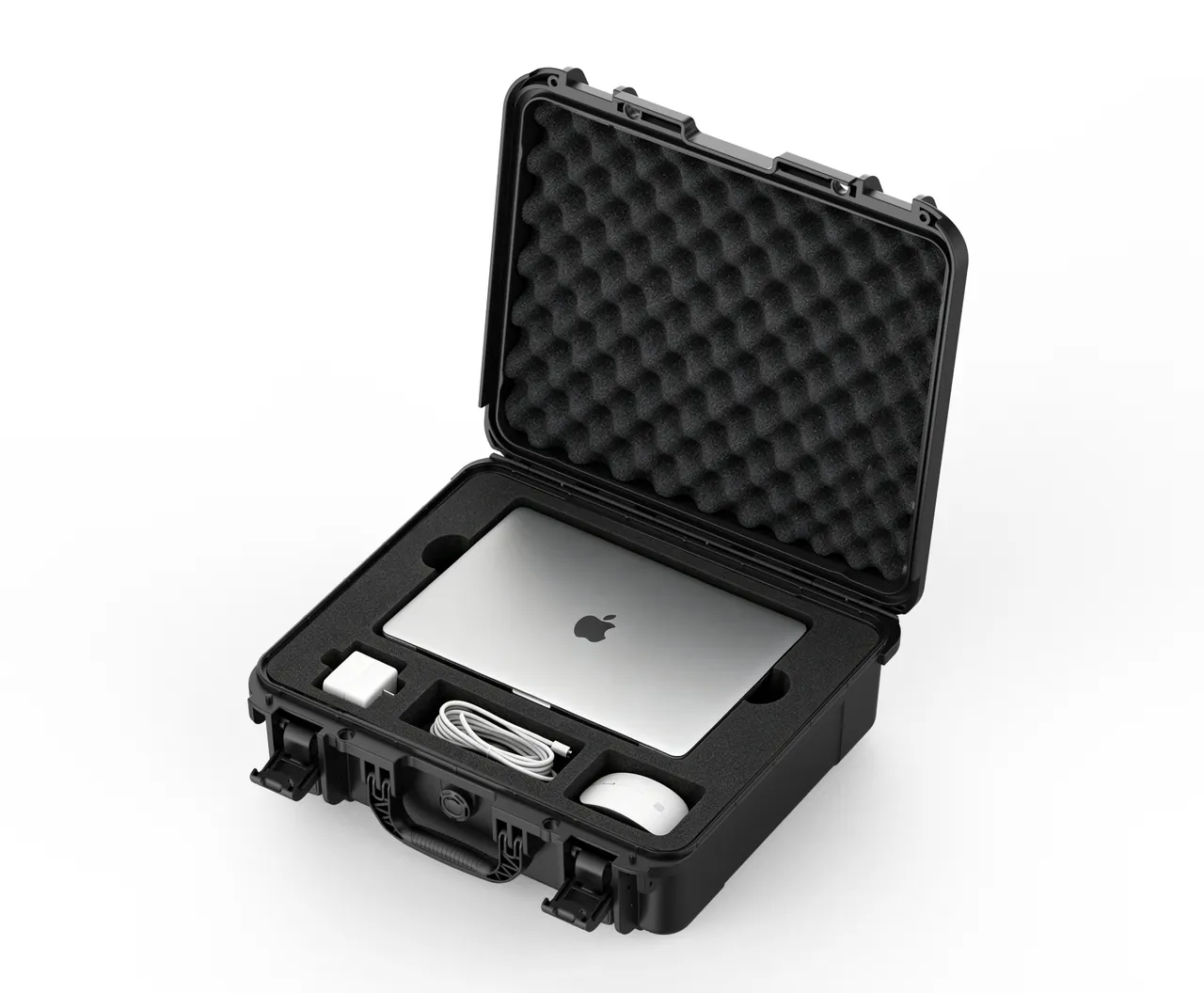
- The liner must achieve "zero displacement". The liner's role is to constrain gear at a fixed position so the gear itself does not participate in vibration. The criterion: after loading, push the gear by hand to check its displacement; empirically it should be within a few millimeters (specific per design requirement); for heavy and precision gear, it should be completely immovable.
- Layered cushioning, avoid "hard against hard". Rigid gear (metal tools, gas cylinders, cookware) and soft gear (fabric, coated cookware parts) should be layered or zoned; rigid parts must have a soft isolation layer between them to prevent metal-on-metal long-term fretting wear and noise.
On mitigation of "internal impact". Internal impact (gear bouncing then striking the wall) is the main transmission path of shock loads. Three mitigation means: positioning (gear cannot move), cushioning (compressible material between gear and wall absorbs energy), and layering (avoid placing heavy items on top of heavy items). Among them positioning is most effective and lowest cost, cushioning next, and layering is a necessary supplement.
4. Fixation & Tie-Down: Straps, Anchors and Inertial Loads
Tie-down is the safety baseline of on-board storage. No matter how strong the case itself is, if it cannot be reliably fixed to the vehicle, it is not a qualified on-board storage solution.
Magnitude of inertial loads. When a vehicle brakes, accelerates and corners, the inertial force on cabin objects is determined by the acceleration multiple. In road transport cargo-securing practice, the following acceleration criteria are commonly used to check fixation strength (industry practical values; specifics should follow applicable regulations, vehicle-manufacturer requirements and customer specifications):
| Direction | Common check acceleration (industry practical value) | Typical trigger scenario |
|---|---|---|
| --- | --- | --- |
| Forward (braking direction) | about 0.8 g | Hard braking |
| Lateral | about 0.5 g | High-speed lane change and corner roll |
| Rearward (acceleration direction) | about 0.5 g | Start-off and hill start |
| Vertical | about 0.5 g (pothole and speed-bump scenarios need separate check) | Pothole, speed bump, washboard road |
The meaning of this magnitude is direct: a 20 kg accessory case under 0.8 g forward acceleration generates about 157 N of forward force; if that force is borne by a single tie-down point, that point's load capacity must be significantly higher than this with margin. European road-vehicle cargo-fixation standards (such as the EN 12195-1 series) give tie-down force calculation methods; domestically one may also reference road-transport cargo-fixation requirements. Specific calculation and judgment should be done by professionals per applicable standards.
Four fixation types and their applicability.
| Fixation type | Principle | Advantage | Limitation | Applicable scenario |
|---|---|---|---|---|
| --- | --- | --- | --- | --- |
| Strap fixation | Webbing and tensioner press case to fixed surface | Versatile, quick detach, low cost | Needs reliable anchor; tension decays over time and needs re-tightening; may crush case edges | General first choice, especially medium-heavy cases |
| L-track / slide-rail system | Case connects via slider and rail, position adjustable | Adjustable position, reliable fixation, modular layout | Needs pre-buried or added rails; slider and rail need regular cleaning | Converted RVs, storage bays and rear compartments |
| Clip / quick-release base | Case and base mechanically interlock | Extremely fast pick-up, fixed position, no appearance impact | Custom to case; high base-install precision | High-frequency cases, drawer-type cases |
| Limiting compartment / frame | Fixed frame and divider limit displacement | No straps needed, good for centralized placement | Occupies fixed space, low flexibility | Storage-bay division, fixed equipment bay |
Four practical points on strapping.
- Anchor strength is the premise. Anchors (D-rings, floor hooks, rails) must be fixed to vehicle structural members, not merely to interior trim or thin panels. Anchor load capacity should be significantly higher than the inertial force it shares, with margin; specific values should follow vehicle-manufacturer provisions and product ratings.
- Strap angle affects efficiency. The smaller the angle between the strap and the fixed surface, the smaller the effective clamping force and the worse the anti-slip effect. Engineering should maximize the strap angle (make the strap closer to vertical onto the fixed surface) and use "cross strapping" to limit multiple-direction displacement. Relevant calculation methods reference cargo-fixation standards such as EN 12195-1.
- Tension decays. Webbing slowly relaxes under vibration and temperature-humidity change, so long trips should set re-tightening checkpoints (e.g., check and re-tighten every certain mileage or every stop).
- Avoid crushing the case. Straps directly on case edges cause local indentation or even cracking; use corner protectors or wider webbing and press straps onto reinforced structures (not thin-wall areas).
On the practice of "using heavy items to press down". Using heavy items to press a case is a common error: it only provides vertical restraint, has almost no resistance to forward and lateral inertia, and the pressing item itself becomes a projectile in a hard brake. Vertical restraint and horizontal restraint must be designed separately, not substitute for each other.
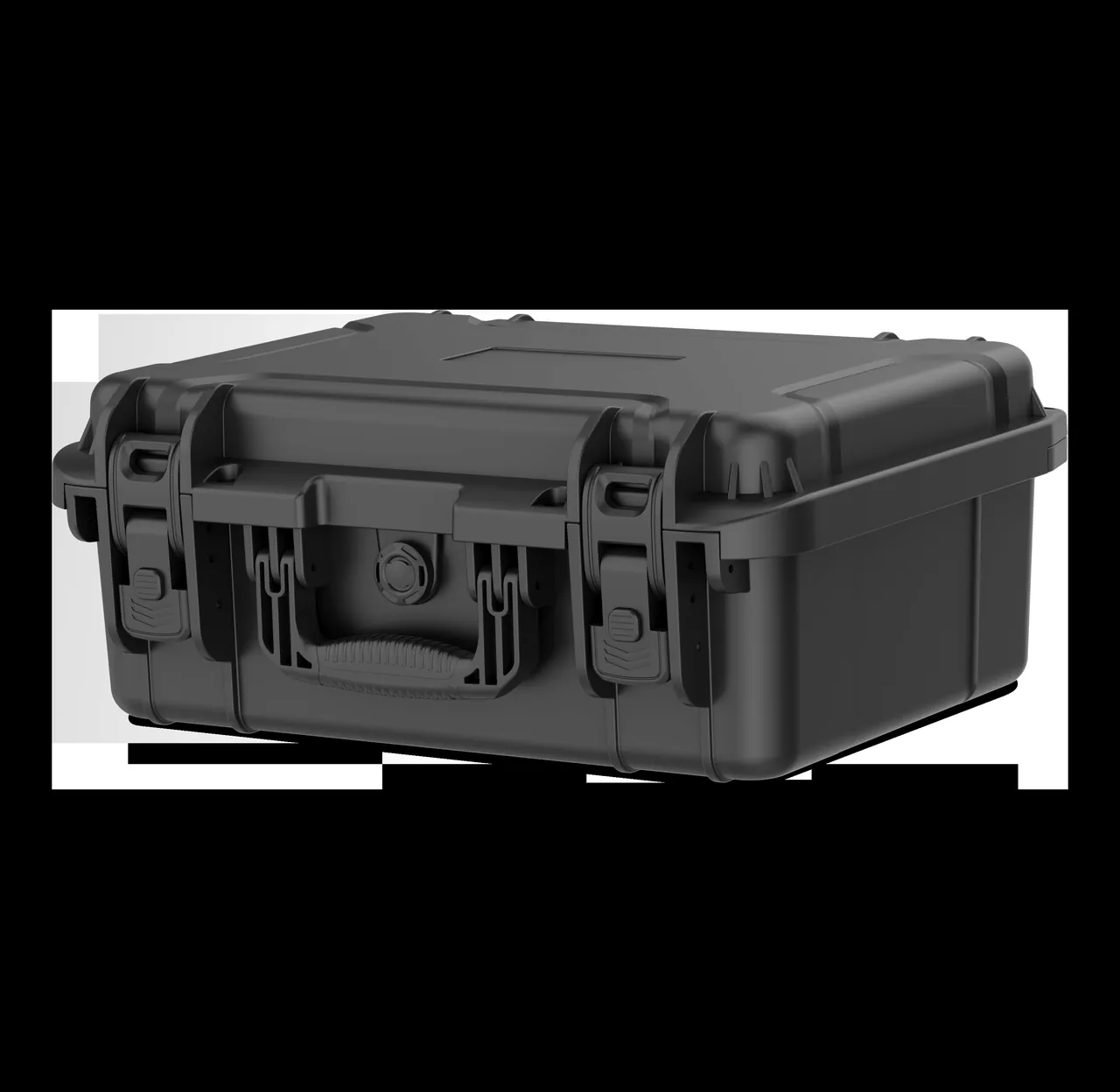
On the necessity of "locking the lid". One easily overlooked detail in on-board scenarios: the lid may self-pop open under vibration. The reason is the latch may slowly shift under vibration, or case deformation reduces latch engagement. Therefore on-board cases should choose latches with secondary locking or anti-release structures (e.g., press-and-rotate latches, anti-release clip structures), and preferably adopt sufficient and continuously distributed latches (empirically, when the lid long side exceeds 800 mm, no fewer than 3 latches is advised). For selection see case hinge, latch and seal selection and case lock customization options.
A safety note: a "projectile check" must be completed before every drive. Confirm one by one that all cabin items (including cases, gas cylinders, water buckets, tables/chairs, tableware, charging devices) are fixed or restrained; any item that cannot be fixed and is of non-trivial mass must be removed from the cabin or placed in a closed storage bay. This check takes under two minutes but is the most critical safety action in on-board storage.
5. Temperature, Condensation and Pressure Equalization
In-cabin high temperature is the No. 1 environmental enemy of travel-living gear. A sealed cabin under direct sun can reach an interior temperature far above the outside ambient, and heat inside the cabin is non-uniform: areas near windows and roof are hottest, floor and under-bed storage are relatively cooler. This distribution directly decides placement strategy:
- Heat-resistant items (metal tools, cookware, hard gear) can go in hot zones;
- Temperature-sensitive items (lithium batteries, gas cylinders, food, medicine, cosmetics, aerosol products) should avoid hot zones, preferring floor or ventilated storage bays;
- Absolutely forbidden to place gas cylinders, pressure vessels and lithium batteries long-term in sun-exposed in-cabin hot zones.
Effects of low temperature. Winter and high-cold regions carry dual risks: first, water-system freezing (water tank, pipes, pump, water heater may freeze-crack, causing unusability or even leakage mid-trip); second, lithium battery usable capacity drops significantly (reduced discharge at low temperature, limited charging, and some batteries risk lithium plating when charged cold). Responses include: drainable water systems with drain procedure executed; battery thermal insulation or placement in a relatively stable-temperature cabin area; thermal-insulation or heating solutions for water and liquids that must travel.
Condensation: the most easily overlooked in-cabin problem. Condensation forms when "warm humid air meets a cold surface." In RV scenarios there are three high-incidence situations: first, regions with large day-night temperature swings (cabin warms by day, drops sharply at night, in-case water vapor condenses on low-temperature surfaces); second, after in-cabin cooking and bathing (absolute humidity rises sharply, night condensation risk rises sharply); third, the case moves from high-temperature to low-temperature environment or vice versa (e.g., summer moving from cabin to shade, winter from cabin to indoor). Condensation consequences include: fabric and bedding mold, metal-tool rust, electronic-device damp, powdered-food caking, and damage to paper documents and certificates.
Three layers of response:
- Control internal moisture sources: damp clothing, rain gear, mops, un-dried cookware must be zoned from dry items and not long sealed in airtight cases;
- Use moisture-absorbing materials: place desiccant in sealed cases (suitable for food and clothing) and replace regularly; note desiccant is unsuitable for electronics and batteries (may compound corrosion risk), such items should rely on sealing and temperature control;
- Ventilation and dehumidification: ventilate the cabin when parked, or use on-board dehumidification equipment; reduce cabin absolute humidity via air-conditioning dehumidification while driving.
Pressure equalization: on-board cases need it too. On-board differential-pressure sources are three: altitude change (plateau trips), temperature-induced pressure change in sealed cases (day-night swing creates alternating positive/negative pressure), and cooling shrinkage after moving the case from hot to cold zone. Effects include: difficult opening (negative-pressure suction), seal repeated compression fatigue, and extra load on latches. Therefore for sealed-grade (IP67 and above) and larger-volume on-board cases, a pressure-equalization valve is recommended, whose selection points are opening differential pressure matched to the chain, moisture transmission rate meeting contents requirements, and valve material not releasing odor (especially important for food and clothing cases). See the role and selection of pressure-equalization valves; material and structure trade-offs for extreme-temperature scenarios see case design under extreme temperatures.
6. Dustproof, Waterproof and Weathering: IEC 60529 and GB/T 4208 in the On-Board Context
Meaning of the IP code. IEC 60529 defines the IP code as two digits: the first indicates solid-foreign-object protection (0–6), the second indicates liquid protection (0–9K); China's identically adopted standard is GB/T 4208. In addition, the automotive industry has ISO 20653 specifically for road-vehicle protection grades, similar in code system to IEC 60529 but differing in rating definitions and test conditions (e.g., IP6KX / IPX9K). On-board accessory-case protection-grade selection should consider both "in-cabin use" and "exterior use" scenarios and clarify the standard system relied upon.
| Usage scenario | Suggested protection grade (empirical) | Protected against | Note |
|---|---|---|---|
| --- | --- | --- | --- |
| In-cabin closed storage (dry) | IP54 | Dust, splashing | General storage and clothing |
| In-cabin near window / roof (dust + condensation) | IP65 | Fully dust-tight, water-jet proof | Items needing dust and damp resistance |
| Exterior storage bay (exposed while driving) | IP65–IP67 | Dust, water jet, brief immersion | Tools, hard gear, spares |
| Roof box / external box (wind-rain, dust) | IP67 | Dust, brief immersion | Items needing strict waterproofing |
| Temporary site possibly flooded | IP68 | Sustained immersion | Extreme scenario, usually unnecessary |
| Frequent washing (high-pressure gun) | Above IP67 and confirm water-jet impact resistance | High-pressure jet | Confirm seal structure endurance |
Selection logic see IP grade selection for waterproof cases and IP67 protective case design points.
Key reminder one: IP grade does not prevent condensation. A sealed case cannot expel internal water vapor under in-cabin day-night temperature swing and may still condense on low-temperature inner surfaces. "Waterproof" and "damp-proof" are two different things: waterproof relies on sealing, damp-proof relies on the combination of "sealing + desiccant + reduced internal moisture source". Key reminder two: dust damages the opening structure far more than the case body. Dust entering latches and hinges forms an abrasive medium causing stiff opening and non-self-locking. Responses include: choosing hinges and latches with dust-proof structures; regular cleaning and dry lubrication (avoid grease lubricants that attract dust); timely cleanup after dust-environment use. Maintenance methods see case cleaning and care points. Key reminder three: UV is the main cause of plastic-case aging. Cases long exposed on roof or exterior bays show surface chalking, color change and embrittlement. Material weather-resistance grade should be confirmed at selection, preferring UV-additive materials; meanwhile seal UV-aging speed is faster than the case body, so seals should be on the regular-replacement list. Replacement criteria see protective-case service-life evaluation.
Where flame-retardant materials apply. UL94 is a classification standard for plastic material burning performance, used to evaluate the case plastic, liner foam and sealing material themselves, not a fire-certification for the whole machine or packaging system, and the rating must be stated together with "material + thickness." Because on-board scenarios involve batteries, fuel and high-temperature environments, some vehicle manufacturers and rental operators require flame-retardant performance of case materials, which should be clarified at the quotation stage as material-and-thickness combinations and executed per the customer-specified standard.
7. Zoned Storage System: Modular, Stackable and Visual Identification
The core logic of zoned storage is "three dimensions". The quality of on-board storage design depends on whether the following three dimensions are simultaneously optimized:
Dimension one: mass — heavy low and light high, near-axis near-floor. Heavy items (water tank, gas cylinder, tools, battery) should be at the cabin low position, near the vehicle longitudinal center and rear-axle load zone; light items (clothing, bedding, tableware) can be placed higher. Two reasons: lower vehicle center of gravity improving driving stability; and avoid large displacement and projectile risk of heavy items under bumps and braking.
Dimension two: frequency — high-frequency easy-access, low-frequency deep-stored. Divide by usage frequency into three tiers: used multiple times daily on a trip (tableware, cookware, water, common tools, first-aid kit); once daily or every few days (clothing, food resupply, outdoor gear); once per trip or emergency use (spares, seasonal gear, emergency supplies, repair tools). High-frequency items should be accessible when parked without moving other items — this is the key to "camp convenience."
Dimension three: medium — dry/wet separation, food/non-food separation, chemical/life separation. This is specific to travel-living scenarios and must be strictly enforced:
| Zone | Contents | Key requirement |
|---|---|---|
| --- | --- | --- |
| Dry zone (living) | Clothing, bedding, paper documents | Breathable, damp-proof, anti-mold |
| Wet zone | Sanitation, rain gear, cleaning supplies | Independent seal, drainable, leak-proof |
| Food zone | Dry goods, tableware, cookware | Dust-proof, insect-proof, washable, avoid chemical odor |
| Chilled zone | Fresh, chilled drinks | Insulated seal, washable, anti-odor |
| Chemical zone | Cleaners, fuel, lubricant | Independent chamber, leak-proof, ventilated, away from food and battery |
| Electrical zone | Battery, inverter, cables | Fixed, insulated, terminal protection, away from combustibles |
| Tool zone | Tools, spares, consumables | Compartment positioning, anti-friction, anti-loss |
| Emergency zone | First-aid, fire extinguisher, warning items | Fixed, visible, easy-access, regular check |
Modular and stackable design points.
- Unified case-size series. Adopt a few standard sizes (e.g., 2–3 tiers by width or depth) so cases combine freely and form neat stacking and fit inside the vehicle.
- Design stacking-locator structures. Case top and bottom should have interlocking locator structures (e.g., groove and boss) to avoid misalignment sliding when stacked; the stacked whole should be unifiedly fixed by straps or frame, not each layer separately.
- Label content and mass. Recommend a label position on the case exterior (case number, content category, mass hint, check date) for "identify without opening", critical for trip access efficiency and pre-trip check.
- Reserve handling interfaces. Cases should have reasonable handle positions and load structures; heavy cases (empirically over 20 kg) should be configured with wheel and trolley-handle systems or use slide-rail bases. See removable divider system design and portable transport box design.
On "visual management". The most common complaint about on-board storage is not "no place to put it" but "cannot find it." Three zero-cost methods: first, external labels (case number + category + main-item list); second, internal fixed positions (each tool has a fixed slot, missing at a glance); third, unified storage rules (e.g., "all cookware in case 2, all tools in case 5", and mark case and vehicle storage position correspondingly). Once these three are established, access and check efficiency both rise significantly.
8. Equipment Sub-Categories: Kitchen, Water, Power, Tools and Outdoor
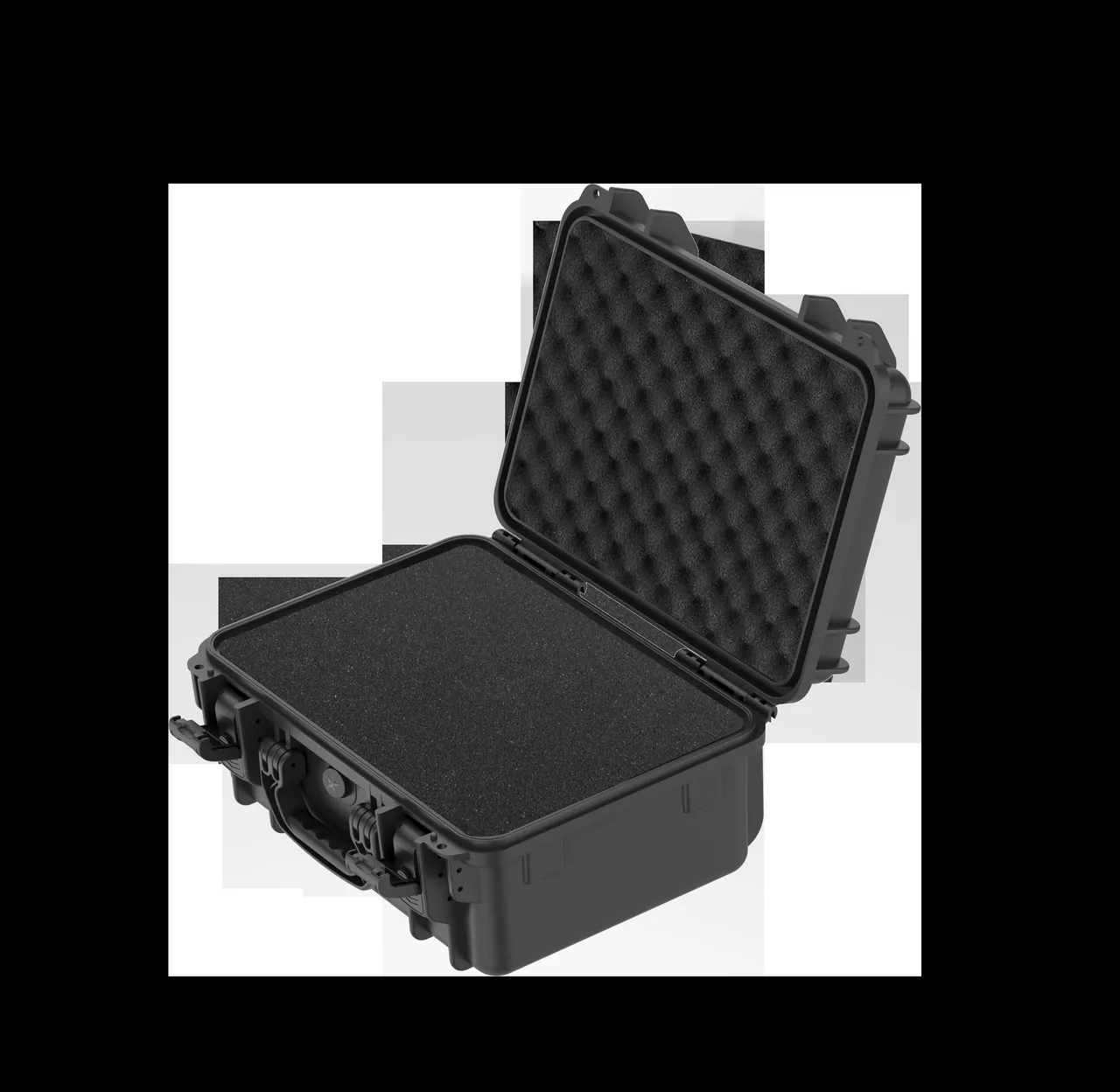
Kitchen and food. The core demand of a cookware case is "anti-friction, anti-odor, washable." Points: soft isolation between pots (metal and coated pots touching directly causes coating scratches); dishware should use divider rack structures; knives should have independent slots with fixed tip direction; condiments and liquid bottles upright fixed with secondary containment; dry food in independent sealed chamber with desiccant. Liner material should be washable, non-odor-absorbing closed-cell material; avoid open-cell foam (absorbs cooking oil and food odor).
Water system. Three protection points: first, freeze protection (winter and cold regions must be drainable; case and pipes reserve drain ports and lowest-point drainage); second, leak protection (water tank, pump and joints need secondary containment and absorbent layer to avoid leaking onto cabin structure); third, contamination protection (drinking and non-drinking water strictly zoned; fill port with dust cap). Special reminder: food-contact compliance of vehicle water tanks is a product-certification and regulatory matter, to be judged by applicable standards and professional advice; this article draws no compliance conclusion.
Power system and lithium battery. This is the highest safety-requirement category in on-board storage and must be emphasized separately:
- Mechanical fixation: battery packs must be rigidly fixed, not allowed to move inside the case; terminals should have insulating covers to prevent short circuit;
- Temperature management: lithium batteries strictly forbidden long-term in-cabin high-temperature environment (thermal-runaway risk, and high heat accelerates capacity fade); also avoid low-temperature charging risk;
- Compartment isolation: battery must be zoned from fuel, cleaners and metal tools;
- Cable management: cables fixed and avoiding long-term pull and compression, with stress relief at joints;
- Compliance: lithium batteries in transport are governed by dedicated rules (UN number, packing and marking); on-board use and transport are different scenarios, specifics should follow current regulations, battery-manufacturer instructions and vehicle-manufacturer requirements. Background see hazmat transport case compliance design and ESD-shield case design points.
Gas cylinder and fuel. Gas cylinders must be placed in a ventilated independent sealed bay (usually exterior bay), strictly forbidden in living cabin or sealed unventilated case. Reasons: leaked gas accumulates in sealed space; high heat raises cylinder pressure; cylinder corrosion causes long-term hazard. Case-level requirements are "upright fixation, anti-topple, anti-collision, ventilation, away from heat", and structures allowing leak detection should be set (e.g., vent and odor-dispersing layout). Gas-cylinder storage, use and transport requirements are mandatory safety-regulation matters, to follow current regulations and professional-agency advice.
Repair tools and spares. The core of a tool case is "positioning and anti-loss." Points: slot by tool shape (missing at a glance); heavy tools (hammer, jack, socket set) fixed at lower layer near case bottom; cutting edges and precision gauges independent compartments with sheaths; consumables (ties, tape, sandpaper, gaskets) zoned and labeled; build a tool list and check regularly (lost tools are a common on-board problem, and unsecured tools become hazards while driving).
Outdoor and camping gear. Tents, tables/chairs, awning poles, lamps and ropes are characterized by "long shape, large volume, easy tangle." Design points: long poles use full-length slots or tube racks, avoid diagonal lay; soft items (tent, sleeping bag) use breathable bags, avoid long compression (long compression affects filling rebound); lamps and glass items independent compartments with soft cushioning; ropes and webbing should be coiled and fixed to avoid tangling other gear.
Sanitation and cleaning supplies. Common trait is "liquid, chemical, easy leak." Requirements: independent chamber; upright fixation; secondary containment (independent ziplock or separate compartment); away from food, clothing and electrical zones; chemical labels must stay clearly legible (cleaner misuse is a real travel-living risk).
9. Scenario-to-Case Selection Reference Table
| Usage scenario | Typical gear | Suggested case form | Protection grade | Fixation | Key constraint |
|---|---|---|---|---|---|
| --- | --- | --- | --- | --- | --- |
| In-cabin daily storage (clothing/bedding) | Clothing, bedding, fabric | Soft storage / module case | IP54 | Limiting compartment + stacking locator | Breathable, anti-mold, washable |
| In-cabin kitchen gear | Cookware, tableware, condiment | Compartmented hard case | IP54–IP65 | Rail fixation or strap | Upright liquid, coating anti-scratch |
| In-cabin dry food | Dry goods, cans, snacks | Sealed case + desiccant | IP65 | Strap or clip base | Insect-proof, damp-proof, avoid heat |
| Exterior storage bay (tools/spares) | Tools, spares, consumables | Hard case + tool liner | IP65–IP67 | Rail + strap + limit | Compartment position, anti-loss, anti-rust |
| Exterior storage bay (chemicals) | Cleaners, lubricant, fuel accessory | Independent sealed case | IP65–IP67 | Independent chamber + strap | Upright, secondary containment, ventilation |
| Roof box / external box | Tent, table/chair, long poles | Long-body hard case | IP67 | Vehicle lock + special bracket | Wind drag, UV, dust, anti-vibration |
| Electrical and battery case | Battery, inverter, cables | Hard case + insulated liner | IP65 | Rigid fixation + terminal protection | Avoid heat, anti-short, separate chamber |
| Gas-cylinder bay | Cylinder, hose, regulator | Exterior ventilated bay (not general case) | Ventilation priority | Upright clamp fixation | Ventilation, upright, away from heat, compliance |
| First-aid and emergency | First-aid kit, extinguisher | Wall-mounted hard box | IP54 | Wall fixation + quick release | Visible, easy-access, regular check |
| Long-term parked (fixed use) | Full gear deployed | Drawer module + frame | IP54 | Frame + rail | Deploy efficiency, passage space |
| Short self-drive (temporary load) | Mixed supplies | General hard case | IP54–IP65 | Strap + anti-slip mat | Fast load/unload, projectile check |
| Equipment import/export transport | Full set gear | Transport-grade hard case | IP65–IP67 | Pallet + strap (per transport spec) | Pass transport test, stackable |
Three empirical rules: first, any item of large mass that must travel gets "case fixation + liner positioning" dual restraint, not relying on "jamming"; second, any liquid and chemical gets upright fixation and independent secondary containment; third, anything involving battery, gas and pressure vessel gets "highest safety grade" treatment with separate compliance confirmation.
10. Materials & Liners: Anti-Mold, Anti-Odor and Washable
Case-material selection logic. On-board cases commonly use HDPE, PP, modified PP alloy and engineering plastics, with trade-off dimensions: impact toughness (frequent on-board shock), weather resistance (UV and temperature swing), rigidity (load and stacking), chemical tolerance (contact with cleaners and fuel), and weight. Special note: different formulations of the same nominal "PP" can differ significantly in low-temperature toughness and UV resistance, so request the material data sheet and weathering test data rather than only looking at the material name.
Three special requirements for liner materials.
- Anti-mold. Travel-living scenarios are high-humidity and large-swing; liners using open-cell foam or absorbent fabric become mold habitats. Prefer closed-cell foam, or removable washable fabric liners.
- Anti-odor. Food, fuel, cleaners and clothing share one vehicle; cross-odor pollution is a real high-frequency problem. Liner should be low-odor and non-absorbing; different media zones must use independent liners (not one liner with dividers).
- Washable. Travel-living gear contacts grease, sand, food residue and chemicals. Liner should be removable for washing, or surface directly wipeable; do not use unrecoverable water-absorbing material.
Material comparison (oriented to on-board and travel-living scenarios).
| Material / structure | Cushioning | Weather/water | Washable | Odor | Fitted part |
|---|---|---|---|---|---|
| --- | --- | --- | --- | --- | --- |
| EVA (medium-high density, closed-cell) | Medium | Good | Good (wipe) | Low odor, no absorb | Compartment, tool slot, general position |
| Low-rebound EVA / memory foam | Good | Medium | Medium | May absorb | Precision gear, shock position |
| PE / XPE (closed-cell) | Medium | Good | Good | Low odor | Plane isolation, layer pad |
| Structural foam (high load) | Low | Good | Good | Low odor | Load block, heavy tool seat |
| PU foam (open-cell) | Medium | Poor (absorb) | Poor | Easy absorb, easy mold | Not recommended for travel-living |
| Pearl cotton (EPE) | Good (thin) | Medium | Poor | Low odor | Outer wrap, short-term cushion |
| Removable fabric liner | Low | Depends | Good (machine wash) | Needs anti-mold | Clothing, bedding, soft gear |
| Hard divider (plastic / aluminum) | No cushion | Good | Good | None | Zoning, load, stacking |
| Silicone / EPDM seal | No cushion | Good (but ages) | Good | Low odor | Case seal (consumable) |
| Stainless steel hardware | No cushion | Good (salt-spray care) | Good | None | Hinge, latch, anchor |
On "washable" structural design. True washability is not just "material not absorbing water" but also: liner removable as a whole (not glued dead inside); no hygiene dead corners inside (avoid deep narrow grooves and unreachable seams); drain or liquid-discharge structure (water after washing can drain); and hardware not long-contacting wash liquid (avoid corrosion). These designs add a little cost initially but decide whether the case stays usable over years of travel-living.
On reuse and odor management. If a case once carried fuel or cleaner, before converting to a food case it must complete thorough ventilation, cleaning and odor confirmation; for odor-sensitive categories (food, clothing, bedding), assign fixed cases per medium, avoid rotating between media. Cleaning and care methods see case cleaning and care points and case liner material comparison.
11. Loading Fixation SOP and Pre-Trip Inspection
Preparation before loading.
- Inventory and classify: classify all supplies by "mass — frequency — medium" three dimensions; list and mark case number and content category.
- Vehicle load confirmation: confirm storage bay and floor load allowable (should follow vehicle-manufacturer provisions); confirm anchors, rails and fixings intact, no looseness or rust.
- Case status confirmation: check corners, latches, hinges, seals and handles for cracks and functional anomaly; confirm seal not hardened or permanently flattened; confirm pressure-equalization valve intact (if fitted).
- Liner preparation: choose liner and compartments per contents; confirm liner dry, clean, no residual odor.
Loading standard operating procedure (SOP).
- Heavy first, bottom in place: put heavy cases at low and near-axis area first, confirm bottom flat with no point contact; confirm no hard protrusion between case and vehicle body.
- Liner positioning: position per gear shape, confirm no displacement space (push by hand, empirically within a few millimeters, heavy and precision gear completely immovable); add soft layer between rigid parts.
- Medium zoning: liquids and chemicals upright fixed with secondary containment; food and non-food zoned; battery and fuel away from each other and combustibles.
- Case fixation: prefer rail or clip base for mechanical interlock; when strapping use cross strapping, maximize strap angle, add corner protectors at contact; confirm strap tensioned and not crushing thin wall.
- Stacking and whole fixation: when stacking use locator-interlock cases and fix the whole (not single layer) by strap or frame; confirm stacked center of gravity not too high.
- Deployment verification: simulate parked use, confirm high-frequency items accessible without moving others; confirm lid opening angle not blocked.
- List and label: attach case label (number, category, main items, mass hint, check date); keep list at fixed position (door interior or electronic memo).
- Record: photograph loading and fixation state, record trip date and fixing-check result.
Pre-trip inspection (before every departure).
- Projectile check: confirm one by one all items fixed or restrained; any item that cannot be fixed and is non-trivial mass must be removed or placed in closed storage bay.
- Fixing check: strap tension, anchor integrity, rail and base lock state; spot-check for slack and wear.
- Lid check: lightly press and pull each lid, confirm latch truly engaged, no self-pop risk.
- Medium check: confirm liquids and chemicals upright, no leak trace; confirm battery area no abnormal odor or heat; confirm gas bay ventilated and valve normal.
- Emergency-item check: first-aid, extinguisher, warning items in place and quick-access.
- Mid-trip re-tighten: long trips should set re-tighten checkpoints (e.g., check straps and lids at every rest stop).
Empirical tip: make the "pre-trip check" a checklist stuck inside the door, turning the six items above into checkbox actions. This is the lowest-cost, most-effective safety-management means, especially useful when multiple drivers rotate or the vehicle is lent out.
12. On-Board Regulations and Compliance Notes
Travel-living vehicles involve many regulatory topics; those directly related to accessory cases are mainly the following. The following are only reminders, not compliance conclusions. Specifics should follow current regulations, vehicle-manufacturer requirements and professional-agency advice:
- Dangerous goods and on-board fuel: fuel, gas cylinders, some cleaners and chemicals carried on board may be bound by dangerous-goods rules in cross-border and some domestic transport scenarios (involving UN number, packing and marking). Specific applicable clauses should follow current rules and carrier requirements.
- Lithium battery: lithium-battery production, transport and use are governed by multiple rule sets. Transport scenarios (especially air and sea) differ from on-board use, involving state of charge, packing strength, marking and documentation. Follow battery-manufacturer instructions, current transport rules and vehicle-manufacturer requirements.
- Pressure vessel: gas cylinders, extinguishers and other pressure vessels have periodic-inspection requirements and service-life limits, and expired or abnormal-state containers must not be used.
- Food-contact material: vehicle water tanks, tableware and food containers involve food-contact-material compliance, related to GB 4806 series and similar standards; specific applicability follows product type and professional advice.
- Vehicle modification: adding storage bays, rails, external boxes and roof racks may involve vehicle-structure change and announcement/filing requirements, to follow vehicle-manufacturer provisions and local vehicle-management rules; modification must not affect structural safety and regulated lighting, vision and safety devices.
- Load and distribution: vehicle total mass, axle-load distribution and luggage-rack load all have limits, to follow vehicle-manufacturer provisions; overload significantly worsens braking distance and handling stability.
- Transport-packaging regulation: when the accessory case is delivered to customers as a product, its outer packaging is transport packaging, possibly involving GB/T 4857 series requirements and ISPM 15 quarantine of wooden packaging; plastic cases avoid wooden-packaging quarantine, but accompanying wooden pallets remain wooden packaging.
13. OEM/ODM Customization and Supplier Evaluation
Customization strategy: case standardization + liner customized per gear + modular fixation interface. Travel-living gear has many categories, small per-batch quantities, and obviously different storage-space sizes across brands and models; if every solution opens a new mold, cost is unbearable. The viable approach: case in 2–3 standard-size series (covering most storage spaces and gear sizes); liner customized per specific gear list (accept drawings, 3D data or physical modeling); fixation interfaces (rail slider, clip base, strap point, stacking-locator structure) made as standard parts reusable across cases. This covers multiple models while spreading tooling cost, see case mold cost analysis.
JUNZHJIA's standard practice in the travel-living and on-board direction is: accept vehicle storage-space dimensions and gear list → produce modular case-size series and zoning plan → customize compartmented liner and fixation interface → first-article trial fit confirmation (including vibration and shock pre-test) → batch production and sampling → provide seal specification and test, inspection-document support. Matching rail, clip-base and strap accessories can be supplied so the case system arrives install-ready rather than as loose components.
Six dimensions to evaluate suppliers.
- On-board load understanding: can they give vibration and shock protection thinking per installation position; can they explain the respective roles of liner positioning and case fixation; can they provide vibration and shock pre-test data. This is the most effective question to distinguish professional from non-professional factories.
- Fixation-interface capability: do they provide standard interfaces such as rails, clip bases, strap points and stacking-locator structures; can they be compatible with mainstream on-board rail systems.
- Material and weathering data: low-temperature impact toughness, UV and chemical data of materials; weathering and replacement cycle of seals; do they provide material data sheets (not just material names).
- Hygiene and cleaning design: is liner removable and washable; are there hard-to-clean dead corners; are hardware resistant to wash liquid.
- Test capability: can they provide vibration / shock / drop / thermal-humidity cycle / salt-spray / dust-water records; do they have low-temperature drop-test conditions.
- Quality system and delivery: sampling rules and nonconforming handling (see custom-case acceptance and AQL sampling); capacity elasticity before conversion peak and RV shows; can they build traceability by case number. Related factory-selection methods see how to choose a case OEM factory and instrument case selection guide.
Quotation list. A practical quotation should include: vehicle model and storage-space dimensions (including opening size and internal clearance, photos or 3D data); installation position (in-cabin / exterior bay / roof) and local temperature, dust, rain conditions; gear list (name, quantity, size, mass, whether liquid / battery / chemical); key items to fix and their mass; whether rail or clip base needed and existing vehicle rail spec; whether stacking and unified fixation needed; target IP grade; whether pressure-equalization valve needed; whether flame-retardant material needed and basis standard; whether removable washable liner needed; whether label and list system needed; whether transport test needed (with standard and items); project quantity and delivery milestone. The more complete the data, the closer the supplier plan is to directly producible. Related solutions see custom foam insert guide and EVA liner custom process.
FAQ
Q: What is the most easily overlooked risk for an RV or travel-living accessory case?
A: The most easily overlooked and most serious is the "projectile risk" — unsecured items flying out during hard braking or evasive maneuvers. The reason is that most storage discussion talks about "how to pack more and how to arrange neatly" but rarely about "how to not move under inertia." When a vehicle brakes, cabin objects move forward at a multiple close to the braking acceleration; a 20 kg accessory case under the common cargo-fixation check acceleration (industry practice about 0.8 g forward) generates about 157 N of forward force, and if the case is only "jammed tight" without connection to the vehicle structure, this force directly makes it slide or even flip, piercing the front seat backboard or injuring an occupant. A more hidden problem is "semi-fixation": many solutions use a heavy item to press the case down, which only provides vertical restraint, almost no resistance to forward and lateral inertia, and the pressing item itself becomes a projectile. Therefore the first principle of on-board storage is: any non-trivial-mass item must be restrained at a fixing point or within a confined area, and vertical and horizontal restraints must be designed separately. The concrete action is a "projectile check" before every departure, confirming all items fixed or restrained, with any unfixable non-trivial-mass item removed or placed in a closed storage bay.
Q: How should vibration tolerance of an accessory case be verified? Is such strict testing necessary?
A: It is necessary, but "match strength to installation position" rather than stricter is better. Driving vibration is broadband random vibration, small amplitude, extremely long duration, random direction, very wide band; the truly dangerous band is not the largest-amplitude one but the one coinciding with the equipment or case natural frequency — once resonance occurs, the actual acceleration borne is several times the excitation itself. Therefore verification should do three things: first, identify resonance points (through sine sweep or random vibration confirm case and key gear show no significant resonance amplification in the actual speed range); second, verify positioning effectiveness (after random vibration check whether gear displaced, fasteners loosened, tools ejected from slots); third, verify shock tolerance (through mechanical shock and drop tests check case corner, latch, handle and liner). Methodologically reference automotive ISO 16750-3 / GB/T 28046.3 (road-vehicle electrical/electronic environmental conditions and testing — mechanical loads) and the IEC 60068 series vibration, shock and drop methods; as environmental-test method basis one may also reference MIL-STD-810H vibration (Method 514) and shock (Method 516), but it must be clear MIL-STD-810H represents no military certification. Test load spectrum and strength should follow installation position (in-cabin / exterior bay / roof / suspension area) and vehicle-manufacturer requirements; roof and external positions typically demand far higher strength than in-cabin storage.
Q: Does an on-board accessory case need IP67, or is IP54 enough?
A: It depends on installation position, not on "higher is better." In-cabin closed storage only faces dust and occasional splashing, IP54 is usually enough; in-cabin near window or roof with dust and condensation combined suggests IP65; exterior storage bay directly exposed to wind-rain and dust while driving suggests IP65–IP67; roof box and external box long subjected to rain, dust and driving-airflow washing suggests IP67; only possibly flooded temporary sites need IP68. Three notes in selection: first, IP grade does not prevent condensation — a sealed case under in-cabin day-night swing cannot expel internal water vapor and may still condense on low-temperature inner surfaces, so "waterproof" and "damp-proof" are two things, damp-proof needs "sealing + desiccant (for food/clothing) + reduced internal moisture source"; second, dust damages the opening structure far more than the case body, dust entering latches and hinges forms an abrasive medium causing stiff opening and non-self-locking, so choose dust-proof hardware and regular dry lubrication (avoid dust-attracting grease); third, in UV-aging speed, seals are faster than the case body, so long-exposed roof or exterior cases should put seals on the regular-replacement list. Also the automotive industry has ISO 20653 for road-vehicle protection grades, similar in code to IEC 60529 but differing in test conditions; clarify the standard system relied upon at selection.
Q: How dangerous is in-cabin summer high temperature, and what gear must not be placed inside?
A: A sealed cabin under direct sun can reach interior temperature far above the outside ambient (industry observation commonly tens of degrees Celsius rise, depending on sunlight, body color, glazing area and ventilation), and temperature is non-uniform inside — near windows and roof hottest, floor and under-bed storage cooler. This distribution directly decides placement. Gear that must strictly avoid in-cabin hot zones includes: lithium batteries (high heat accelerates capacity fade and raises thermal-runaway risk), gas cylinders and pressure vessels (heat raises internal pressure), aerosol products (pressure rise causes leak and deformation risk), medicine and some cosmetics (heat lowers potency, causes separation or softening), chocolate and oily foods (melt and oxidize), and seals and some plastic gear (accelerated aging). Heat-resistant gear (metal tools, cookware, hard structural parts) can go in hot zones. Two often-overlooked rules: first, low temperature is also harmful — winter low temperature lowers lithium usable capacity, limits charging, and may freeze water systems and crack pipes, so water systems should be drainable with drain procedure executed; second, "cool before opening" — moving from hot to cold zone and opening immediately makes warm humid air meet cold surfaces and condense, so let it return to temperature before opening. Suggest concentrating temperature-sensitive items at low, ventilated, insulated storage and fitting a logging thermometer for traceability.
Q: If I pack the case full, will it stop rattling?
A: Packing full only solves part of the problem and may even introduce new ones. "Full" reduces the free-displacement space of in-case items, but the case itself still slides or even lifts under vehicle inertia — fixation between case and vehicle is a completely independent issue that no amount of packing replaces. Meanwhile, packing full hides the "internal impact" problem: gear continuously strikes the wall and neighboring gear under vibration, and repeated heavy impact causes case cracking, gear deformation and coating scratches, while these damages are harder to spot when full because every opening needs re-organizing, easily missing slowly changing deformation. Also, over-filling causes two side effects: access efficiency drops (every item needs digging), and some materials (sleeping bags and down filling) lose rebound under long compression. The correct approach is "liner positioning plus case fixation" dual combination: use shape-cut liners to constrain each item at a fixed position (criterion: push by hand displacement within a few millimeters, heavy and precision gear completely immovable), then connect the case to vehicle structure by strap, rail or clip base; fill level should be "smooth access, no rattle", not "packed until it will not close."
Q: Why do seals and hardware of RV accessory cases fail faster than household cases?
A: Because the on-board environment simultaneously applies three loads absent in household scenarios. First, persistent random vibration: it slowly backs off threaded connections, causes micro-motion wear on seals, and gradually loosens latches under long-term tiny displacement; this damage is cumulative, one trip shows nothing, dozens of trips show "screws that will not tighten, lids that will not close." Second, dust and mud: dust entering hinges and latches forms an abrasive medium causing stiff opening and non-self-locking, and this failure often occurs mid-trip, directly affecting driving safety (lid pops open under bumps). Third, UV and temperature swing: long-exposed roof or exterior cases show surface chalking and embrittlement, and seal UV-aging speed is faster than the case body, so the seal is often the first failed part. Responses: prefer dust-proof metal hinges and latches (with replaceable design where needed); regular cleaning and dry lubrication (avoid dust-attracting grease); choose UV-additive case materials; put seals on the regular-replacement list and do a simple criterion check before each load (after closing confirm even fit all around, no visible gap, no "floaty" feel). Since seals are consumables, carry spare seals for mid-trip replacement.
Q: Can gas cylinders and lithium batteries be placed in the same accessory case?
A: No, these two must be zoned separately, and each has clear additional requirements. Gas cylinder side: must be placed in a ventilated independent sealed bay (usually exterior), strictly forbidden in living cabin or sealed unventilated case. Three reasons: leaked gas accumulates in sealed space forming explosion risk; high heat significantly raises cylinder pressure; cylinder corrosion causes long-term hazard. Case-level requirements are "upright fixation, anti-topple, anti-collision, ventilation, away from heat", with structures enabling leak detection. Pressure vessels also have periodic-inspection and service-life limits, expired or abnormal containers must not be used. Lithium battery side: must be rigidly fixed, not allowed to move in case; terminals need insulating covers to prevent short circuit; strictly forbidden long-term in-cabin high-temperature environment (heat accelerates fade and raises thermal-runaway risk), and avoid low-temperature charging risk; cables fixed with stress relief. Both must also be zoned from cleaners, fuel and metal tools, because short-circuit, corrosion and chemical-reaction risks compound in one space. Emphasize that gas-cylinder and lithium-battery storage, use and transport are mandatory safety and dangerous-goods regulation matters involving pressure-vessel inspection, dangerous-goods transport rules and battery-transport provisions, specifics to follow current regulations, battery and cylinder-manufacturer instructions, vehicle-manufacturer requirements and professional-agency advice; this article draws no compliance conclusion.
Q: How can an accessory-case system make things "findable"?
A: The most common on-board complaint is not "no place to put it" but "cannot find it", so the storage system's design goal should include "fast retrievability." Three zero-cost methods are most effective: first, external labels — set a label position on the case exterior marking case number, content category, main-item list, mass hint and latest check date, achieving "identify without opening"; second, internal fixed positions — slot by gear shape so each tool has a fixed place, convenient for access and making "what is missing" obvious, especially important for tools and emergency supplies; third, unified storage rules — e.g., "all cookware in case 2, all tools in case 5, all liquids in case 7", and mark this rule on both case and vehicle storage position. On top of this add an efficiency layer: zone by usage frequency, placing items used multiple times daily (tableware, cookware, water, common tools, first-aid) where accessible when parked without moving others, and items used once per trip or for emergency (spares, seasonal gear, emergency supplies) deeper. Suggest a list (paper on door interior, or electronic memo) updated after each trip, so "findable" does not degrade with trip count.
Q: Should travel-living accessory cases be plastic or another form, and what to watch?
A: In most on-board and travel-living scenarios, plastic hard cases (HDPE / PP and modified materials as main structure) are the more suitable base choice, for four reasons: impact toughness (frequent on-board shock, plastic cases resist permanent deformation and crack less on drop); controllable sealing and protection (seal strips achieve IP65 / IP67, with replaceable seals and latches); weather and chemical resistance (good tolerance of UV, rain-snow and common cleaners, further improved by UV additives); weight and cleanability (lighter than metal, easier to clean than wood and not a moisture source from absorption). Six watch-points at selection: first, formulation difference — same nominal PP differs significantly in low-temperature toughness and UV resistance, request material data sheet and weathering test data rather than only the material name; second, hardware grade — hinges and latches prefer metal with replaceable design, as their on-board wear rate far exceeds indoor use; third, dust protection — choose dust-proof opening parts and regular dry lubrication; fourth, washability — liner removable as a whole, no hard-clean dead corners, with drain structure; fifth, fixation interface — case should reserve or be compatible with rail slider, clip base and strap point, otherwise even the best case cannot be reliably fixed; sixth, stacking locator — for stacking choose cases with interlocking top/bottom locator structures and fix the whole (not single layer). For oversized items or long-fixed equipment, combine frame or drawer solutions with plastic module cases.
Conclusion and Related Reading
The design of RV and travel-living accessory cases is essentially a "constraint-system design" problem, not a "container capacity" problem. On-board gear simultaneously faces five load classes: long-duration low-amplitude random vibration, occasional high-amplitude shock, extreme in-cabin temperature and humidity, dust and UV, and inertial projectiles — and the most dangerous class has nothing to do with the case itself: the projectile formed by unsecured items in hard braking. Therefore an effective solution must design "liner positioning (managing inside the case)" and "tie-down fixation (managing the case)" as two independent yet mutually supporting subsystems, and adopt "zoning by mass, frequency and medium" as the organizing principle of the storage system.
The implementation path compresses to seven steps: first classify supplies by mass, frequency and medium → then determine vibration, shock and protection-grade requirements by installation position → choose cases by raising stiffness and avoiding resonance, and use interlocking-locator structures for modularity → achieve zero-displacement positioning with shape-cut liners → connect cases to vehicle structure by rail, clip or cross strap with ample safety margin → handle liquids, chemicals and batteries by zoning, secondary containment and thermal isolation/heat avoidance → finally turn "projectile check + fixing check + lid check + medium check" into a fixed action via a pre-departure checklist stuck inside the door. If you need a modular case and fixation plan for a specific vehicle's storage space, gear list and installation position, provide the vehicle dimensions and gear list to JUNZHJIA, which will produce drawings and arrange first-article trial fit with vibration and shock pre-test confirmation.
Related Reading