

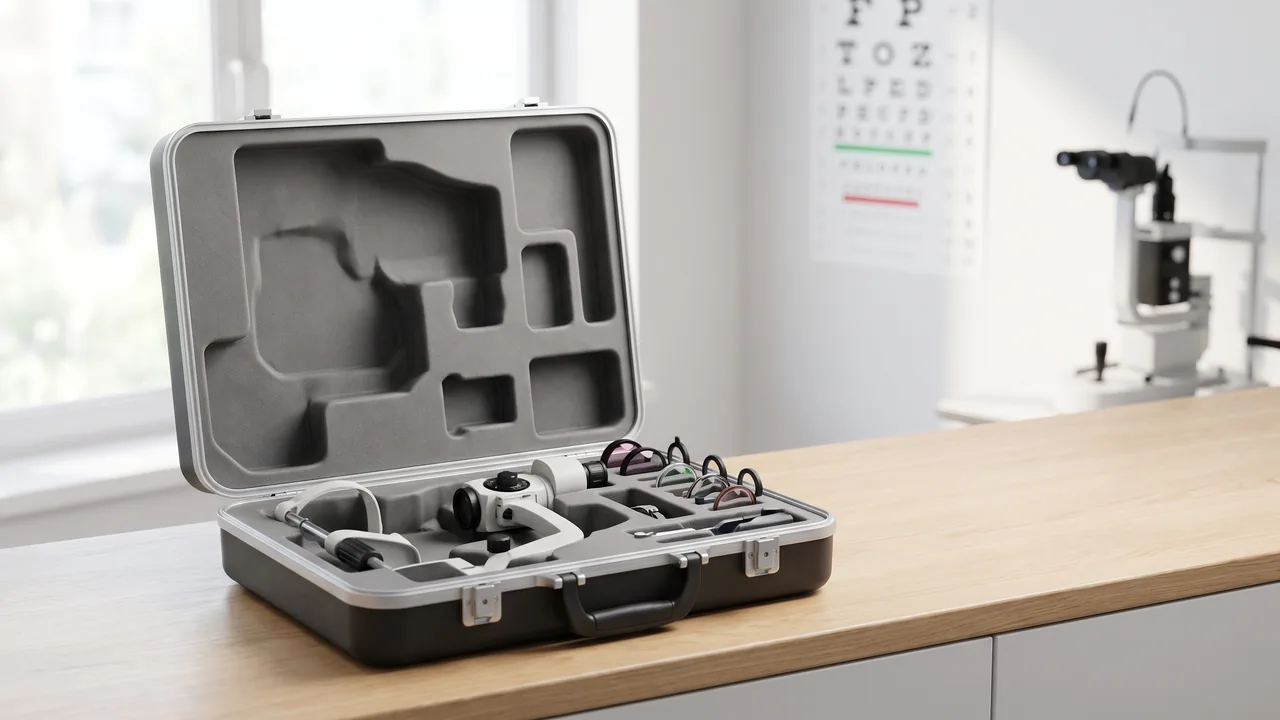
The most frustrating way for disaster supplies to fail is not to be consumed, but to be stored into uselessness. After a typhoon, one neighbourhood committee opened emergency kits purchased three years earlier and found compressed biscuits caked with moisture, alkaline batteries that had leaked and corroded torch springs, PVC rain ponchos fused into a single sticky mass, and paper contact cards so badly mildewed that the phone numbers were unreadable. The inventory list was complete, procurement had followed procedure, and the storeroom was reasonably dry. The only thing that had failed was the container.
JUNZHIJIA's core protection principle for emergency kit cases is this: the reliability of disaster supplies is not decided at the moment of packing but at the moment of opening, and a protective case must therefore treat three years of stillness followed by instant use as its primary design input, converting time from an enemy into a neutral variable through sealing, cushioning, compartmentalisation and moisture management.
Table of Contents
- The Real Risk of Supplies That Fail After Three Years in Storage
- Where the Case Sits in a Disaster Preparedness System
- Shell Materials and Moulding Processes: Rotomoulded PE versus Injection PP
- Sealing, Dust and Water Ingress: What IP Ratings Mean in Long-Term Storage
- Internal Compartments and Modular Storage: Visible and Reachable
- Cushion Liners: EPE, EVA and IXPE Under Long-Term Compression
- Pressure Equalisation Valves and Moisture Management
- Latches, Hinges and Handles: The First Opening After a Decade
- Temperature, Humidity and Corrosion: Salt Spray, Mould and Metal Failure
- Stacking, Handling and Marking: The Logic of Community-Level Reserves
- Transport and Drop Validation: ISTA and GB/T 4857 Criteria
- Acceptance Testing and Maintenance Intervals
- Frequently Asked Questions FAQ
- Conclusion and Related Reading
The Real Risk of Supplies That Fail After Three Years in Storage
In long-term storage, supply failure almost never appears as a single cause. It emerges as a coupled chain of moisture vapour, thermal cycling, biological degradation and electrochemical corrosion. Consider four common emergency items. Food and drinking water are governed by water activity and package integrity; once relative humidity stays above 60 percent, mould spores have what they need to germinate. Alkaline batteries are governed by temperature, with leakage risk roughly doubling for every 10 degrees Celsius rise. Rubber and PVC goods migrate plasticiser into the enclosed air, cross-contaminating neighbours until adjacent items stick together. Lighting and communication devices with metal springs and contacts suffer pitting and sulphide blackening under chlorides and sulphur compounds.
A fact routinely overlooked is that reserve storerooms are not climate-controlled. Most community-level reserve points sit in basements, raised ground floors or ordinary offices, where daily temperature swings reach 8 to 15 degrees Celsius and relative humidity can stay above 85 percent for forty consecutive days during the rainy season. Under those conditions the container's breathing effect becomes a slow pump running in reverse: daytime warming pushes air out, night-time cooling draws air in, and over three years the accumulated vapour exchange can saturate five hundred grams of desiccant.
The first task of an emergency kit case is therefore not to hold everything, but to keep everything out. What is needed is quantifiable barrier performance: dust exclusion, resistance to water jets or brief immersion, impact resistance, resistance to stacking deformation, resistance to ultraviolet ageing, and enough stiffness to keep the sealing faces in contact through repeated thermal cycles. On emergency reserve projects, JUNZHIJIA requires that after ISTA 2A and GB/T 4857 series testing, residual compression set at the sealing face does not exceed 20 percent of the initial value, the floor below which a case can no longer be trusted to open cleanly and seal effectively a decade later.
Where the Case Sits in a Disaster Preparedness System
In the hierarchy of an emergency plan, the case is usually purchased as a low-priority consumable. From a system reliability perspective it is the only node that simultaneously occupies three states: storage, transport and distribution. In storage it is a micro-environment chamber. In transport it is a shock isolator. In distribution it is an identifiable, rapidly auditable unit. The structural demands of those three states are not aligned and sometimes conflict: storage demands a tight seal, distribution demands fast opening, transport demands a liner that grips, auditing demands contents that are visible at a glance.
The way to resolve the conflict is to separate the case into three design layers. The outer layer is the structural shell, responsible for impact, stacking, ultraviolet resistance and sealing; it is typically a one-piece rotomoulded polyethylene body with 4 to 6 millimetre wall thickness and naturally thickened corners acting as energy-absorbing zones. The middle layer is the environmental control layer, comprising the seal profile, pressure equalisation valve, desiccant bay and humidity indicator card, holding the internal micro-environment inside a target band. The inner layer is the storage interface, comprising divider modules, cushion liners and the marking system that keeps different batches of supplies in their assigned places.
Once the three layers are decoupled, any one of them can be upgraded without disturbing the others; moving the liner from EPE to IXPE, for example, requires no new tooling. The model also dictates that acceptance criteria be set per layer rather than reduced to a single IP rating. The shell is judged on ISTA drop and stacking performance, the middle layer on seal compression set and valve airflow, the inner layer on divider dimensional chains and liner creep. A similar breakdown for reserve-type enclosures is discussed in Emergency Supply Reserve Case.
Shell Materials and Moulding Processes: Rotomoulded PE versus Injection PP
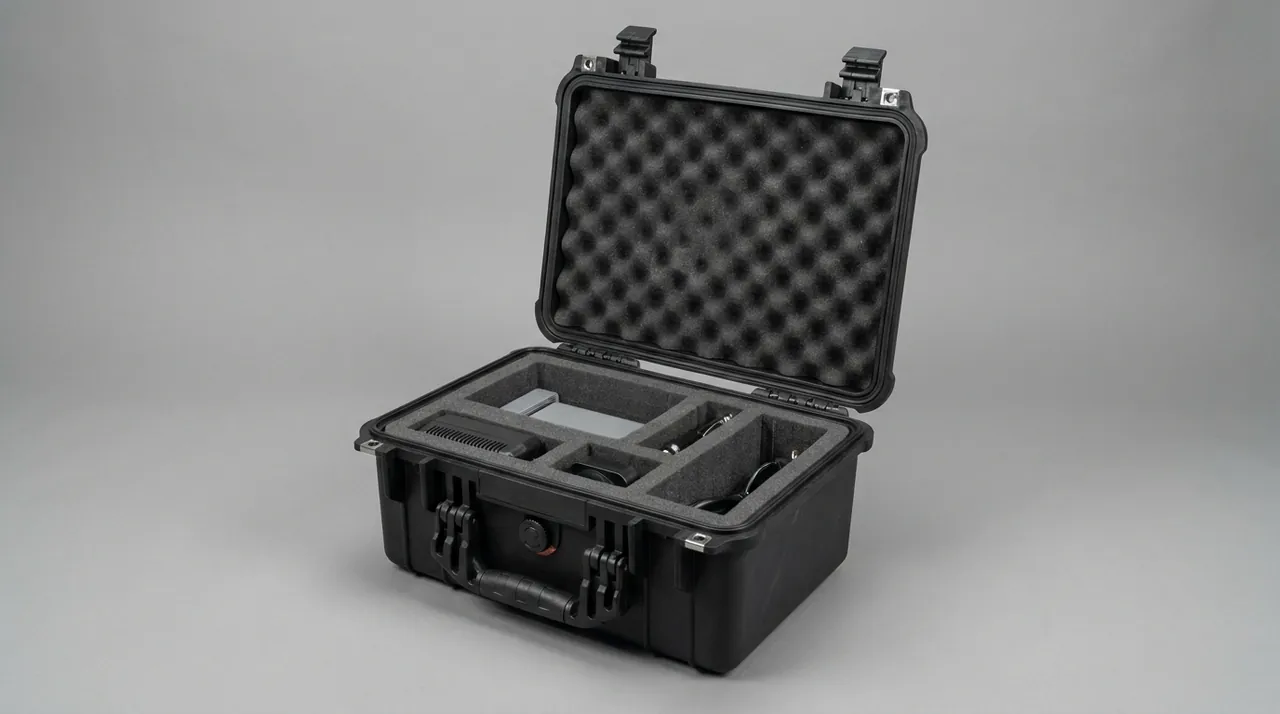
Choosing a shell material for an emergency kit case is fundamentally a trade-off between impact resistance, dimensional precision, unit cost and batch threshold. Two routes dominate: rotomoulded polyethylene and injection-moulded polypropylene copolymer, and their behaviour in long-term storage differs sharply. Rotomoulding offers low tooling cost, large one-piece shells with no weld lines, and naturally accumulated wall thickness at the corners that delivers the best drop performance. Its penalty is looser dimensional tolerance, typically plus or minus 2 to 3 millimetres, with surface flatness dependent on post-machining. Injection moulding delivers tight tolerances around plus or minus 0.5 millimetres, fast cycle times and excellent surface finish, and suits small to medium cases with complex latch geometries and ribbing, but tooling investment is high, weld lines are structurally weaker, and large parts tend to warp.
For long-term storage two further properties matter. The first is environmental stress crack resistance: polyethylene in prolonged contact with surfactants, oils and certain disinfectants can craze near wall-thickness transitions and weld lines, so the grade should carry ESCR data such as ASTM D1693. The second is ultraviolet stability, since a case stored beside a window without sufficient hindered amine light stabiliser and carbon black will chalk within three years and lose roughly a third of its impact performance.
| Comparison Item | Rotomoulded LLDPE | Injection PP Copolymer | Effect on Long-Term Storage |
|---|---|---|---|
| --- | --- | --- | --- |
| Typical wall thickness | 4.0 to 6.0 mm | 2.5 to 3.5 mm | Thicker walls resist puncture and stacking creep |
| Dimensional tolerance | plus or minus 2 to 3 mm | plus or minus 0.5 mm | Affects interchangeability of divider modules |
| Drop resistance at minus 20 C | Excellent, no weld lines | Moderate, weld lines are weak points | Safer handling in cold-store rooms |
| ESCR resistance | Requires high-ESCR grade | Inherently good | Governs life under disinfectant contact |
| UV stability | Depends on carbon black and HALS | Depends on additive package | Determines rate of surface chalking |
| Unit cost in small batches | Moderate | Lower at high volume | Determines economics of reserve scale |
| Large-format feasibility | Excellent, up to 1200 mm | Limited by clamping force | Influences single-pack versus split-pack strategy |
Sealing, Dust and Water Ingress: What IP Ratings Mean in Long-Term Storage
IP ratings under IEC 60529 and GB/T 4208 are among the most frequently misread specifications in emergency reserve work. Many procurement officers treat IP67 as the ultimate target, yet IP67 is defined as protection against water ingress during thirty minutes of immersion at one metre depth. That is a single-event test, not evidence of continuous vapour blocking over three years. What governs long-term storage is the compression set of the seal profile and the ability of the shell to recover its shape under stacking load: a case passing IP67 on day one may, once its gasket exceeds 30 percent compression set after two years, block everyday vapour less effectively than a well-maintained IP54 case with healthy seals.
JUNZHIJIA therefore applies a dual criterion: the IP rating serves as the outgoing threshold, normally IP65 or IP67, while compression set serves as the life threshold, held to no more than 25 percent under 22 hours at 70 degrees Celsius with reference to GB/T 7759. In seal geometry, lip-type or hollow tubular profiles in silicone or EPDM are preferred, with compression held between 20 and 30 percent of original height. Under-compression leaves insufficient contact stress; over-compression accelerates permanent set. The seal groove should be an open, replaceable channel rather than a formation moulded integrally with the shell, so the gasket can be serviced in the field.
For reserve points in coastal districts or below ground, salt spray and mould deserve equal attention. GB/T 10125 neutral salt spray testing is usually specified for metal parts, but the latches, hinges and valve bodies on a case must be covered by the same requirement. Hardware should survive at least 96 hours of neutral salt spray without visible red rust, or be substituted with 316 stainless steel and engineering polymer. Broader frameworks for sealing system design are covered in System Level IP67 Design and Outdoor Case Seal Ring.
Internal Compartments and Modular Storage: Visible and Reachable
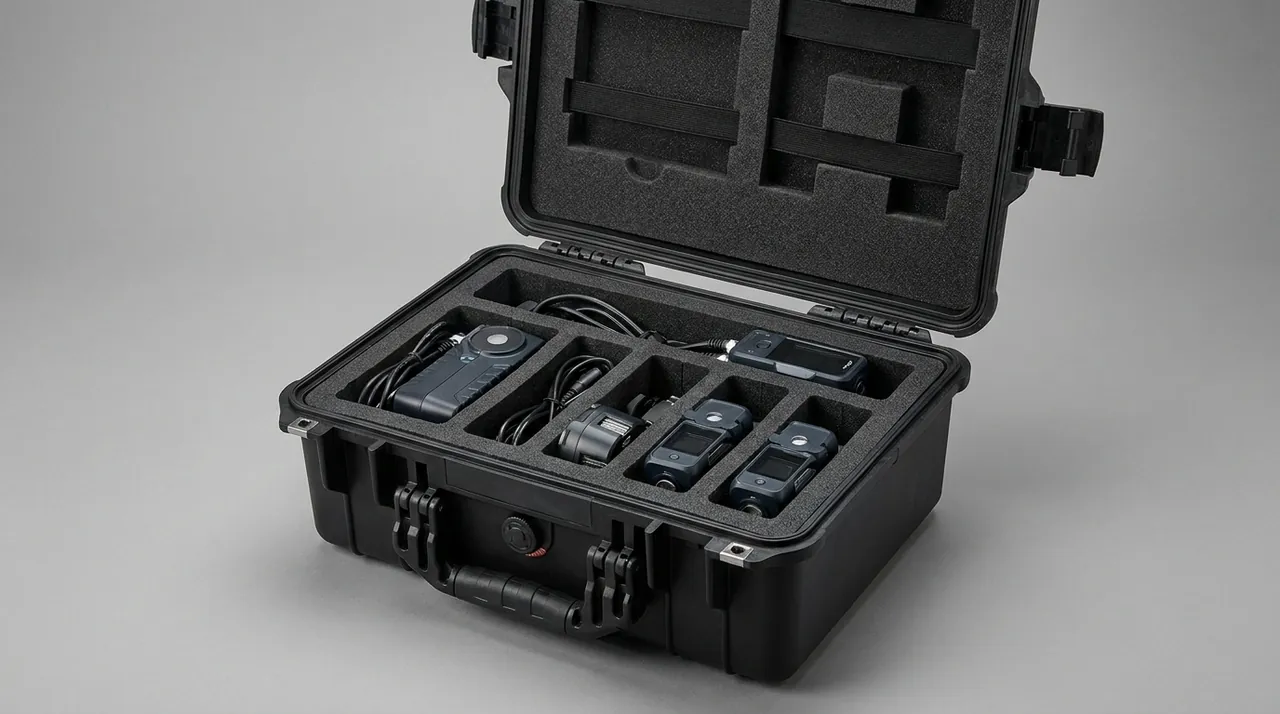
Storage design for emergency supplies rests on one deceptively difficult rule: with no lighting, gloves on hands and time pressure, the user must still locate the target item within thirty seconds. That means compartmentalisation is not about chopping space into small boxes but about reorganising along three axes: use frequency, use scenario and complementarity. High-frequency general items such as torches, whistles, gloves and drinking water belong in the outermost positions, retrievable without moving anything else. Lower-frequency but critical items such as spare batteries, emergency medication and window breakers sit in the middle layer. Items with the longest reserve life, used only during prolonged supply interruption, such as compressed food and water purification tablets, go to the bottom.
Three implementation routes exist, each with clear boundaries. Movable divider systems use slots formed into the shell plus insertable panels; they are the most flexible and cheapest, and suit organisations whose inventory changes seasonally. Foam-cut layouts give the most precise location and the best shock protection, but must be remade whenever item dimensions change, suiting fixed, standardised kits. Fabric pouches and mesh pockets handle irregular soft goods well but make auditing harder. The approach JUNZHIJIA usually recommends is a hybrid: a hard divider system at the bottom providing the primary zones, with EVA-wrapped fabric pouches carrying individual items inside each zone.
Visual management is the dimension most often ignored. Divider tops should carry a label slot or silk-screened area, written on weather-resistant synthetic paper with an oil-based pen, never with adhesive labels that creep and soil the shell. A laminated inventory card should record the latest inspection date, the responsible person, and the expiry month of dated items.
Cushion Liners: EPE, EVA and IXPE Under Long-Term Compression
Cushion liners inside an emergency kit are usually understood as shock-absorbing material, but in long-term storage they function more like constant-pressure clamps. Contents may sit undisturbed for three years while the liner stays compressed the entire time. Under those conditions the decisive property is not initial rebound but compressive creep and compression set. EPE, expanded polyethylene, is cheap and resilient but creeps noticeably under sustained load, and its cell structure can slowly admit water through repeated thermal cycling. EVA foam is dense, easily thermoformed and has a gentle cushioning curve, but is heavier and stiffens at low temperature. IXPE, irradiation cross-linked polyethylene foam, has the finest uniform cell structure, the least creep and the widest temperature range, making it the best choice for long-term storage at the highest unit price.
A practical selection criterion is thickness retention after 1000 hours at 25 percent compression. EPE typically retains 85 to 90 percent, EVA 90 to 93 percent, and IXPE more than 95 percent. Thickness loss translates directly into a loose liner, allowing contents to shift and suffer collision wear during transport. For supplies containing precision components such as emergency radios, blood pressure monitors or infrared thermometers, IXPE should be specified outright, or applied locally as reinforcement at critical points. For purely soft goods such as clothing and blankets, EPE is sufficient and further investment is unnecessary.
| Material | Typical Density kg per cubic metre | Thickness Retention at 25 Percent, 1000 h | Service Temperature | Water Absorption | Suitable Contents |
|---|---|---|---|---|---|
| --- | --- | --- | --- | --- | --- |
| EPE expanded polyethylene | 20 to 35 | 85 to 90 percent | minus 40 to 70 C | Low but not fully closed cell | Clothing, blankets, soft packaging |
| EVA foam | 60 to 120 | 90 to 93 percent | minus 20 to 60 C | Very low | Thermoformed irregular parts |
| IXPE cross-linked | 33 to 67 | 95 percent or better | minus 60 to 90 C | Extremely low, closed cell | Instruments, electronics, medicines |
| PU sponge | 25 to 40 | 70 to 80 percent, hydrolyses | minus 20 to 70 C | High | Not recommended for long storage |
One specific caution: liners should never sit in direct contact with plasticised PVC goods. Long-term contact between EVA and soft PVC causes plasticiser migration, leaving the liner surface tacky and the PVC hardened and cracked. If PVC rainwear or waterproof pouches must be stored in the case, a polyester film barrier should separate them.
Pressure Equalisation Valves and Moisture Management
The breathing effect of a sealed emergency case under thermal cycling is the main channel for moisture ingress. Two countermeasures exist. The first is to seal the case completely rigidly and accept the internal-to-external pressure differential, at the cost of difficult opening, permanent gasket loading and the possibility of a bulging lid during high-altitude transport. The second is to install a pressure equalisation valve using expanded PTFE membrane or an equivalent microporous film, permitting air passage while blocking liquid water and particulates, so that the differential stays minimal. JUNZHIJIA recommends the second, specifying airflow of at least 300 millilitres per minute at 7 kilopascals differential with a protection rating no lower than IP67.
It must be stated clearly that a pressure valve equalises pressure, not humidity. Moist air will still diffuse slowly through the membrane, just at a rate far below that of whole-case breathing. Moisture management therefore remains the job of desiccant, and desiccant quantity must be calculated from the true vapour load rather than from habit. Load sources include the water content of the air sealed in at packing, the moisture content of the contents and liner themselves, the air exchanged at every inspection opening, and long-term permeation through the gasket and valve. For a 60 litre case opened four times a year in an environment averaging 70 percent relative humidity, annual vapour load is roughly 8 to 14 grams, so with a safety factor at least 100 grams of silica gel should be installed, using indicating silica gel so saturation can be judged visually.
Desiccant bay design matters as much as quantity. The bay belongs in the upper region where natural convection occurs, never buried under contents or in direct contact with them, and should be a grid-sided polymer box rather than a fabric pouch, preventing loose granules from contaminating supplies. A humidity indicator card should sit alongside so that a single glance at inspection reveals whether the micro-environment has gone out of control. JUNZHIJIA integrates both into a flip-down compartment on the inside of the lid, so inspection needs no disturbance of the contents below.
Latches, Hinges and Handles: The First Opening After a Decade
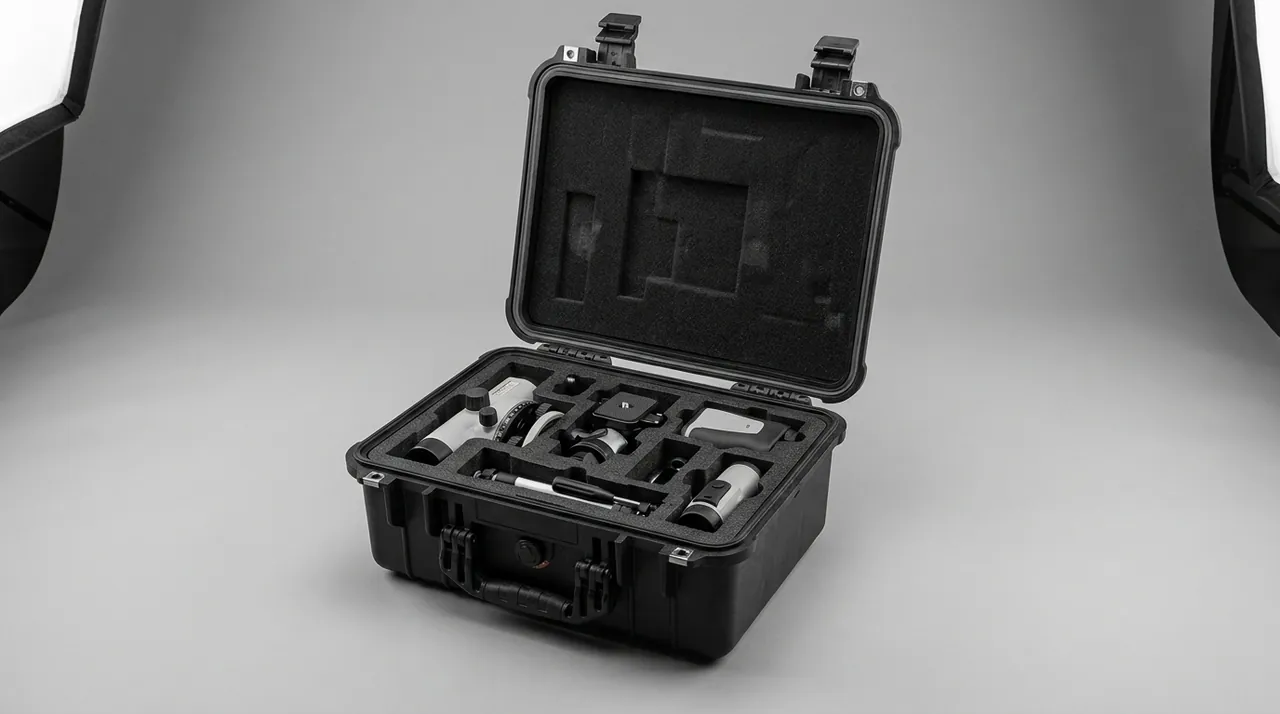
In an emergency, failure to open the case is catastrophic: the supplies inside are intact, but nobody can reach them. Storage creates three distinct opening obstacles: corrosion seizure of metal latch components, adhesion between the gasket and the shell, and creep in polymer latch parts under constant load that drives the engagement too tight. Each has both a design and a maintenance answer.
Latches should use an engineering polymer body with a stainless steel pin rather than an all-metal construction that can rust solid in salt-laden air. The pin location should accept lubrication or run in a self-lubricating bush. On coastal projects JUNZHIJIA specifies PA66-GF30 latch bodies with 316 stainless pins, and requires that opening force after ten years of storage remain below 80 newtons, verified by measurement after 500 hours of accelerated ageing at 60 degrees Celsius and 90 percent relative humidity. Metal hinges should be stainless with polymer bushes isolating dissimilar metal contact; integral polymer hinges must be checked for low-temperature embrittlement, making a minus 20 degree Celsius drop test mandatory.
Gasket adhesion is addressed through material and surface treatment: EPDM and silicone gaskets can be silicone-oil sprayed or given a low-tack finish, with a small non-adhering land preserved at the shell contact face. The case should also be opened every twelve months and the latches cycled three to five times.
Handles are routinely underestimated. A fully loaded emergency kit weighs 15 to 30 kilograms, requiring two-person carrying or a trolley and wheel set. Both a folding side handle and a primary end handle should be provided, with a soft over-mould on the grip at least 25 millimetres wide to spread pressure. Attachment to the shell should use through-going metal pins rather than self-tapping screws, which enlarge their holes under sustained load. A fuller treatment of this hardware appears in Toolbox Hinge Latch Seal.
Temperature, Humidity and Corrosion: Salt Spray, Mould and Metal Failure
Among emergency supplies, items containing metal suffer the most: torch springs and contacts, battery terminals, knife edges and tool plating. In long-term storage the mechanism is electrochemical corrosion compounded by microbiological attack. Above 60 percent relative humidity, a continuous adsorbed water film forms on the metal surface and corrosion rate climbs sharply. Chlorides in coastal air or sulphur dioxide in industrial districts multiply that rate further, while organic acids produced by mould metabolism accelerate local attack.
Engineering countermeasures work at three levels. The first is environmental control: sealing plus desiccant holding internal relative humidity between 40 and 50 percent, which is the single most effective measure because below 40 percent most metallic corrosion and mould growth nearly stops. The second is barrier packaging: metal tools and torches sealed individually in volatile corrosion inhibitor bags, whose inhibitor volatilises in the enclosed space and forms a monomolecular film on the metal, typically effective for two to three years and therefore to be aligned with the rotation cycle. The third is material substitution, preferring stainless steel or gold-plated contacts for springs and terminals and avoiding bare copper and bare steel.
For the case's own hardware, in addition to the salt spray requirement above, galvanic corrosion between dissimilar metals must be avoided. An aluminium hinge with stainless steel screws, for example, makes the aluminium anodic and corrodes it quickly in damp conditions. Such pairings should be avoided or broken with polymer washers. Before shipment, JUNZHIJIA samples complete cases through 96 hours of neutral salt spray per GB/T 10125, with acceptance defined as no red rust on hardware, normal function, and opening force variation within 15 percent.
Stacking, Handling and Marking: The Logic of Community-Level Reserves
Community-level emergency reserves are characterised by small scale, many locations and long periods of stillness. A single sub-district may operate eight to fifteen reserve points, each holding five to twenty cases on shelving or floor pallets. This pattern places clear demands on stacking capacity and marking legibility.
Stacking capacity must distinguish static from transport loading. Static stacking in a storeroom persists for years, and polyethylene creeps under sustained load, so the calculation must use the creep modulus corresponding to a twenty-year service life rather than the short-term elastic modulus. A practical criterion is that a fully loaded case under three-layer stacking at 40 degrees Celsius should show no more than 1.5 percent permanent deformation in the height direction after one year. Transport stacking is brief but combined with vibration, and must be validated by ISTA 3E or GB/T 4857.3. Cases should incorporate interlocking location features, a boss on the top face engaging a recess in the base, to prevent sliding, and stacking height should be limited to four layers.
For marking, emergency cases normally use high-visibility orange or fluorescent yellow with reflective tape and silk-screened category icons. Screen printing should use weather-resistant ink and pass a cross-cut adhesion test; stickers should be avoided. A marking area of at least 100 by 70 millimetres should be reserved on the front face carrying contents category, responsible unit, latest inspection date and rotation month.
For handling, the centre of gravity of a loaded case should sit low, with heavy items such as drinking water and canned food at the bottom and light bulky items above. Where a single case exceeds 25 kilograms, a trolley handle and wheel set should be specified, with rubber-coated bearing wheels validated over a five kilometre run. More detail on stacking appears in Stackable Toolbox Design Benefits.
Transport and Drop Validation: ISTA and GB/T 4857 Criteria
Transport failures for emergency kit cases occur predominantly during distribution, handled by untrained volunteers, tossed from vehicle beds and carried over rough roads. Only structural validation protects against this.
Drop testing is the foundation. GB/T 4857.5 and ISTA 2A define drop height and attitude by weight class, typically 600 to 800 millimetres for cases of 10 to 20 kilograms, covering corner, edge and face drops. Conditioning at minus 20 degrees Celsius for four hours before dropping is critical, because polyethylene loses impact strength when cold and a sample passing at room temperature may crack during winter distribution. JUNZHIJIA's internal criterion is that no through-thickness crack may appear after a cold drop, with local whitening permitted but not extending beyond 50 millimetres.
Vibration testing reproduces the cumulative damage of long hauls, normally run to ISTA 3A or ASTM D4169 assurance level II using a road transport spectrum for 60 to 120 minutes. Acceptance requires that latches do not self-release, liners do not shift more than 10 millimetres, contents show no abrasion, and sealing faces do not separate. For kits holding satellite phones or emergency radios, shock response spectrum testing per GB/T 4857.23 or ASTM D3332 should confirm the liner holds transmitted peak acceleration below the product fragility level.
| Test Item | Reference Standard | Typical Parameters | Acceptance Criterion |
|---|---|---|---|
| --- | --- | --- | --- |
| Ambient drop | GB/T 4857.5 / ISTA 2A | 600 to 800 mm, six faces three edges one corner | No through crack, function normal |
| Cold drop | Same, plus minus 20 C for 4 h | Same as above | No crack propagation beyond 50 mm |
| Random vibration | ISTA 3A / ASTM D4169 | Road spectrum, 60 to 120 min | Latches hold, liner does not shift |
| Stacking test | GB/T 4857.3 / ISTA 3E | Three-layer equivalent load for 24 h | Deformation 1.5 percent or less, no collapse |
| Neutral salt spray | GB/T 10125 | 96 h, 5 percent NaCl | No red rust, opening force change 15 percent or less |
| Sealing verification | IEC 60529 / GB/T 4208 | IP65 water jet or IP67 immersion | No trace of water inside |
| Liner creep | Internal specification | 25 percent compression, 1000 h | Thickness retention 90 percent or better |
Acceptance Testing and Maintenance Intervals
A protective case should not leave the management system the moment it enters the storeroom. The effective approach is to register it in the emergency plan's asset ledger with defined inspection intervals and rotation criteria. JUNZHIJIA recommends a quarterly external and marking inspection requiring no opening, an annual full opening inspection covering humidity card reading, desiccant replacement, expiry verification and latch cycling, a five-year seal condition assessment with compression set sampling, and a ten-year whole-case requalification with drop sampling or sealing retest.
Incoming acceptance should be sampled on an AQL basis with defects graded separately for appearance and function. Key items include a seal profile free of breaks and flash, latches cycling smoothly with positive engagement feedback, an undamaged valve membrane, liner dimensions matching the drawing, and acceptable marking adhesion. For community projects exceeding 200 units, a full-dimensional first-article inspection plus AQL 2.5 batch sampling is recommended, retaining three sealed reference samples for later comparison.
The step most likely to fail in maintenance is desiccant replacement. Indicating silica gel that saturates and is not regenerated becomes a moisture source inside the case. Regeneration means two to three hours in an oven at 120 degrees Celsius until the blue colour returns, cooling, and immediate sealed installation to avoid re-adsorption from ambient air. The date and operator should be recorded at each change to build a traceable maintenance chain. JUNZHIJIA supplies a maintenance work instruction with delivery training, standardising the intervals, criteria and record forms so that non-specialist staff at sub-district or property management level can execute them. Acceptance criteria are discussed more fully in Custom Case Acceptance AQL.
Frequently Asked Questions FAQ
Q: Should an emergency kit case be specified to IP65 or IP67, and is IP67 worth pursuing for indoor reserve storage?
A: For indoor reserve storage, IP65 is usually sufficient and often the more sensible choice. IP65 is defined as protection against water jets, which covers the risks that actually occur in storerooms: cleaning, wind-driven rain through a doorway, and plumbing leaks. IP67 verifies resistance to thirty minutes of immersion at one metre, which corresponds to the case falling into water or a flooded floor, an event with low probability in an indoor storeroom. What governs long-term storage is not single-event immersion capability but the compression set of the seal profile and the creep recovery of the shell. JUNZHIJIA advises redirecting budget from a higher IP rating towards a better gasket material and a replaceable seal structure: EPDM or silicone hollow tubular profile, compression held between 20 and 30 percent, and compression set no greater than 25 percent after 22 hours at 70 degrees Celsius. If the reserve point sits in an underground car park or a flood-prone ground floor, upgrade to IP67 and fit a pressure valve so thermal cycling cannot draw moist air in.
Q: How much desiccant should go inside the case and how often should it be replaced?
A: Desiccant quantity should be calculated from the vapour load rather than taken from habit. There are four load sources: the water content of the air sealed in at packing, the moisture content of the contents and liner themselves, the air exchanged at every opening, and long-term permeation through gasket and valve. For a 60 litre case opened four times per year in an environment averaging 70 percent relative humidity, annual vapour load is roughly 8 to 14 grams, so at least 100 grams of fine-pore silica gel should be installed once a safety factor is applied. Larger cases or frequent opening call for 20 to 30 grams per 10 litres of volume. Replacement should be triggered by the colour of indicating silica gel rather than a fixed calendar: once it turns from blue to pink it must be regenerated or replaced. Regeneration is two to three hours at 120 degrees Celsius until the blue returns, then cool and seal immediately. A humidity indicator card should accompany it, with the target being a stable internal relative humidity between 40 and 50 percent.
Q: For emergency kits stored more than three years, is EPE or IXPE the better liner material?
A: For storage beyond three years, IXPE, irradiation cross-linked polyethylene foam, is the preferred choice, or at minimum should be applied as local reinforcement at critical points. The deciding property is not initial rebound but thickness retention under long-term compression. EPE retains roughly 85 to 90 percent of thickness after 1000 hours at 25 percent compression, EVA about 90 to 93 percent, and IXPE more than 95 percent. Lost thickness directly produces a loose liner, allowing contents to shift and suffer collision wear in transit. IXPE is also fully closed cell with extremely low water absorption, so unlike EPE it will not slowly take up water through repeated thermal cycling, and its service range minus 60 to 90 degrees Celsius suits both cold stores and hot storerooms. Cost is the counterweight, with IXPE running two to three times the price of EPE, so the practical answer is zoned specification: IXPE where precision electronics, medicines and instruments sit, EPE where clothing and blankets sit, balancing performance against budget across the whole kit.
Q: Does an emergency case need a pressure equalisation valve, and will fitting one let more moisture in?
A: Fitting one is recommended and it will not meaningfully increase moisture ingress. The valve exists to equalise the pressure differential and avoid two failure modes. The first is positive pressure: a case packed at low altitude and then driven to high ground or flown can see its lid bulge, lifting the sealing face or even rolling the gasket out of its groove. The second is negative pressure during night-time cooling, where any discontinuity in the seal face is actively pumped by suction that draws moist outside air inward, which is precisely the driver of the breathing effect. An expanded PTFE microporous membrane valve keeps the differential negligible and largely eliminates breathing. On moisture, it must be understood that the valve equalises pressure rather than humidity: molecular diffusion through the membrane is far slower than bulk exchange through case breathing, so the net effect is less moisture entering, not more. Specify airflow of at least 300 millilitres per minute at 7 kilopascals, protection no lower than IP67, and confirm the membrane is undamaged after transport vibration.
Q: Why do metal tools, torches and spare batteries fail during long storage, and how can this be prevented?
A: Metal parts fail mainly through electrochemical corrosion compounded by microbiological attack. Above 60 percent relative humidity a continuous adsorbed water film forms on the metal surface and corrosion rate rises sharply; chlorides near the coast or sulphur dioxide in industrial districts accelerate it further. Batteries suffer self-discharge and leakage on top of corrosion, with leakage risk roughly doubling for every 10 degrees Celsius rise, and the electrolyte that escapes then corrodes neighbouring contacts and springs. Prevention works at three levels. The first is environmental control: a sealed case with desiccant holding relative humidity between 40 and 50 percent, the single most effective measure because below 40 percent most corrosion and mould growth nearly halts. The second is barrier packaging: metal tools and torches sealed individually in volatile corrosion inhibitor bags, with inhibitor effective for two to three years and therefore aligned to the rotation cycle. The third is material and habit: prefer stainless or gold-plated contacts, remove batteries for separate storage, test their voltage periodically, and never leave cells installed inside appliances for years.
Q: For a community reserve point, is one large case better than several smaller ones?
A: Several smaller cases grouped by function is the better answer, not one large mixed case, for four reasons. First, distribution: a loaded 120 litre case can exceed 40 kilograms and cannot be moved by untrained staff, whereas a 40 to 60 litre case weighs about 15 to 25 kilograms loaded and can be carried by one person or lifted by two. Second, failure containment: if one item leaks or grows mould, the contamination is confined to a single functional group. Third, rotation flexibility: food lasts two to three years, medicines one to two, batteries three to five, so grouped cases can be rotated per group without unpacking everything. Fourth, placement flexibility: several cases can be spread across floors or buildings, reducing single-point failure risk. A workable split is water and food, lighting and power, medical first aid, tools and protective gear, and communications and marking, each group in its own colour with stacking arranged by group. JUNZHIJIA can supply unified marking and documentation templates to match whichever grouping scheme is chosen.
Q: How many layers can emergency cases be stacked in a storeroom, and will long-term stacking deform the bottom case?
A: Stacking height must be calculated from static creep, not short-term strength. Polyethylene creeps under sustained load, so the design should use the creep modulus corresponding to a twenty-year service life. A practical criterion is that a fully loaded case under three-layer stacking at 40 degrees Celsius shows no more than 1.5 percent permanent deformation in the height direction after one year. On that basis, conventional rotomoulded emergency cases should not be stacked more than four layers, and the bottom layer should sit on a pallet rather than directly on the floor to isolate ground moisture and capillary rise. If the storeroom runs above 35 degrees Celsius year-round, reduce the stack by one layer. Cases should also have interlocking location features, a top boss engaging a base recess, to prevent sliding, and stacks must be aligned with weight evenly distributed. Swap bottom and top cases at each annual inspection so one unit does not carry fixed load indefinitely. Transport stacking is separate and must be validated by ISTA 3E or GB/T 4857.3.
Q: What customisation does JUNZHIJIA offer on emergency kit cases, and how long does a custom programme take?
A: Customisation spans four layers: shell, liner, marking and documentation. At the shell level, external dimensions, wall thickness, colour including high-visibility orange, fluorescent yellow and camouflage, stacking location features, latch and hinge configuration, valve position and the presence of a trolley and wheel set can all be specified. At the liner level, CNC-cut, thermoformed or divider-based layouts in EPE, EVA or IXPE can be produced from the inventory list, with integrated desiccant bays and humidity card holders. At the marking level, screen printing, thermal transfer and laser engraving are available to fix contents category, responsible unit and inspection record fields permanently. At the documentation level, shell test reports, seal ageing reports, liner performance reports and a maintenance work instruction can be supplied. The workflow normally runs through requirements review, scheme and drawings, first-article build and validation, then batch production with AQL acceptance. Rotomoulding has simpler tooling and a shorter first-article stage; injection requires tooling first, with higher upfront cost but a lower unit price at volume.
Conclusion and Related Reading
Emergency preparedness converts today's certainty into protection against tomorrow's uncertainty. Sealing, liners, compartments, marking and maintenance each decide whether stored supplies remain usable. JUNZHIJIA delivers custom emergency kit cases with liners, marking and OEM or ODM programmes.
Related Reading