

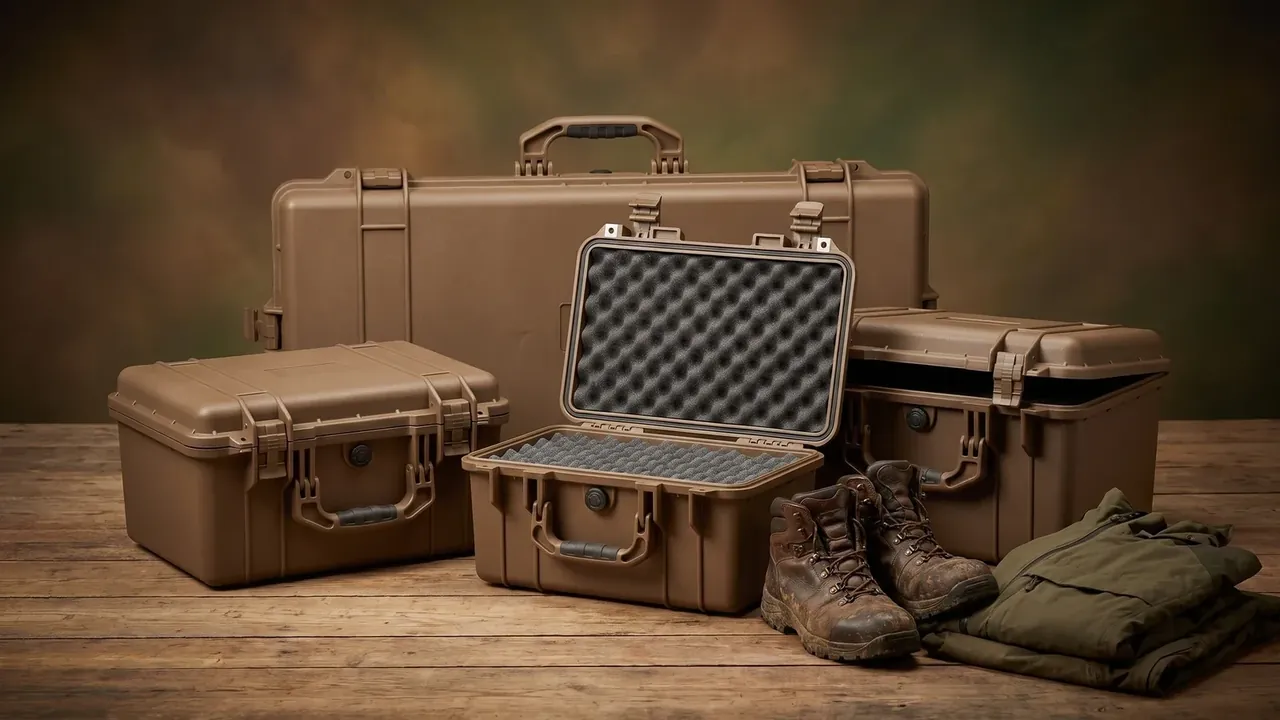
Quick answer: An outdoor waterproof equipment case cannot be judged by an IP number alone. Acceptance splits into seven measurable gates: rain intensity and duration, immersion depth, UV hours, cold impact, salt-spray hours, stacking load and gasket hardness. Each gate needs a stated condition and a pass criterion.
Table of contents
- Outdoor waterproof equipment case grades in numbers
- Two hours at 300 mm per hour against IP65 and IP67
- Three ageing gates: UV, cold and salt spray
- Stacking, drain holes and gasket hardness
- FAQ
1. Outdoor waterproof equipment case grades in numbers
Outdoor duty adds items a workshop test never touches. Grading an outdoor waterproof equipment case starts with the IP code: IP65 is a 6.3 litre-per-minute jet for three minutes; IP67 is immersion with the lid 150 mm below the surface, the lowest point near 1000 mm, held thirty minutes.
One resists dynamic pressure, the other static head. Quoting IP67 to explain a storm is a category error.
The second layer turns deployment into rows: rain intensity, irradiation hours, low-temperature floor, salt-spray hours and immersion depth.
| Acceptance item | Quantitative gate | Pass criterion | Usual failure point |
|---|---|---|---|
| Driving rain | 300 mm/h, 2 h, 45 degree spray | No indicator change, gain under 0.1% | Latch seats, hinge bosses |
| Immersion | 150 mm above the lid, 30 min | No droplets or pooling | Gasket groove corners |
| UV | 1000 h, black panel 65 C | dE within 3, no chalking | Sun-facing lid |
| Cold impact | -30 C for 4 h, 1 m drop | No cracks, latches intact | Corners, rib roots |
| Salt spray | 480 h, 35 C, 5% NaCl | Metal corrosion under 5% | Hinge pins, rivets |
2. Two hours at 300 mm per hour against IP65 and IP67
300 mm per hour is the intensity written into many outdoor specifications; two hours of it equals 600 mm of cumulative rain, an extreme event. The gate separates a case rained on from one rained through.
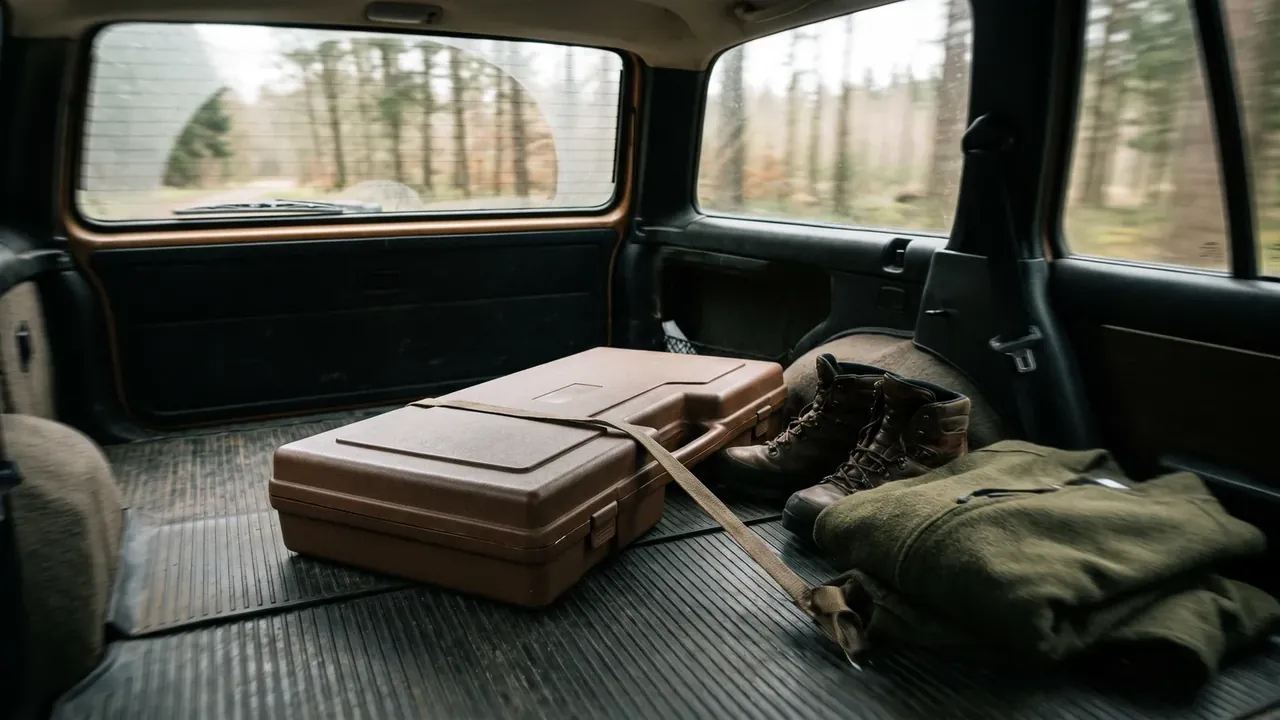
A field re-test needs no rain chamber. Close the empty case and tape water-indicator strips inside each corner. Sweep a calibrated nozzle across six faces from 3 m at 45 degrees, twenty minutes per face. Dry the shell, open it, read the strips, then weigh the case. Weighing beats looking: it turns an invisible seep into a number, and a gain above 0.1% means the groove holds water. Two people finish in an hour, and it repeats between batches. It proves this sample on this day, nothing more.
Read the result against three patterns.
- Strips discoloured near one latch: preload too low
- Discolouration at mid-span: the lid lifts under pressure
- Water in one corner: gasket stretched thin at the turn
IPX6 is a 12.5 litre-per-minute jet, IPX7 is still-water immersion, and 300 mm per hour sits between them: weaker in pressure, far longer in time. Passing IPX6 does not mean surviving two hours of driving rain; the failures differ, front panel against lid edge.
3. Three ageing gates: UV, cold and salt spray
UV exposure of 1000 hours runs at a 65 C black panel with 18 minutes of spray every 102 minutes, roughly two to three years outdoors in a temperate zone, screening a formulation rather than a service life.
Cold impact is four hours at -30 C then a 1 m drop. A drop that passes warm often cracks at a rib root at -30 C, where wall thickness changes.
Salt spray of 480 hours at 35 C with 5% sodium chloride matches sea freight and coastal storage. It grades metal, not polymer, so a report saying the shell showed no corrosion measured little.
| Ageing item | Condition | Pass criterion | What it grades |
|---|---|---|---|
| UV | 1000 h, 65 C panel, spray cycle | dE within 3 | Surface appearance |
| Cold impact | -30 C soak, 1 m drop | No cracks | Brittle shift |
| Salt spray | 480 h, 5% NaCl | Corrosion under 5% | Hardware material |
All three convert a vague sense of going old into a repeatable condition, and show how much margin an outdoor waterproof equipment case has left after two years.
4. Stacking, drain holes and gasket hardness
Three structural items get skipped when specifying an outdoor waterproof equipment case. Stacking is 200 kg static for 24 hours, or three tiers at 1.2 m, with deflection under 2 mm; the lid centre is always softest.
A drain hole sits at the lowest corner, 6 mm across, with a one-way membrane that lets condensation out and keeps water from running in. Drill it high and the pool stays; drill it wide and the membrane cannot hold.
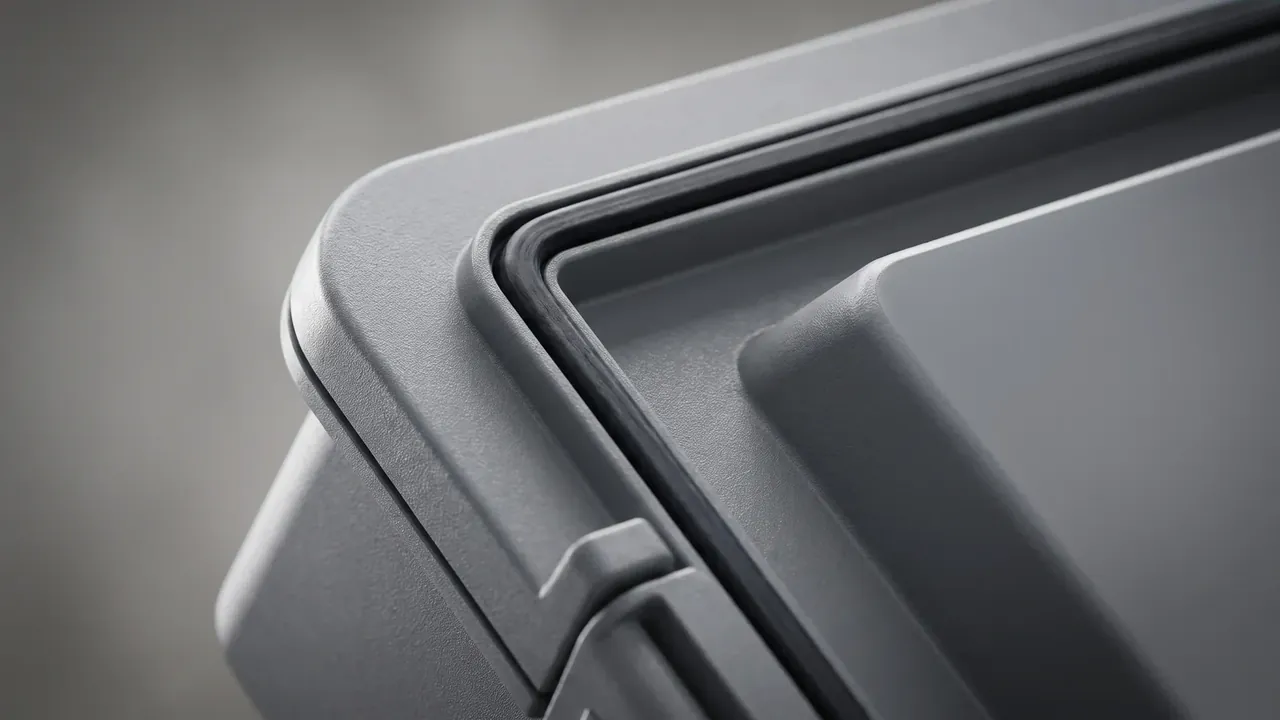
The gasket is the cheapest part and the likeliest to fail. 60 plus or minus 5 Shore A is the common band: too soft and it extrudes, too hard and it cannot fill corners. Hold compression at 25 to 30% and match groove depth to cord section; a thick cord in a shallow groove jacks the lid up.
Below -30 C the cord gains five to eight points of hardness, so any case through a cold drop deserves a second compression-set check.
Conclusion
The value of seven gates is not the numbers but the arguments: how long, how deep, how many hours of sun, how cold, how many days of salt. Once written down, a price difference has an explanation. Acceptance of an outdoor waterproof equipment case is the work of turning adjectives into conditions.
This article discusses only the container (case body) side of specifications and design intent, and does not cover any handling, loading or use of the contents.
Related Reading
- Waterproof hard case standards: IP grades and test conditions
- Production SOP steps and self-check points for case bodies
- Marking rules for pallets and cases
Related Products
- 8 Series — Gun Cases; Military Equipment Cases; Camera Equipment Cases; Drone Cases; Watch Cases; Knife Cases; First Aid Cases; Electronics Equipment Cases
- WL8-2812 PP Gun Case — model WL8-2812
- All protective cases and toolboxes: 7 series, 158 models