

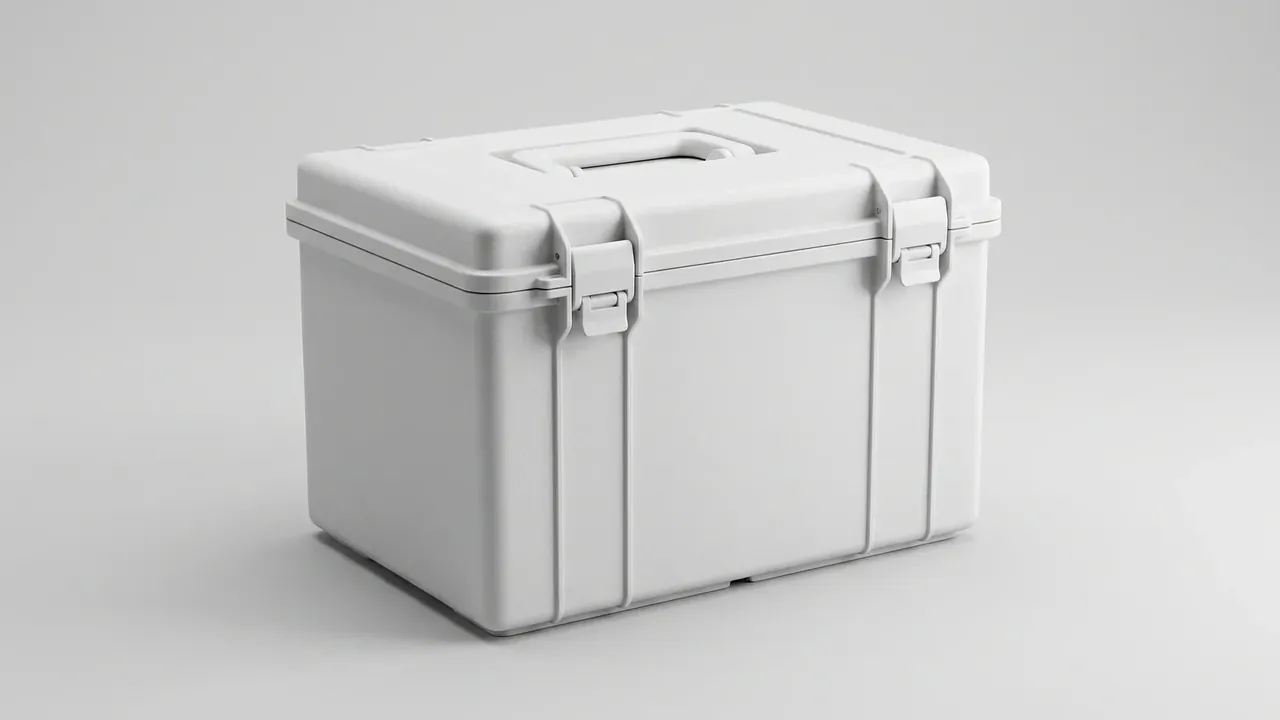
Quick answer: A shelf tag gives outside size and one water-resistance claim. Interior volume, wall, resin, latches, seals, reports, order size and lead time decide whether a load arrives intact.
Table of contents
- What Plastic Cases Harbor Freight Shelves Actually Tell You
- Comparing Interior Volume and Wall Thickness
- Material, Latch and Seal Tiers
- Certification and Order Quantity Reality
- Lead Time and Unit Price Maths
- FAQ
1. What Plastic Cases Harbor Freight Shelves Actually Tell You
Shelf labels give outside length, width, height and one water-resistance claim. Harbor Freight is one US hardware retail channel; the name and trademark belong to its owner, and this site has no sales or licensing relationship with it.
The same footprint hides different interior classes. A 560×410×230 mm body with thin walls holds 528×390×205 mm; a ribbed heavy-wall version holds 520×380×195 mm. Plastic cases Harbor Freight shelves carry should be judged inside first, price last.
| Dimension | What the tag shows | What to request |
|---|---|---|
| Interior | outside L×W×H | interior size, per-side tolerance |
| Wall | usually blank | side wall and base, ribs included |
| Resin | plastic | PP, ABS or HDPE, regrind share |
| Seal | water resistant | latch count, gasket hardness, valve |
| Testing | usually blank | test items, report number |
2. Comparing Interior Volume and Wall Thickness
Measure inside at the tightest usable point. Drafted walls leave the base narrower than the rim, so a 20 mm change in measured height becomes 6 to 8 mm across the long side. A quote for plastic cases Harbor Freight shelves carry should state interior L×W×H and ±2 mm moulded or ±3 mm rotomoulded tolerance.
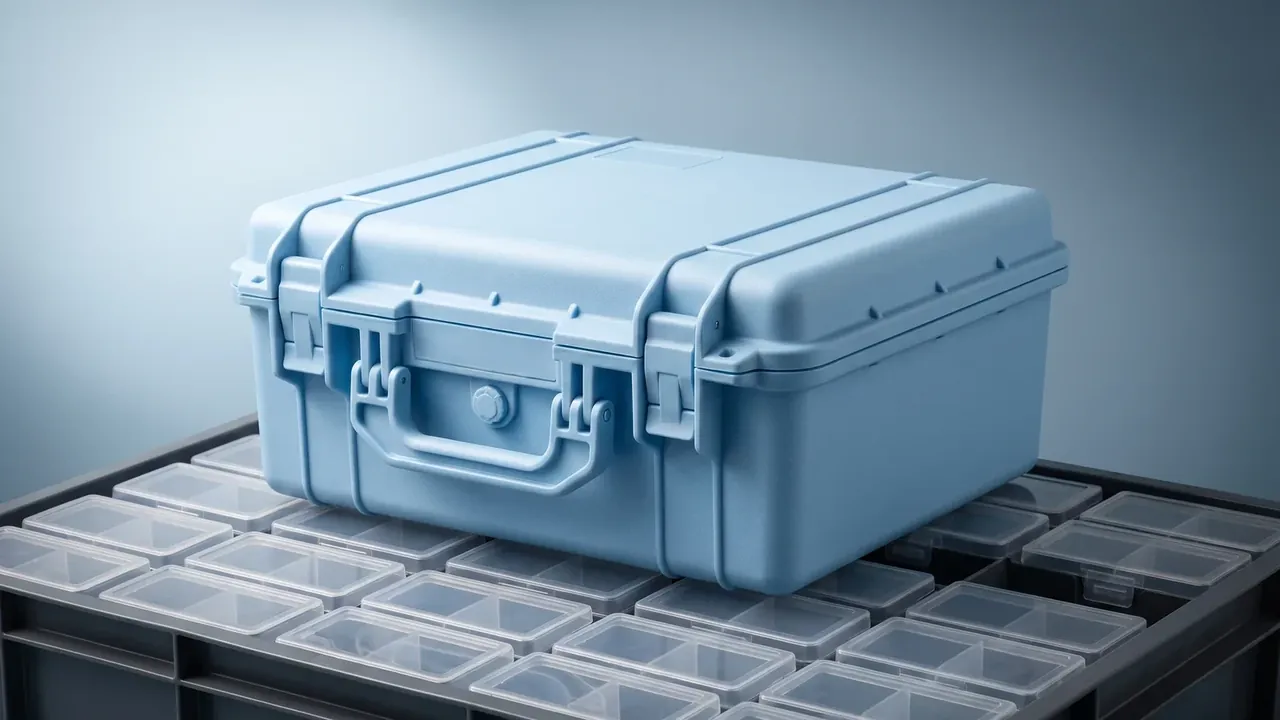
Wall thickness belongs in three places. The base runs 0.3 to 0.6 mm thicker than the side wall because it carries stack load, yet most quotes give one figure. On one line 2.8 mm and 3.4 mm differ by 12% in cost, while base capacity moves from 18 kg to 25 kg.
3. Material, Latch and Seal Tiers
Resin sets the temperature at which a case stops surviving a drop. PP turns brittle near −10 °C; HDPE still takes −20 °C but needs ribs; ABS is hard and stable. Plastic cases Harbor Freight sells in this class can differ by 40% in price.
Latches and seals form the second divide. Two latches with an EPDM gasket at 55±5 Shore A reach IP54 to IP65, enough for road and rail; four latches, a thicker lip and a one-way valve hold IP67 at sea. A 4 mm groove with a 3.2 mm gasket lands near 20% compression.
4. Certification and Order Quantity Reality
Certification is a test list, not a badge: IP65 or IP67 to IEC 60529, three hours of random vibration to an ISTA 3A profile, and a 1.2 m drop on six faces, three edges and one corner. Reports behind plastic cases Harbor Freight stocks rarely travel with the goods.

Order quantity splits cleanly: 500 units for a colour change on a stock mould, 1,000 for a logo, 3,000 for a private mould plus tooling. Stock moulds keep a first order small.
5. Lead Time and Unit Price Maths
A bare case runs USD 6.5 to 19 depending on wall, latches and resin, with EVA inserts adding 1.2 to 4. A 40-foot high cube takes about 620 units of 560×410×230 mm, so freight lands at 0.9 to 1.4 per unit.
Lead time for plastic cases Harbor Freight lists splits into three blocks: 5 to 7 days for samples, 10 to 14 for scheduling, 10 to 14 for production, so 25 to 35 days plus 25 to 40 on the water.
| Mode | Transit | Wall | Seal target | Stack limit |
|---|---|---|---|---|
| Road, full truck | 1–3 days | 2.6–3.0 mm | IP54 | 5 high |
| Rail wagon | 5–8 days | 3.0–3.4 mm | IP65 | 4 high |
| Sea, full load | 25–40 days | 3.2–3.8 mm | IP67 plus desiccant | 3 high |
| Air freight | 2–5 days | 2.6–3.0 mm | IP54 | 4 high |
| Parcel, single unit | 1–4 days | 2.4–2.8 mm | IP54 | no stacking |
Read the table against your own route: trucking does not need IP67, and a sea shipment without a valve may open onto damp inserts.
Conclusion
A shelf gives appearance and one waterproof word; a factory gives interior, wall, resin, latches and dates. Until those align, the price gap measures nothing. Ask for interior tolerance and gasket compression first. The best of the plastic cases Harbor Freight shoppers weigh is the one whose specifications match the route.
This article discusses only the container (case body) side of specifications and design intent, and does not cover any handling, loading or use of the contents.
Related Reading
- Shipping case selection guide
- Stackable case specifications
- Export packaging process
- Waterproof hard case standards
Related Products
- 8 Series — Gun Cases; Military Equipment Cases; Camera Equipment Cases; Drone Cases; Watch Cases; Knife Cases; First Aid Cases; Electronics Equipment Cases
- WL8-2812 PP Gun Case — model WL8-2812
- All protective cases and toolboxes: 7 series, 158 models