

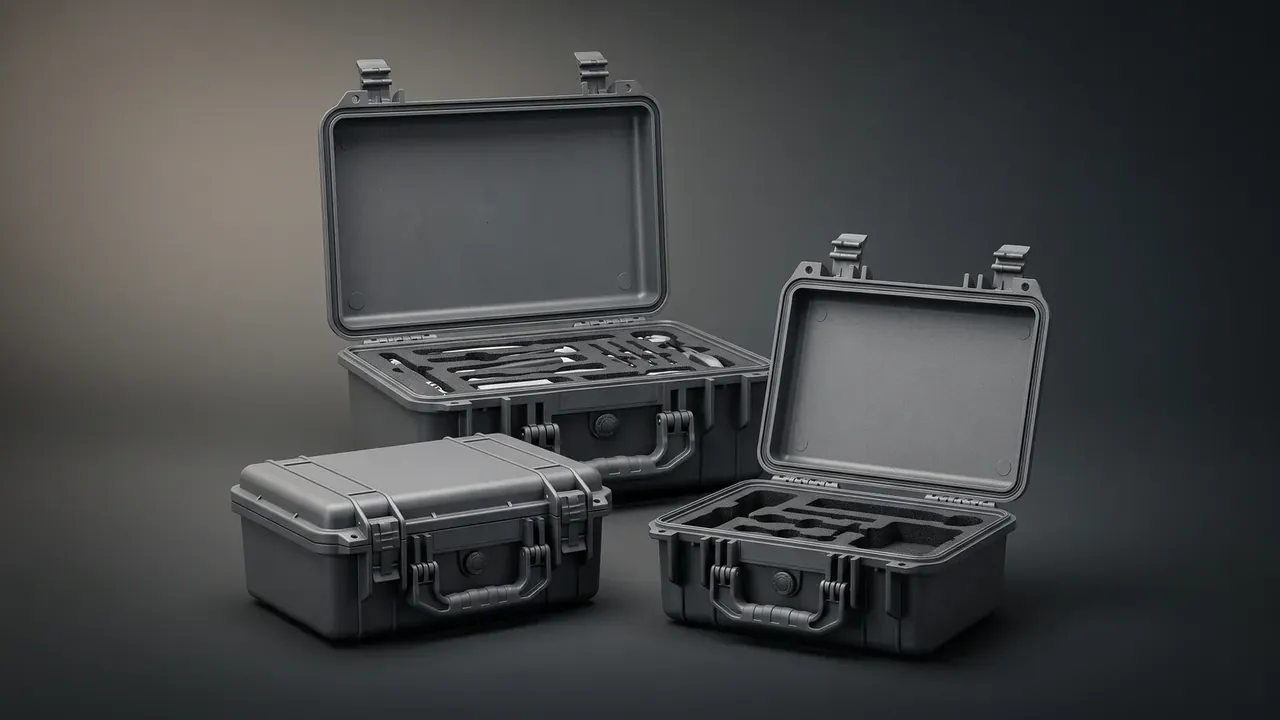
Quick answer: On a call-out, a plastic tool carrying case is judged by three movements, not by volume: strapping it into the van, carrying it upstairs, opening it at the work point. Set margin against the vibration and heat clauses of MIL-STD-810H, set protection against IP55, and write strap points and stair width into the job card.
Table of contents
- Three loading postures for a plastic tool carrying case
- Securing the case: straps, stops and floor ribs
- Carrying it upstairs: handle, centre of gravity, stair width
- Opening on site and the improvised bench
- FAQ
1. Three loading postures for a plastic tool carrying case
The van decides the posture before the specification does. A flat floor suits a case lying down, side rails suit one standing upright, a partitioned body suits one hung on a bulkhead.
Lying down, the four bottom corners rest on 12 mm floor ribs, so half the base carries the load and the strap must cross the middle. Upright, the handle root becomes the load path: a 23 kg loaded case on a 4.6 kg structure shears the side wall. Hung on a bulkhead, the latches take the load directly.
| Posture | Main load path | Suitable body | Cases per trip | Usual failure |
|---|---|---|---|---|
| Lying, strapped | Bottom corners and floor ribs | Flat-floor panel van | 6 to 8 | Lower layer trapped after stacking |
| Upright, against wall | Handle root and side wall | Van with side rails | 4 | Handle deformed by steady pressure |
| Hung on bulkhead | Latches and lid front edge | Partitioned body | 2 | Neighbouring case jolts the lid open |
Do not mix postures in one bay: the strap points compete, and a tight-looking strap may hold only the topmost plastic tool carrying case.
2. Securing the case: straps, stops and floor ribs
Securing takes two passes: a 25 mm webbing strap pulls the case onto the floor, and 15 mm stops block horizontal travel. The webbing breaks at 800 kg, and a tensioned case should move less than 5 mm.
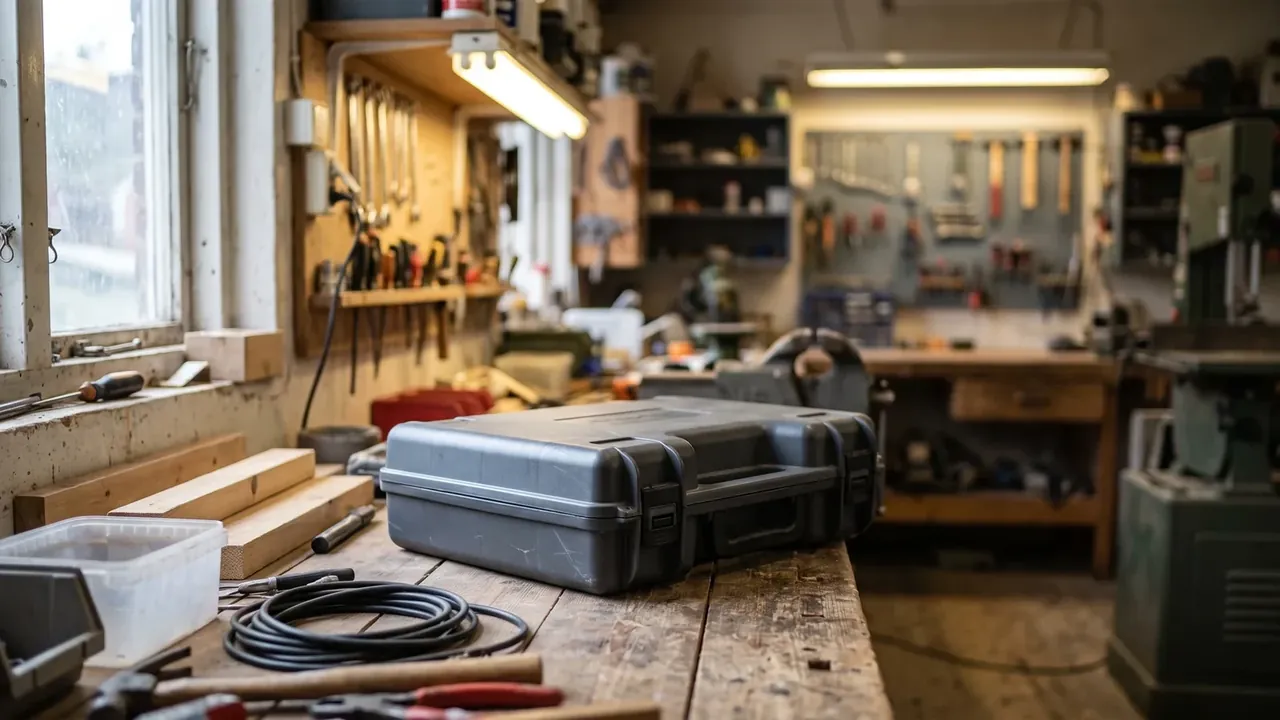
Pull the front strap first, then the rear, then the two diagonals. Latches stay up, nothing loose sits on the lid, tool bags hang on the side wall. Diagonals laid too flat creep loose on broken tarmac.
| Strap point | Holds down | Count | Posture |
|---|---|---|---|
| Front cross strap | Front section and lid edge | 1 | Lying |
| Rear cross strap | Rear section and corners | 1 | Lying |
| Two diagonals | Sideways shift in corners | 2 | Lying |
| Side-wall lashing | Vertical travel over bumps | 2 | Upright |
Method 514.8 of MIL-STD-810H covers hours of gravel-road excitation. The weak point of a plastic tool carrying case there is the handle joint: a strap over the handle feeds vibration into the thinnest ribbing.
3. Carrying it upstairs: handle, centre of gravity, stair width
The climb is the ten minutes most likely to go wrong. Stairwells in older blocks run 900 mm wide with 1200 mm landings; past that the turn goes overhead and the centre of gravity leaves the body.
At 23 kg loaded, the centre of gravity sits near 40% of case height. Carried one-handed, it leans about 10° toward the body and the free hand is on the handrail. Re-torque the handle screws to 2.5 N·m before leaving the depot.
Five checks before the climb:
- Clear width of 900 mm and landings of 1200 mm
- 23 kg or less per case, otherwise two people
- Handle screws at 2.5 N·m, every latch closed
- Riser above 170 mm: keep 50 mm at the stair nose
- Dry shell on wet days so the handle grips
Two-person carry grips the shell front and rear, never the handle. The mistakes repeat: handle used as a lifting eye, a loaded case carried one-handed to a sixth floor, parts parked on the lid.
4. Opening on site and the improvised bench
Opening on site follows a fixed order: set the case down, level it on four points, release both latches together, push the lid to 105°. Reverse it and the lid swings back onto your fingers.
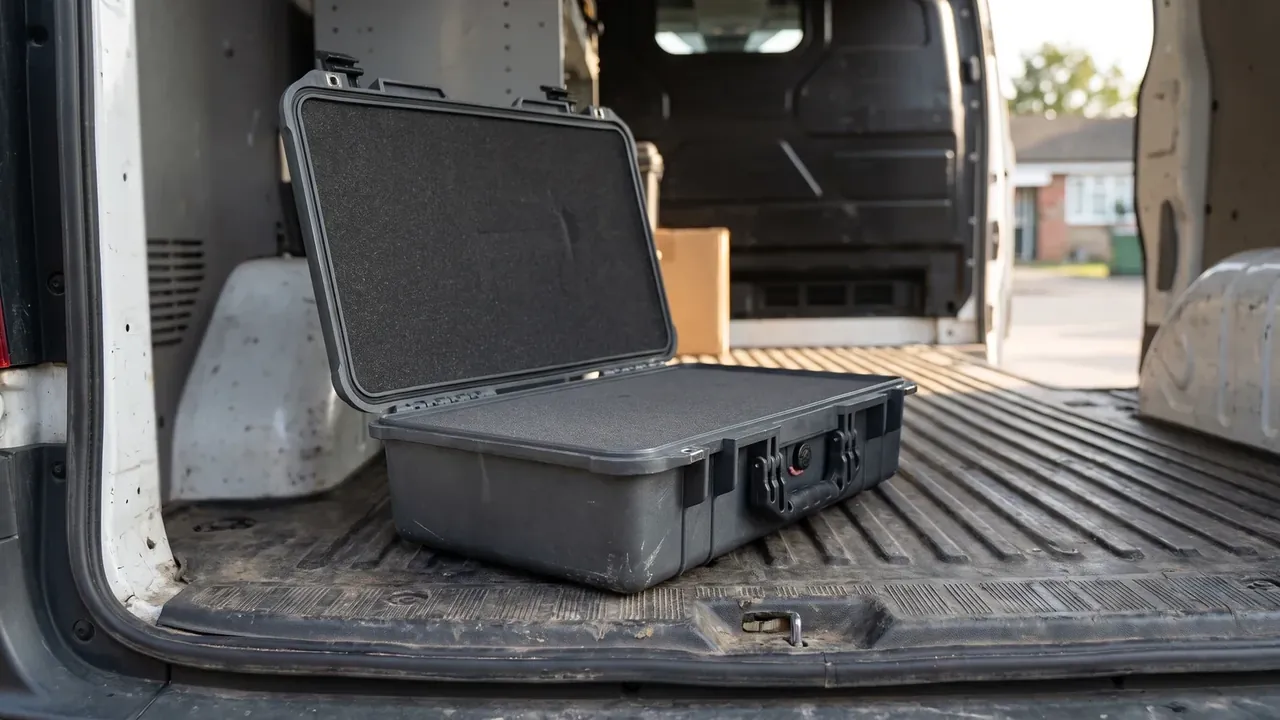
The improvised bench is the most useful second job this shell does. Closed, the lid takes a 30 kg static load over 520 by 380 mm. That is enough for bolts and small parts off the machine. Keep it off slopes, because at 3° small parts walk off on their own. A van in the sun reaches 68 °C inside, the condition Method 501.7 of MIL-STD-810H is written around. The shell holds its shape there, but rubberised grips and spare batteries should come out.
IP55 reads in two digits: dust ingress that does not interfere, and spray from any direction causing no harm. Standing water needs IP67.
Mistakes cluster around the opening action: lifting with the lid open, opening on a slope, moving with one latch engaged. The gasket loses compression after about 2000 cycles, so a lid that suddenly closes easily needs a new gasket.
Conclusion
On a call-out the plastic tool carrying case earns its place through three movements done right: a defined loading posture, defined strap points, a defined opening sequence. Use MIL-STD-810H vibration and heat clauses for margin and treat IP55 as the wet-weather floor. Get those right and one plastic tool carrying case lasts a full service visit.
This article discusses only the container (case body) side of specifications and design intent, and does not cover any handling, loading or use of the contents.
Related Reading
- Fitting out a service van with tool cases
- Moving a wheeled tool case over long distances
- Where a tool satchel stops and a case starts
Related Products
- 8 Series — Gun Cases; Military Equipment Cases; Camera Equipment Cases; Drone Cases; Watch Cases; Knife Cases; First Aid Cases; Electronics Equipment Cases
- WL8-2812 PP Gun Case — model WL8-2812
- All protective cases and toolboxes: 7 series, 158 models