

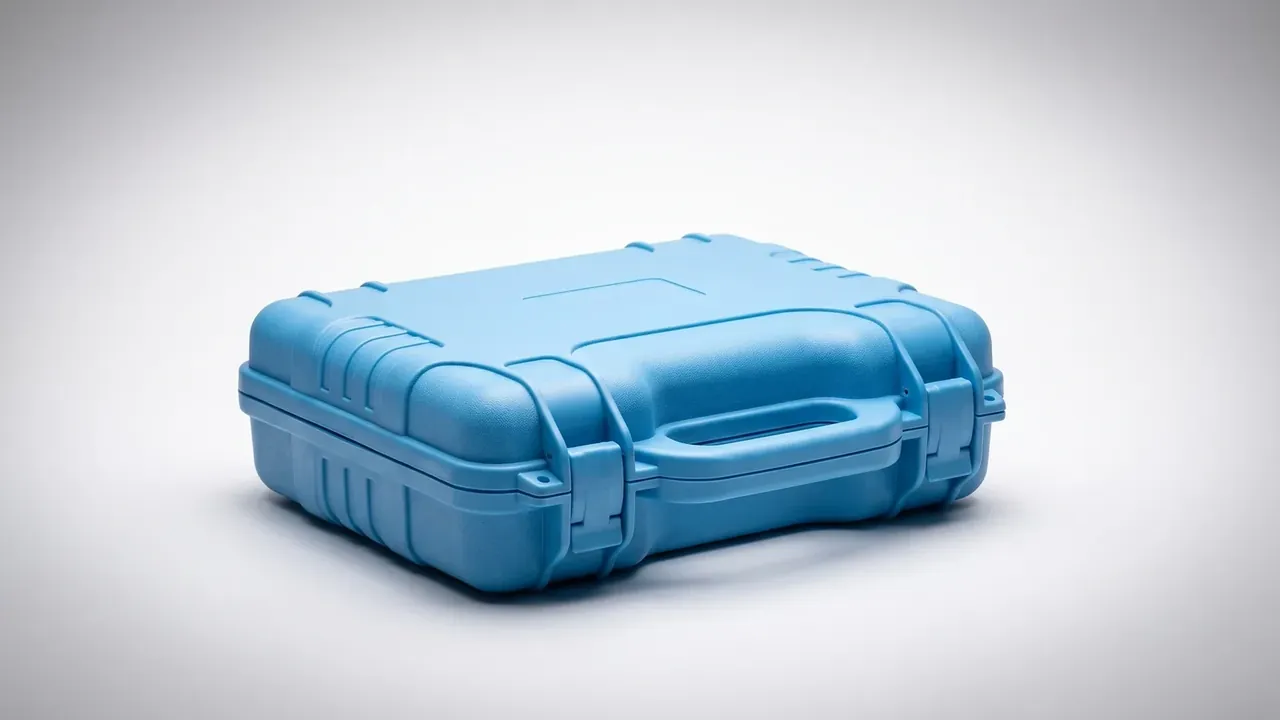
Quick answer: Work backwards from how many drives travel and how: bays first, then per-drive clearance, desiccant and static control, handle and dead weight, latches and transit tests last.
Table of contents
- Portable Case for HDD Selection: Order of Five Criteria
- Bays and Slots: Drive Dimensions Set the Compartments
- Per-Drive Cushioning: Vertical Travel and Neighbour Gap
- Dry Air and Static: Humidity and Surface Resistance
- Latches, Dead Weight and Transit Proof
- FAQ
1. Portable Case for HDD Selection: Order of Five Criteria
Most of the price gap sits in the bay layout, not the shell: the same 400 by 300 by 150 mm outside carries four drives or eight.
| Criterion | Locks down | A wrong call shows up as |
|---|---|---|
| Bay layout | Case class | Drive will not seat |
| Cushion clearance | Foam thickness | Neighbours strike each other |
| Dry air, static | Lining, desiccant | Condensation on arrival |
| Handle, weight | Carrying posture | Boss cracks under load |
| Latches, testing | Transit conditions | Lid pops open |
The sequence cannot be shuffled: bay count sets layout, layout sets the outside, outside sets weight and a portable case for HDD handle size.
2. Bays and Slots: Drive Dimensions Set the Compartments
A 3.5-inch drive measures 147 by 101.6 by 26.1 mm, a 2.5-inch unit 100 by 70 by 15 mm. Add 6 to 8 mm per bay.
Three layouts exist: one foam block slotted per bay, rigid dividers, or a tray of pods. Up to four drives the block is simplest; from eight upward, dividers let you pull one drive alone.
Orientation must match the posture: upright cases take drives standing, flat cases stack them. The slots run opposite ways, so state it on the drawing.
3. Per-Drive Cushioning: Vertical Travel and Neighbour Gap
Neighbours hitting each other hurts more than the drop: eight drives reach 5.4 kg, and movement between adjacent bays knocks the heads off track.
Set the gap at 10 mm and vertical travel at 15 mm, with 5 mm of foam on four sides, assuming a 1 m drop with eight drives.
| Drop height | Gap between bays | Foam per drive | Route |
|---|---|---|---|
| 0.5 m | 8 mm | 15 mm | Carried by hand |
| 1.0 m | 10 mm | 20 mm | Single parcel |
| 1.5 m | 12 mm | 25 mm | Repeated handling |
Use foam at 25 kg per cubic metre, softer than 30 for whole-machine cases, because a bare drive has no chassis. Above 40 Shore C it turns brittle at minus 10 degrees Celsius.
4. Dry Air and Static: Humidity and Surface Resistance
Moisture and static account for two failure routes: a board above 60 percent relative humidity for a fortnight oxidises, while dry air builds charge that lands when the lid opens.
Size desiccant by volume: 5 g of molecular sieve per litre, so a 6-litre eight-bay case takes 30 g and holds under 40 percent relative humidity. Fit a pressure valve too, or a temperature swing pulls damp air in.
Static takes two routes out: a lining between ten to the sixth and ten to the ninth ohm, and a grounding stud bonded to the latches. Bag the drive, then seat it.
5. Latches, Dead Weight and Transit Proof
Latches carry the side load: at 5.4 kg loaded one latch can see three times that in a moving vehicle, so the tongue needs two-point engagement.
Dead weight needs a ceiling: a 3 mm wall shell, 400 by 300 by 150 mm outside, weighs 1.6 kg, and with foam and eight drives a portable case for HDD reaches 7.4 kg.
| Test | Condition | Pass criterion |
|---|---|---|
| Whole-case drop | 1 m, once per face | No bay shift, latches closed |
| Cold storage | Minus 10 degrees Celsius, 24 hours | Foam rebounds, lid opens |
| Stacking | Three high, 48 hours | No permanent lid set |
| Damp heat | 40 degrees Celsius, 90 percent RH, 72 hours | No condensation inside |
Load-test the handle at 22 kg for an hour, watching for an elongated boss hole. Stacking is the check buyers skip: a week under two more cases sets the lid down 2 mm.
Conclusion
Fix bays, cushioning, dry air, handle, latches and testing in that order, because each follows from the drive count. Put the 10 mm gap, 5 g per litre and 7.4 kg on the drawing, and a portable case for HDD approves first time.
This article discusses only the container (case body) side of specifications and design intent, and does not cover any handling, loading or use of the contents.
Related Reading
- Sealing and desiccant layout in moisture-proof cases
- Cavity and handle structure in hand-carry hard cases
- How protective case foam is slotted and divided
- Reading specification classes for small plastic cases
Related Products
- 8 Series — Gun Cases; Military Equipment Cases; Camera Equipment Cases; Drone Cases; Watch Cases; Knife Cases; First Aid Cases; Electronics Equipment Cases
- WL8-2812 PP Gun Case — model WL8-2812
- All protective cases and toolboxes: 7 series, 158 models