

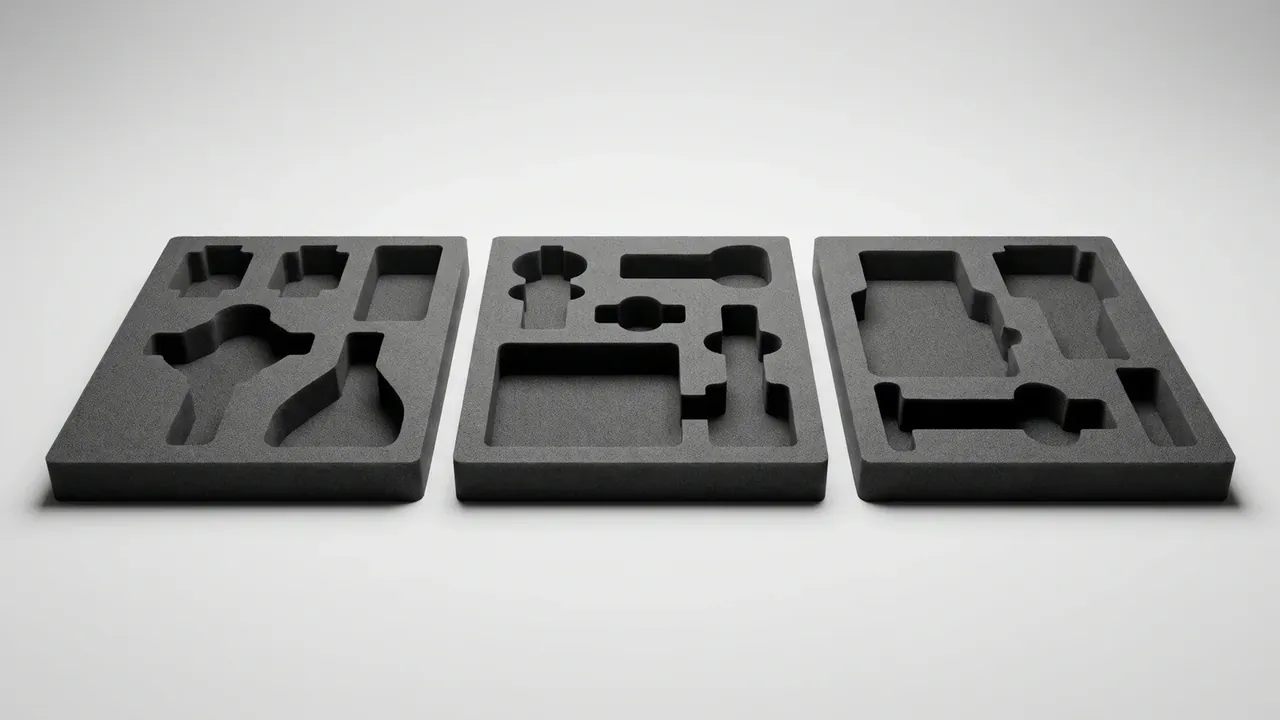
Quick answer: A Custom Foam Insert is a pad cut to the case interior with pockets cut to the outline of the contents. Density sets vibration absorption, hardness sets grip, cutting sets wall shape. Get one wrong and a strong case still fails.
Table of contents
- What a Custom Foam Insert is
- Density
- Hardness at the same density
- Cutting routes
- Three constructions
- FAQ
1. What a Custom Foam Insert is
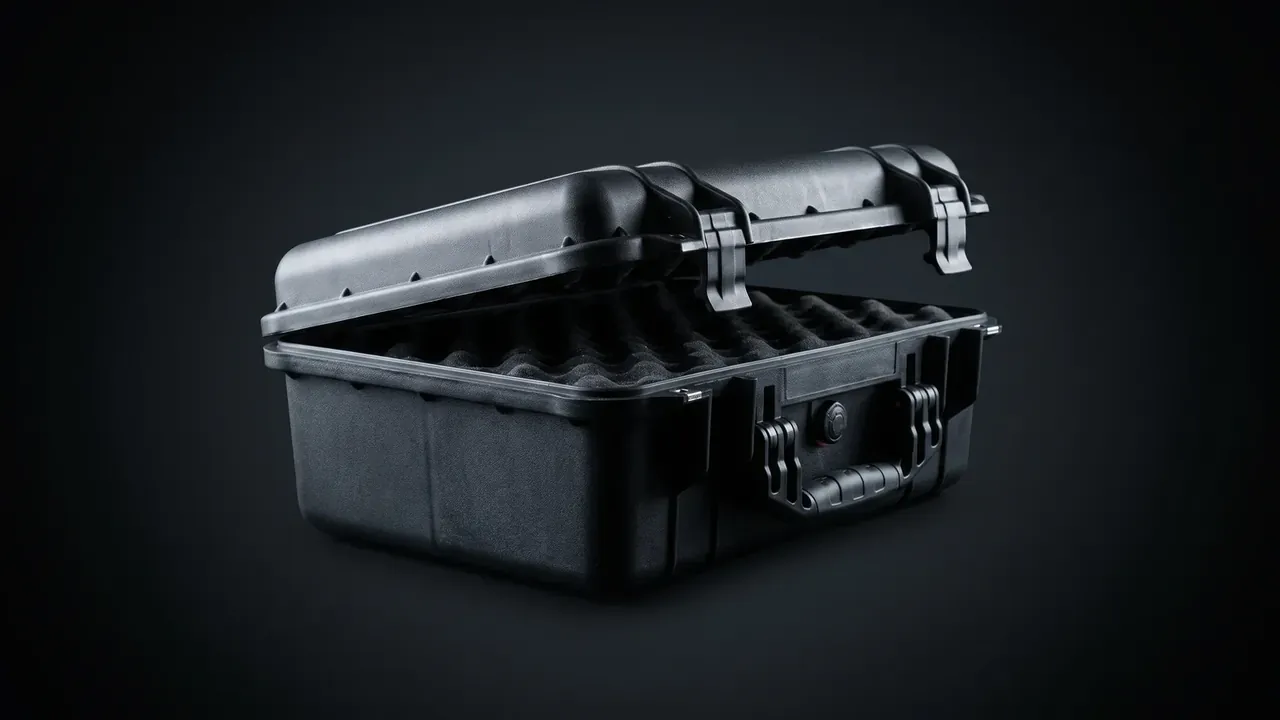
It is not cotton wool packed around a product. It is a pad cut to the interior, with pockets cut to the outline of the contents, so all six faces are covered and shock is damped through the cell walls.
It does three jobs: pockets 0.5 to 2 mm smaller than the part locate it, webs of at least 8 mm keep metal parts apart, and 10 to 15 mm of base thickness is the only margin when the case lands on a corner.
Pick-and-pluck foam is pre-cut in squares and fails once a part has a flange; a Custom Foam Insert is cut to a drawing instead.
2. Density
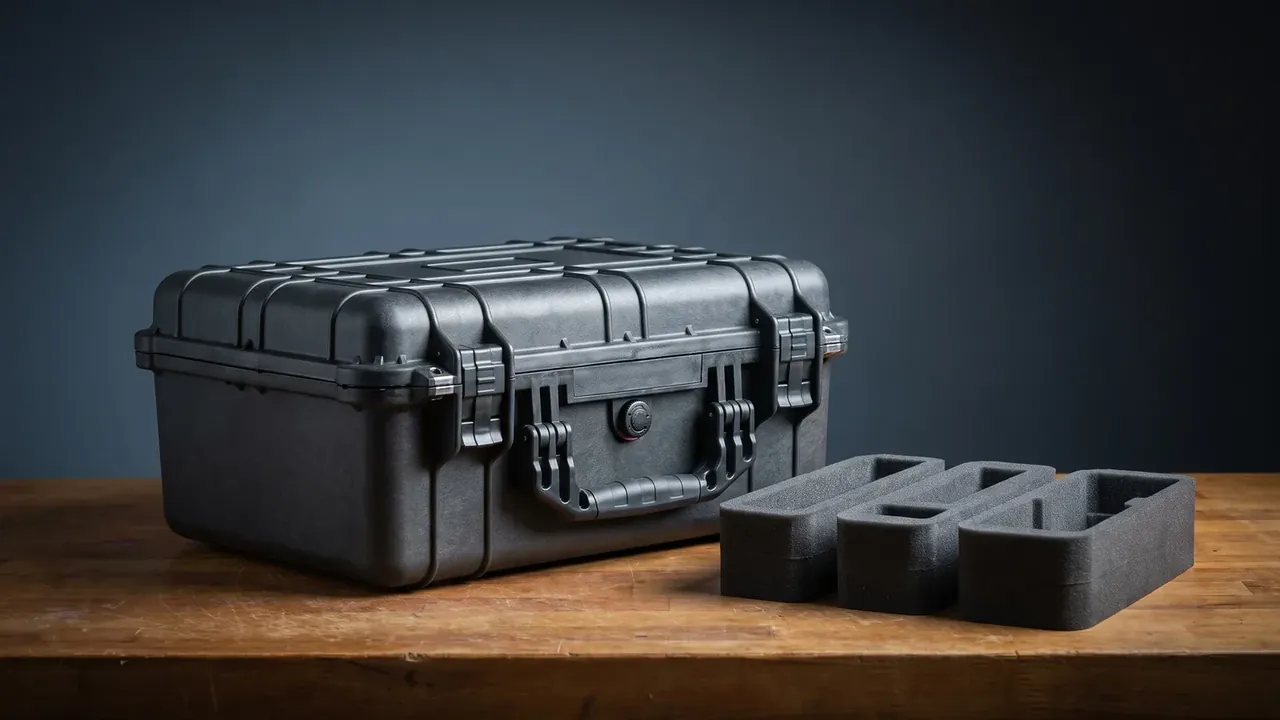
Density is weight per cubic metre. Higher density brings thicker walls, more strength, more weight and more cost; inserts sit between 25 and 50.
Too low, walls collapse after a few dozen cycles and the part moves. Too high, the foam barely compresses, clamping the part between two sheets of plastic so drop shock reaches the case. Protection needs 20 to 40 percent of compressible travel.
| Material and density | Feel | Typical use |
|---|---|---|
| PE 25–30 | soft, marks stay | cable, fabric, light shells |
| PE 42–50 | firm, edges hold | heavy parts, long pockets |
| EVA 60–90 | dense, takes up little water | precision parts, daily handling |
3. Hardness at the same density
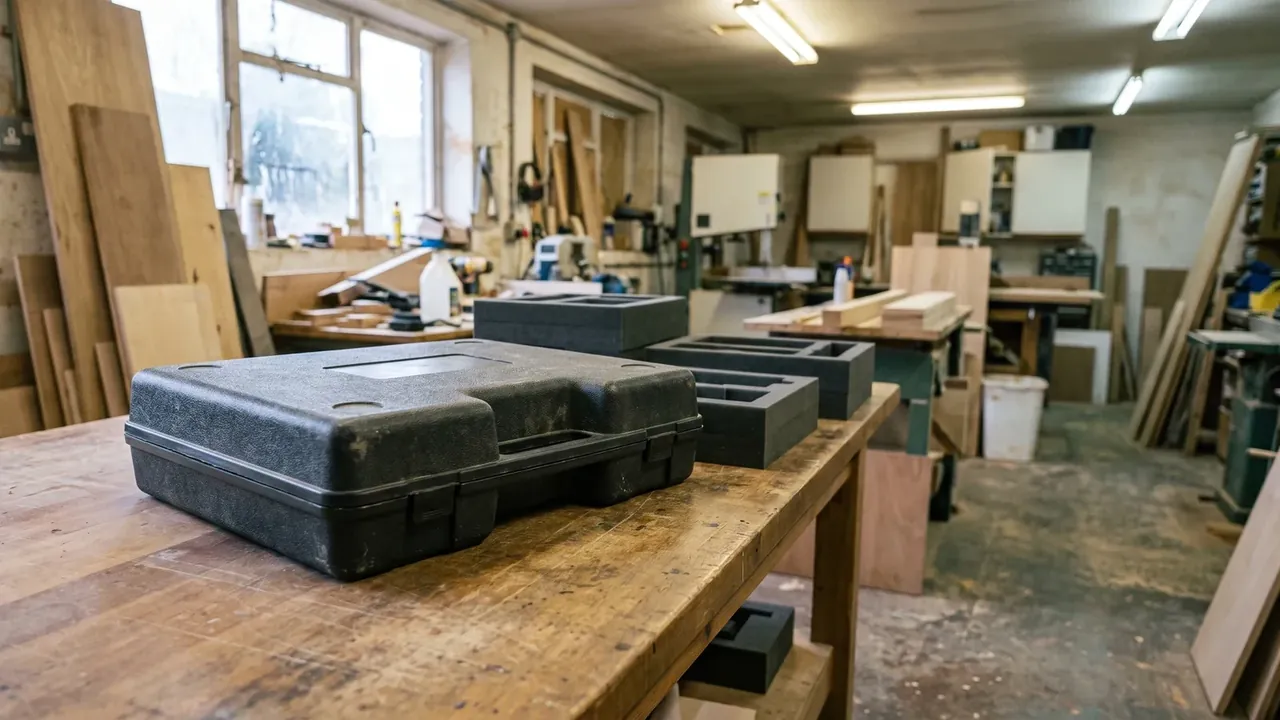
Hardness is quoted as force at 25 percent compression, or Shore C, and decides how much effort a part takes to seat.
A hard wall means prising the part out by a corner, and corners go white first. A soft wall leaves room, and vibration lets a hard shell grind the pocket to powder.
Pocket depth runs 2 to 4 mm under part thickness; below 2 mm the part shifts, above 4 mm the latches sit preloaded and the hinge dies first.
4. Cutting routes
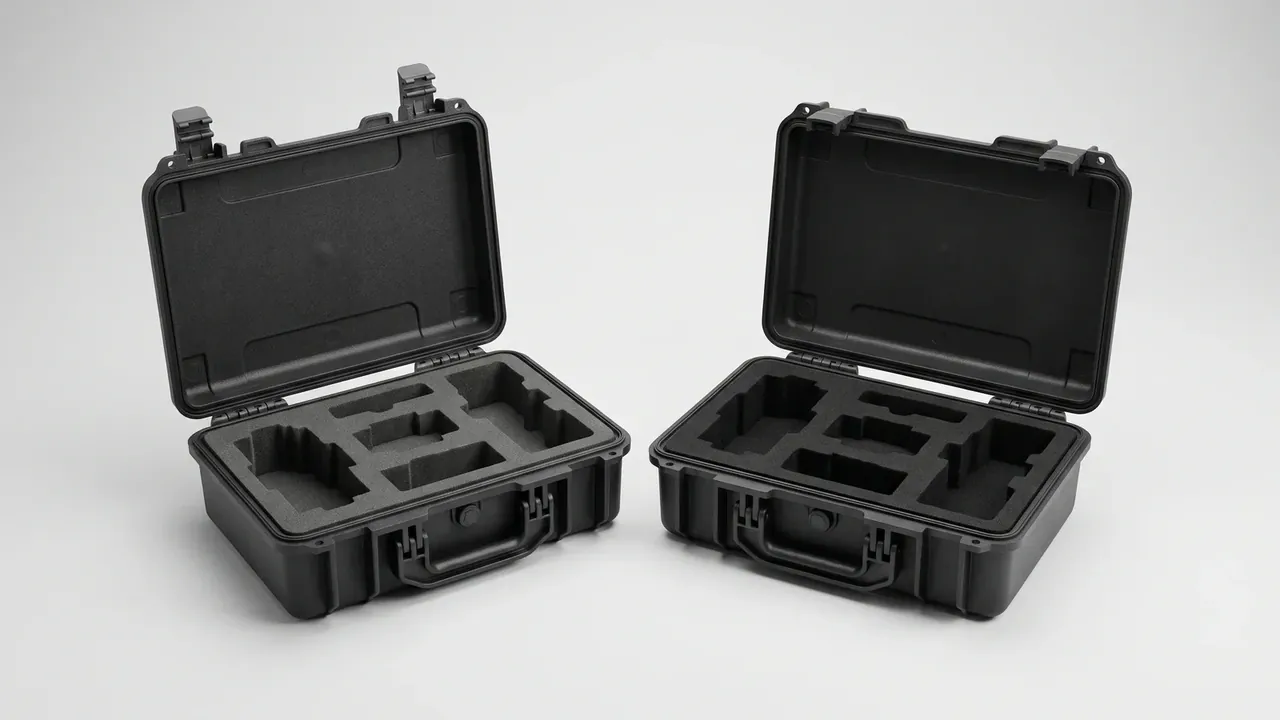
How the pocket is cut decides cost, lead time and wall quality. Choosing wrong does not make the insert impossible, only uneconomic.
Die cutting presses a sheet through a steel rule die: walls run vertical, tooling only thins above 200 pieces, and deep pockets are out. CNC routing runs a single piece, but walls need 2 to 5 degrees of draft and carry tool marks.
Lamination stacks 5, 10 and 20 mm sheets, each cut to a different outline, to build a stepped pocket; anything with a flange goes this way.
| Method | Minimum run | Deep pocket |
|---|---|---|
| Die cutting | 200 plus | no |
| CNC routing | 1 | yes |
| Lamination | 50 plus | yes |
| Thermoforming | 300 plus | no |
5. Three constructions
Three builds cover every part. Ask whether it has a step, then whether it is thicker than the base pad.
A single cut pad is one 30 to 50 mm sheet cut through, with the part fully inside; flat items shorter than the pad are cheapest this way. Lamination bonds two to four layers, a wide pocket above a narrow one, the only fit for tool sets and instruments with a battery bay. Sandwich construction puts a pad in base and lid, locating long items that exceed the base thickness.
Hot melt is the quiet failure: it holds to 60 degrees, a container on deck reaches 70, and the bond creeps. For export, specify adhesive by sea freight conditions.
Conclusion
Three numbers decide a Custom Foam Insert: density for absorption, hardness for grip, cutting for shape. Each fails differently, but put all three on the drawing and the Custom Foam Insert is specified.
This article covers container-side specifications and design implications only, not the handling, loading or use of the contents.
Related Reading
- Types of case foam inserts
- Comparing foam materials
- Where pick-and-pluck foam stops
- Structure of a foam insert case
Related Products
- 8 Series — Gun Cases; Military Equipment Cases; Camera Equipment Cases; Drone Cases; Watch Cases; Knife Cases; First Aid Cases; Electronics Equipment Cases
- WL8-2812 PP Gun Case — model WL8-2812
- All protective cases and toolboxes: 7 series, 158 models