

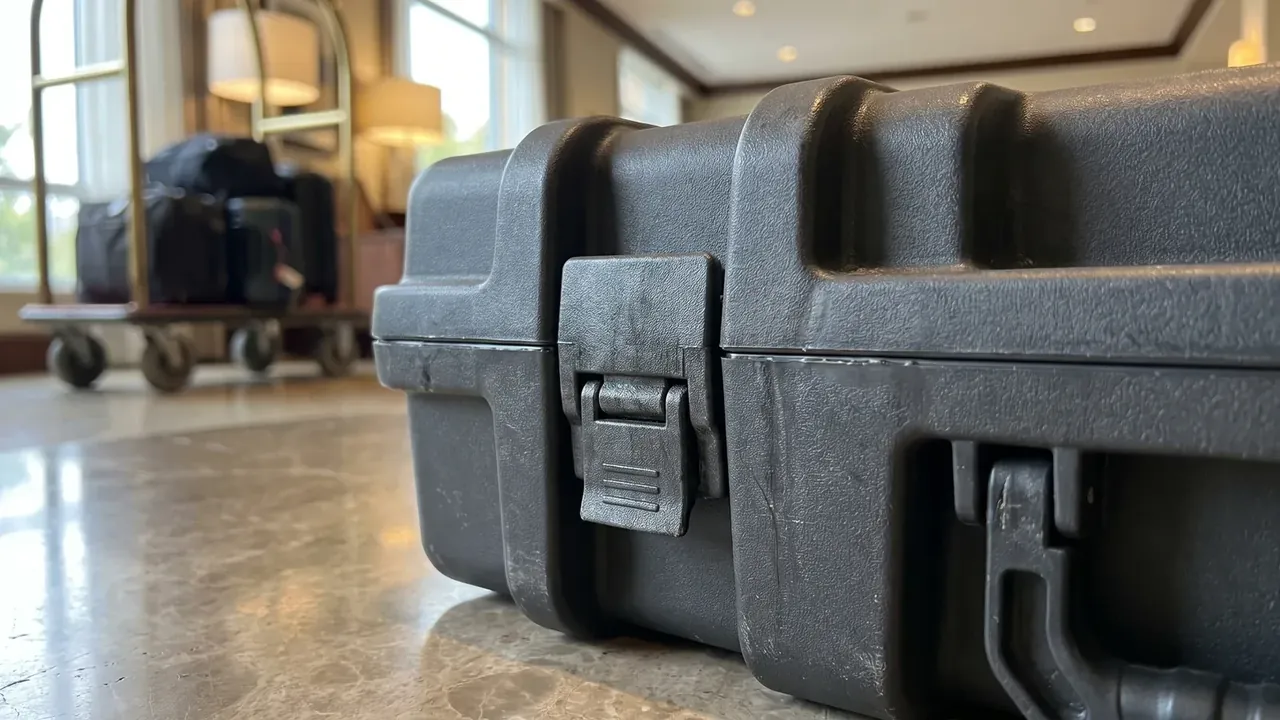
Quick answer: A Portable Generator Equipment Case holds a 4 h full-load rise under 18 K with a 180 cm² inlet, 220 cm² outlet, 45° louvers and a φ40 mm drain.
Table of contents
- The Heat Gap in a Portable Generator Equipment Case
- Inlet and Outlet Area Ratio
- Louver Angle and Splash Protection
- Full-Load Temperature Rise and Derating
- Oil Cleaning and Caster Load
- FAQ
1. The Heat Gap in a Portable Generator Equipment Case
Once the engine starts, the first thing the box cannot tolerate is not the cable but the trapped air.
A body at 620×420×380 mm with a 5.0 mm wall and 9.5 kg empty leaves a thin layer of air between machine and shell, and that layer does not move. On the bench, an unvented sample passed 25 K of internal rise after 4 h at full load; with ambient at 35 °C the inside reached past 60 °C.
Rise is not cosmetic. Every 10 K of intake temperature costs 2% to 3% of usable output, so 25 K quietly removes 5% to 7% of the rating, and no nameplate shows it. The gap is self-inflicted, because the shell seals itself. Stacked 2 high, two bodies face each other, the air between them stops, and the upper box runs 2 K hotter.
| Cooling grade | Opening | Internal rise after 4 h at full load |
|---|---|---|
| Sealed grade | No opening, wall conduction only | Above 25 K |
| One-side grade | Plain opening on one side, no louver | 20 to 23 K |
| Twin-louver grade | Inlet and outlet on separate sides, 45° louvers | Below 18 K |
Take the cooling grade that still holds internal rise below 18 K after 4 h at full load; a smaller opening suits intermittent duty only.
2. Inlet and Outlet Area Ratio
The inlet on a Portable Generator Equipment Case is 180 cm² and the outlet 220 cm², about 1:1.22. Heated air expands, so more hot volume leaves than cold arrives, and a narrow exit pressurises the box until air seeps back through latch gaps.
Both figures are opening areas, not free areas. A 45° louver passes about 0.55 of its opening, so 180 cm² works out at 99 cm² and 220 cm² at 121 cm². Draw only the opening and delivered airflow can miss by 40%.
Plant rooms size the inlet at 1.5 times radiator face area, and the logic carries over: mesh, louvers and dust each take a slice. With a louver and screen fitted, only about six tenths of the opening still passes air. Put the inlet low and the outlet high on the opposite side, or two openings at one height short-circuit and leave the middle hot.
3. Louver Angle and Splash Protection
45° is the compromise for a Portable Generator Equipment Case. Dropping the blade to 25° lifts the free-area factor to 0.65, until driven rain enters; raising it to 60° drops the factor under 0.5 and half-closes the window just cut.
IP54 is what survives the opening: level 5 for dust allows limited ingress, level 4 for water requires no harmful effect from splashing. A Portable Generator Equipment Case could hold IP66 while sealed, but louvers drop the assembly to IP54, and that downgrade belongs in the specification.
| Opening form | Blade and pitch | Rain and splash behaviour |
|---|---|---|
| Plain opening | No blade, punched mesh only | Direct rain enters, shed use only |
| Single louver | 45°, 12 mm pitch | Small ingress on driven rain, drains out |
| Offset twin louver | 45°, inner row offset half a pitch | Splash stays out, about 20% more drag |
Drag costs about 20% of airflow, so the twin version needs a larger opening. Add a drip edge on each blade lip and a drain at the lowest point, or water that reaches the cavity has no route out.
4. Full-Load Temperature Rise and Derating
The 4 h full-load figure for a Portable Generator Equipment Case is read with ambient at 35 °C, three probes averaged and the clock running to hour four. A rise of 18 K means the interior sits that far above ambient.

Enlarging the opening flattens fast: 180 cm² up to 260 cm² buys about 2 K while dust intake nearly doubles, which is why a Portable Generator Equipment Case settles at 180 and 220 cm². The derating boundary follows the same 18 K, and at 2% to 3% per 10 K the output loss lands near 4% to 5%, added to the selection margin.
An opening is also a sound path. The 68 dB(A) figure is measured with louvers open; closing them buys about 3 dB(A) and returns the rise to 25 K.
5. Oil Cleaning and Caster Load
The drain on a Portable Generator Equipment Case is φ40 mm at the lowest point of the base, with a screwed cap and an O-ring. After running, the floor collects oil sludge that no louver will pass.
Clean dry, then wet, then drain; hosing straight away drives sludge into corners where it sets. Take the cap off quarterly and check for a swollen O-ring.
| Check order | What to look at | Release condition |
|---|---|---|
| Step one | Dust depth on blades and screen | Light still shows through the pitch |
| Step two | Drain cap and O-ring | Turns to the stop without slipping |
| Step three | Casters and axles | 3 m push runs straight |
Two casters at φ75 mm on a Portable Generator Equipment Case work with a 55 kg handle rating. Loaded at nearly 40 kg, one person towing at 30° of tilt lets the wheels take the mass and the handle only steer.
A φ75 mm caster rolls over a 10 mm gap and needs a lift at a 20 mm threshold. Keep the base ribs 5 mm clear of the caster mounts, or a Portable Generator Equipment Case cracks at the boss under load.
Conclusion
The cooling account for a Portable Generator Equipment Case comes down to three numbers: 180 cm² in, 220 cm² out, 45° of louver. Balance those and a 4 h run holds an 18 K rise with output loss near 4% to 5%.
Related Reading
- Thermal Runaway Isolation for Battery Modules
- Export Packaging Cost Compared
- Why Heavy Goods Skip Cartons
Related Products
- 8 Series — Gun Cases; Military Equipment Cases; Camera Equipment Cases; Drone Cases; Watch Cases; Knife Cases; First Aid Cases; Electronics Equipment Cases
- WL8-2812 PP Gun Case — model WL8-2812
- All protective cases and toolboxes: 7 series, 158 models