

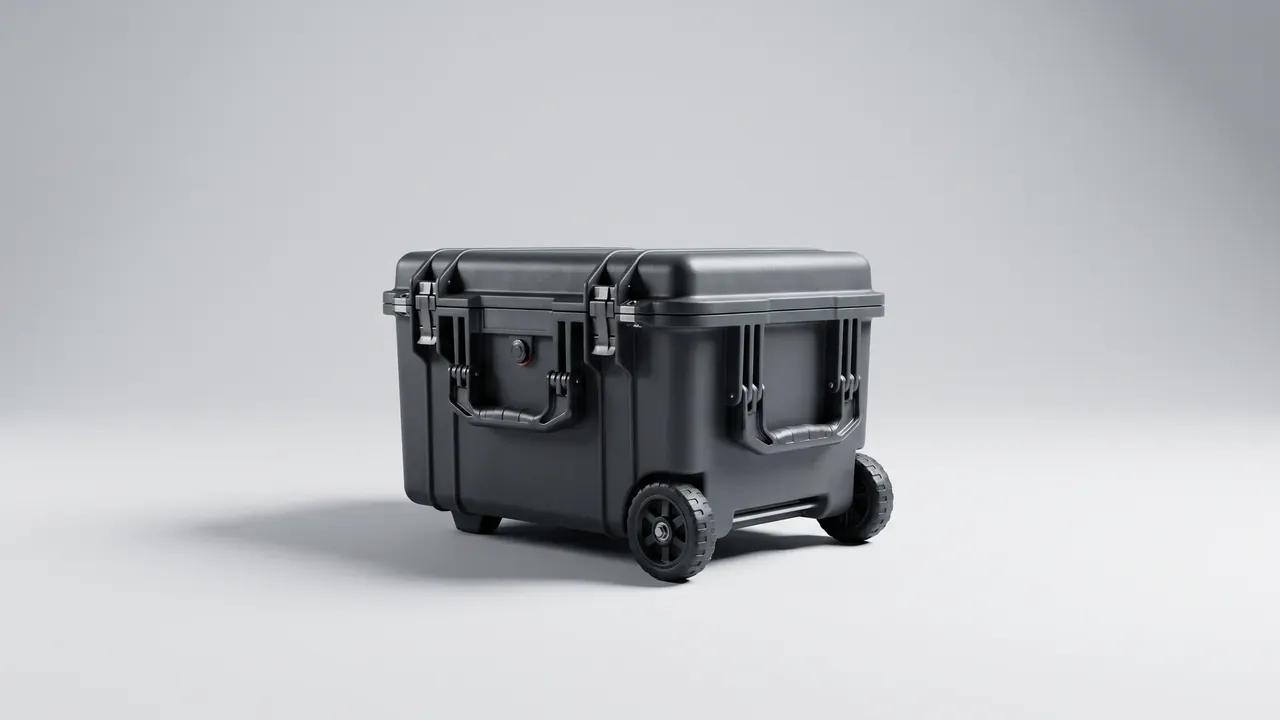
Quick answer: Rate the wheel by dynamic load, not total weight divided by four. A 100 kg box puts 60 kg on the outer wheel in a turn, which points to 75 mm wheels, 12 mm clearance and a 2.0 mm plate on six M5 screws at 2.5 N·m.
Table of contents
- Portable Wheels for Boxes Start With Load per Wheel
- Wheel Plates and the Load Path into the Base
- Wheel Material Against the Floor
- Handle Angle and Pulling Posture
- Retrofit Feasibility and Acceptance
- FAQ
1. Portable Wheels for Boxes Start With Load per Wheel
The first number is not diameter but dynamic load per wheel. Weight divided by four only holds on a straight line; in a turn the outer front wheel takes about 60 percent, so a 100 kg box loads one wheel at 60 kg.
Diameter follows load, and width matters: at the same diameter a 25 mm tread doubles floor pressure against a 32 mm one.
| Load per wheel | Diameter | Clearance | Box weight |
|---|---|---|---|
| 25 kg | 50 mm | 5 mm | 60 kg |
| 40 kg | 65 mm | 8 mm | 100 kg |
| 60 kg | 75 mm | 12 mm | 150 kg |
| 90 kg | 100 mm | 15 mm | 220 kg |
2. Wheel Plates and the Load Path into the Base
Failures sit in the plate, not the wheel. A retrofit plate for portable wheels for boxes is 2.0 mm cold-rolled steel on six M5 screws at 2.5 N·m; under-torque and they back out, over-torque and the bosses whiten, and both end loose.
Screws must land on rib crossings where the wall reaches 3 mm. Between ribs, 200 m of loaded pushing turns a round hole into an oval, and a 20 mm washer drops contact pressure from 12 MPa to under 4 MPa.
Offset decides whether an empty box stands up: within 30 mm the centre of gravity stays inside the track, past 50 mm the box tips forward.
3. Wheel Material Against the Floor
Material sets feel and floor life. Polyurethane at 95A rolls light but leaves pale tracks on epoxy floors; TPE at 75A marks less and adds about 15 percent rolling resistance; nylon is toughest on rough ground at roughly 68 dB; rubber runs at 62 dB and wears twice as fast at the same load.
Rank floor first, load second, noise last. Portable wheels for boxes working on two surfaces can run polyurethane front and rubber rear, at the cost of two spare types.
4. Handle Angle and Pulling Posture
A three-section handle pulls to 1.05 m, and at 45 degrees the wrist load is lowest; drop to 30 degrees and the user stoops, open to 60 and the box presses against the shin.
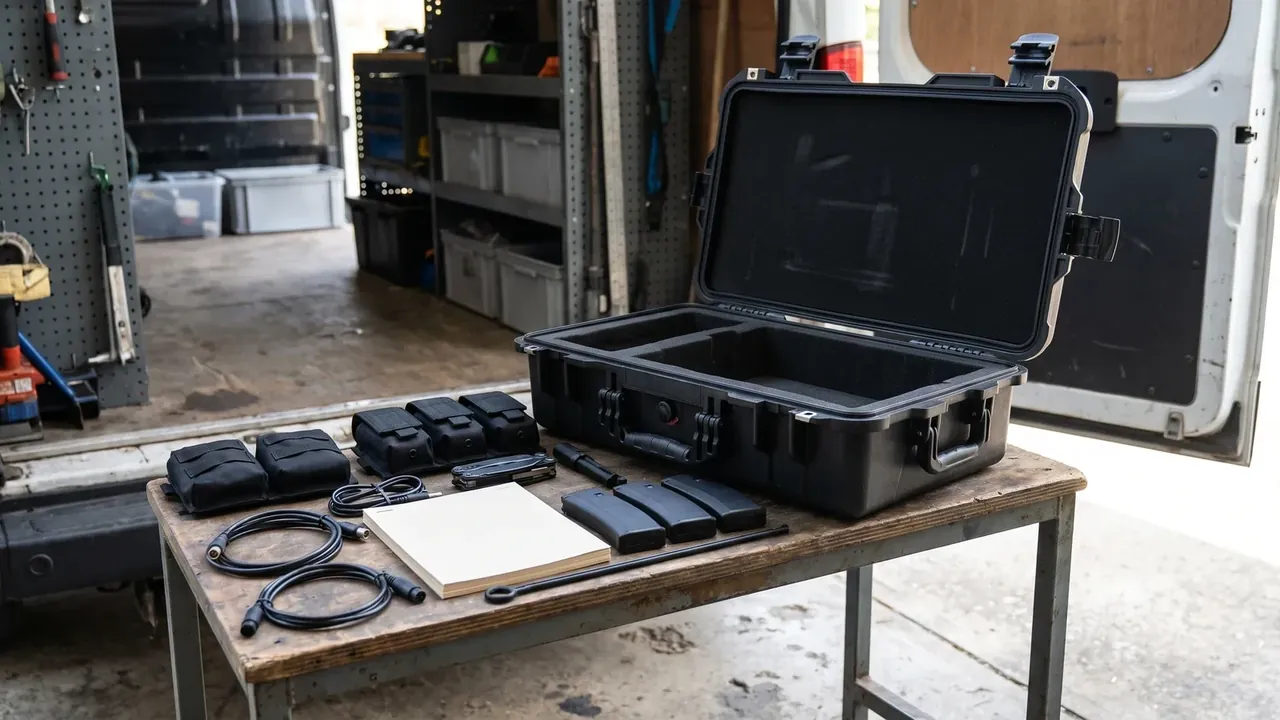
The mount takes bending moment, not tension: four M5 bolts with a 3 mm backing plate last about twice as long as screws driven straight into the shell. Extend the handle, hang 30 kg for 10 minutes, and the bracket should neither whiten nor rock.
Track width shapes posture too. At 300 mm the box wanders one-handed; 380 mm tracks straight but turns wide, so a 500 mm wide body suits 380 mm best.
5. Retrofit Feasibility and Acceptance
Retrofit portable wheels for boxes need a flat base, walls of 3 mm or more and usable ribs. Screwing a plate into a thin tote cracks it in three months along the rib.
Adding wheels moves the centre of gravity: a 1.2 kg wheelset pushes it back about 20 mm, so three-high stacking puts 15 percent more load on the bottom plate.
| Item | Method | Pass |
|---|---|---|
| Screw torque | Torque wrench, every screw | 2.5 N·m ±0.2 |
| Static load | 4× dynamic load, 1 minute | No flat spot or crack |
| Brake hold | Parked on a 10 degree slope | 120 N or more |
Conclusion
Fitting portable wheels for boxes runs in order: rate the load per wheel, check the plate against the ribs, pick material for the floor, set handle angle and track width, then record torque and brake figures on the acceptance sheet. The first two decide whether the box rolls; the last three whether the wheels stay square. Work in that order and the portable wheels for boxes you fit will turn without flat spots and stack three high without bending.
This article discusses only the container (case body) side of specifications and design intent, and does not cover any handling, loading or use of the contents.
Related Reading
- Wheeled protective case selection and load ratings
- Rolling tool case options compared
- How a hand-carry hard case is built
- Case accessories and how to specify them
Related Products
- 8 Series — Gun Cases; Military Equipment Cases; Camera Equipment Cases; Drone Cases; Watch Cases; Knife Cases; First Aid Cases; Electronics Equipment Cases
- WL8-2812 PP Gun Case — model WL8-2812
- All protective cases and toolboxes: 7 series, 158 models