

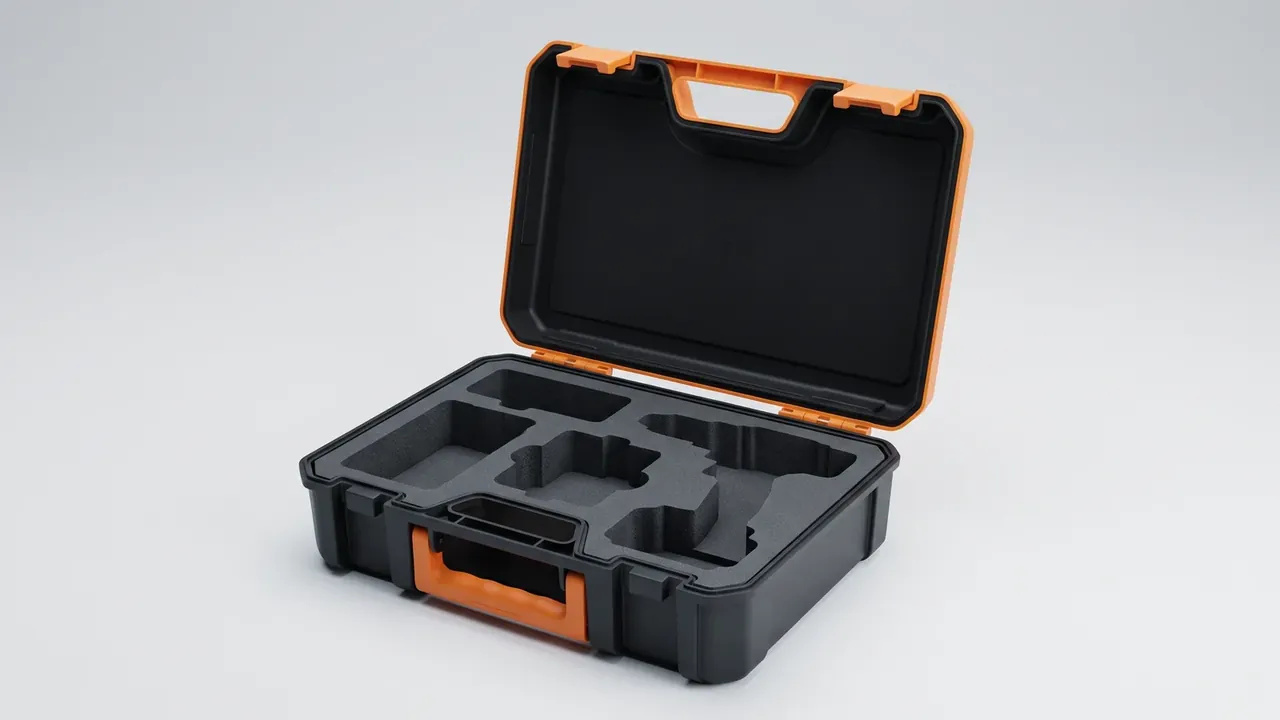
Quick answer: A power tool carrying case on site passes three tests: how it rides in the bed, how it comes down the tailgate, how it opens on a plank. With a 520 mm bed wall and 26 kg at full load, sort the loading position by the surface underneath before touching a strap.
Table of contents
- Three Loading Positions for a Power Tool Carrying Case
- Forty Seconds at the Tailgate: Handle, Latches and a One-Handed Load
- Temporary Footing: Opening Up on a Scaffold Plank
- Splitting the Battery, the Charger and the Consumables
- FAQ
1. Three Loading Positions for a Power Tool Carrying Case
A double-cab bed looks flat until the mat comes up: two arched wheel housings split the floor into three patches, none the same size.
The patch against the cab bulkhead is flattest, steel over a 6 mm rubber mat, and damps longitudinal bounce best. Above the housing the bottom stands on two edges, so vertical acceleration peaks. Behind the tailgate, checkered plate is quickest to reach and first to take rain.
| Position | Surface | Dominant excitation | Time to retrieve one case | Cases advised |
|---|---|---|---|---|
| Against cab bulkhead | Flat floor plus 6 mm rubber mat | Longitudinal | 40 s | 3 |
| Above wheel housing | Arched crown | Vertical | 55 s | 2 |
| Behind tailgate | Checkered steel | Lateral sway | 15 s | 1 |
Never mix the three: a case half on the housing and half in the air is being bent, whatever the strap tension.
The usual mistake is two tiers under one 25 mm webbing; the upper case lands its corners in the lower lid and one gravel road leaves four pale dents. Lay them side by side with a 10 mm EVA strip between.
2. Forty Seconds at the Tailgate: Handle, Latches and a One-Handed Load
The step from bed to ground is about 400 mm. Carrying a loaded power tool carrying case down it one-handed, the arm absorbs close to twice body weight at touchdown.
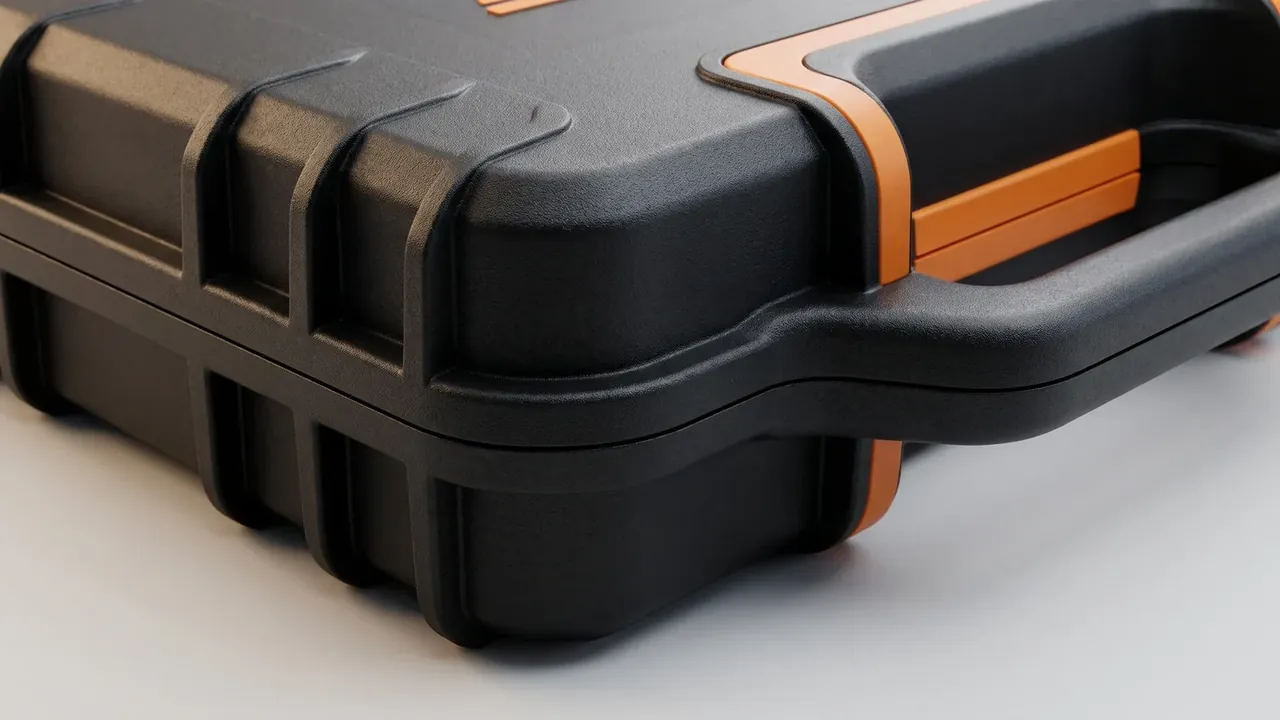
The handle is the thinnest part of the power tool carrying case. The grip measures 28 mm by 18 mm; at 26 kg it survives, and the ring of ribs where it meets the lid fails first. Lift the loaded case 10 cm, hold three seconds, look for whitening at the root.
Both latches need about 35 N. Thick gloves kill the feel, so press each with the heel of the hand. Carried upright, the latches face the body and the lid loads the hinge.
To change hands, bring the case to hip height and slide the free palm under the base. Stay clear of the recessed channels: a 2 mm radius with 26 kg on the palm cuts.
3. Temporary Footing: Opening Up on a Scaffold Plank
A standard plank on the third lift is 250 mm wide. A 340 mm case overhangs 45 mm each side, and an overhang springs when someone leans in.
Six checks before setting a case down:
- Add an 18 mm plywood pad when clearance is under case width plus 80 mm
- Run the long side along the plank, short side out, so the lid never passes the guardrail
- Leave nothing loose in the lid: it stops at 95 degrees and the contents slide out
- Set the battery inboard against a standard, never on a guardrail tube
- Close both latches before releasing the straps, or the case opens as tension goes
- Pass cases up and down on a line, never by throwing
The opening angle matters more than the space. The lid stops at 95 degrees on hinge friction, and pushing further tips the case over.
The end-of-shift sequence is what people skip. A workshop counts first; a scaffold closes first, because anything through a plank gap is gone with the next gust.
4. Splitting the Battery, the Charger and the Consumables
A 5.0 Ah pack weighs 0.65 kg, a charger 1.1 kg, an impact driver 1.9 kg. Three items a factor of three apart compress one foam three ways.
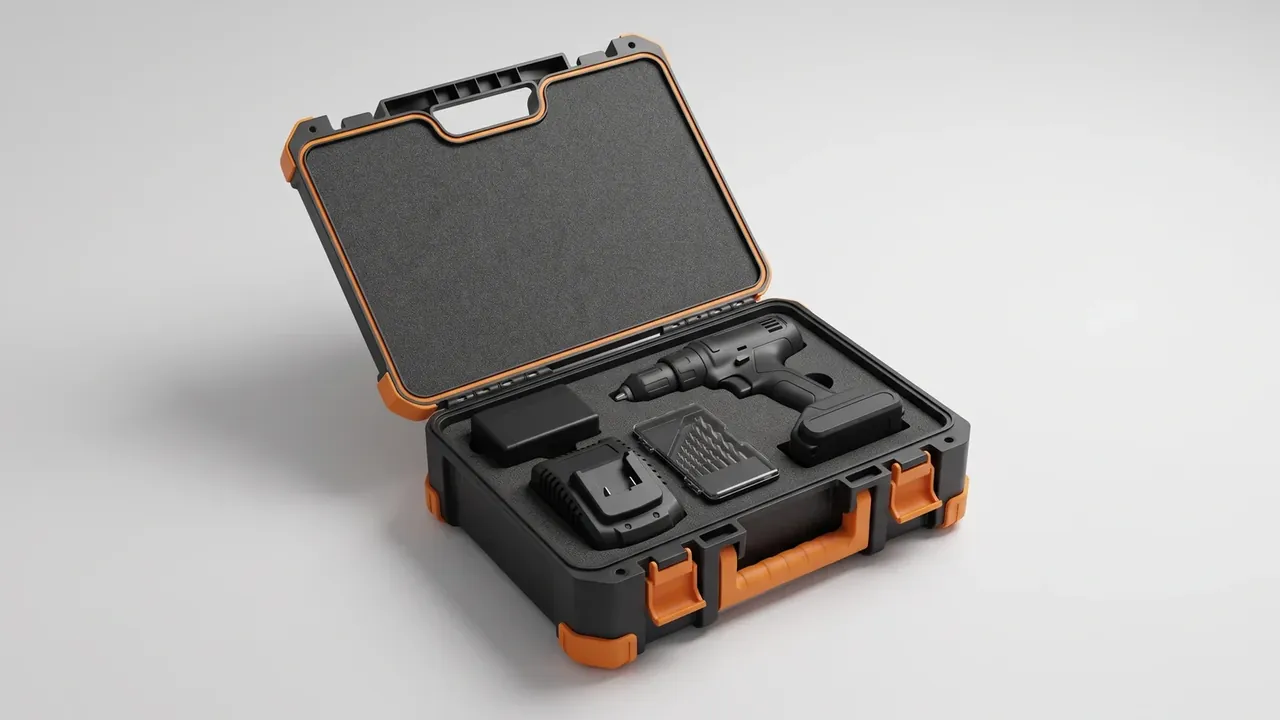
Splitting a case is not filling pockets; it is giving each pocket one order of pressure. The tool bay sits mid-case in 30 mm EVA with 2 mm clearance, so the machine neither rattles nor sticks. The battery bay stands upright on the handle side, 20 mm showing, with an 8 mm finger hole for gloved hands. The charger needs its own bay and an 8 mm venting gap: its shell reaches about 45 C, and a charger against a pack is a heat source bonded to that pack. The consumables box clips into the outer corner, light and off-centre, balancing the battery opposite.
With four bays set, the centre of gravity falls within 15 mm of the handle line and the case hangs level, which does more than any strap.
At minus 15 C the PP shell keeps about forty percent of its impact strength and the foam recovers slowly. Bring a stuck case indoors before prying anything out.
Conclusion
Most of what a power tool carrying case does on site is decided when it is loaded, and the rest when it opens. Bed surfaces, handle and latch direction, overhang on a plank all surface long before wall thickness does. Put those moves in the crew card, and choose a power tool carrying case by measuring the bed wall first, the plank width second.
This article discusses only the container (case body) side of specifications and design intent, and does not cover any handling, loading or use of the contents.
Related Reading
- Fixing and reaching a vehicle tool case on a service truck
- What a rolling tool case gives up under heavy transfer loads
- Dividers inside a tool box and the habit of putting things back
Related Products
- 8 Series — Gun Cases; Military Equipment Cases; Camera Equipment Cases; Drone Cases; Watch Cases; Knife Cases; First Aid Cases; Electronics Equipment Cases
- WL8-2812 PP Gun Case — model WL8-2812
- All protective cases and toolboxes: 7 series, 158 models