

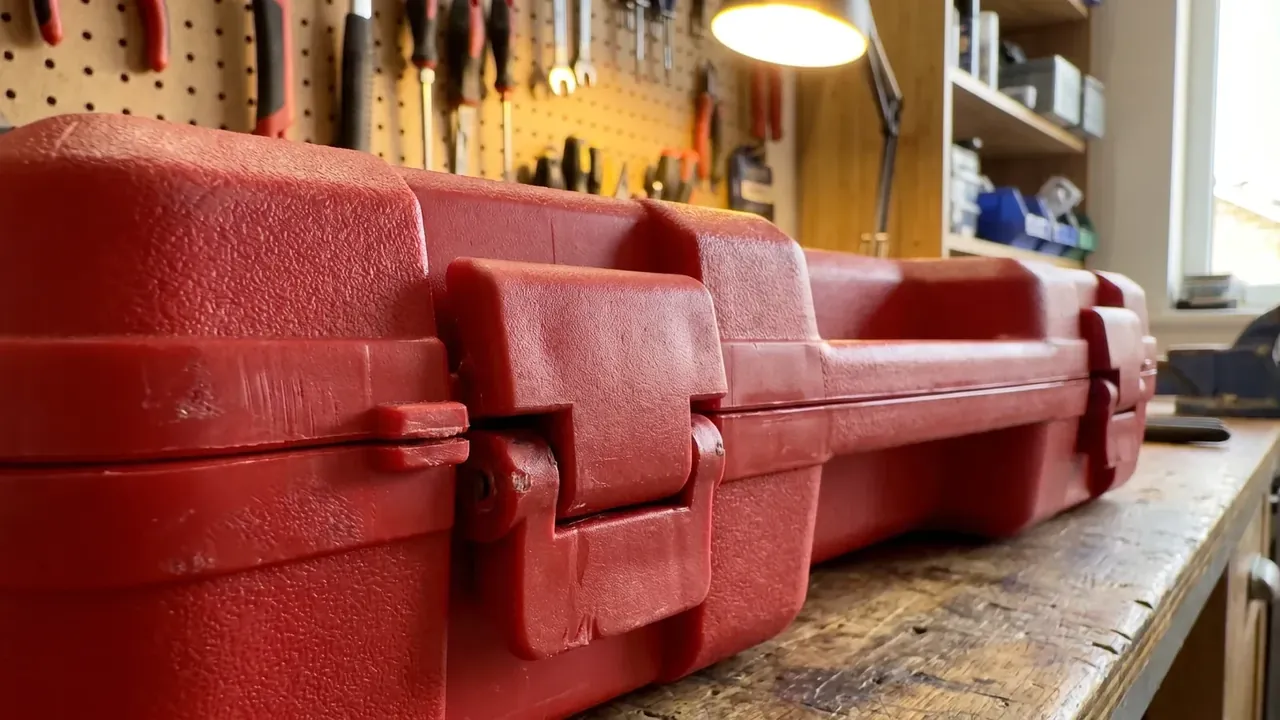
Quick answer: A precision equipment case buying guide puts three quotes on one drawing: at 500×400×230 mm, wall grade, foam cut and hinge life explain the price gap.
Table of contents
- Where a Precision Equipment Case Buying Guide Starts
- Wall Thickness Grades and Rib Count
- Foam Density, Cut Method and the Price Gap
- Hinge Life and Latch Holding Force
- Acceptance Criteria on Arrival
- FAQ
1. Where a Precision Equipment Case Buying Guide Starts
Three quotes sit on the desk, the numbers differ by a factor of two, and the drawing looks identical.
Ask each supplier to split the price into shell, liner and tooling. The shell is quoted at 500×400×230 mm in 3.0 mm, then again at 4.0 mm and 5.0 mm. The liner is quoted as EVA 25 mm and PU 20 mm. Tooling stands alone, and for a cavity this size the common band runs 80,000 to 150,000 RMB.
| Quote basis | How it is usually written | Where the gap hides |
|---|---|---|
| Single all-in price | One unit price, shell and liner merged | Wall grade erased, 3.0 mm and 5.0 mm priced alike |
| Shell and liner split | Shell by weight, liner by sheet area | Rib count never enters weight, six ribs look like four |
| Tooling amortised | Unit price carries the tool, spread over 200 | Order size changes and price plus lead time both move |
Tooling and batch size share a line. First article usually lands in 25 to 35 days, with a 25-day delivery at the fast end, and a minimum order of 500 units drops to 200 with a quick-change tool. A precision equipment case buying guide asks for both in the enquiry, so the gap has nowhere to hide.
2. Wall Thickness Grades and Rib Count
Wall thickness moves money first. PP shrinks 1.2% to 2.0% on cooling, so a 230 mm cavity drifts 1.8 mm, and thick walls cool slowly into warpage and sink marks.
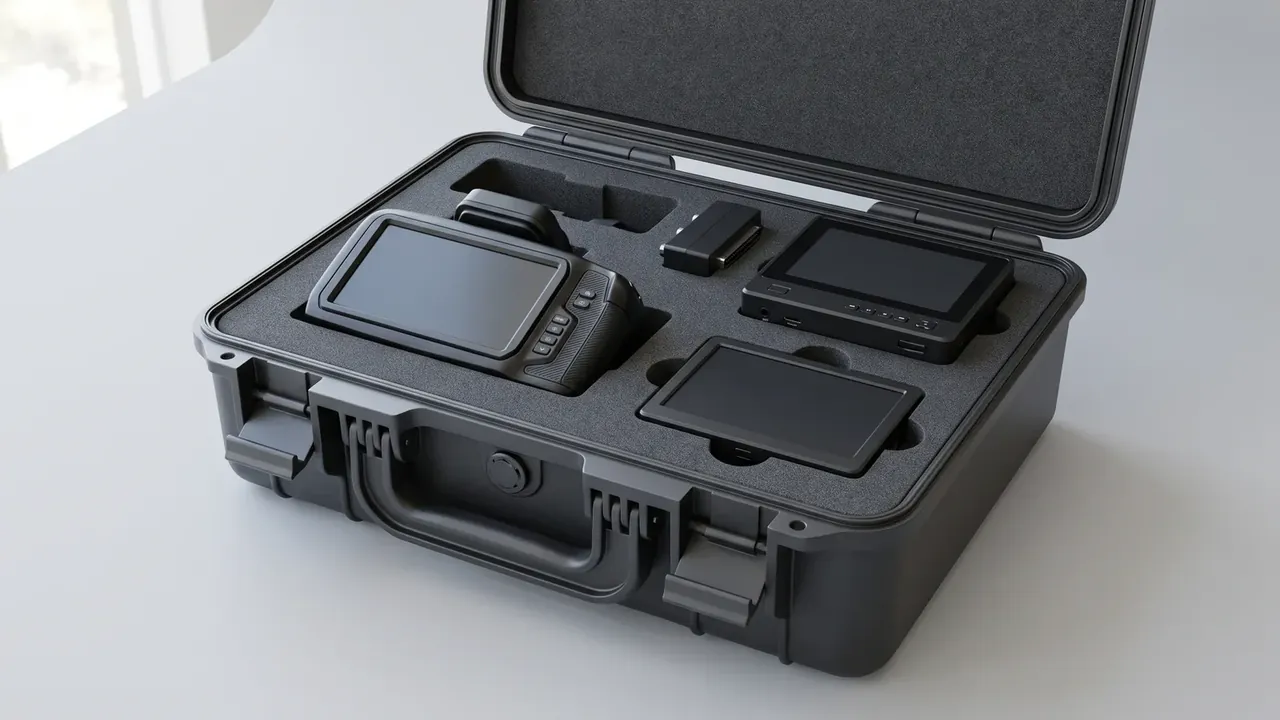
At 3.0 mm the empty case stays light for courier work. At 4.0 mm the shell takes routine stacking. At 5.0 mm it is built for lifting eyes. Past 3 mm, thickness buys stiffness slowly and prints a shadow behind every rib.
Six ribs suit a 500×400 mm base: two along the long edge, four across the 400 mm span, none wider than 60% of nominal wall or taller than three times it.
This precision equipment case buying guide puts thickness and rib count in one line. PP parts from 100 to 200 mm hold ±0.40 to 0.70 mm, and a 500 mm outer runs past that, so relax to about ±1.5 mm and mark three figures: cavity clearance, hinge bore pitch, latch mounting face. A drawing that says only "per 3D model" leaves the supplier to pick what suits the machine.
3. Foam Density, Cut Method and the Price Gap
In a precision equipment case buying guide, the liner gap is not resin price but density paired with cut method.
EVA runs 60 to 120 kg/m³, with 80 kg/m³ doing the load-bearing work; PU runs 16 to 40 kg/m³, and 25 kg/m³ is commonest. EVA 25 mm beside PU 20 mm is stiff, closed-cell and upright, while the PU conforms and costs about 30% less.
| Liner grade | Density and thickness | Cut method | Cost driver |
|---|---|---|---|
| Laminated | EVA 25 mm, two layers bonded | Die-cut then glued | Bonding labour, seams on cavity walls |
| Routed solid | EVA 25 mm at 80 kg/m³ | Single CNC pass | Machine time, walls held to ±0.5 mm |
| Moulded soft | PU 20 mm at 25 kg/m³ | Aluminium tool, foamed in place | Tool amortisation, uneconomic below 200 units |
Three methods matter. Lamination splits 25 mm into 10 mm plus 15 mm, cheap but seamed. Routing makes one pass, holding EVA to ±0.5 mm and PU to ±1 to 2 mm. Moulding needs an aluminium tool that never pays below 200 units.
EVA at 100 kg/m³ stands at 5 mm, while PU at 25 kg/m³ collapses below 15 mm. On a 500×400 mm base a 5 mm grid yields nearly twice the pockets, and every extra pocket thins the corner.
4. Hinge Life and Latch Holding Force
Hinges carry the third price step. Two hinges with a 4 mm pin cost half as much as a bushed pair, and the gap between a 20000-cycle rating and a 5000-cycle one lives in pin-to-bore clearance. At ten openings a day, 20000 cycles is a little over five years.
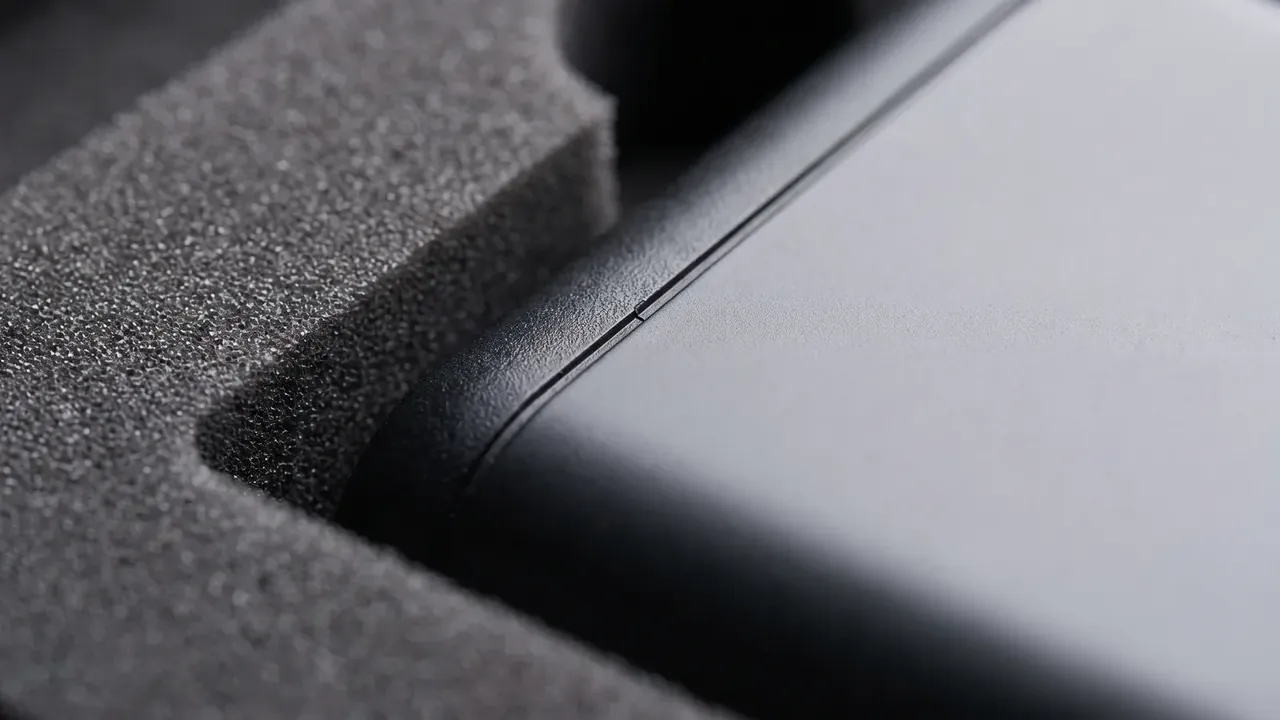
Latch holding force is 300 N. That is what the catch resists once the gasket is compressed. Below it the IP67 condition of 1 m immersion for 30 min fails, and water finds the corners first. Two latches at a quarter and three quarters of the long edge compress the gasket more evenly than a centred pair.
Test the two apart, because a hinge fails by pin wear and a latch by tongue rebound. Ask for clearance gain after 20000 cycles and holding force left at the same count; a precision equipment case buying guide reads them as two numbers, not one line saying "20,000 cycles".
5. Acceptance Criteria on Arrival
A precision equipment case buying guide runs incoming inspection at AQL 2.5 on level II. A 500-unit lot draws 50 samples, acceptance number 3 and rejection number 4; a 200-unit lot draws 32, which raises the weight of each defect.
| Acceptance test | What is measured | Reject line |
|---|---|---|
| Dimensional | Cavity clearance and hinge bore pitch | Beyond ±1.5 mm counts as a defect |
| Seal | Hold pressure plus immersion check | Any ingress fails the unit |
| Batch reject rate | Defects divided by sample size | Above 1.5% returns the whole lot |
A 1.5% batch reject rate is a tighter internal line than AQL 2.5. AQL limits how often one lot passes, the reject rate limits a run of lots. Fifty samples only reach rejection at the fourth defect, and the 1.5% line allows none.
Acceptance criteria sit at AQL 2.5 with a batch reject rate still under 1.5%; anything looser belongs to non-structural parts.
Conclusion
A precision equipment case buying guide earns its place by turning three look-alike quotes into rows that can be compared. Wall grade sets material and sink marks, liner grade sets tolerance and pocket count, hinges and latches set the five-year margin, and sampling decides whether the lot is accepted. Comparing quotes means pulling all three back onto one drawing first.
Related Reading
- Three Dimensions That Set Foam Case Specs
- Tolerances Every Case Drawing Needs
- Sampling a Bulk Delivery
Related Products
- 8 Series — Gun Cases; Military Equipment Cases; Camera Equipment Cases; Drone Cases; Watch Cases; Knife Cases; First Aid Cases; Electronics Equipment Cases
- WL8-2812 PP Gun Case — model WL8-2812
- All protective cases and toolboxes: 7 series, 158 models