

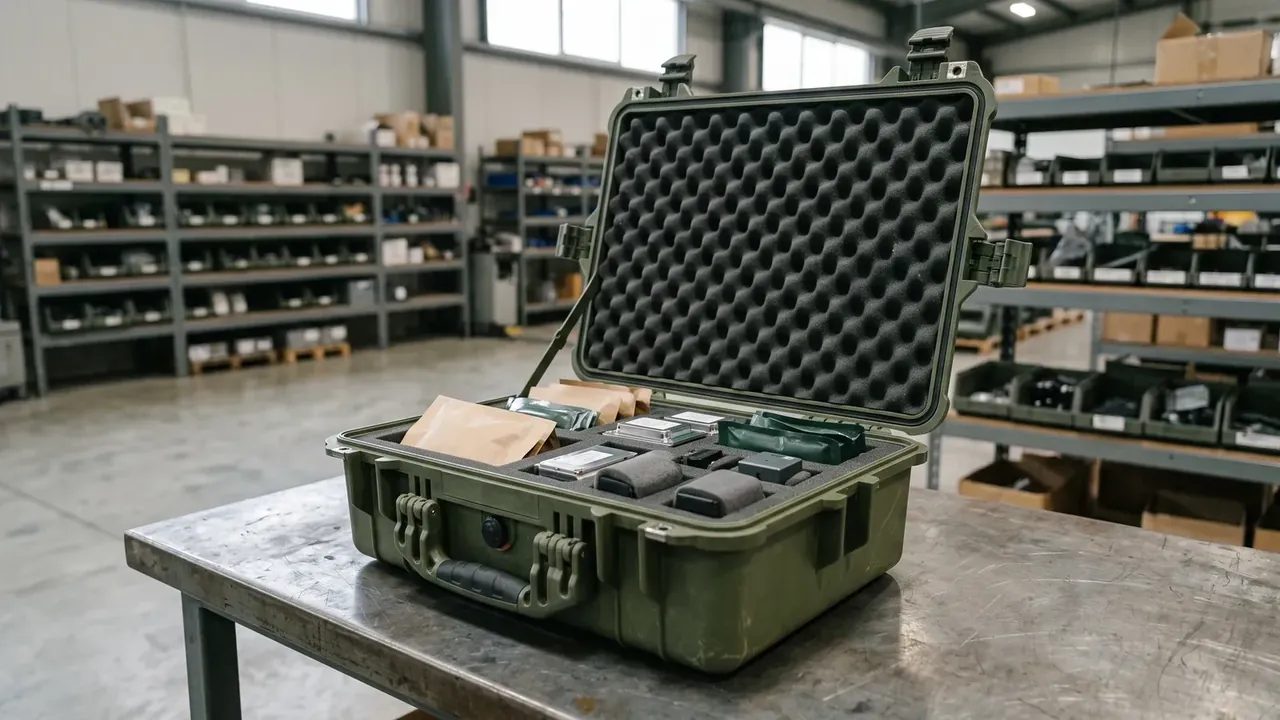
Quick answer: Convert the outer footprint into usable internal volume first, then check lid travel and latch position, drop and stack figures, divider tolerance and tooling lead time. Each item should resolve into a number you can verify.
Table of contents
- Internal Volume Against Outer Footprint
- Lid Opening and Latch Position
- Drop and Stack Performance
- Foam Dividers and Cell Tolerance
- Small-Batch Tooling and Lead Time
- FAQ
1. Internal Volume Against Outer Footprint
A 400 x 300 x 150 protective box with 2.5 mm walls loses 5 mm per axis before draft angles. Measured internals come out at 395 x 295 x 132, a usable volume of 78 percent; quoting capacity from the outside overstates it by a third.
Usable height decides fit. A 6 mm foam pad on the floor and an 8 mm liner in the lid leave 118 mm of real space inside a 150 mm box, so treat any quoted volume as a ceiling rather than a promise.
| Outer | Internal | Usable height | Volume used |
|---|---|---|---|
| 300 x 220 x 120 | 295 x 215 x 102 | 88 mm | 76 percent |
| 400 x 300 x 150 | 395 x 295 x 132 | 118 mm | 78 percent |
| 500 x 350 x 180 | 495 x 345 x 162 | 148 mm | 80 percent |
The narrowest point decides fit, not the average: side ribs pull the cavity in by 4 mm, so long items are quoted at the narrowed width.
2. Lid Opening and Latch Position
On a protective box, one hinge carries a span up to 400 mm; beyond that, two hinges and a 105 degree opening stop the lid falling back. On a 400 mm box the free end should droop no more than 1.5 mm when open.
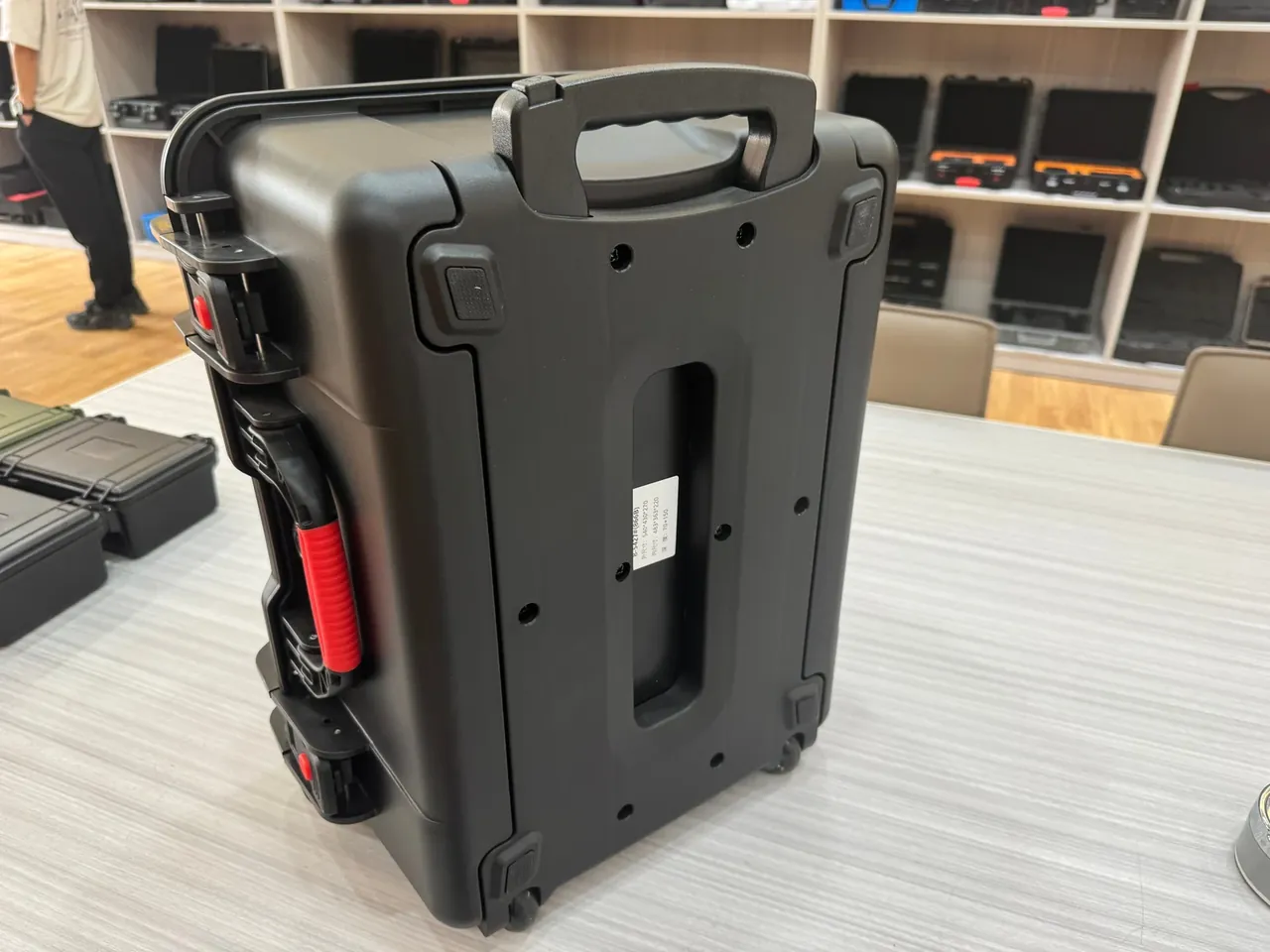
Latch position matters more than count. Two latches at 12 kg each, set 40 mm in from the ends, sit over the straight run of the gasket; pushed to the middle, they let both ends lift.
Close the lid and run a hand around the 3 mm lip: even resistance is right, and a soft spot marks a lip that moulded short.
3. Drop and Stack Performance
A protective box is small, so drop energy concentrates. Test at 1.5 m on six faces plus a corner drop; a 6 mm corner radius survives where 3 mm cracks, because the load spreads wider.
Stack five high at 15 kg each for 24 hours with lid deflection under 1.0 mm; above that the second layer stops seating, and a lid warped by 2 mm rocks from the fifth up.
| Test | Condition | Accept |
|---|---|---|
| Six-face drop | 1.5 m, empty | Latches closed, no crack |
| Corner drop | 1.5 m, bottom corner | No whitening |
| Stack | 5 high, 15 kg, 24 h | Deflection under 1.0 mm |
4. Foam Dividers and Cell Tolerance
Dividers decide how fast a protective box works. Specify EVA at 30 kg per cubic metre, 4 mm walls and cell tolerance of 0.5 mm on a 6 mm base; foam under 25 kg per cubic metre collapses and neighbouring cells merge.
Set tolerance against moulding: cavity size moves 0.8 mm across a batch, so measure ten boxes and cut inserts 0.3 mm under the median.
5. Small-Batch Tooling and Lead Time
Tooling sets the calendar for a protective box. A mould takes about 45 days and three trial shots, with colour signed off after the second. Minimum order is 200 pieces at ΔE 1.0 instead of the 1.5 allowed in a mixed batch, since a short run has no second batch to hide a colour shift.
On the press side, a 350 t machine on a 95 second cycle suits protective box bodies up to 400 mm. Push the cycle under 80 seconds and walls thicken unevenly, which shows as a lid sitting high on one side.
| Stage | Scope | Lead time |
|---|---|---|
| Tooling | One mould, trials included | 45 days |
| Trials | 3 shots, colour on the second | 12 days |
| Production | 200 pieces, ΔE 1.0 | 18 days |
Conclusion
The five criteria form one chain: the outline sets the cavity, the cavity sets the dividers, dividers and lid decide handling speed, drop and stack decide life, tooling decides the schedule. Written as numbers, a protective box becomes easy to compare.
This article discusses only the container (case body) side of specifications and design intent, and does not cover any handling, loading or use of the contents.
Related Reading
- How small plastic cases are chosen
- Military box selection criteria
- Choosing a lockable storage box
- How a tool box body is built
Related Products
- 8 Series — Gun Cases; Military Equipment Cases; Camera Equipment Cases; Drone Cases; Watch Cases; Knife Cases; First Aid Cases; Electronics Equipment Cases
- WL8-2812 PP Gun Case — model WL8-2812
- All protective cases and toolboxes: 7 series, 158 models