

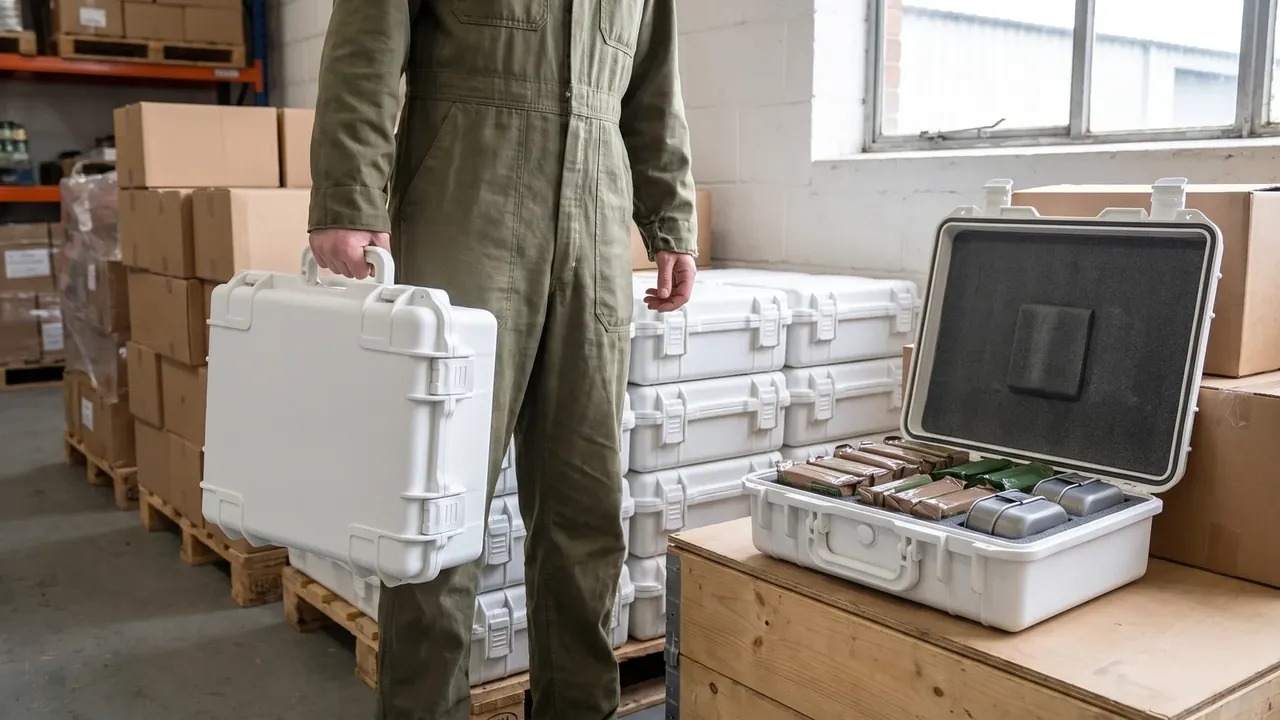
Quick answer: A ration box is not the only way to move food. At 60 L, a trolley, a cooler, a carton and a soft bag each win somewhere; the gaps sit in four readings: four-hour rise, tare, reuse, cost against wash minutes.
Table of contents
- How the Ration Box and Four Alternatives Are Positioned
- Temperature: What Four Hours Costs
- Weight and Payload: How Tare Eats a Trip
- Service Life: Which Part Sets the Reuse Count
- The Whole Bill: Amortisation and Wash Minutes
- FAQ
1. How the Ration Box and Four Alternatives Are Positioned
All five hold a meal issue; fit is never the question. This one is a washable rigid unit: the wall is the food-contact surface, the lid closes off odour, loading runs by portion, and the closed case goes through the wash line.
| Option | Structure | Sealing | Tare | Typical use |
|---|---|---|---|---|
| Ration box | 25 mm foamed PP body | Twin-lip gasket, four latches | 6.8 kg | Portion issue |
| Stainless trolley | 1.0 mm 304 sheet | Lid overlap, no gasket | 18.5 kg | Canteen runs |
| EPS cooler | 40 mm moulded EPS | Plug lid, no gasket | 2.4 kg | Cold chain |
| Carton | 7 mm five-ply board | None | 0.9 kg | Transfers |
| Soft bag | 600D oxford, 8 mm EPE | Zip and flap | 1.6 kg | Carry |
The alternatives are a moving shelf, an insulated shell, transit packaging and a carry bag. The column readers skip is sealing, which decides whether vapour and odour stay out and how long washing takes.
2. Temperature: What Four Hours Costs
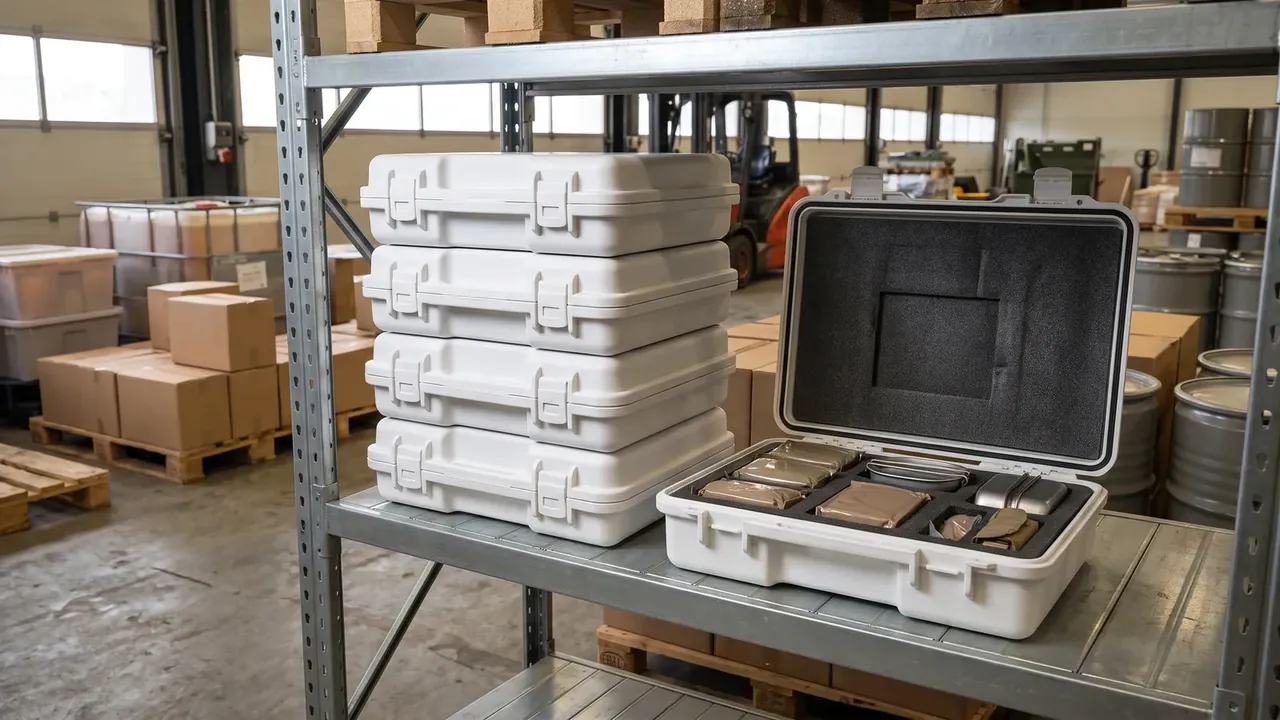
Conditions: 32 °C ambient, 60 percent load, 4 °C start, lid closed, centre probe.
| Option | 0 h | 1 h | 2 h | 4 h | Rise |
|---|---|---|---|---|---|
| Ration box | 4.0 °C | 4.6 °C | 5.6 °C | 7.6 °C | 3.6 °C |
| EPS cooler | 4.0 °C | 4.4 °C | 5.0 °C | 5.9 °C | 1.9 °C |
| Stainless trolley | 4.0 °C | 6.9 °C | 10.1 °C | 15.4 °C | 11.4 °C |
| Carton | 4.0 °C | 7.4 °C | 12.0 °C | 18.2 °C | 14.2 °C |
| Soft bag | 4.0 °C | 6.2 °C | 8.9 °C | 13.7 °C | 9.7 °C |
The cooler wins at 1.9 °C, this case second at 3.6 °C; the gap is thickness, 25 mm against 40 mm, both closed-cell foam. It stays thin because the wall needs stiffness, or the gasket groove loses compression.
The stragglers are the trolley and the carton: a 1.0 mm sheet climbs 11.4 °C, corrugated board 14.2 °C, neither designed to hold temperature.
3. Weight and Payload: How Tare Eats a Trip
Tare is payload. On a 1200 × 800 mm pallet with a 500 kg vehicle limit, the 600 × 400 × 340 mm case fits four across and five high: twenty units plus 136 kg of empty body.
EPS coolers weigh 48 kg for the same twenty but stack only two high: a 40 mm wall cracks on a 0.8 m drop, so a trip carries eight. The 18.5 kg trolley stops at twelve units.
4. Service Life: Which Part Sets the Reuse Count
Reuse count is set by whichever part fails first: the gasket and the draw latch. After twelve months or 300 washes the gasket takes a set beyond 1.2 mm; after 5,000 cycles pin clearance passes 0.4 mm. Both are replaceable.
An EPS cooler has no spares: one notch, then the second knock cracks through at 25 trips. A carton averages 1.4, a soft bag 180, a welded trolley 2,500.
5. The Whole Bill: Amortisation and Wash Minutes
On a relative index covering purchase, wash labour and spares, this case sits at 1.00: the cooler lands at 0.62, the carton at 0.48, the trolley at 1.85, the bag at 0.95.
The cooler pays for 0.62 with 25 trips and eight units a trip, the carton for 0.48 with no washing and no return leg. The trolley costs nine wash minutes a unit, the bag 6.5 plus eight hours of drying. On price the carton wins; counting labour, reuse and payload, this case returns to 1.00.
Conclusion
Temperature follows thickness, weight follows structure, life follows swappable wear parts, cost follows whether wash minutes and payload amortise together. The cooler wins on heat, the carton on price, the trolley on rolling, the bag on weight — yet only one case holds all four in daily portion issue: the ration box stays the baseline.
This article discusses only the container (case body) side of specifications and design intent, and does not cover any handling, loading or use of the contents.
Related Reading
- How a ration box is built and where it is used
- How emergency supply cases are specified
- Where temperature-controlled cases stop making sense
- Military supply cases inside the logistics chain
Related Products
- 8 Series — Gun Cases; Military Equipment Cases; Camera Equipment Cases; Drone Cases; Watch Cases; Knife Cases; First Aid Cases; Electronics Equipment Cases
- WL8-2812 PP Gun Case — model WL8-2812
- All protective cases and toolboxes: 7 series, 158 models