

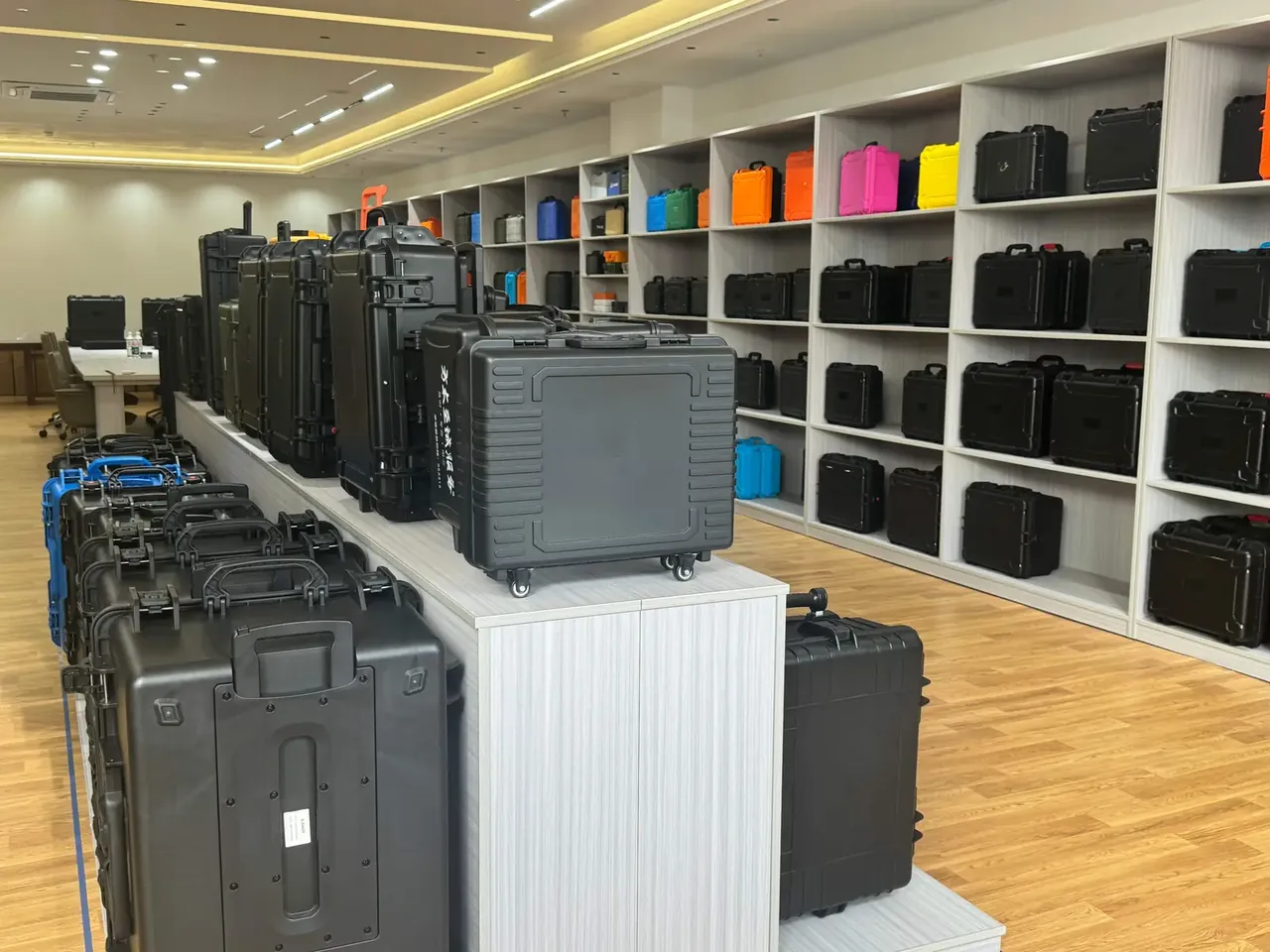
Quick answer: A Military Supply Case drawing is built from three drafting layers. Material fixes resin grade, density and nominal wall; colour fixes reference number, masterbatch ratio and texture; marking fixes plate, ink and label pad. Each layer has to end in a measurable value, or a second toolmaker cannot reproduce the body.
Table of contents
- How a Military Supply Case Specification Splits
- Material Layer: Resin, Density and Wall
- Colour Layer: Olive Drab, Sand and Black
- Marking Layer: Plates, Ink and Label Pads
- Order of Writing into Drawings
- FAQ
1. How a Military Supply Case Specification Splits
On a Military Supply Case drawing, dimensions are only the frame. What decides whether a second factory can reproduce the body is the specification stack: material, colour and marking.
The layers are chained. Material caps wall thickness and shrinkage. Colour rides on material, because one pigment reads differently on HDPE and on PP. Marking rides on colour, since light ink on a dark body needs a base coat.
| Layer | Question | Typical entries |
|---|---|---|
| Material | Which resin, how thick | Grade, density, nominal wall |
| Colour | Which appearance, how stable | Reference, masterbatch, grain |
| Marking | Which information, how long | Plate, ink film, label pad |
2. Material Layer: Resin, Density and Wall
Most bodies are moulded in HDPE or PP. HDPE runs 0.941 to 0.965 g/cm3, and copolymer grades resist brittle fracture at minus 40 °C. PP at 0.90 to 0.91 g/cm3 is stiffer, but loses impact strength near minus 10 °C.
Toughened PP adds 15 to 20 percent ethylene-octene copolymer, moving the brittle point to minus 30 °C while tensile strength falls from 30 to 24 MPa. Nominal walls run 3.5 to 4.5 mm, with shrinkage at 1.4 to 1.8 percent.
| Resin | Density (g/cm3) | Low-temperature | Nominal wall (mm) |
|---|---|---|---|
| HDPE homopolymer | 0.95 to 0.96 | crack risk at -20 °C | 3.5 to 4.5 |
| HDPE copolymer | 0.94 to 0.95 | tough at -40 °C | 4.0 to 5.0 |
| Toughened PP | 0.90 to 0.92 | usable at -30 °C | 3.0 to 4.0 |
Melt temperature of 200 to 230 °C and mould temperature of 30 to 50 °C belong in the same clause: run low, and weld-line strength falls by a third.
3. Colour Layer: Olive Drab, Sand and Black
Colour clauses name a reference system and a tolerance, never a colour. Olive drab sits near RAL 6003 or FS 34094, sand between FS 33446 and RAL 1019, black on RAL 9005. Masterbatch runs 2 to 4 percent; below 1.5 percent, clouding appears on large flats.
Consistency is read under D65: under 1.5 within a batch, under 2.5 between batches. A VDI 3400 grade 18 to 24 grain reads half a step darker than a polished sample, so colour is approved on the final grain.
| Colour | Reference | Masterbatch | Usual drift |
|---|---|---|---|
| Olive drab | RAL 6003 / FS 34094 | 3 to 4% | grain, regrind |
| Sand | RAL 1019 / FS 33446 | 2 to 3% | hide, yellowing |
| Black | RAL 9005 | 2 to 2.5% | carbon dispersion |
4. Marking Layer: Plates, Ink and Label Pads
The marking layer is about where information sits and how long it survives. Plates are 0.5 mm aluminium or 0.8 mm stainless, riveted to a 300 N pull-off target, 40 mm below the top edge; adhesive loses 40 percent of its grip at minus 20 °C.
Screen printing uses two-component polyurethane at 25 to 35 micrometres, cured 30 minutes at 80 °C, and must hold grade 1 cross-cut after 500 rubs. Label pads are 80 by 50 mm recesses with two 3 mm drains.
5. Order of Writing into Drawings
Fix material and wall first, then colour and texture, then marking and position. Each later layer leans on the earlier one, so reversing the order forces rework.
Drawings carry measuring points: eight wall readings, three colour readings with the light source named, and a position tolerance of plus or minus 1 mm.
Conclusion
A Military Supply Case is best specified as three measurable layers rather than one drawing: material governs mechanics, colour governs consistency, marking governs legibility. Each has its own reference system, yet all three obey one rule, that every clause ends in a test method. Apply it to drawing points and contract terms, and the same Military Supply Case comes out the same way twice.
This article discusses only the container (case body) side of specifications and design intent, and does not cover any handling, loading or use of the contents.
Related Reading
- Material Evolution of Military Storage Boxes: The Lightwei…
- Military Equipment Boxes & Tactical Gear Boxes: Police/Mil…
- Selecting a military supply transport case
- Rotomolded Cases: Rotational-Moulded Shell Structure & Pro…
Related Products
- 8 Series — Gun Cases; Military Equipment Cases; Camera Equipment Cases; Drone Cases; Watch Cases; Knife Cases; First Aid Cases; Electronics Equipment Cases
- WL8-2812 PP Gun Case — model WL8-2812
- All protective cases and toolboxes: 7 series, 158 models