

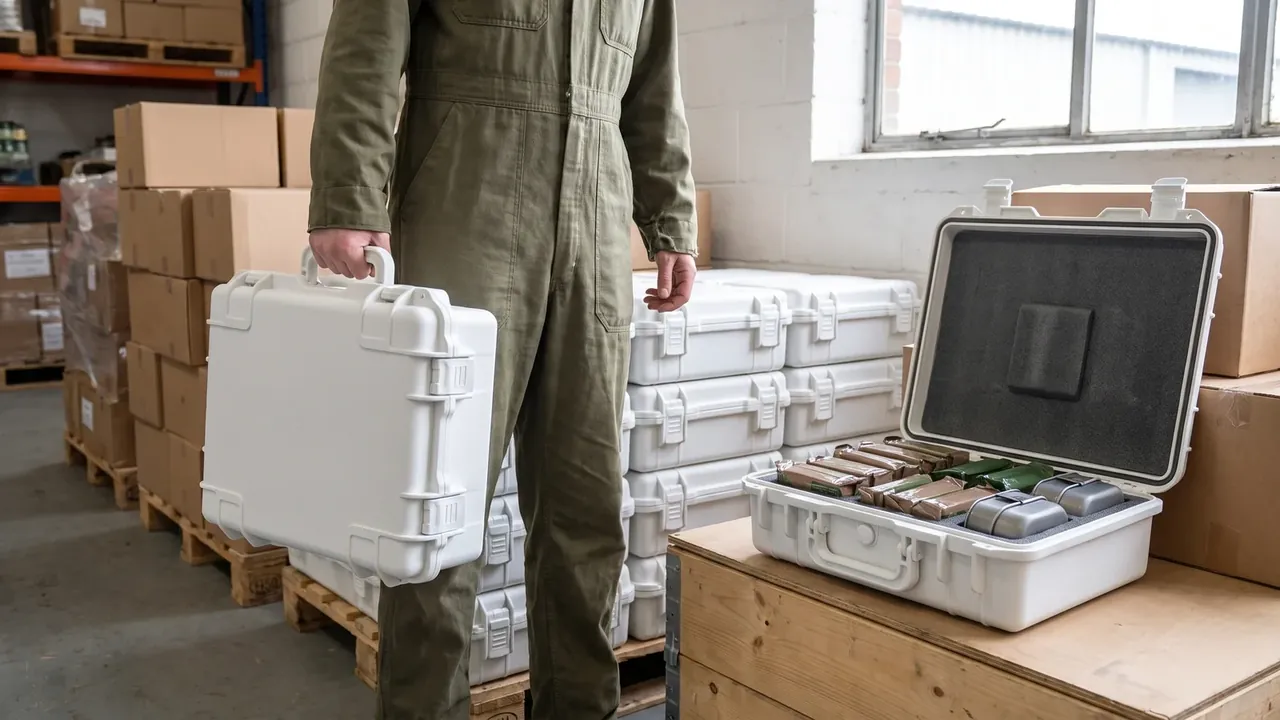
Quick answer: Measure three things before materials: portions per case, meals per day, and who lifts or forks it. Portions set volume, meal rounds set case count, handling sets the weight ceiling. Temperature and sealing only narrow what is left.
Table of contents
- Five criteria at a glance
- Sizing volume from portions and meal rounds
- Wall material by temperature band and hold time
- Stacking and forklift interfaces
- Sealing, moisture and reuse cycles
- FAQ
1. Five criteria at a glance
A ration box is usually chosen backwards: sample first, price second, portions last. Reverse that and the wall follows from the numbers.
| Criterion | Anchor | Failure |
|---|---|---|
| Portions and meals | 1.9 L per portion, 12% margin | Trays crushing |
| Temperature | 90 min or 4 hours | Warm on arrival |
| Stacking and forking | 5 tiers, 95 mm pocket | Bottom tier collapse |
| Sealing | 25%–30% compression | Water at the rim |
| Washing | 60 °C, 300 cycles | Fuzzed interior |
The five are sequential: portions fix volume, handling fixes the weight, temperature and washing choose the rest.
2. Sizing volume from portions and meal rounds
One meal sets the unit: a two-dish rice tray at 210 by 160 by 45 mm is 1.5 L net, 1.9 L of interior with clearance.
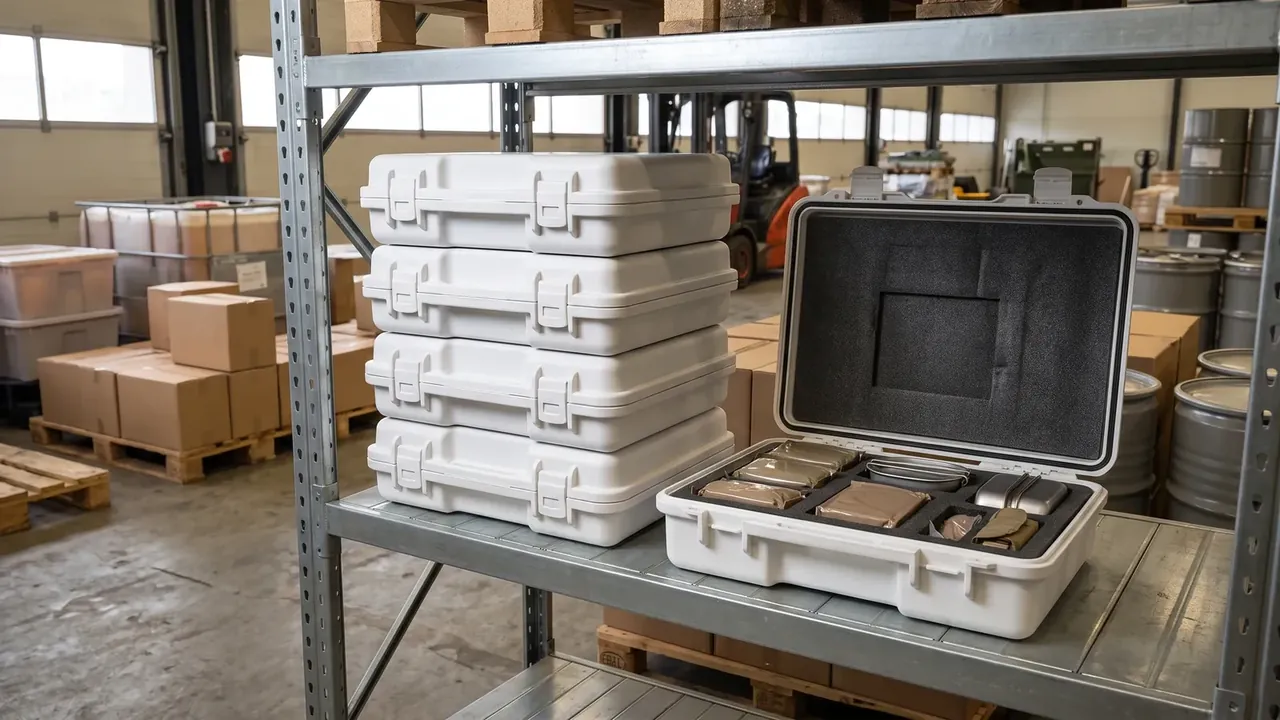
Twenty-four portions need 45.6 L; a 12% margin takes that to 51 L, and a 55 L case gives 50.6 L usable at a 92% fill factor — tight on purpose, since slack lets trays slide.
Meal rounds count cases: 720 portion-meals for 120 people over two days is 30 cases at 24 each. If the wash line returns 12 a day, a ration box must carry 60 or the cycle drops to one day, at 45 kg, which is two people's limit.
3. Wall material by temperature band and hold time
Three bands: frozen at -18 °C, chilled at 0–4 °C, hot above 60 °C; two windows: 90 minutes in camp, 4 hours between camps.
Single-wall PP at 3.2 mm suits 90 minutes but cracks under impact at -18 °C. Copolymer PP with 12 mm foam, near 0.035 W/(m·K), holds 4 hours for 1.8 kg more and 8% less volume. Rotomoulded PE at 6 mm stays ductile at -40 °C but needs pressure washing.
| Band and window | Wall | Risk |
|---|---|---|
| Hot chain, 90 min | PP, 3.2 mm | Dished lid pools water |
| Chilled, 4 h | PP, 12 mm foam | 8% less interior |
| Frozen, -18 °C | Rotomoulded PE, 6 mm | Rough interior |
| Frozen, long haul | Reefer | Runs warm |
Pick the window, then the wall, then check weight against handling. A dished lid pools condensation, so a hot-chain ration box should crown or carry a rib.
4. Stacking and forklift interfaces
Static load first: 22 kg loaded, five tiers, 110 kg on the bottom case, under 3 mm of lid deflection after 24 hours.
A lid needs a bearing face and an 8 mm register groove, offset within 5 mm, or the stack walks when a truck brakes. Boss into groove is what makes a case stackable rather than stackable-looking.
A 95 by 200 mm pocket admits a 120 mm fork; without pockets, twelve cases ride a pallet at 1.35 m. Loads above 22 kg moved by hand need pockets or castors.
5. Sealing, moisture and reuse cycles
An 8 mm gasket compresses 25%–30% at Shore A 45–55; under 20% it leaks odour, over 35% it takes a permanent set.
Moisture enters at seams: blind bores at the latch pivot and a retaining ring on the hinge pin hold vapour transmission below 1 g/(m²·24h). Ten minutes open beats a desiccant sachet.
A 60 °C, pH 11 caustic wash works when interior radii are R5 or larger, and the case must dry open; closed storage grows mould.
| Cycles | Check | Action |
|---|---|---|
| 50 | Gasket witness mark | Replace if flat |
| 150 | Latch pivot and hinge pin | Replace a loose pin |
| 300 | Full-perimeter gasket | Replace the gasket |
| 500 | Interior radii and base | Retire on cracks |
Three items can be measured on a sample: lid deflection, gasket compression, interior radius.
Conclusion
Five criteria in one sequence: portions and meal rounds produce volume and case count, the handling limit cuts anything too heavy, and then temperature, sealing and washing choose the material. Written into an inquiry sheet, the numbers make quotations comparable, which is what separates a specified ration box from one chosen by appearance.
This article discusses only the container (case body) side of specifications and design intent, and does not cover any handling, loading or use of the contents.
Related Reading
- What a ration box is: unit packaging requirements
- Ration box versus insulated carrier
- Setting the temperature window for a controlled case
- Specification anchors for stackable cases
Related Products
- 8 Series — Gun Cases; Military Equipment Cases; Camera Equipment Cases; Drone Cases; Watch Cases; Knife Cases; First Aid Cases; Electronics Equipment Cases
- WL8-2812 PP Gun Case — model WL8-2812
- All protective cases and toolboxes: 7 series, 158 models