

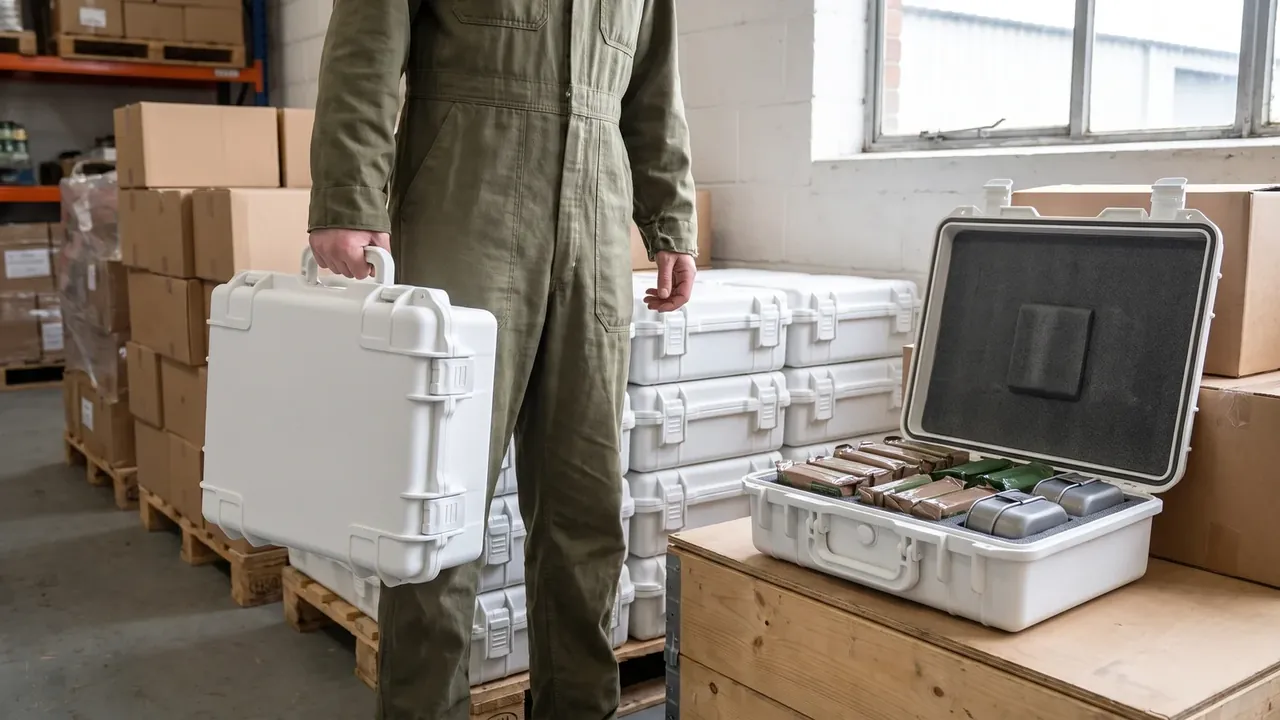
Quick answer: Ration box specifications run backwards from the cavity: set the internal size from the tray layout, add wall, rib relief and lid overlap for the envelope, check static load against stack height, then close with insulation thickness.
Table of contents
- Where Ration Box Specifications Begin
- Wall Thickness and Rib Pitch
- Static Load and Stacking Checks
- Fork Pockets and Lifting Points
- Insulation Thickness and Temperature Band
- FAQ
1. Where Ration Box Specifications Begin
A specification sheet opens with three lines: cavity, envelope and lid gap, and only the cavity is a requirement. One meal with cup and cutlery takes a 150 by 120 mm cell, so four cells give 600 by 400 mm.
The envelope is not cavity plus one wall: a 3.2 mm wall plus 2.8 mm of rib root and lid overlap add 6 mm per side, and a 42 mm lid brings height to 326 mm.
Polypropylene shrinks 1.4 to 1.8 percent, so a 1.5 mm cavity tolerance and a 2.5 mm envelope tolerance are realistic.
| Datum | Example | Tolerance |
|---|---|---|
| Cavity | 600 x 400 x 280 mm | 1.5 mm |
| Envelope | 612 x 412 x 326 mm | 2.5 mm |
| Lid gap | 0.6 to 0.8 mm | 0.8 mm |
2. Wall Thickness and Rib Pitch
Cost reviews attack wall thickness first. Cutting 3.2 to 2.8 mm saves 0.4 kg, but side deflection under a 200 N point load climbs from 4.2 to 6.5 mm and the lid land stops sealing.
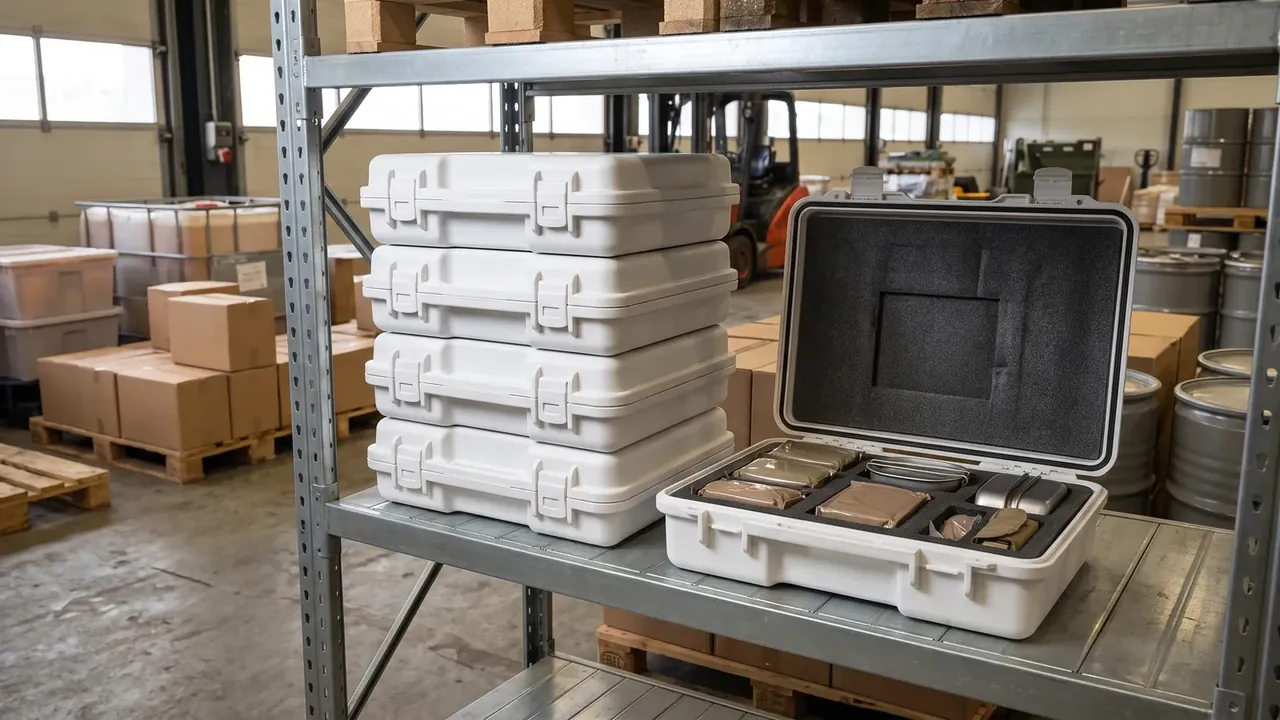
Ribs buy stiffness more cheaply: raising rib height from 8 to 12 mm multiplies section inertia about 3.4 for 0.2 kg, and 110 mm pitch balances trapped gas against panel bow.
| Wall | Rib | Pitch | Deflection at 200 N |
|---|---|---|---|
| 2.8 mm | 1.4 mm | 130 mm | 6.5 mm |
| 3.2 mm | 1.6 mm | 110 mm | 4.2 mm |
| 3.6 mm | 1.8 mm | 95 mm | 3.1 mm |
3. Static Load and Stacking Checks
Static load is a single-box figure and stacking is a system figure; merging them is the commonest datasheet error. A ration box is rated at 180 kg on the lid for 24 hours.
Stacking is figured on the bottom box: boxes above times loaded weight plus self-weight. At five tiers, 28 kg of contents and a 4.8 kg box put 131 kg on it, 73 percent of the rating.
| Stack height | Load on bottom box | Share of rating |
|---|---|---|
| 3 tiers | 66 kg | 0.37 |
| 5 tiers | 131 kg | 0.73 |
| 7 tiers | 197 kg | 1.09 |
| 9 tiers | 262 kg | 1.46 |
4. Fork Pockets and Lifting Points
Fork pockets are often missing from a drawing because they sit under the base. A 90 mm clear height, 180 mm width and 350 mm centre spacing suit a 45 mm thick, 125 mm wide fork with 20 mm of entry clearance.
Position sets the centre of gravity: centred, the box balances between the forks; too far back, it tips forward onto thin base material. The material between pocket roof and cavity floor should stay above 12 mm.
Lifting points go four to a box as M8 inserts rated at 150 kg, and the check assumes two points with a 1.2 eccentricity factor. Side handles carry 40 kg each; single-person lifting needs a through-wall handle.
5. Insulation Thickness and Temperature Band
A temperature band always ends as a wall thickness. Frozen transfer at minus 18 degrees Celsius and trailer exposure at plus 55 degrees Celsius are the two bands that matter. Polyurethane at 0.024 W per metre-kelvin adds 0.42 square metre-kelvin per watt per 10 mm.
Thicker is not always better. A 25 mm layer brings the wall to 28 mm, a 40 mm layer suits minus 30 at the cost of two boxes per pallet, and 15 mm covers only minus 5 to plus 40 with about 9 K of rise in four hours. Whichever is chosen, the lid land needs a double seal at 30 percent compression.
Conclusion
A ration box specification is a chain of numbers that constrain one another, not a size settled in a meeting. The cavity follows the tray layout, the envelope follows wall, rib and lid, and insulation sends the envelope back for another pass. Put the numbers in the drawing with test methods; only then is the specification of a ration box complete.
This article discusses only the container (case body) side of specifications and design intent, and does not cover any handling, loading or use of the contents.
Related Reading
- What a ration box is and how its body is built
- How to read the specifications of a stackable case
- Temperature-controlled case selection by band and foam thickness
- Foam insert dimensions and tolerances
Related Products
- 8 Series — Gun Cases; Military Equipment Cases; Camera Equipment Cases; Drone Cases; Watch Cases; Knife Cases; First Aid Cases; Electronics Equipment Cases
- WL8-2812 PP Gun Case — model WL8-2812
- All protective cases and toolboxes: 7 series, 158 models