

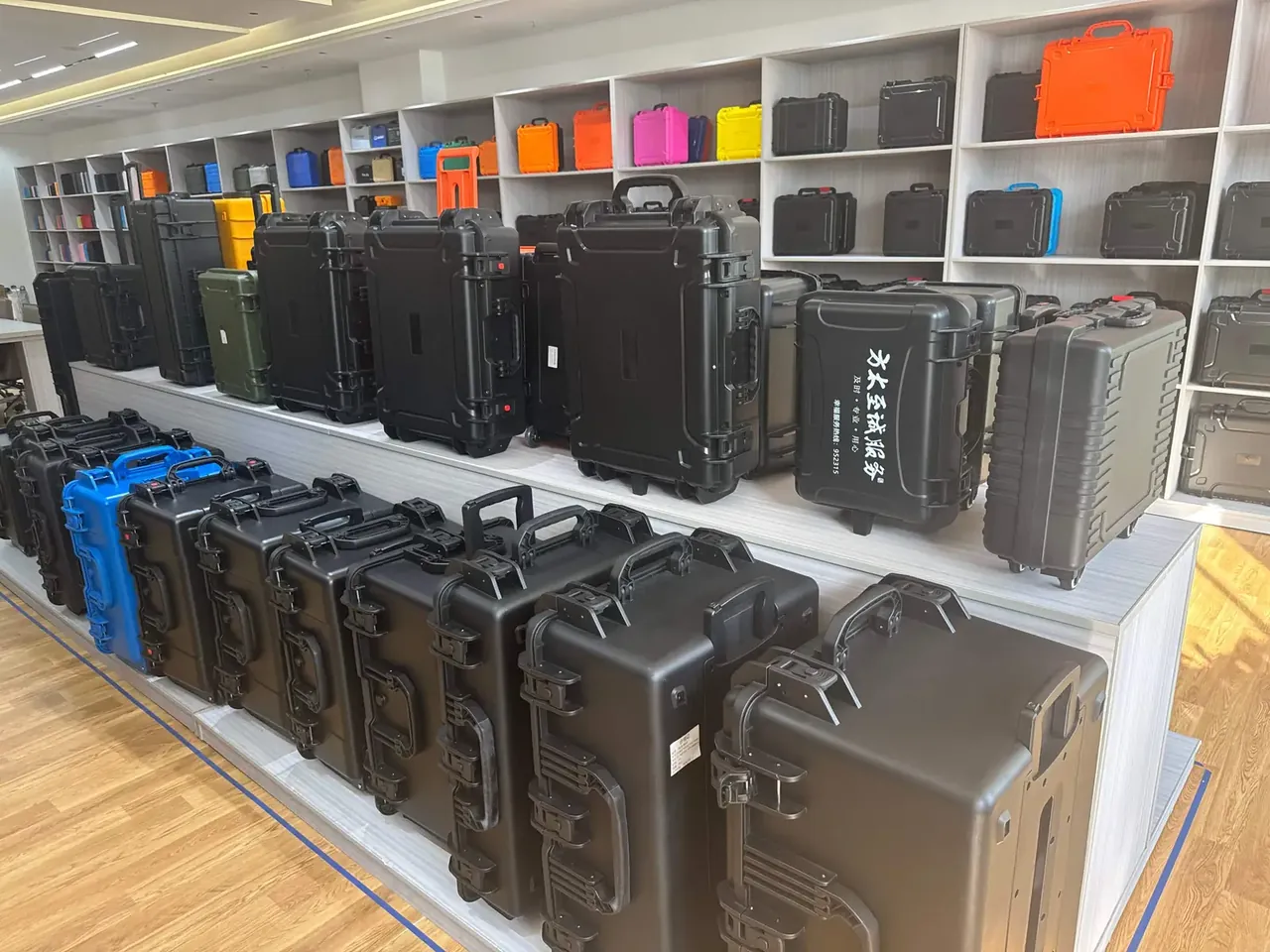
Quick answer: Acceptance for a rotationally molded case runs in three layers: zero acceptance for critical defects, AQL 1.0 for major ones, 2.5 for minor ones. Every item needs a limit that fits in a record, or inspection becomes a matter of feel.
Table of contents
- Grading defects before listing items
- Sampling and what counts as a lot
- Limits for size and weight
- Limits for appearance and colour
- Re-verification and disposition
- FAQ
1. Grading defects before listing items
The first decision is the defect grade, not the checklist. The same scratch is minor on a stacking face and major on the lid sealing face, where it lets a rotationally molded case leak. Grade by consequence: weakened protection is critical, affected assembly or service life is major, appearance alone is minor. Mix them and bad lots ship while good cases get picked over.
| Grade | Typical items | Judgment | Disposition |
|---|---|---|---|
| Critical | through cracks, broken gasket groove | veto | reject the lot |
| Major | lid flatness, wall below minimum, colour shift | AQL sampling | reject or sort |
| Minor | flow lines, light scratches off the seal | concession | rework or accept |
2. Sampling and what counts as a lot
Define the lot first: one mould, one material batch, one colour, one shift. An order of five hundred rotationally molded cases at level II gives a sample of fifty, which two inspectors clear in an hour.
Publish acceptance numbers so nobody asks permission: critical 0 and 1, major 1 and 2, minor 3 and 4. Below fifty pieces inspect everything; above three thousand two hundred the sample steps up.
| Lot size | Sample | Critical Ac Re | Major Ac Re | Minor Ac Re |
|---|---|---|---|---|
| up to 50 | all | 0 / 1 | 0 / 1 | 1 / 2 |
| 51 to 500 | 50 | 0 / 1 | 1 / 2 | 3 / 4 |
| 501 to 3200 | 80 | 0 / 1 | 2 / 3 | 5 / 6 |
3. Limits for size and weight
Name the points and instruments, or the limits on a rotationally molded case mean nothing. Outer length, width and height take plus or minus 3 mm, the cavity plus or minus 2 mm, and the diagonals must sit within 4 mm of each other. The diagonal exposes mould distortion: a case can be right in length and width and still stack crooked.
Weight is indirect evidence of wall: plus or minus 5 percent of nominal, since the light pieces are usually the thin ones. Thickness is read at eight points, four base corners, base centre, lid centre and both side walls, the smallest above 85 percent of nominal.
4. Limits for appearance and colour
Appearance on a rotationally molded case is judged by face. Sealing face, stacking face and handle root take no scratches, sink marks or flash; other faces allow flow lines to 0.3 mm. Flash gets waved through, yet it holds a gap open under the gasket.
Colour is measured, not eyeballed: Delta E 2 within a lot and 3 between lots, sampled on a flat panel away from ribs. Metal parts add 48 hours of neutral salt spray at grade 9 or better.
| Item | Method | Limit | Record |
|---|---|---|---|
| Outer size | tape, three readings | plus or minus 3 mm | value per case |
| Diagonals | tape, crossed | 4 mm maximum | stop the line |
| Weight | scale | plus or minus 5 percent | value per case |
| Wall | caliper, eight points | 85 percent of nominal | ten cases per lot |
| Colour | spectrophotometer | Delta E 2 within lot | three cases per lot |
5. Re-verification and disposition
Re-verify on triggers, not the calendar: a new mould, material batch, supplier or structural change restarts the full set. Drop at 1.2 m on a corner, then check the gasket groove; hold 55 °C for four hours and confirm lid flatness moves under 1.2 mm.
A rejected rotationally molded case gets a red tag and its own stack. A concession states its scope and never goes on a sealed order; rework covers trimming, part replacement and re-marking only. Keep three cases per lot for twelve months, records for twenty-four.
Conclusion
Acceptance of a rotationally molded case rests on three layers: defect grades fix the consequence, sampling fixes the risk, limits fix the action. Write all three and nobody works by feel. If no one can say whether an out-of-limit reading is critical or minor, the standard is unfinished and no rotationally molded case should ship against it.
This article discusses only the container (case body) side of specifications and design intent, and does not cover any handling, loading or use of the contents.
Related Reading
- Acceptance standards for rotomolded cases
- How to specify a rotationally molded case
- Inspection points and replacement lines
- Common problems with military rotomolded cases
Related Products
- 8 Series — Gun Cases; Military Equipment Cases; Camera Equipment Cases; Drone Cases; Watch Cases; Knife Cases; First Aid Cases; Electronics Equipment Cases
- WL8-2812 PP Gun Case — model WL8-2812
- All protective cases and toolboxes: 7 series, 158 models