

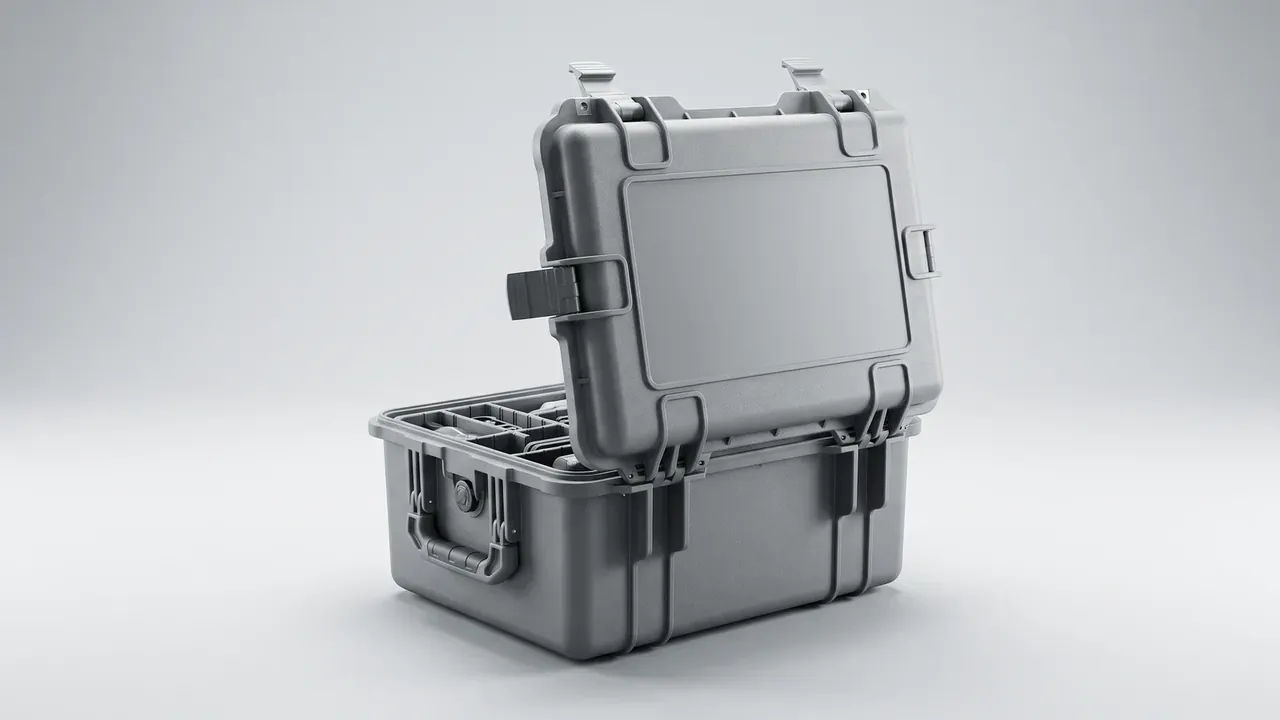
Quick answer: Acceptance for a rotomolded case runs in three steps: classify defects, fix the sampling rules, then write the pass lines as numbers.
Table of contents
- Sorting Defects Before Sampling a Rotomolded Case
- Appearance and Colour Verdicts
- Re-Measuring Dimensions and Wall Thickness
- Type Tests for Sealing and Load
- Lot Verdicts, Retests and Records
- FAQ
1. Sorting Defects Before Sampling a Rotomolded Case
Inspection rarely fails because nobody looked; it fails because findings cannot be named. A rotomolded case carries three classes: class A breaks protection, such as a through crack; class B affects life, such as wall below the lower limit; class C is cosmetic.
Take a 320-unit lot at level II: 50 units sampled, one class A finding rejects the lot, class B accepts one and rejects two, class C accepts three and rejects four.
| Class | Definition | Examples | Verdict |
|---|---|---|---|
| A | Breaks protection | Through crack, latch fault | 1 unit rejects the lot |
| B | Affects life | Thin wall, hinge offset | Sample 50, Ac 1 / Re 2 |
| C | Cosmetic only | Pitting, colour drift | Sample 50, Ac 3 / Re 4 |
Samples must also span pallet levels, with three first-off and three last-off pieces.
2. Appearance and Colour Verdicts
Appearance needs fixed viewing conditions, or two people reach two verdicts. Use 1000 lx, a 500 mm distance and a 45-degree sight line on visible faces. Pitting: three spots below 1.0 mm per face, one between 1.0 and 2.0 mm, larger is class C.
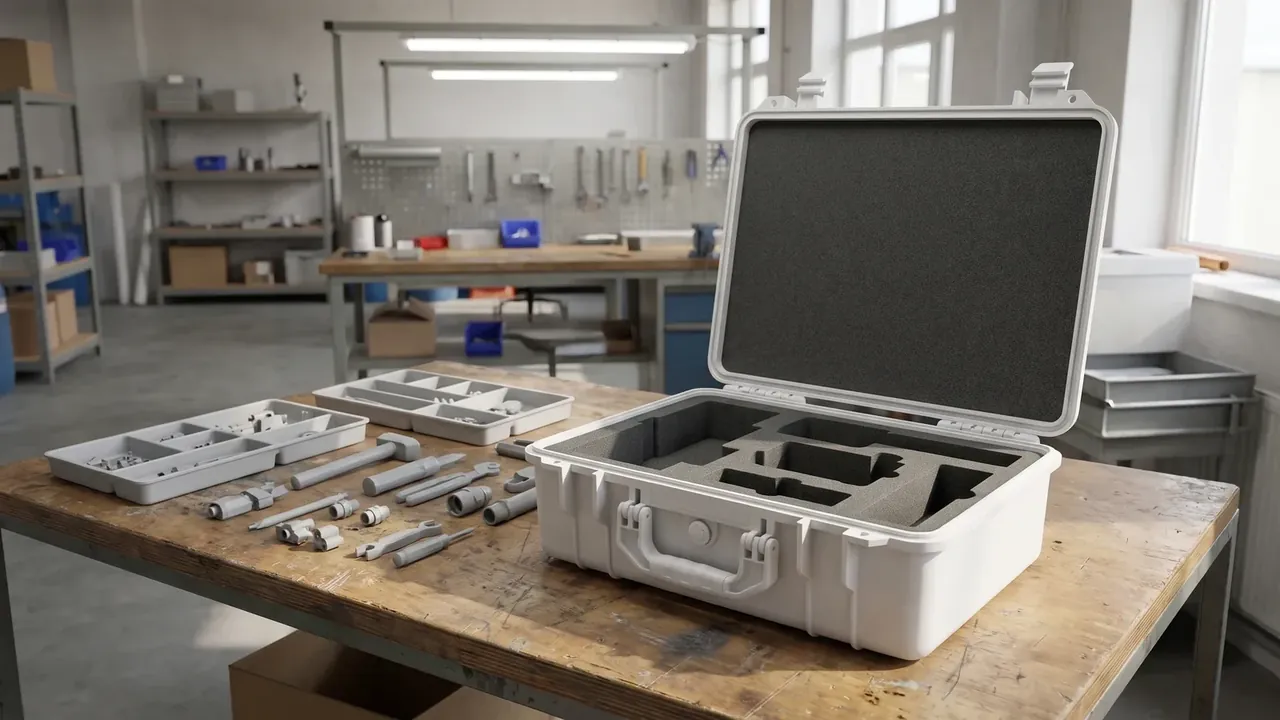
Colour is judged by instrument. Under D65 and 45/0 geometry the Lab reading stays within 1.5 of the master chip in a lot and 2.0 between lots, because three minutes of extra mould time moves yellowness by 0.8.
3. Re-Measuring Dimensions and Wall Thickness
Dimension checks need fixed points: two readings on each outer dimension, two on each cavity dimension and two diagonals, twelve figures against plus or minus 3 mm outside, 2 mm inside and 3 mm diagonal difference. Lid flatness is checked with a straight edge and feeler, under 1.0 mm.
Wall thickness uses a 5 MHz ultrasonic gauge at the same points. The pass line is spread, not one reading: 0.8 mm maximum across twelve points, and nothing below 80 percent of nominal, which is 4.0 mm on a 5.0 mm rotomolded case.
Record the environment. Polyethylene expands 1.5 x 10⁻⁴ per degree, so a 1150 mm case shifts 4.3 mm between 10 C and 35 C; measure at 23 C.
4. Type Tests for Sealing and Load
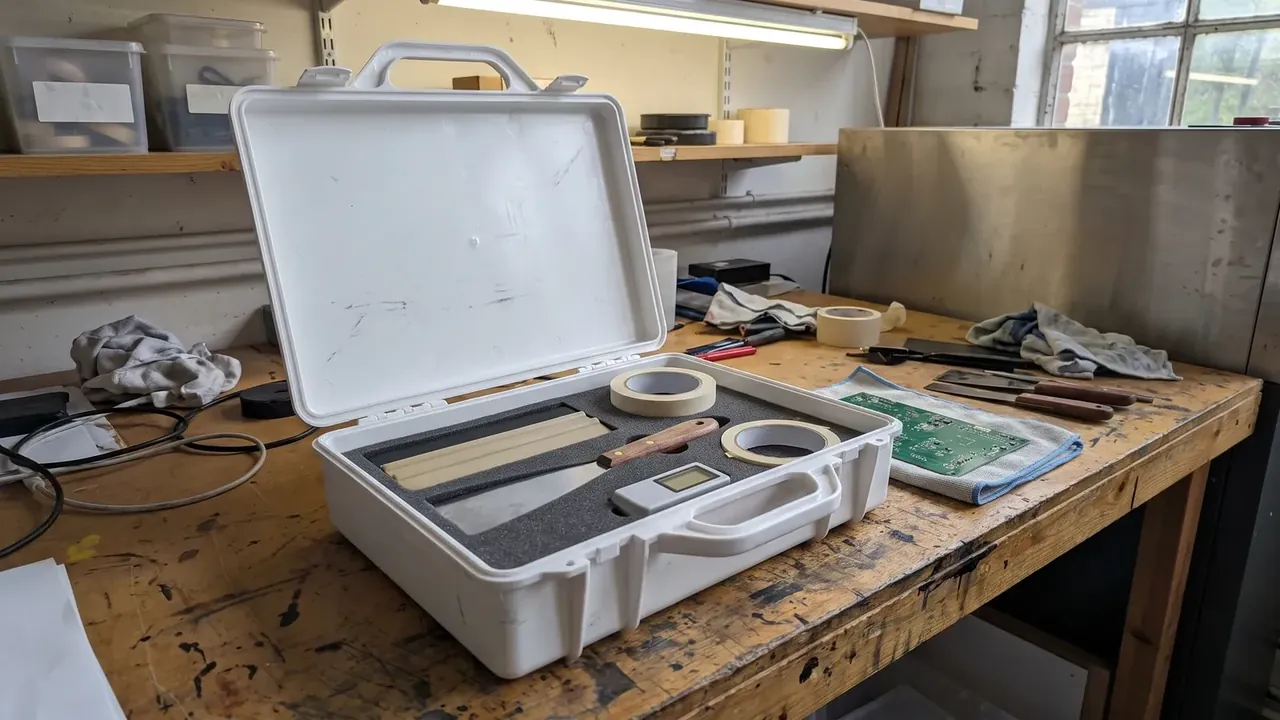
Sealing separates a rotomolded case from an ordinary tote. Empty it, close the latches, submerge 100 mm for 5 minutes, dry and reopen: a water film fails as class A. Valved models take 20 kPa for 120 seconds with a 1.5 kPa drop allowed.
| Test | Condition | Pass line |
|---|---|---|
| Immersion | 100 mm depth, 5 minutes | No water film inside |
| Pressure | 20 kPa held 120 seconds | Drop under 1.5 kPa |
| Static load | 1.5 times rating, 24 hours | Set under 2 mm |
| Drop | 1.1 m, six faces and four corners | No crack, latches shut |
Top load is 800 kg for 24 hours with no collapse. Hardware takes -25 C for four hours and 48 hours of neutral salt spray; service life is 5000 closures, with latch pull checked every 1000.
5. Lot Verdicts, Retests and Records
Verdicts must be fixed first. One class A unit rejects the lot with no retest; two class B units in 50 trigger a sample of 100, and three cumulative findings reject; class C accepts three and rejects four.
| Lot size | Sample | Class A | Class B | Class C |
|---|---|---|---|---|
| 51 to 150 | 20 | 0 / 1 | 1 / 2 | 2 / 3 |
| 151 to 500 | 50 | 0 / 1 | 1 / 2 | 3 / 4 |
| Over 501 | 80 | 0 / 1 | 2 / 3 | 5 / 6 |
Records are part of acceptance: lot number, mould number, powder batch, twelve dimensions, twelve wall readings, the Lab value and test results, kept three years, or a crack a year later cannot be traced. Retests use fresh samples only; a failing lot is best handled by concession with a written price adjustment.
Conclusion
Acceptance for a rotomolded case comes down to three habits: class the defects, write the verdicts as numbers, keep the records. Together they make inspection repeatable rather than personal, which is what a rotomolded case acceptance standard delivers.
This article discusses only the container (case body) side of specifications and design intent, and does not cover any handling, loading or use of the contents.
Related Reading
- How the structure and process work
- Field problems and their fixes
- Maintenance intervals and checks
- Rotomolded case versus alternative builds
Related Products
- 8 Series — Gun Cases; Military Equipment Cases; Camera Equipment Cases; Drone Cases; Watch Cases; Knife Cases; First Aid Cases; Electronics Equipment Cases
- WL8-2812 PP Gun Case — model WL8-2812
- All protective cases and toolboxes: 7 series, 158 models