

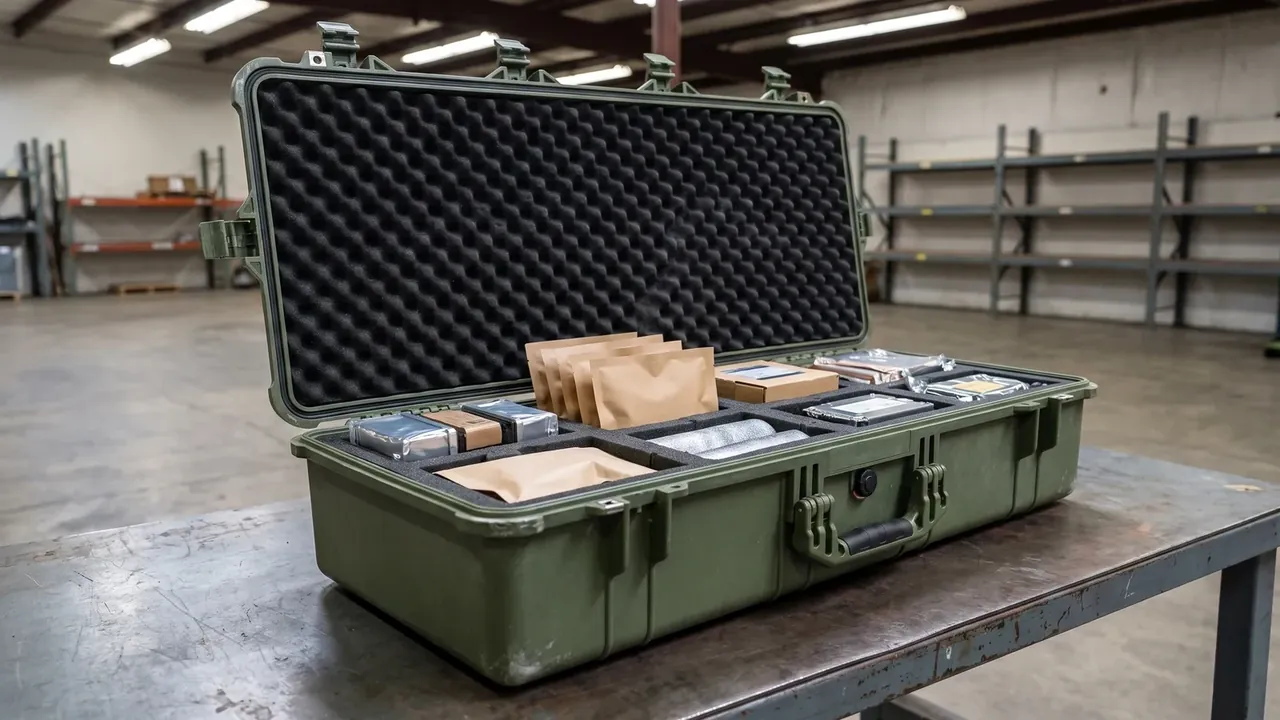
Quick answer: A rotomolded case competes with blow molded, bent metal and thermoformed panel cases. The gap is not one strength figure but four items: tooling, break-even volume, wall and rib freedom, repairability.
Table of contents
- Four Comparable Items to Align First
- Wall and Rib Freedom Against Blow Molded Cases
- Weight and Repair Cost Against Bent Metal Cases
- Stiffness and Volume Threshold Against Thermoformed Panels
- Reading the Four Options in One Table
- FAQ
1. Four Comparable Items to Align First
Options compare only when four parameters line up: outer size and internal volume, wall thickness with rib layout, annual volume, and repairability. Let one drift thirty percent and every cost figure afterwards is meaningless.
Tooling outlay decides whether a small batch starts; break-even volume decides where two cost curves cross. Wall freedom decides rib count, repairability the year-five bill.
| Item | What to pin down | Cost of skipping it |
|---|---|---|
| Size and volume | Outer size, internal clear size, wheels | Unit prices on different volumes |
| Wall and ribs | Nominal wall, rib count, rib depth | Thin-wall price against a thick-wall part |
| Annual volume | First-year take, three-year forecast | Break-even miscalculated, decision reversed |
| Repair path | Field welding, spare part commonality | Rework and replacement left out |
2. Wall and Rib Freedom Against Blow Molded Cases
Blow molding pushes a parison against the mold wall with air, so thickness follows the parison and thins at corners. At the same outer size, blow molded walls run 2 to 3 mm; a rotomolded case holds 4 to 6 mm with both faces within 0.8 mm. A 4.5 mm wall with four recessed ribs stacks five tiers at 320 kg on top; a blow molded case of that footprint needs a pallet at tier three.
Rotational molds are open steel or aluminum tools, so ribs and latch seats are cut into the cavity and four to six ribs form in one shot. Blow molding manages one or two shallow ribs before the wall stretches thin. Past a 900 mm long edge, rib placement buys more than another 0.5 mm of wall.
3. Weight and Repair Cost Against Bent Metal Cases
Bent sheet metal skips heavy tooling; fixtures at about CNY 12,000 start a small batch. The price is weight and corrosion. At 80 liters, a rotomolded case weighs 9.2 kg empty, cold rolled steel 15.6 kg, aluminum 6.8 kg. In humid sea freight, steel rusts at folded edges and welds after 240 hours of salt spray, and the fix means sanding and repainting.
Polyethylene shells take hot air welding at 210 to 230 °C, keeping roughly 85 percent of the original falling-dart strength. Repainting metal rarely hides the scar, leaving about 2 color-difference units against the sample.
4. Stiffness and Volume Threshold Against Thermoformed Panels
A thermoformed case is an ABS sheet drawn over a tool and riveted to an aluminum frame. The tool costs about CNY 35,000 and arrives in ten days. The shell is 2.5 mm thick, so stiffness sits in the frame; a sharp corner leaves a dent that will not spring back.
Below 250 units a year, a panel case lands about 18 percent under a rotomolded case, because tooling amortization and per-unit labour vanish. Above 600 units, the rotomolded case pulls ahead on unit cost and stops paying frame riveting labour. Between the two, check the long edge.
5. Reading the Four Options in One Table
Read in order: volume, outer size, repair method, then unit price. Price comes last; once the first two are wrong the figure means nothing.
| Item | Rotomolded case | Blow molded case | Bent metal case | Thermoformed case |
|---|---|---|---|---|
| Main tooling | Steel mold, CNY 80,000 | CNY 140,000 | Fixtures, CNY 12,000 | Aluminium tool, CNY 35,000 |
| Typical wall | 4 to 6 mm | 2 to 3 mm | 1.0 to 1.5 mm steel | 2.5 mm sheet |
| Empty weight, 80 liters | 9.2 kg | 7.5 kg | 15.6 kg steel, 6.8 kg aluminum | 5.4 kg |
| Tooling lead time | 22 to 28 days | 25 to 35 days | 7 to 10 days | 10 to 15 days |
Under 250 units, thermoformed and metal routes move faster. Between 250 and 600, size and duty cycle decide. Above 600 units with a long edge past one meter, a rotomolded case has amortized its mold and wall freedom turns into an advantage. Read repair second: capability sets the year-five bill, a quotation shows only year one.
Conclusion
No route wins everywhere; each has a volume band where it makes sense. The real strengths of a rotomolded case are wall and rib freedom, a corrosion path with no metal substrate, and a shell that is welded rather than scrapped. Its weakness is tooling outlay and per-unit labour. Put volume, size and repair method into the enquiry, and the rotomolded case comparison will hold up.
This article discusses only the container (case body) side of specifications and design intent, and does not cover any handling, loading or use of the contents.
Related Reading
- Rotomolded case vs injection molded case
- What a rotomolded case is
- Military case setups for field and sea freight
- Low-temperature embrittlement and seal failure
Related Products
- 8 Series — Gun Cases; Military Equipment Cases; Camera Equipment Cases; Drone Cases; Watch Cases; Knife Cases; First Aid Cases; Electronics Equipment Cases
- WL8-2812 PP Gun Case — model WL8-2812
- All protective cases and toolboxes: 7 series, 158 models