

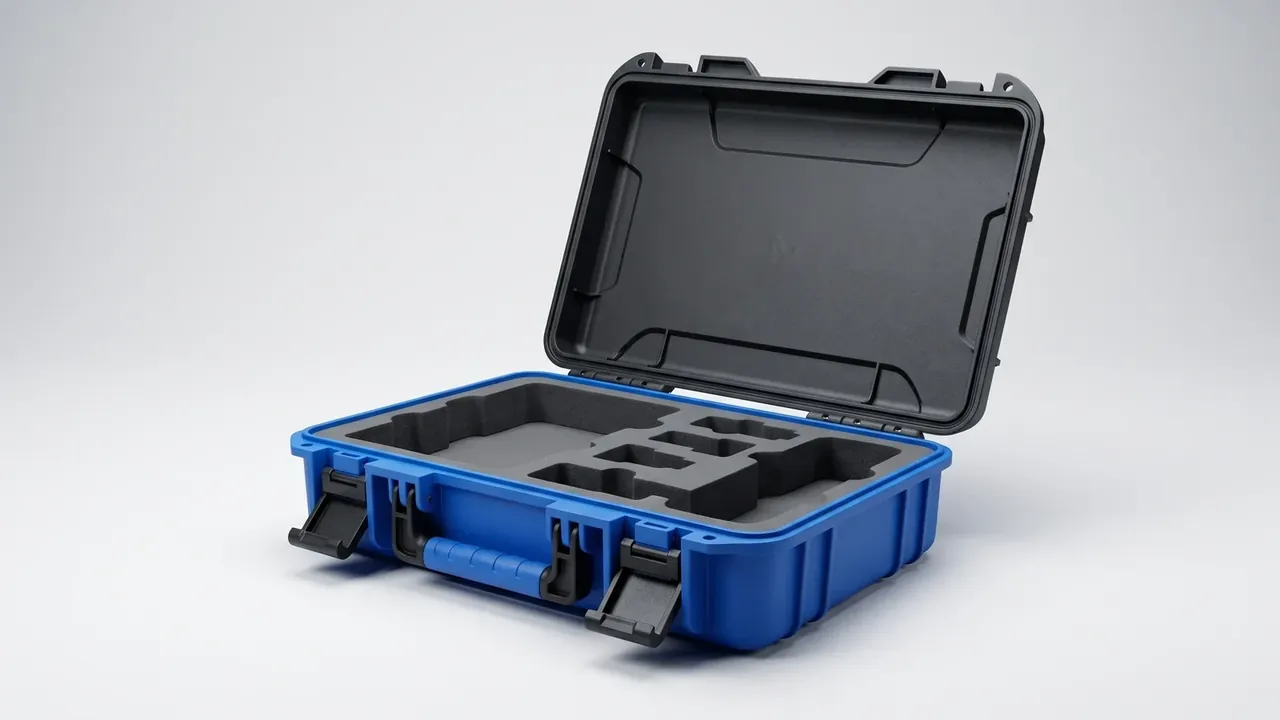
Quick answer: Acceptance of a shockproof plastic case rests on three measurable groups: drop height and a ten-drop sequence set by packed mass, a vibration spectrum with a resonance dwell, and a peak acceleration limit on a dummy load inside the case.
Table of contents
- Where the acceptance criteria come from
- Drop height and drop count by packed mass
- Vibration spectrum, dwell and in-package g levels
- Field re-test and disposition of failures
- FAQ
1. Where the acceptance criteria come from
Before dawn a shockproof plastic case leaves a cold store at minus twenty degrees Celsius and is loaded onto a six-tonne truck for three hundred and eighty kilometres of mountain road. The bay warms to twenty-two degrees on the way, a forty-two-kelvin swing, and the twenty-three-kilogram unit inside has its centre offset left. Acceptance that stops at able to take a knock has verified nothing. Three questions follow: which test clause applies, how the condition is reproduced on site, and what happens when a sample fails.
The criteria fall into three layers, and each settles a different question.
| Layer | Question it settles | Reference clause | Evidence retained |
|---|---|---|---|
| Design | Does cushion travel match static stress | Cushion curve and static stress | Calculation sheet and curve family |
| Type test | Does the design hold at the limit | Free-fall drop and random vibration methods | Sample serials and raw time histories |
| Routine test | Is this batch built the same way | Latch preload, insert fit clearance | Record for every unit |
2. Drop height and drop count by packed mass
Drop height is banded by packed mass. A shockproof plastic case at twenty-eight kilograms corresponds to zero point six six metres; at eleven kilograms it corresponds to zero point eight one metres. That hundred and fifty millimetres changes the cushion travel. One flat height is too gentle for the light unit and too harsh for the heavy one.
| Packed mass | Drop height | Face drops | Edge and corner |
|---|---|---|---|
| Up to 9 kg | 1.07 m | Six, one per face | One corner, three edges |
| 9 to 18 kg | 0.81 m | Six, one per face | One corner, three edges |
| 18 to 28 kg | 0.66 m | Six, one per face | One corner, three edges |
| 28 to 45 kg | 0.53 m | Six, one per face | One corner, three edges |
| Above 45 kg | 0.46 m | Six, one per face | One corner, three edges |
The sequence runs weakest corner, three edges, six faces, ten drops for the shockproof plastic case. Every attitude change needs a fresh sling point, and the release adds no initial velocity.
Four conditions decide: no latch opens, no through-wall crack appears, insert displacement stays under 3 mm, and peak acceleration on the dummy load stays under 45 g.
3. Vibration spectrum, dwell and in-package g levels
Vibration is where a shockproof plastic case is easiest to fake: a spectrum cannot be seen, and one grms figure hides almost anything. A complete clause states five things.
- Shape: a flat 0.015 g²/Hz plateau from 10 to 100 Hz, rolling off 6 dB per octave from 100 to 500 Hz.
- Level: 1.2 grms overall, near the floor response of a loaded six-tonne truck.
- Duration: 45 minutes on each axis, never combined into one run.
- Resonance: a 0.5 g sine sweep from 5 to 200 Hz at one octave per minute, then a 15-minute dwell at the peak.
- Instrumentation: one accelerometer per bottom corner and one on the dummy load, sampled at 5 kHz.
The dwell is the first item to be dropped. A moulded case usually resonates between 35 and 70 Hz, exactly where a loaded truck floor carries most energy, and a sweep passes through it too fast to show damage. Fifteen minutes of dwell forces the fatigue mark out of the insert. Judgement reads two figures: peak on the dummy load below 45 g as a 6-millisecond half-sine, and no through-thickness mark between insert and wall. The transducer sits on the vertical projection of the load centre, since ten millimetres of offset shifts the reading by three to five g.
4. Field re-test and disposition of failures
With no shaker on site, re-testing covers two things: a repeat drop and an assembly check.
The repeat drop uses a sling and quick-release hook, height measured from the lowest point and held within 5 mm; each unit takes one corner and one long edge. The assembly check pulls each latch at 60 N for ten seconds, then measures insert clearance with a depth gauge.
| Observation | Verdict | Disposition | Re-check |
|---|---|---|---|
| Latch opens during a drop | Unit failure | Double the sample to six | All six repeat the drop |
| Through-wall crack | Batch failure | Reject, no re-test | Change resin or ribs, resubmit |
| Insert shift above 3 mm | Unit failure | Replace insert | Two more drops, same attitude |
| Peak between 46 and 50 g | Conditional pass | Add 5 mm to the base pad | Re-test the same point |
| Raw time history missing | Report invalid | Re-test | Averages are not accepted |
Conclusion
Acceptance of a shockproof plastic case is a list that turns a claim into numbers: drop heights banded by mass, a ten-drop sequence, a vibration spectrum with a dwell, and a 45 g ceiling inside the case. Clear clauses, a repeatable field method and graded disposition give the report its authority. Written into the contract annex, they make a shockproof plastic case genuinely qualified.
This article discusses only the container (case body) side of specifications and design intent, and does not cover any handling, loading or use of the contents.
Related Reading
- Airdrop case acceptance items and pass limits
- Pallet and case marking conventions
- Process checkpoints in production SOPs
Related Products
- 8 Series — Gun Cases; Military Equipment Cases; Camera Equipment Cases; Drone Cases; Watch Cases; Knife Cases; First Aid Cases; Electronics Equipment Cases
- WL8-2812 PP Gun Case — model WL8-2812
- All protective cases and toolboxes: 7 series, 158 models