

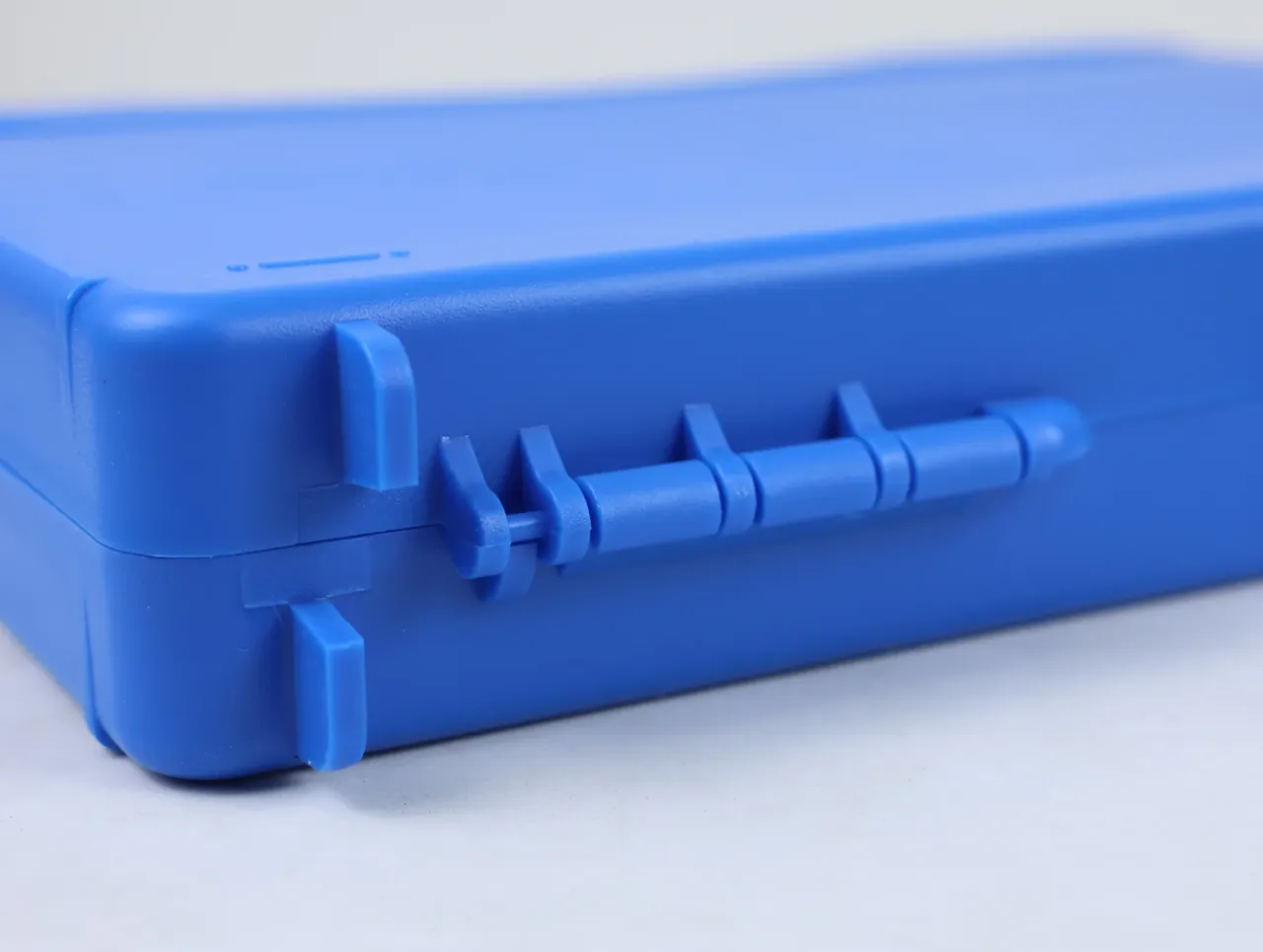
Quick answer: A small plastic case is sized inside out: part dimensions set the cavity, span and stacking set the wall, draft and radii close the chain. Two parts of 96 by 62 by 38 mm give a 198 by 66 by 44 mm cavity, a 1.2 mm wall and a 201 by 69 by 53 mm outside.
Table of contents
- Cavity Size Starts From the Part
- Picking Wall Thickness
- Draft Angle That Still Releases
- Ribs and Radii Restore Stiffness
- Turning the Chain Into a Spec Sheet
- FAQ
1. Cavity Size Starts From the Part
The load is 96 by 62 by 38 mm, two pieces side by side at 0.35 kg each. The outside of a small plastic case follows from those numbers, it is not a guess.
Length comes from three gaps and two pieces: 96 times 2 plus 2 times 3, or 198 mm. Width holds one row, so 62 plus 2 twice gives 66 mm. Depth is 38 plus 4 mm on top plus 2 mm of base rib, or 44 mm.
The allowance is not padding: 2 mm at the sides leaves finger room, under 1.5 mm the part cannot be gripped with a glove.
| Step | Basis | Result |
|---|---|---|
| Part envelope | Measured | 96 by 62 by 38 mm |
| Cavity length | 96 x 2 plus 2 x 3 | 198 mm |
| Cavity width | 62 plus 2 x 2 | 66 mm |
| Cavity depth | 38 plus 4 plus 2 | 44 mm |
Running the chain backwards costs money: size the outside first and the cavity lands 3 to 5 mm short, made up by thicker walls that add weight, not space.
2. Picking Wall Thickness
Two figures decide the wall: a 198 mm base span and a stack four high.
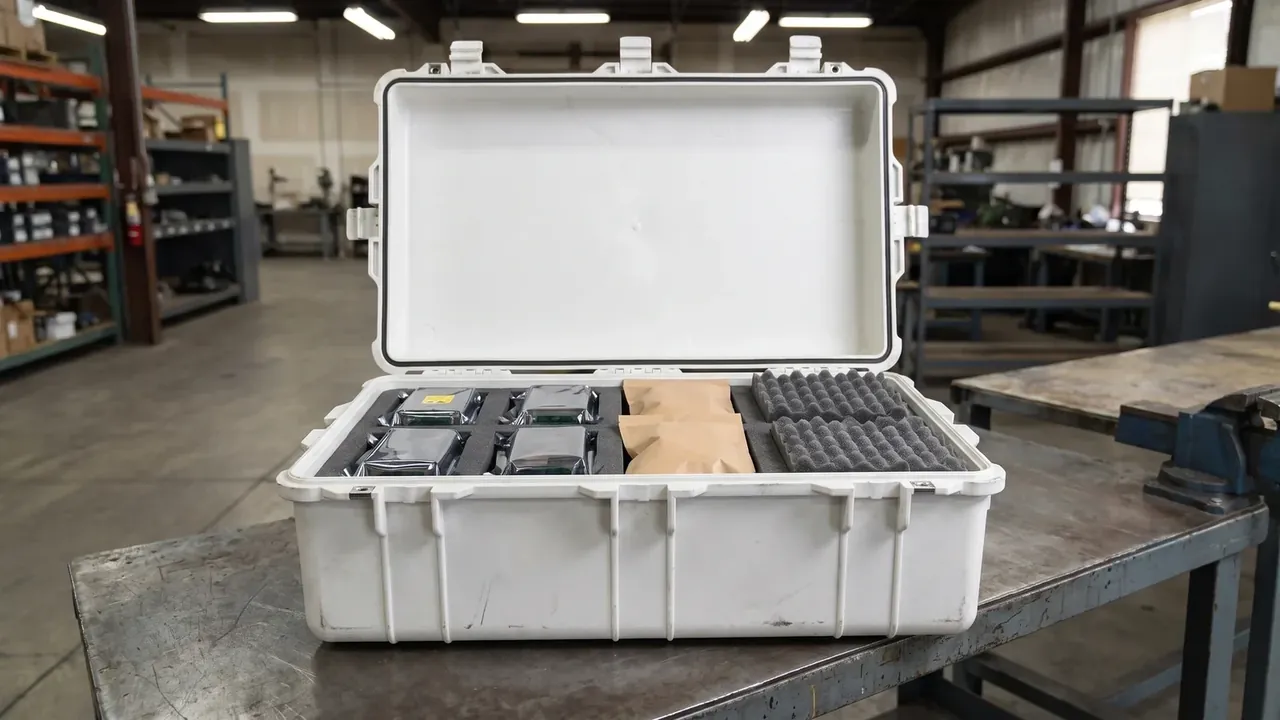
At four high the bottom case carries 1.86 kg over 198 by 66 mm, under 1.5 kPa, so stiffness decides rather than strength.
A 0.8 mm wall holds only below 120 mm span unstacked; at 198 mm, 45 degrees Celsius for 24 hours sags the base 1.6 mm.
| Wall | Max span | Stack | Unit weight | Use |
|---|---|---|---|---|
| 0.8 mm | 120 mm | 1 high | Under 0.3 kg | Disposable inserts |
| 1.0 mm | 160 mm | 2 high | Under 0.8 kg | Spare part packs |
| 1.2 mm | 220 mm | 4 high | Under 1.5 kg | General parts |
| 1.6 mm | 300 mm | 6 high | Under 3 kg | Heavy parts |
Thicker is not stronger. At 1.6 mm unit weight is 0.78 kg, so the bottom case carries 2.34 kg at four high. Cooling time grows, sections above 2.2 mm sink, base flatness falls from 0.4 to 0.9 mm, and a sink mark on a sealing face widens the closed gap from 0.5 to 0.8 mm. PP shrink runs at 1.6 percent, so the thicker the wall, the harder the tolerance. Fix span and stack, step up one grade, stop.
3. Draft Angle That Still Releases
On a 44 mm cavity, 0.5 degree releases 0.38 mm per side, 0.77 mm across.
That is the floor for ejection: below half a degree the wall rubs the tool and leaves drag marks at the rim.
- Plain cavities 30 mm and deeper take 0.5 degree, the minimum.
- Textured faces take 1 degree; 0.1 mm grain barely clears at that.
- Keep every cavity in one case on one angle, or ejection twists the body.
Draft also reaches the outside numbers: half a degree over 44 mm adds 0.38 mm per side, so the outside runs 0.8 mm larger than wall thickness suggests, and 1 degree doubles that to 1.5 mm.
4. Ribs and Radii Restore Stiffness
With the small plastic case wall at 1.2 mm, the rest of the stiffness comes from ribs and radii.
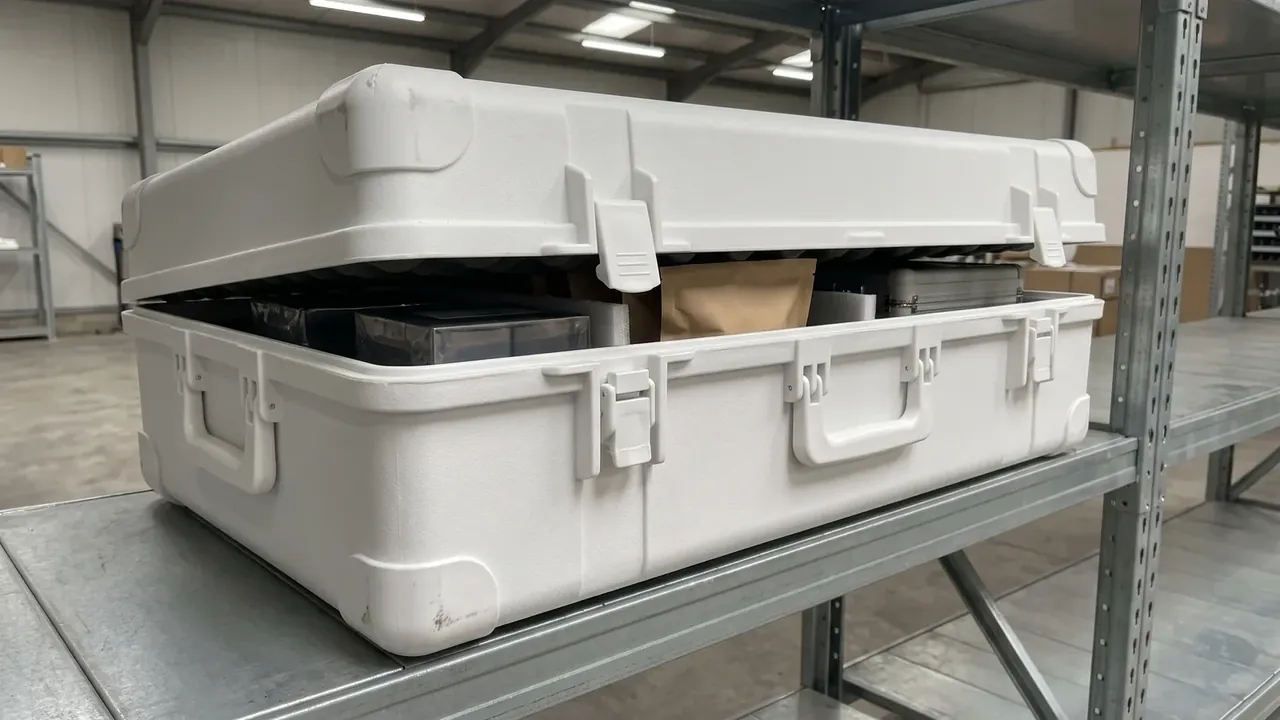
Base ribs run as a grid at 0.6 times the wall: 0.72 mm thick, 6 mm tall, 45 mm apart, so rib and wall cool together. A thicker rib pulls a sink on the opposite face.
Every rib root needs R0.5: a square root concentrates stress, and a 1.0 m twelve-corner drop cracks it 15 mm along. Inside corners take R3 and outside R5, so the cavity wipes clean and a knock only scuffs.
5. Turning the Chain Into a Spec Sheet
The chain ends as a toolmaker table.
| Parameter | Value | Tolerance |
|---|---|---|
| Outside | 201 by 69 by 53 mm | Plus or minus 0.3 mm |
| Cavity | 198 by 66 by 44 mm | Plus or minus 0.2 mm |
| Wall | 1.2 mm | Plus or minus 0.08 mm |
| Draft | 0.5 degree | Not under 0.4 degree |
| Base flatness | 0.4 mm | Not over 0.6 mm |
| Closed gap | 0.5 mm | Not over 0.8 mm |
Base flatness and closed gap get cut most often, yet both decide dust control and stack stability: at 0.6 mm flatness a four-high stack rocks 2 mm.
Three checks settle a sample: cavity size, base flatness, and sink after 24 hours at four high.
Conclusion
The small plastic case spec is a one-way chain: part size sets the cavity, span and stacking set the wall, draft and radii decide what the tool can make. Change one number and three others move, so walk the chain before cutting steel on any small plastic case.
This article discusses only the container (case body) side of specifications and design intent, and does not cover any handling, loading or use of the contents.
Related Reading
- Ammunition box dimension chains
- Where a small case is used
- Selection criteria for small cases
- Tooling changes in small batches
Related Products
- 8 Series — Gun Cases; Military Equipment Cases; Camera Equipment Cases; Drone Cases; Watch Cases; Knife Cases; First Aid Cases; Electronics Equipment Cases
- WL8-2812 PP Gun Case — model WL8-2812
- All protective cases and toolboxes: 7 series, 158 models