

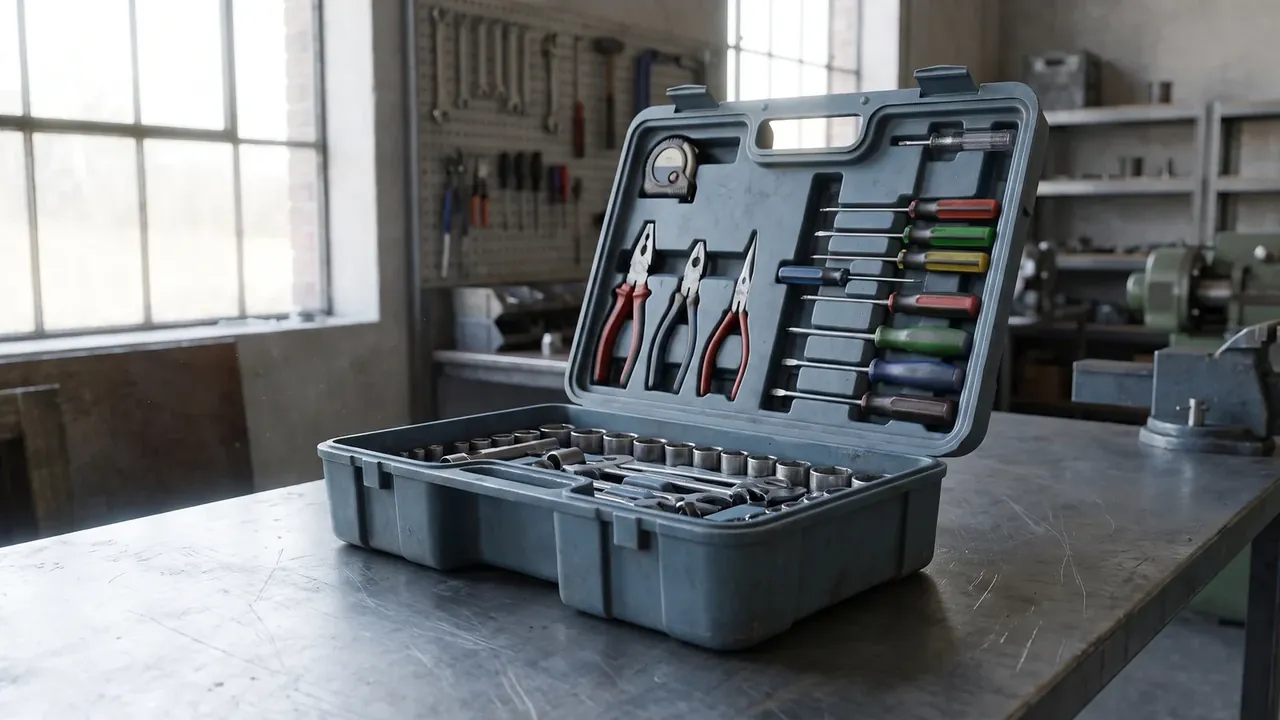
Quick answer: A socket wrench set case is priced in six blocks — shell, insert, hardware, assembly, packing, freight — with tooling amortised across the order. MOQ splits by colour change, insert change and new mould, and ten weeks runs from drawing to shipment, so inspection gates belong in the contract first.
Table of contents
- Socket wrench set case procurement: what the price is made of
- Amortising the mould and the cutting die
- Three MOQ tiers and mixed loading
- Scheduling samples and mass production
- Inspection gates, payment and claims
- FAQ
1. Socket wrench set case procurement: what the price is made of
One number, "thirty-eight yuan a case", survives the meeting and fails the cost sheet. Split the socket wrench set case quote instead.
| Block | Basis | Share |
|---|---|---|
| Shell | Part weight × resin price, plus processing | 40 to 46 percent |
| Insert | Die area × material thickness | 16 to 22 percent |
| Hardware | Latches and hinges, per set | 10 to 14 percent |
| Assembly | Station time × takt | 12 to 16 percent |
| Packing | Inner and outer carton, dividers | 6 to 9 percent |
| Freight | Chargeable weight × lane rate | 4 to 8 percent |
Shell and insert are where quotes turn vague. A shell quoted at 585 g against a true 620 g saves 0.34 yuan a unit at 9800 yuan a tonne — 1700 yuan across 5000 pieces, with both cases identical; weigh the first article against the mould plate. For the insert, ask for the flat pattern: die area runs fifteen to twenty percent above the footprint.
2. Amortising the mould and the cutting die
Tooling is not one-off but deferred into unit price: a single-cavity shell mould at 46,000 yuan, an insert die at 2200, a lid screen at 300. Who pays for the socket wrench set case tooling decides the gap between order one and order ten.
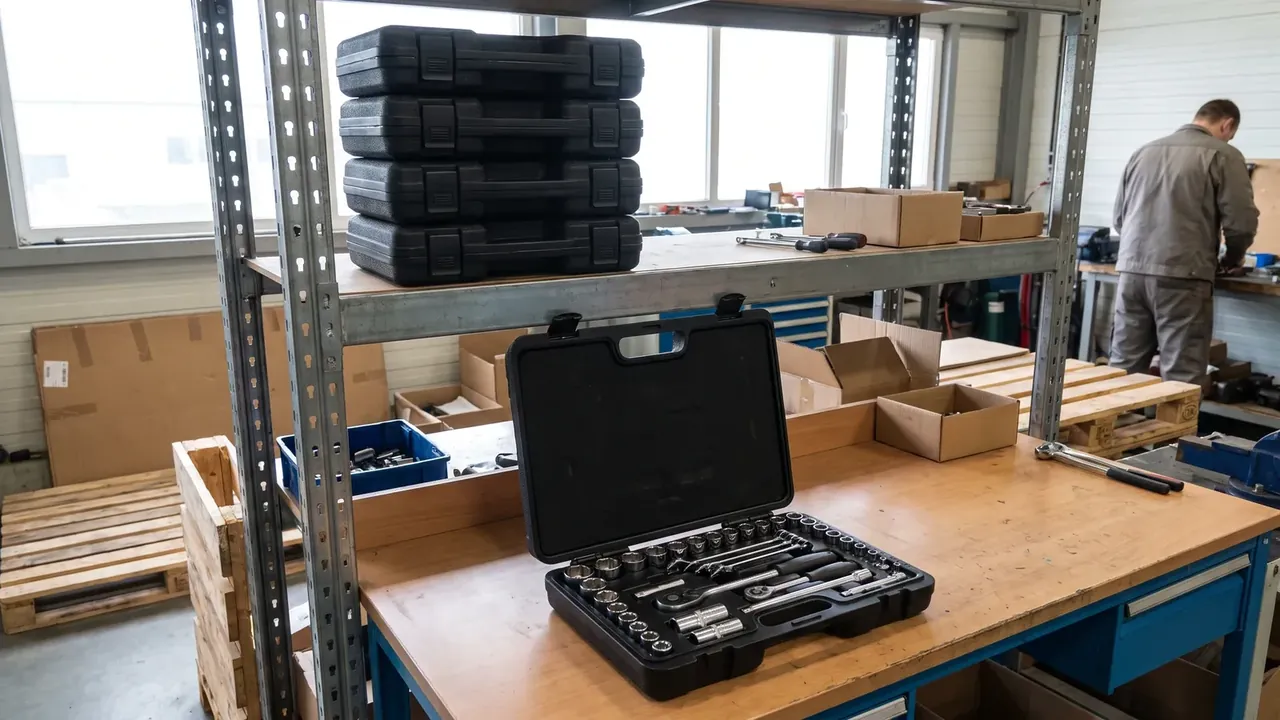
| Order quantity | Mould per unit | Die per unit | Total |
|---|---|---|---|
| 5000 | 9.20 | 0.44 | 9.64 |
| 10,000 | 4.60 | 0.22 | 4.82 |
| 30,000 | 1.53 | 0.07 | 1.60 |
The rule is counter-intuitive: 5000 to 30,000 pieces cuts 8.04 yuan a unit, more than negotiation achieves, so agree volume first. Ownership takes one of three clauses — bought outright, supplier-held, or amortised with a step-down. Mould life joins it: 300,000 shots, then a repair costs 8000 yuan.
3. Three MOQ tiers and mixed loading
MOQ is changeover cost converted into units. A colour change purges the machine for forty minutes and eight kilos of scrap — 70 yuan of material plus two hours of press time; a new insert means re-cutting and die adjustment, over 800 yuan. Hence three tiers: 500 pieces for colour change at about 1.20 yuan extra, 1000 for a new insert die, 3000 before a new shell mould.
Two rules govern mixed loading: inserts must share one shell, or production splits in two, and carton labels follow the insert, since mixed cartons mean relabelling every box.
4. Scheduling samples and mass production
"Two months" is not a lead time; a stage plan is: 12 days for the hand sample, 28 for the mould, 6 for trial approval, 8 for insert samples, 30 for production, 22 for sea freight to a European port. Insert sampling overlaps with mould cutting, saving ten days.
The six days between trial and correction cannot compress: a rushed one returns as a whole first batch. Production of 3000 pieces occupies the press for six days at 500 a day, so expediting means chasing resin and a slot. Peak season pushes that slot two to three weeks, and unless the contract confirms it in writing the lead time exists on paper.
5. Inspection gates, payment and claims
Inspection happens three times: first article, thirty percent into production, and the closed container.
Payment follows the same three gates: 30 percent on order to lock the slot, 60 percent against the bill of lading, 10 percent fifteen days after inspection. That last tenth is the only lever left at the table; on a fully prepaid order, inspection becomes a courtesy. Claims need actions: appearance defects above three percent are reworked at supplier cost, a latch release or hinge crack rejects the lot on one piece, and delay past ten days carries 0.3 percent a day capped at five.
Conclusion
Socket wrench set case procurement is a cost sheet and a calendar, not a price list: split the quote, spread tooling, tier the MOQ, plan by stage, interlock payment with inspection. Five percent on price is negotiable; twenty percent hiding in an unopened line is not, and that is where the cost of a socket wrench set case lives.
This article covers container-side specifications and design implications only, not the handling, loading or use of the contents.
Related Reading
- How to read socket wrench set case specifications
- Socket wrench set cases in repair and inspection work
- How to audit a case supplier's qualifications
- Validating the tool during trial moulding
Related Products
- 8 Series — Gun Cases; Military Equipment Cases; Camera Equipment Cases; Drone Cases; Watch Cases; Knife Cases; First Aid Cases; Electronics Equipment Cases
- WL8-2812 PP Gun Case — model WL8-2812
- All protective cases and toolboxes: 7 series, 158 models