

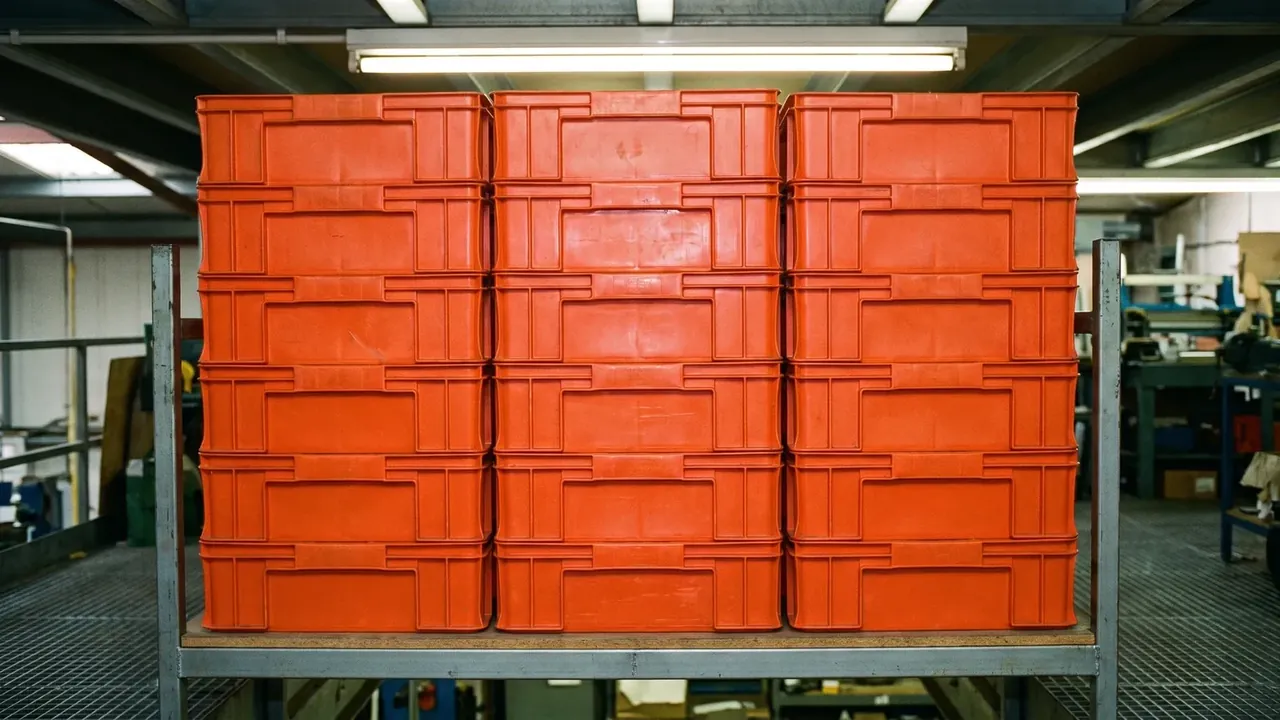
Quick answer: A Solar Equipment Transport Case for 1500 cycles runs 1200×800×600 mm at 14 kg, 6.0 mm walls, R25 corners and a 180 mm fold for 3.2 times return load.
Table of contents
- The Cycle Account Behind a Solar Equipment Transport Case
- Converting Wall Thickness into Stack Load
- Corner Radius and Crack Length After a Drop
- Pallet Fit and Fork Entry
- Folding for the Return Leg
- FAQ
1. The Cycle Account Behind a Solar Equipment Transport Case
A module travels four or five legs from the factory gate to a rooftop, and the case has to survive every one of them.
Each leg means lifting, setting down, opening, unloading, closing and restacking, so a round trip counts twice. A rooftop project sends one Solar Equipment Transport Case out about 20 times at 70 moves per trip, near 1500 cycles, which is the handling work of one project divided by the case count.
Returnable boxes in this class are usually retired after 300 to 500 loops, when corners and base ribs reach the fatigue band. Reaching 1500 means wall, corner radius and ribs move together; thickness alone only adds weight.
| Cycle band | Handling cycles | Wall | Where it fits |
|---|---|---|---|
| Single trip | 1 to 20 | 3.5 mm | One-way dispatch, scrapped on arrival |
| Standard | 300 to 500 | 4.5 mm | In-plant moves, short distribution |
| Long cycle | 1500 | 6.0 mm | Rooftop projects, inter-provincial transfer |
Settle on the band that still keeps corner cracks under 3 mm after 1500 cycles; one band thinner belongs to one-way shipments only.
2. Converting Wall Thickness into Stack Load
The 6.0 mm wall comes from the span. A 1200 mm side bows when forks lift it, and HDPE shrinks 1.5 to 3%, more along the long axis, so the moulding carries an arc that a thin wall turns into a bulge by cycle 200. Six ribs at 200 mm centres cut that span into six short ones, and deflection falls with the fourth power of span.
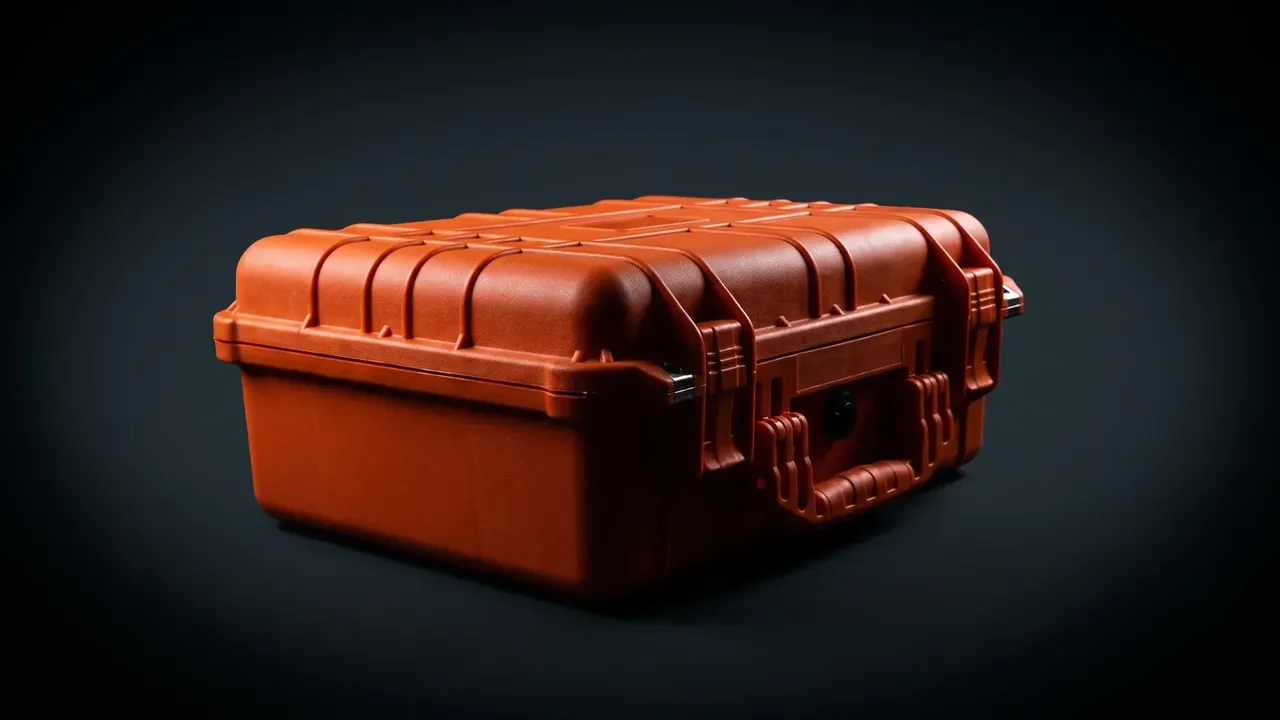
Stacking calculates separately. Rated load is 320 kg including the 14 kg shell; lid crush is 8 kN, about 815 kg, so at a safety factor of 2 one lid carries 1.27 cases, or two layers.
On a Solar Equipment Transport Case, five high never rests on the lid alone: an 18 mm deck board or 100 mm posts send the upper three layers into the pallet, leaving the lid its own gasket squeeze.
| Stack height | Load on the bottom lid | Deck board needed |
|---|---|---|
| 2 high | 320 kg | No, lid carries it |
| 5 high | 1280 kg | Yes, 18 mm board or corner posts |
| Above 5 | From 1600 kg | Steel frame, case as enclosure only |
3. Corner Radius and Crack Length After a Drop
R25 is the first item dropped when cost is squeezed. An R10 corner puts the energy of a fall on a 10 mm arc, stress passes yield and a 3 mm split opens at first impact; R25 spreads the same energy over 25 mm, cutting load per millimetre to under forty percent.
Drop testing covers 26 impacts across 6 faces, 12 edges and 8 corners from 1.2 m onto concrete, and corners are mandatory because one curved surface takes the hit. Measure crack length after each drop and retire the case past 3 mm; whitening is a stress mark, length is failure.
Service temperature runs -30 to 60 ℃. PP turns brittle near -10 ℃ and its notched impact falls to about 1 kJ/m², while HDPE holds 5 to 15 kJ/m² down to -40 ℃. An open yard in winter and a trailer roof in summer hit the same Solar Equipment Transport Case, so the resin is HDPE.
4. Pallet Fit and Fork Entry
A 1200×1000 mm pallet is the 5M module, and a 1200×800 mm case sits long side flush with 200 mm left over. That gap is not waste: forks come in from the 1000 mm side and the 200 mm keeps them off the wall.
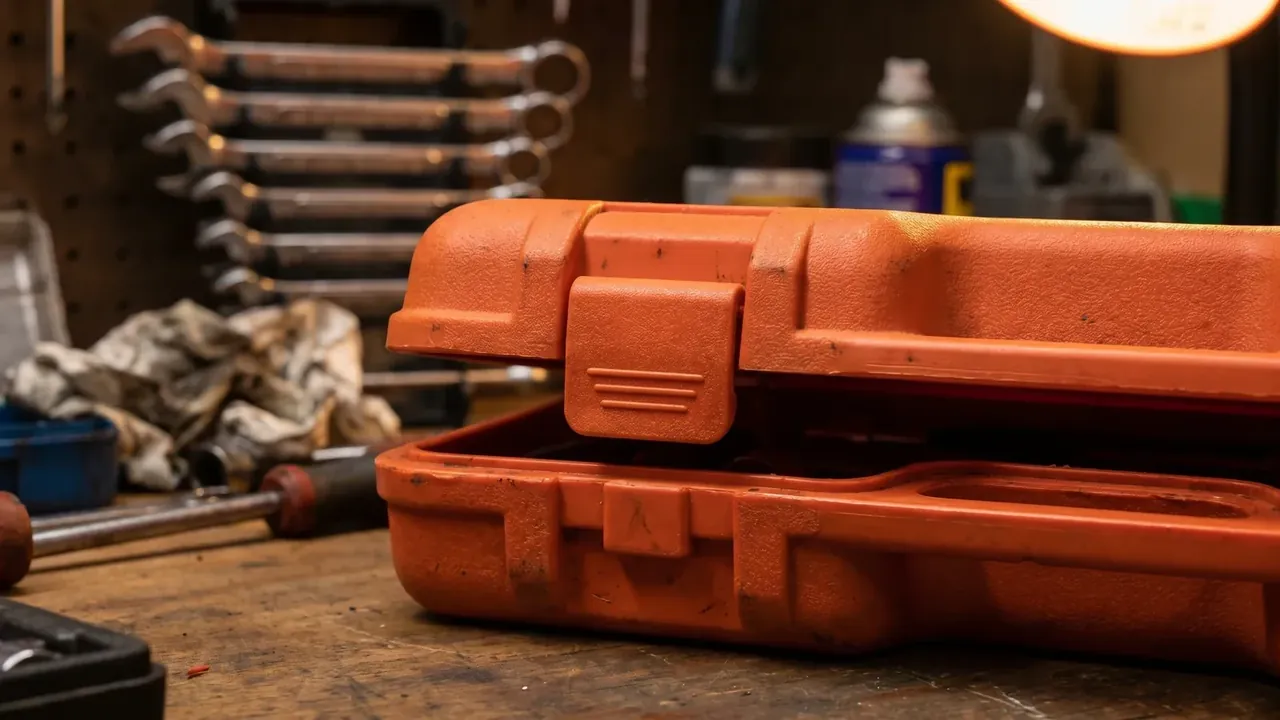
Two cases side by side reach 1600 mm, so one per pallet; extra volume can only come from height. Five cases per pallet land at 1600 kg, which is why the deck board matters more than the box count.
Fork entry height is 100 mm, the clear space under the pallet deck or the case feet. Below 100 mm forks cannot enter square, drivers tilt and stab, and the first base rib is what breaks. Mould 100 mm feet into this Solar Equipment Transport Case and keep six base ribs where the forks land.
5. Folding for the Return Leg
The return leg is where the money goes: loaded out, empty back, an empty case taking a full one's volume. Folding takes 600 mm to 180 mm, under a third of working height.
The fold lives in four side walls, crease thinned to 4.5 mm and bent through 180°, and that crease is a new fatigue point: 500 folds and the case goes, wherever it sits in the 1500.
On a Solar Equipment Transport Case the 3.2 figure comes from folded height against working height, discounted for nesting clearance and pallet height. Five folded layers stack under 1 m, so the same trailer carries 3.2 times the units.
| Return load | Folded height | Units per trailer |
|---|---|---|
| Not folded | 600 mm | Baseline, 1.0 |
| Folded flat | 180 mm | 3.2 times |
| Folded and nested | 180 mm, 40 mm nest | 3.8 times |
Conclusion
Three numbers on a Solar Equipment Transport Case hold each other up: 1500 cycles need 6.0 mm walls, those walls carry a 1200×800×600 mm body, and that body sits one per 1200×1000 mm pallet, five high with a deck board. Corners at R25 and a 180 mm fold make the 3.2 times return load real. Enlarge one alone and the other two fail near cycle 800.
This article covers container-side specifications and design intent only. It does not address any handling, loading or use of the contents.
Related Reading
- Sizing Wall Thickness from 2000 Trips
- Upright or Flat for Curtain Wall
- Three Signals to Drop the Carton
Related Products
- 8 Series — Gun Cases; Military Equipment Cases; Camera Equipment Cases; Drone Cases; Watch Cases; Knife Cases; First Aid Cases; Electronics Equipment Cases
- WL8-2812 PP Gun Case — model WL8-2812
- All protective cases and toolboxes: 7 series, 158 models