

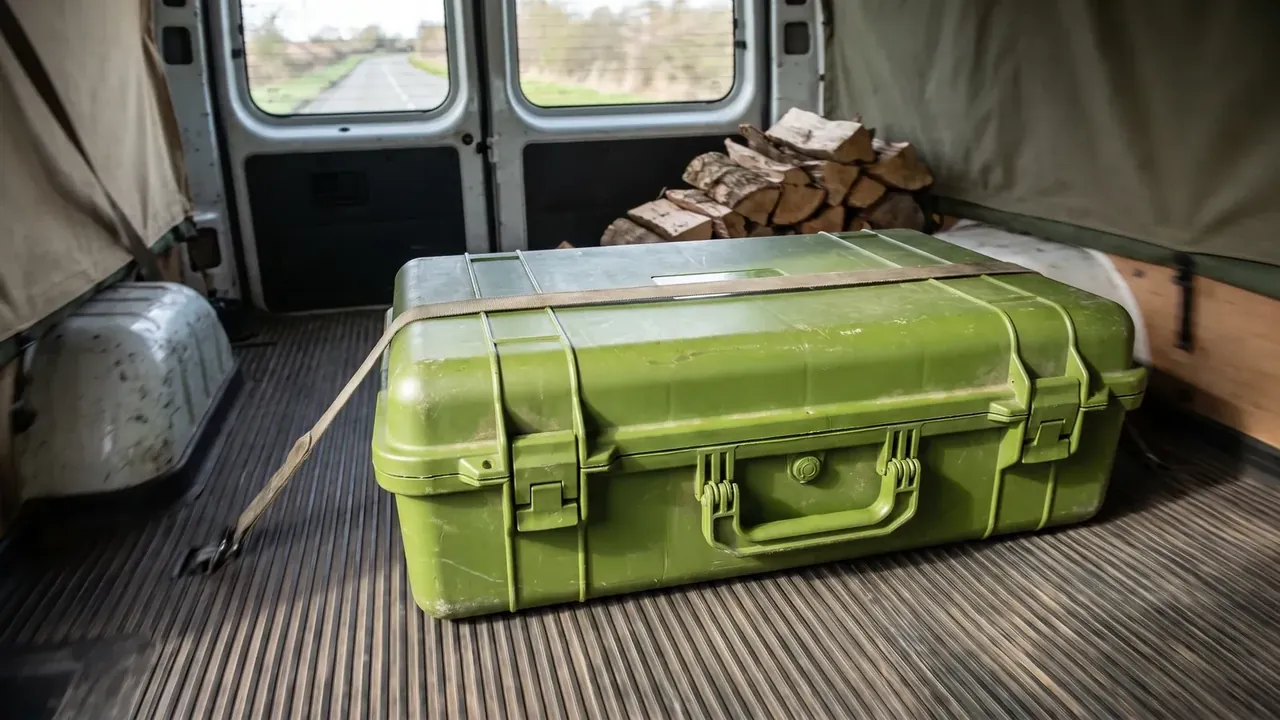
Quick answer: A custom reusable transport case is derived backwards from the life target, not picked from a catalogue. Cycle count and stack height set the load per unit, the load path sets thickness and rib pitch, and drop plus wash duty close the loop.
Table of contents
- The load path that sizes a custom reusable transport case
- Turning cycle counts into wall thickness and ribs
- Drop energy and five-high stack loads
- The structural cost of folding and recycled content
- Wash duty and acceptance parameters
- FAQ
1. The load path that sizes a custom reusable transport case
Four steps in a fixed order: stack height sets the base load, unit mass sets pressure, pressure and span set thickness, thickness and draft set ribs.
| Step | Input | Output | Value |
|---|---|---|---|
| Stack height | 2.4 m racking, 340 mm body | Base load | 5 high, 120 kg at the bottom |
| Unit mass | 8.5 kg body, 15.5 kg payload | Pressure | 24 kg over 0.42 square metres |
| Thickness | Load and a 480 mm span | Panel gauge | 3.5 mm, 4.2 mm at corners |
| Ribs | Mid-span, hinge clearance | Height, pitch | 12 mm high on a 90 mm pitch |
| Closure | 6 opens a day, 300 days | Pin, latch | 6 mm pin, 220 N per latch |
Reverse the order and a custom reusable transport case is trapped by its outline: corners thin to 2.8 mm, a rib recovers stiffness, a second mould appears.
Closures decide where a unit retires: the hinge loosens first.
2. Turning cycle counts into wall thickness and ribs
A cycle count is a life promise that converts into three wear limits: latch retention down no more than 15%, hinge clearance no more than 0.8 mm, panel wear no deeper than 0.2 mm.

500 cycles covers in-plant handling on a shelf, so 3 mm with one rib is enough. 1200 cycles covers palletised freight, calling for 3.5 mm, two long-side ribs and a 5 mm hinge boss. 2000 cycles covers a closed route, where a replaceable corner insert takes the abrasion.
Gauge and ribs are not interchangeable. Going from 3.5 mm to 4.2 mm adds 20% weight for 44% bending stiffness; the same weight on ribs can pass 60%, at the cost of extra slides and longer cooling.
Ribs are cheaper than gauge but eat cavity volume.
3. Drop energy and five-high stack loads
In a 1.2 m six-face drop, a custom reusable transport case takes the energy at corners and edges, and the panel returns it. What counts is corner radius: R8 down to R4 shifts peak acceleration by 20 g.
| Condition | Loading | Governing area | Acceptance |
|---|---|---|---|
| Six-face drop | 1.2 m, one drop per face | Corners, hinge side | 75 g or less, no release |
| Edge drop | 1.2 m on three long edges | Mid-span | No through-crack, set under 2 mm |
| Five-high stack | 120 kg for 24 h | Lid plane, posts | Creep under 1.5 mm |
| Forklift clamp | 400 N on the side wall | Side wall centre | Dent under 1 mm |
Twenty-four kilograms times five is 120 kg, spread unevenly: posts take seventy percent, the lid centre thirty. If the posts match the panel, tier four sags. A double wall at each post, 2.5 mm inside and 3.5 mm outside with a 6 mm cavity, adds 11% weight. Stacking and dropping pull in opposite directions. Stiffness goes into the posts, while the rib field in each panel stays free to buckle and recover.
4. The structural cost of folding and recycled content
A 1:3 fold ratio means the collapsed height is about a third of the open height: 340 mm down to 115 mm. It relies on a 45 mm double-wall band, 2.8 mm thick, that must survive 300 folds.
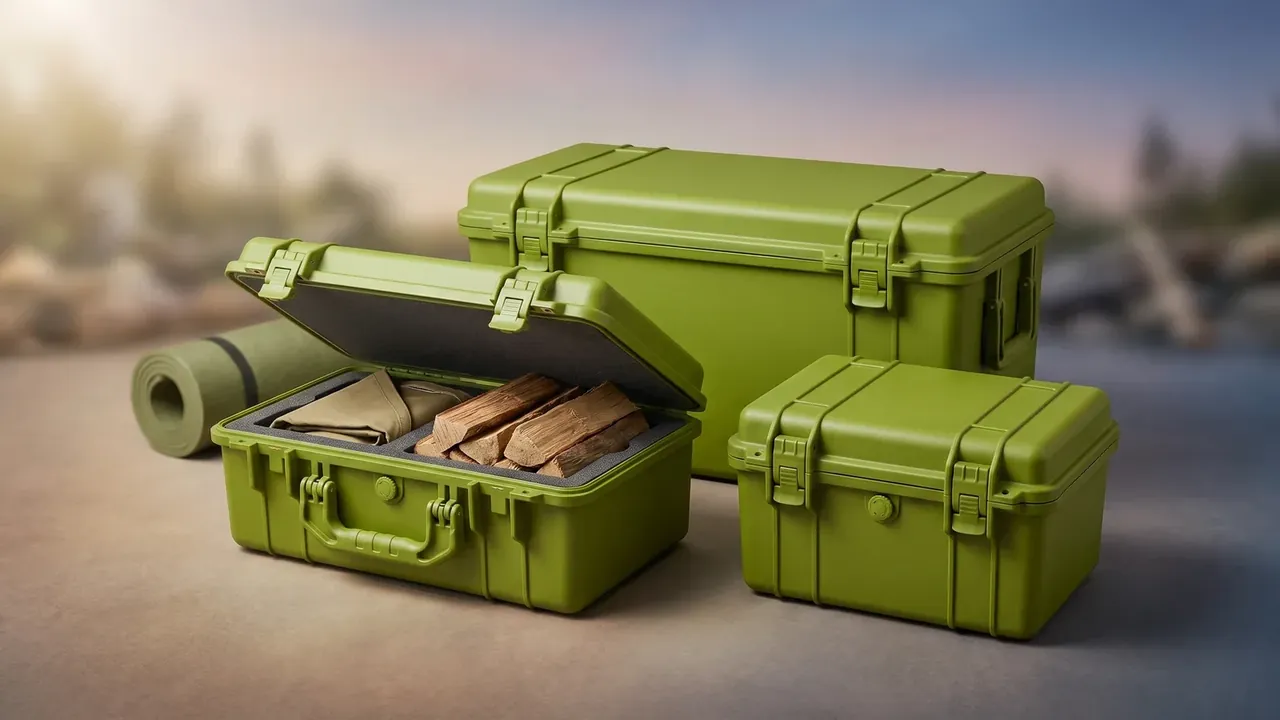
The band is thinner than the panel because it must bend, so it becomes the weakest link of a custom reusable transport case. Let it fold and nothing else: under stack load the posts bear directly, with a 1 mm gap to the lid.
At 30% post-consumer resin a panel loses about 8% tensile strength and 12% notched impact, invisible at room temperature and both turning into cracks at minus ten. Recycled resin belongs in panels and lids only; hinge ears, latch seats and posts stay on virgin compound.
5. Wash duty and acceptance parameters
Every empty trip goes through a wash line, so the gasket and drains become consumables.
- Rinse at 60 °C and 8 MPa, 90 seconds per face, no spot above 70 °C;
- Four 8 mm drain holes, chamfered 0.5 mm;
- Gasket groove 3.2 mm, assembled at 25% compression;
- After 200 washes, gasket set no more than 20%;
- Detergent limited to pH 6 to 9;
- Acceptance: no standing water, no seepage, latch effort above 180 N.
The 60 °C ceiling comes from detergent and pressure, not the resin heat limit. Past it the gasket interval drops from two years to one, costing more per trip than the water saved.
Conclusion
The specification of a custom reusable transport case is a set of numbers that hold each other: cycles set the wear limits, the limits set gauge and ribs, stack height sets the post form, the fold ratio caps the band.
This article discusses only the container (case body) side of specifications and design intent, and does not cover any handling, loading or use of the contents.
Related Reading
- Specification logic for grenade transport cases
- Cartridge box dimensions and compartment design
- Test items and pass criteria for firearm cases
- Air transport conditions for military cases
Related Products
- 8 Series — Gun Cases; Military Equipment Cases; Camera Equipment Cases; Drone Cases; Watch Cases; Knife Cases; First Aid Cases; Electronics Equipment Cases
- WL8-2812 PP Gun Case — model WL8-2812
- All protective cases and toolboxes: 7 series, 158 models