

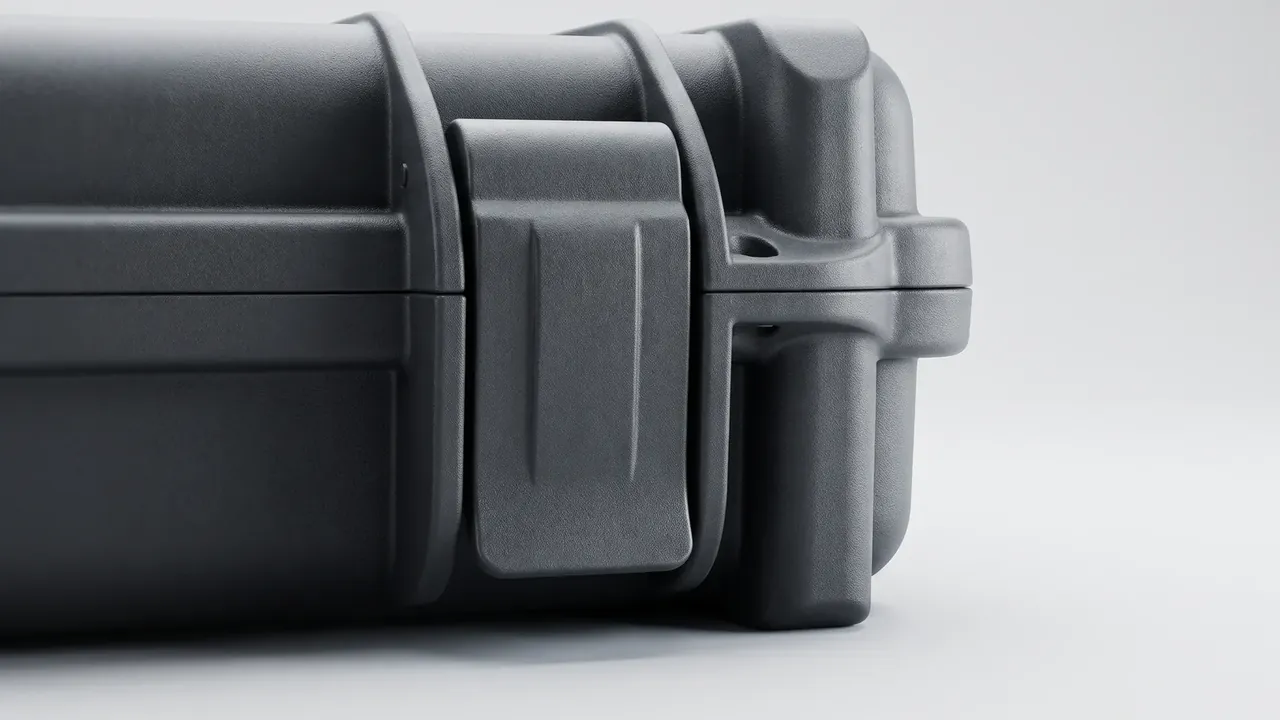
Quick answer: A stackable plastic storage case shows its quality only at the fifth layer. Bring a steel rule, a 25 kg weight and one pallet, then measure three things: 24-hour deflection at the lid centre, wall thickness at the bottom corners, and how the base ribs sit over the pallet gaps.
Table of contents
- What Shows at Layer Five
- Lid Load over Twenty-Four Hours
- Bottom Ribs and Pallet Gaps
- Floor Space: Stack Height versus Pick Height
- FAQ
1. What Shows at Layer Five
Last month a warehouse in southern Jiangsu took five samples from each of three suppliers, all rated 600 × 400 × 320 mm and 20 kg. The supervisor filled them and stacked each group five high for 24 hours.
By morning the second stack had shifted 15 mm left and the bottom lid had caved in.
On the floor the three samples look identical. What separates a good stackable plastic storage case is the load path: weight leaves the lid centre, lands on four corners, and everything between rides on panel stiffness.
| Check | How to measure | Pass line | Failure |
|---|---|---|---|
| Single load | Load to rating, lift by corners | No whitening, diagonals spring back | Corner splits |
| Stack height | 24 h, measure bottom case | ≤1.5 mm compression | Stack leans |
| Lid pressure | 25 kg on centre, 24 h | ≤2 mm, recovers | Upper case sinks in |
| Bottom ribs | Rule on height and pitch | ≥6 mm high, ≤90 mm pitch | Base bulges |
| Pallet fit | Empty case, push a corner | ≤10 mm travel | Stack walks |
None of these figures needs a lab: a steel rule and a day will do. A supplier who will not spare that day has a reason.
2. Lid Load over Twenty-Four Hours
At five layers the bottom lid carries everything above: 21.6 kg per case, so 86.4 kg lands on a 200 × 150 mm lid patch.
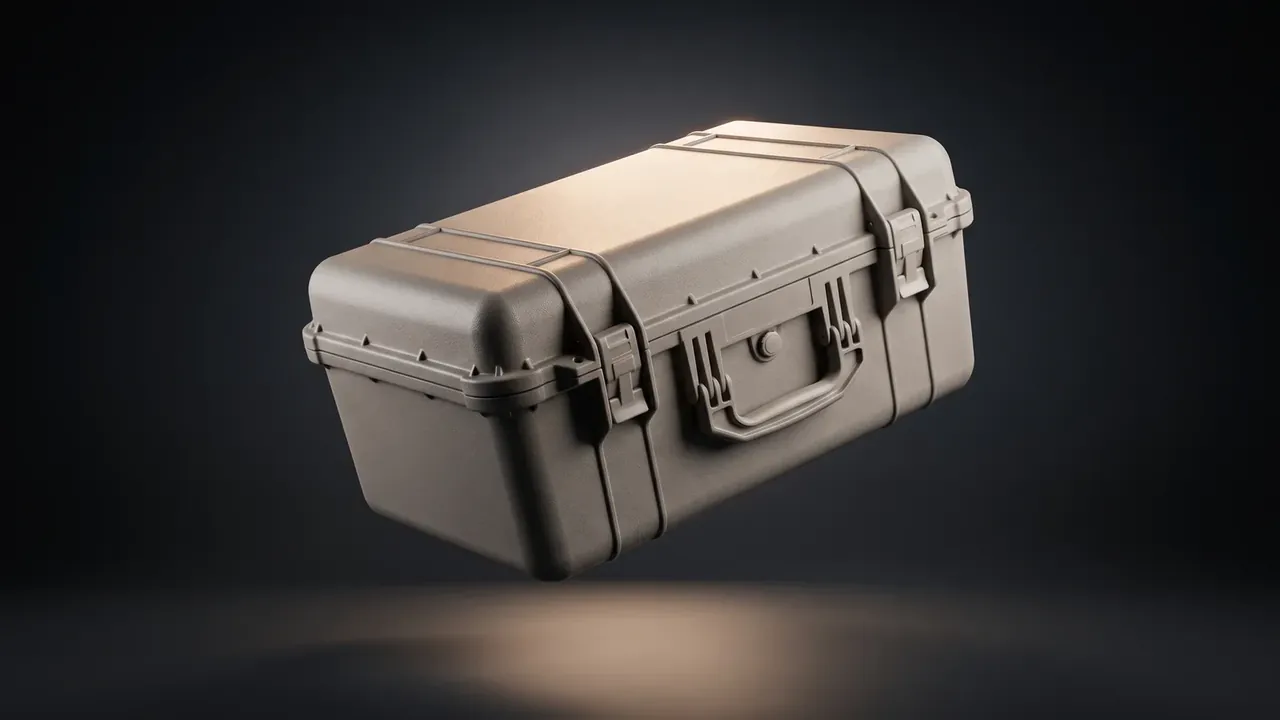
We set a 25 kg weight on that patch and read deflection at 1, 6 and 24 hours. The first supplier flattened within an hour and reached 1.3 mm, springing back to 0.2 mm after unloading. The second was still creeping at hour six and hit 3.4 mm, keeping a set of 1.9 mm. The third sat between them at 1.8 mm. The figures beat any datasheet: 1.3 mm means continuous ribs carry the load to the walls, while 3.4 mm means the ribs stop halfway. The second lid, turned over, held only a perimeter frame.
Heat widens the gap. At 38 °C the same load pushed it to 4.9 mm, with a set of 2.6 mm.
So ask one question: does this stackable plastic storage case lid carry a full-length rib?
| Layers | Load on bottom lid | 24-hour guide |
|---|---|---|
| Three | 64.8 kg | ≤1.0 mm |
| Four | 86.4 kg | ≤1.5 mm |
| Five | 108.0 kg | ≤2.0 mm |
3. Bottom Ribs and Pallet Gaps
The base is the other half: a case can survive the load and still leave a stack that walks.
- Rib height of 6 mm or more, or the loaded base flattens and the forklift lifts a sheet of cases.
- Rib pitch of 90 mm or less, or the base bulges and contact becomes a line.
- Solid material at all four corners; under 4 mm it whitens by the third layer.
- Pallet gaps of 30 mm or less, or the ribs drop in and the stack rocks.
- A base outline within 15 mm of the pallet face, or the centre of gravity sits outside the supports.
- Anti-slip bosses, cutting movement on a turn from 20 mm to under 8 mm.
One empty case and one pallet are enough. Nudge a corner with your foot; past 10 mm, five layers of stackable plastic storage case will lean.
Run the ribs across the pallet boards, not along them, or they slide down the gaps.
4. Floor Space: Stack Height versus Pick Height
Stacking high saves floor space, but the layer where it stops paying comes from the building. Take 6.4 m clear height, 1.5 m beams and a 2.6 m aisle: a 1.2 × 1.0 m pallet holds eight cases, so four layers of stackable plastic storage case give 32 units and five give 40.
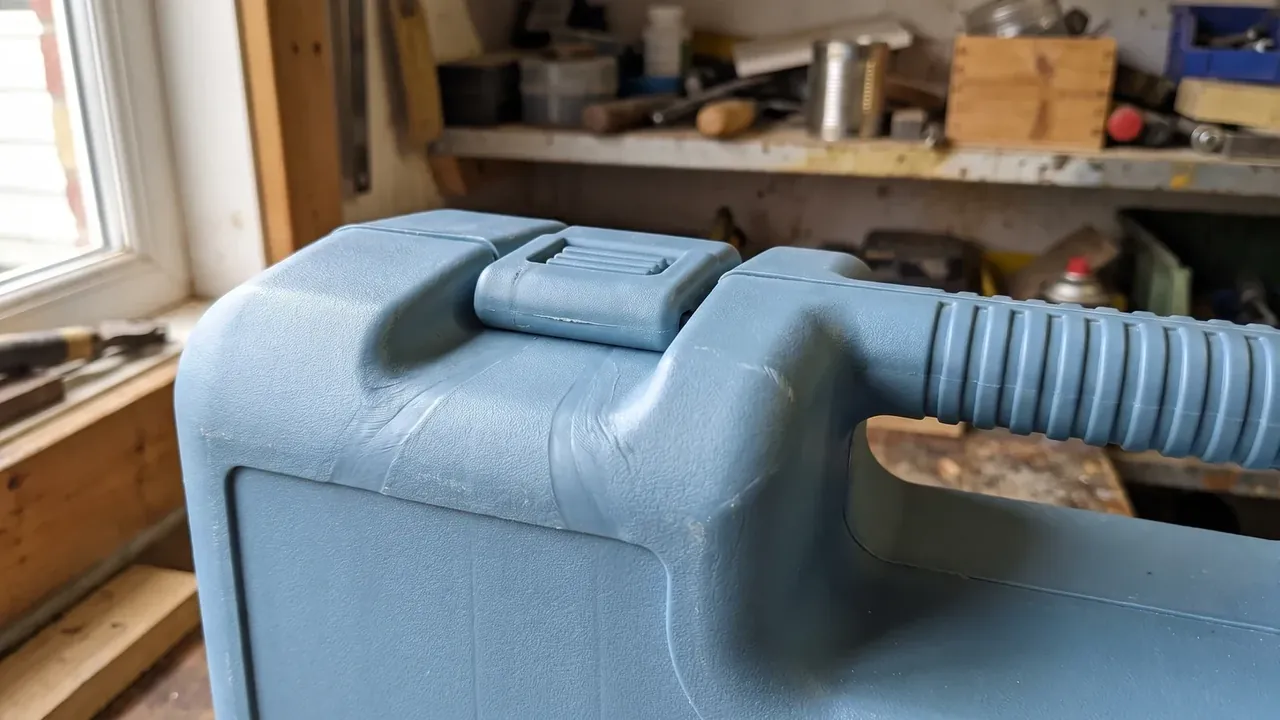
For a thousand units, four layers need 31.25 pallet positions and 37.5 m²; five layers need 25 positions and 30 m². The 7.5 m² is the fifth layer's yield.
But the rim of that fifth case sits 2.35 m off the floor, above the 1.8 m comfortable pick height.
So layer count follows the job. Stock moving by the pallet can go five high, because nobody climbs. Stock broken down for unit picking wants four layers and a step with a guard rail. Either way the locating groove must grip the base above, or every pick nudges the stack out of line.
Conclusion
Judging a stackable plastic storage case takes three moves: stack it, press it, push it. Five layers show whether the stack leans, 24 hours show whether the lid recovers, one push shows whether the base grips the pallet. A sample that survives all three is worth pricing, and those tests belong in the contract annex, not the price argument. Written down, they keep the floor space you paid for usable, the real test of a stackable plastic storage case.
This article discusses only the container (case body) side of specifications and design intent, and does not cover any handling, loading or use of the contents.
Related Reading
- Camping storage box selection criteria
- Latches and lock points on lockable storage boxes
- Pistol case liners and lock point layout
Related Products
- 8 Series — Gun Cases; Military Equipment Cases; Camera Equipment Cases; Drone Cases; Watch Cases; Knife Cases; First Aid Cases; Electronics Equipment Cases
- WL8-2812 PP Gun Case — model WL8-2812
- All protective cases and toolboxes: 7 series, 158 models