

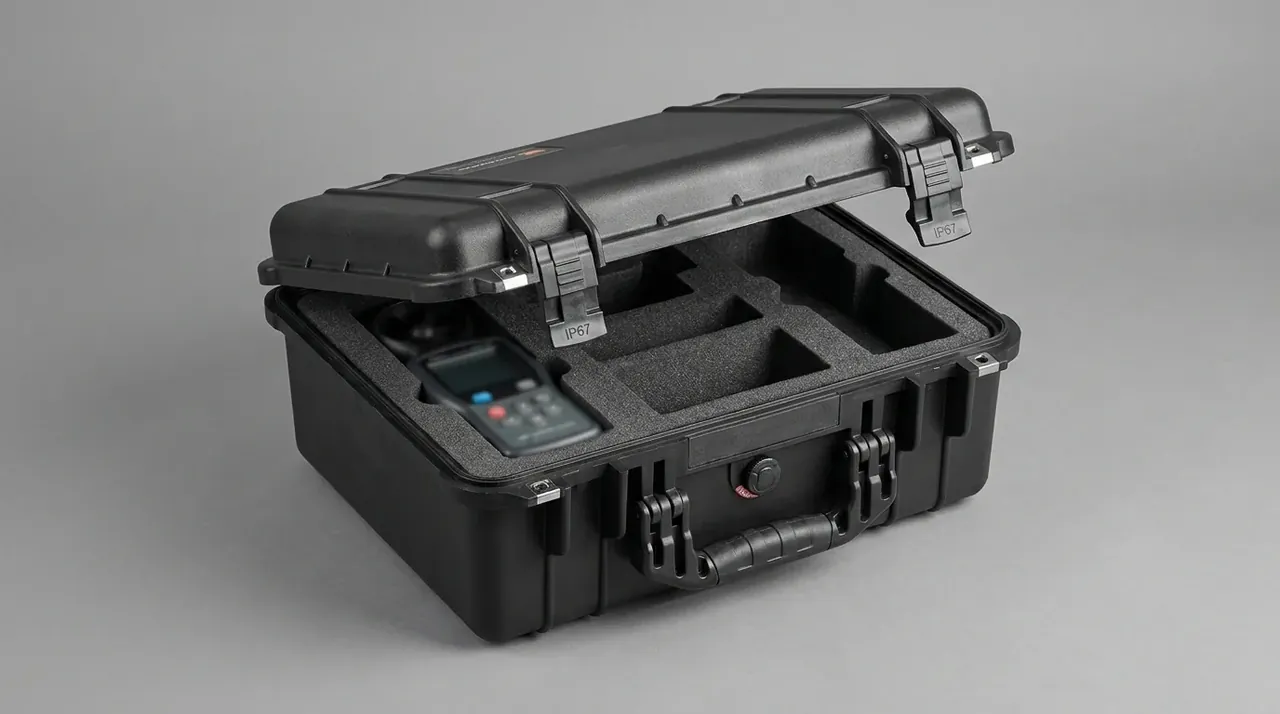
Quick answer: A substation case stays dry when its internal dew point sits 3 °C below the wall: 45 °C air falling to 15 °C leaves 6 g of water in 180 L.
Table of contents
- Where the humidity comes from
- Dew point across a day-night swing
- Desiccant dosage per litre
- Breather valve and membrane
- Heater power and inspection records
- FAQ
1. Where the humidity comes from
At one unmanned site the case read 45 °C and 70 %RH at 14:00, then 15 °C at 05:00. Its dew point is 38.3 °C, and cooling that air to 15 °C releases 33.6 g per kilogram of dry air — about 6 g across 180 L of net volume.
None of that 6 g leaked in; the swing squeezed it out of the air already inside. A gasket stops water entering, not water changing phase, which is the problem a substation case has to solve.
| Time | Inside | RH | Dew point | Condensate, 180 L |
|---|---|---|---|---|
| 14:00 | 45 ℃ | 70 %RH | 38.3 ℃ | 0 g |
| 20:00 | 32 ℃ | 88 %RH | 29.9 ℃ | 0 g |
| 02:00 | 22 ℃ | 96 %RH | 21.4 ℃ | 2.1 g |
| 05:00 | 15 ℃ | 100 %RH | 15.0 ℃ | 6.0 g |
| 08:00 | 26 ℃ | 74 %RH | 21.0 ℃ | 5.4 g |
The 05:00 row is the turning point: temperature catches the dew point, humidity tops out at 100 %, and the case sheds about 1 g an hour. By 08:00 the film evaporates, but humidity is still 74 %RH — nothing is fixed, the water is only invisible.
2. Dew point across a day-night swing
The 25 ℃ and 90 %RH pair is worth memorising: 3.17 kPa saturation, 2.85 kPa actual, dew point 23.0 ℃. A wall 2 ℃ cooler than the air starts to bead.
Radiative cooling pulls the outer wall 4 ℃ to 6 ℃ below the internal air, so the gap is a nightly event rather than a theoretical risk. Field practice keeps 3 ℃ of margin between wall temperature and dew point.
A rough conversion: dew point equals air temperature minus (100 minus RH) over 5. At 45 ℃ and 70 %RH it returns 39.0 ℃ against 38.3 ℃; at 25 ℃ and 90 %RH, 23.0 ℃.
Place the probe a third of the way up from the floor, 100 mm clear of the heater. Three points, median value: a spread over 4 %RH means the air is not mixing and a 5 W fan is missing.
3. Desiccant dosage per litre
Dosage follows net volume, not habit: 1.6 g/L, so 180 L takes 288 g of silica gel for six months at 25 ℃ with sound gaskets.
| Net volume (L) | Desiccant (g) | Bags (≤100 g) | Change interval |
|---|---|---|---|
| 60 | 96 | 1 | 6 months |
| 120 | 192 | 2 | 6 months |
| 180 | 288 | 3 | 6 months |
| 300 | 480 | 5 | 6 months |
| 480 | 768 | 8 | 6 months |
The figure works backwards: 6 g of condensate needs 27 g of dry gel at 22 % uptake, and the other 261 g covers six months of permeation, under 0.03 g per 100 L a day. Sites swinging more than 20 ℃ move to 2.1 g/L.
Three checks are enough — pink colour-indicating gel at about 90 days, a weigh-in above 18 % gain, seven straight days above 60 %RH. Split 288 g across three bags, 30 mm clear of the groove.
4. Breather valve and membrane
The case has to breathe: across a 30 ℃ swing the air in 180 L changes volume by 6 %, so 11 L moves in or out, and with no path the differential lifts the gasket at the weakest corner.
The membrane is ePTFE, 20 mm across, passing 250 mL/min at 10 kPa and holding 80 kPa of water pressure. Gas crosses, liquid water does not, provided it faces down.
Crack the valve at 3 kPa and seal it at -1 kPa, on the lower side wall 40 mm above the floor, out of the heater plume; mounted high, condensate halves membrane throughput in three months. Replace at 12 months on dusty sites, 24 elsewhere.
5. Heater power and inspection records
Heater power scales with volume: 20 W for 180 L, or 0.11 W/L, and 40 W for 300 L. More power pushes moisture into foam and dead corners, where it condenses once the heater stops.
Set the thermostat at dew point plus 5 ℃, or internal air 3 ℃ above the wall, whichever comes first, with 5 ℃ of hysteresis, on 24 V DC through a 10 A fuse.
The energy sum belongs in design review: 20 W for 8 h is 160 Wh, about 29 kWh in six months. Over 60 kWh means the setpoint is too high or the gasket failed.
Inspection runs every 30 days until two clean curves, then 90 days for this substation case, back to 30 in the wet season. Loggers sample every 10 min over -20 ℃ to 60 ℃ at ±2 %RH.
Opening on a repeat visit: read and photograph the last 24 h of curve, release the latches, keep the lid open under 3 min, weigh each bag, wipe the groove dry, and leave the case shut for 30 min.
Conclusion
Unmanned humidity control is not about sealing a case harder; it is about keeping the internal dew point 3 ℃ under the wall. Fit three parts by volume: 1.6 g/L of desiccant, one breather valve up to 300 L, 0.11 W/L of heater set at dew point plus 5 ℃. On a night falling from 45 ℃ to 15 ℃ the case makes 6 g of water and 288 g of gel absorbs 27 g, with margin for six months. Put the rules on the inspection card: seven days above 60 %RH, gel gain over 18 %, or a 20 mL column dropping 5 mm in 10 s. When the season turns, adjust the interval, never the volume factor. A site that sees typhoon loading runs the 30-day interval all year, and the three parts are sized from net volume rather than from habit.
| Site type | Desiccant | Breather valve | Heater | Interval |
|---|---|---|---|---|
| Inland, 15 ℃ swing | 1.2 g/L | 1 | 12 W | 90 days |
| Coastal, 80 %RH | 2.1 g/L | 1 | 20 W | 30 days |
| High altitude, 25 ℃ swing | 2.1 g/L | 2 | 40 W | 30 days |
| Sand-prone | 1.6 g/L | 2, membrane at 12 months | 20 W | 30 days |
This article discusses container-side specifications and design implications only, and does not cover any handling, loading or use of the contents.
Related Reading
- Case protection for wind farm instruments
- Cooling and sealing in inverter enclosures
- Field setup for energy detection cases
- Volume and port planning for power supply cases
Related Products
- 8 Series — Gun Cases; Military Equipment Cases; Camera Equipment Cases; Drone Cases; Watch Cases; Knife Cases; First Aid Cases; Electronics Equipment Cases
- WL8-2812 PP Gun Case — model WL8-2812
- All protective cases and toolboxes: 7 series, 158 models