

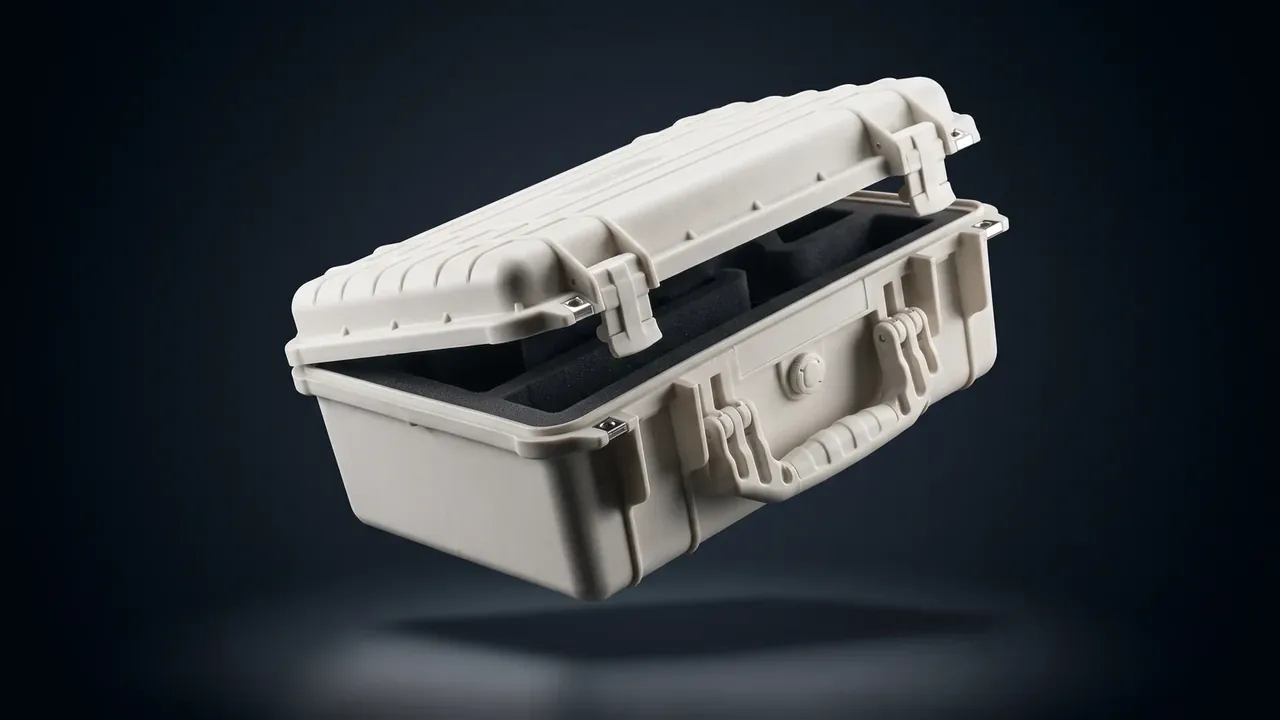
Quick answer: A tactical hard case is accepted in four groups — incoming and first article, dimensions and wall, seal and relief valve, drop, stacking and latch life. Each has its own sample size and limit, and one critical defect sends the lot back.
Table of contents
- How to Split a Tactical Hard Case Acceptance Plan
- Incoming and First Article Checks That Close in a Day
- Sampling for Dimensions and Wall Thickness
- Seal, Pressure Drop and Relief Valve Tests
- Drop, Stacking and Latch Cycle Life
- FAQ
1. How to Split a Tactical Hard Case Acceptance Plan
An acceptance plan cannot stop at a drawing reference. Shape comes from the drawing, but a lot is judged by a grading sheet: four groups split by failure consequence, each with a sample size and a named judge.
A crack, a broken latch or a dead relief valve is critical and one unit returns the lot; oversize dimensions are major at AQL 1.0; scratches are minor at AQL 4.0.
| Group | Main checks | Equipment | Grade |
|---|---|---|---|
| Incoming, first article | Paperwork, colour, latch seating | Colorimeter, force gauge | Critical, major |
| Dimensions, wall | Inner size, wall, rim flatness | Caliper, ultrasonic gauge | Major |
| Seal, relief | Pressure drop, cracking, immersion | Differential gauge, tank | Critical |
| Drop, stack, latch | Six faces, residual set, cycles | Drop rig, cycle tester | Critical, major |
2. Incoming and First Article Checks That Close in a Day
Incoming work judges arrival condition only; eight checks close the same day: carton intact, paperwork complete, colour on the approved sample, no through-scratch, latches seated, plating intact, gasket straight, batch traceable.
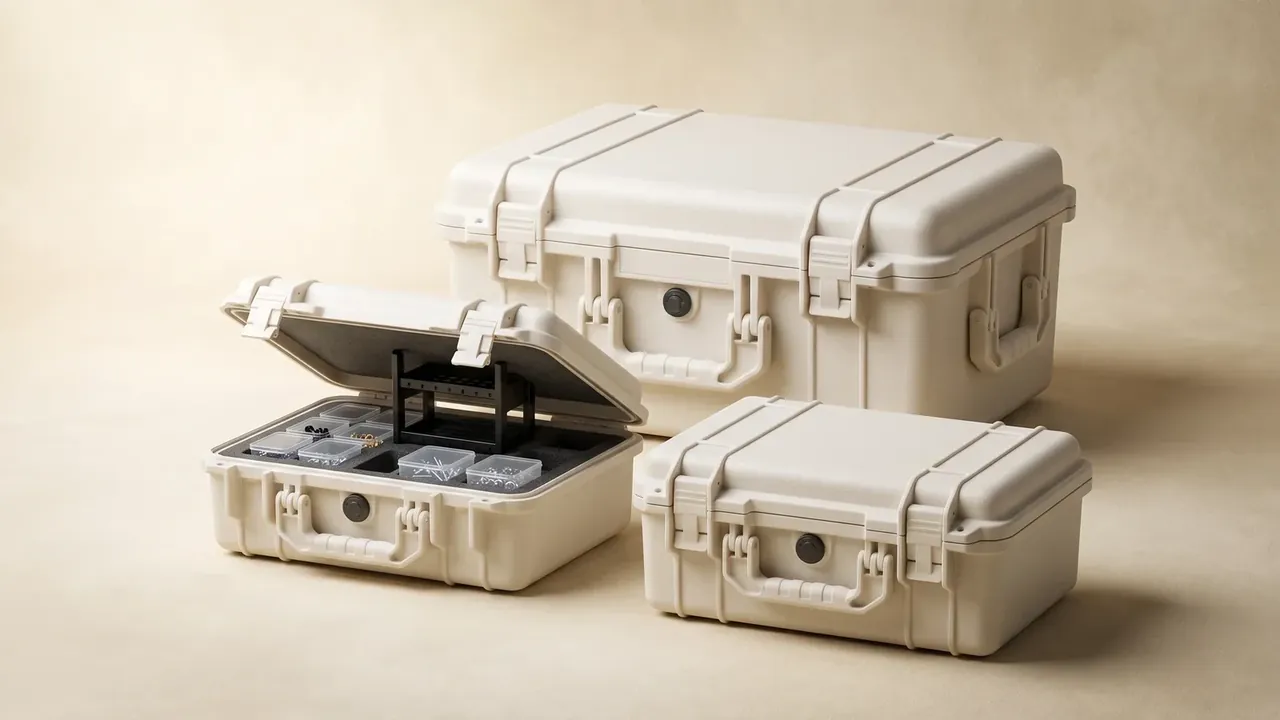
Colour reads within ΔE 1.2 of the sample and 0.8 between units. A scratch over 15 mm that catches a fingernail is major. Opening force must land between 70 N and 130 N, or the claw lets go in transit.
3. Sampling for Dimensions and Wall Thickness
A tactical hard case lot is sampled by size: 5 units below 300, 8 up to 1000, 12 above, drawn across pallets, not three in a row from one cavity.
Wall thickness is invisible, and often waved through. Nominal is 4.0 mm and the thinnest of twelve points may not fall below 3.6 mm. One thin point fails the unit; two units thin in the same place point at a starved runner. Rim flatness past 0.8 mm compresses the gasket unevenly, so the pressure test leaks there first.
4. Seal, Pressure Drop and Relief Valve Tests
Sealing is judged in three steps, order fixed: pressure drop, cracking pressure, immersion. Inflate to 5 kPa, hold 90 s, and 0.3 kPa or less passes. Log temperature, since a 10 °C swing moves the reading by 0.15 kPa.
The relief valve must crack between 3.0 kPa and 4.0 kPa, with no steady leak 30 s after reseating. Set high, the case cannot shed pressure differential on wide temperature swings.
Immersion sinks the closed case 300 mm for 10 minutes; absorbent paper inside may gain 0.5 g.
5. Drop, Stacking and Latch Cycle Life
Drop the loaded case after 4 h at −20 °C, eight strikes within 3 minutes — six faces, one corner, one edge — from 1.5 m onto 50 mm concrete. Pass means no through crack and no latch release.
Stacking puts 420 kg on the lid at 50 °C for 48 h, residual set capped at 2.5 mm, polypropylene near softening.
Latch life runs 3,000 cycles at 20 per minute, force logged every 500, still 70 N to 130 N, then a 400 N static pull for 60 s.
| Test | Condition | Units | Pass | Retest |
|---|---|---|---|---|
| Pressure drop | 5 kPa, 90 s | 3 | 0.3 kPa or less | Add 3 |
| Relief valve | Ramp to cracking | 3 | 3.0 to 4.0 kPa | Reject |
| Drop | −20 °C, 1.5 m, 8 hits | 2 | No through crack | Critical |
| Stacking | 420 kg, 50 °C, 48 h | 2 | 2.5 mm or less | Add 2 |
| Latch cycle | 3,000 at 20 per min | 3 | Force in band | Add 3 |
A critical defect returns the lot with a cause analysis in three working days; a major doubles the sample; past 15% rework, full inspection.
Conclusion
An acceptance plan earns its value when each group can be repeated and blamed on its own. Pin the verdict table to one form, and the tactical hard case holds its batch quality when the inspector changes.
This article discusses only the container (case body) side of specifications and design intent, and does not cover any handling, loading or use of the contents.
Related Reading
- How to choose a tactical hard case by protection and latch system
- Tactical hard case against soft tactical bags
- Quality control points on the case assembly line
- Standard work and records on the production floor
Related Products
- 8 Series — Gun Cases; Military Equipment Cases; Camera Equipment Cases; Drone Cases; Watch Cases; Knife Cases; First Aid Cases; Electronics Equipment Cases
- WL8-2812 PP Gun Case — model WL8-2812
- All protective cases and toolboxes: 7 series, 158 models