

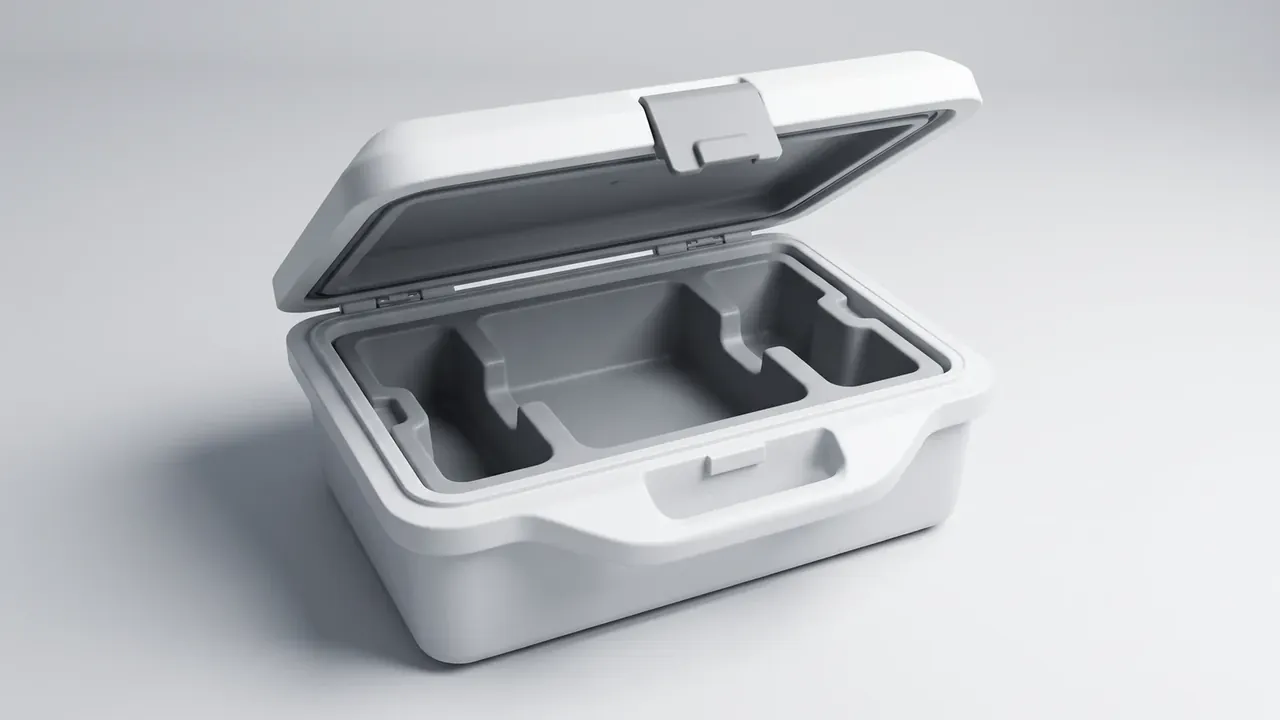
Quick answer: Five items settle a temperature-controlled case: layer order in the wall, heater margin, probe placement, seal compression at the lid, and calibration before shipping. Skimp on any one and the internal curve drifts within four hours.
Table of contents
- Five Layers in the Wall: Order and Thickness
- Heating Power and Holdover Without Mains
- Controllers and Sensors: Placement and Hysteresis
- Seals and Lid Seam: Stopping Heat Leaks
- Rotomoulding, Foaming and Factory Calibration
- FAQ
1. Five Layers in the Wall: Order and Thickness
A temperature-controlled case wall is five layers: 3 mm HDPE skin, 0.2 mm hot-melt film, 45 mm polyurethane foam, 2.5 mm liner, 0.05 mm foil facing. About 51 mm in total, with foam carrying seventy percent of the resistance.
Density decides whether that resistance lasts: at 38 to 42 kg/m³ and 0.022 W/(m·K), loss stays under five percent for three years; below 32 kg/m³ resistance falls ten percent in a season.
Thicker is not better: 45 mm to 60 mm adds thirty percent resistance but takes a 40 L case from 6.8 kg to 8.4 kg.
| Layer | Material | Thickness | Job |
|---|---|---|---|
| Skin | HDPE | 3.0 mm | Impact, UV |
| Bond | Hot-melt film | 0.2 mm | Adhesion |
| Foam | Polyurethane | 45 mm | Thermal resistance |
| Liner | Modified PE | 2.5 mm | Wipe-down surface |
| Facing | Aluminium foil | 0.05 mm | Reflects radiant heat |
2. Heating Power and Holdover Without Mains
Power in a temperature-controlled case follows the coldest duty. At 40 L, a 40 K split and 0.62 m², steady loss is 13.6 W; a 36 W film leaves a factor of 2.6 and lifts -20 °C to 20 °C in about 22 minutes.
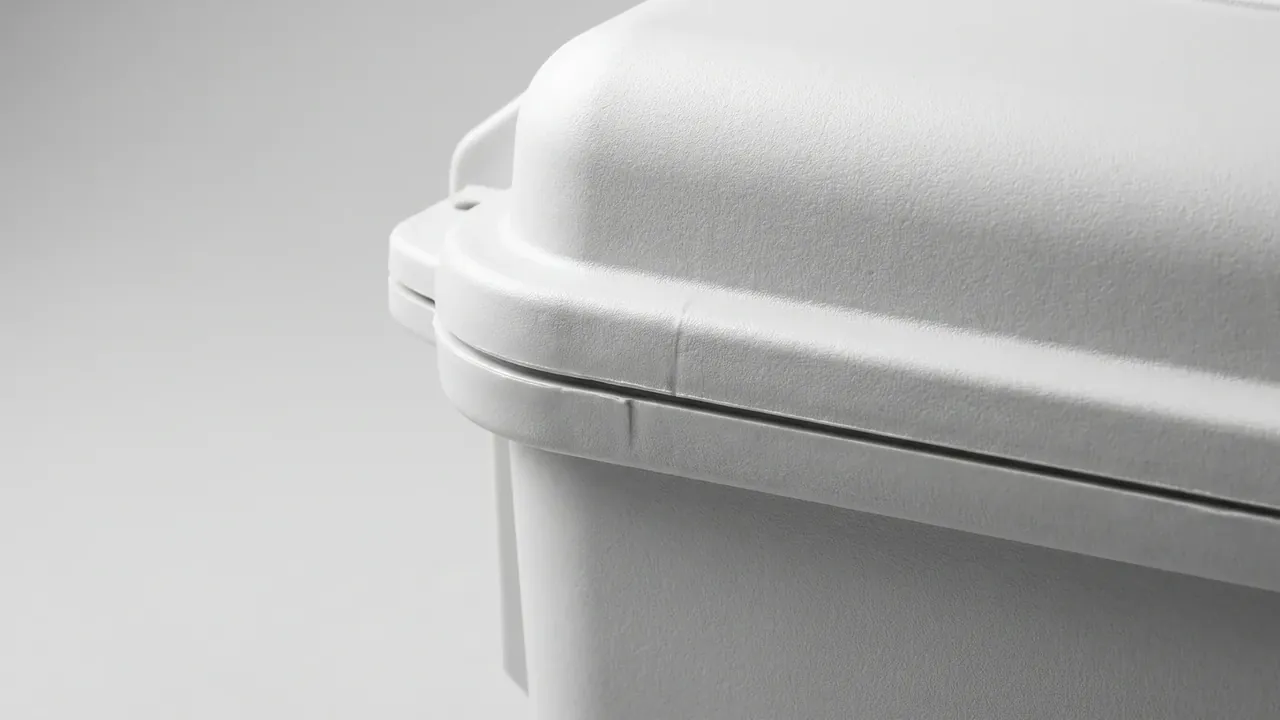
Film on the liner responds fast but runs 6 °C above the mean, so the probe beside it reads high and control quits early; buried in foam it is four minutes slower and even. Film bonded to a 1.5 mm plate first holds face difference inside 2 °C.
Holdover is a phase-change pocket, not a bigger battery: 1.2 kg at a 20 °C switch point and 180 kJ/kg keeps the interior above 15 °C for about five hours.
3. Controllers and Sensors: Placement and Hysteresis
Accuracy comes from probe position, not the ±0.5 °C on the label. A probe inside the lid drops 3 °C on opening, the film hits full power, and the interior overshoots 2 °C.
Two probes, liner return side and usable volume centre, weighted 0.7 and 0.3, hold better. Hysteresis at 0.8 °C saves twenty percent against 0.3 °C and keeps swing inside ±1 °C.
| Setting | Typical | Too tight | Too loose |
|---|---|---|---|
| Hysteresis | 0.8 °C | Relay cycles 60 times an hour | Swing ±2.5 °C |
| Sample rate | 5 s | Standby draw up 8% | 20 s to react |
| Probes | 2 | Extra leak paths | Drift and overshoot |
4. Seals and Lid Seam: Stopping Heat Leaks
A third of the heat entering a temperature-controlled case comes through the lid seam. A twin-lip gasket sets an outer lip against water and dust, an inner lip against air, with a 1.2 mm cavity closing to 0.35 mm. That rim is also a bridge into the lid.
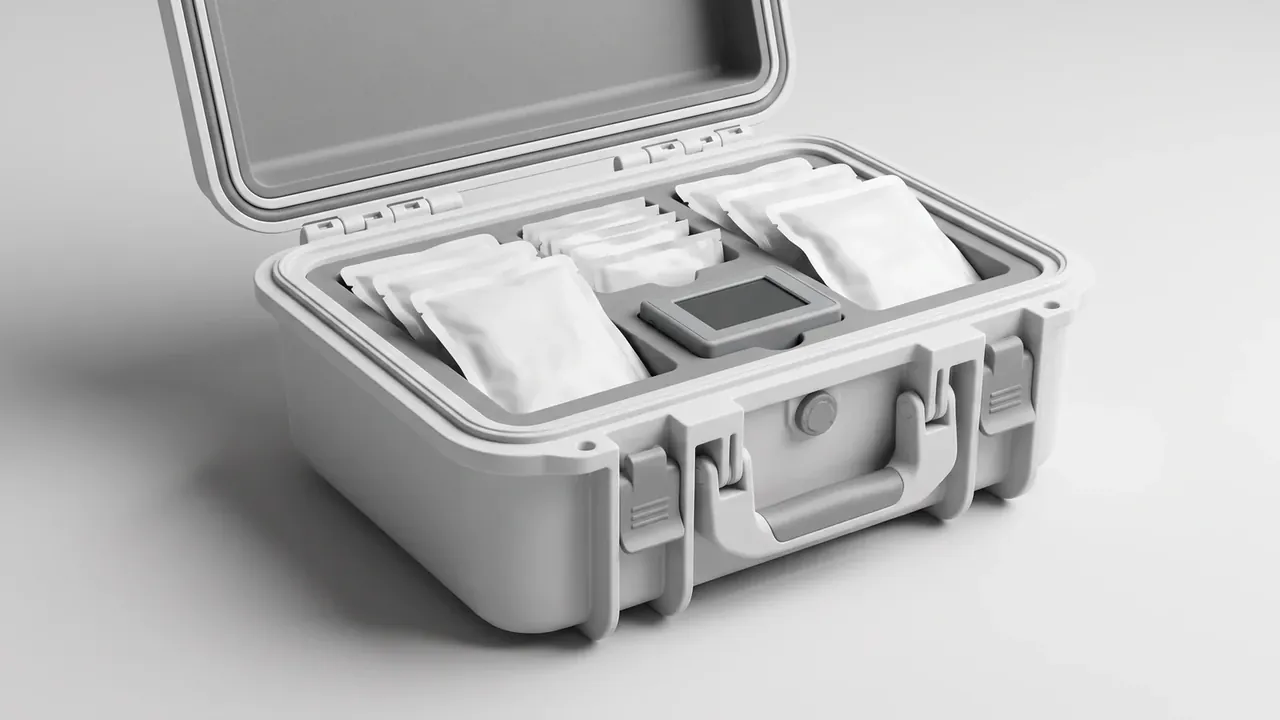
Compression runs at thirty percent: an 8 mm EPDM cord at 5.6 mm gives 4.2 N/cm, about 75 N around 1.8 m. Fifty percent will not close; fifteen percent hardens at -20 °C.
Group feedthroughs onto one 60 by 40 mm block, pot the bores, and fit a 0.02 MPa breather: a 40 K split otherwise pulls the lid in 0.6 mm.
5. Rotomoulding, Foaming and Factory Calibration
A temperature-controlled case body rotomoulds at 260 °C on an 18-minute cycle, thickness set by charge weight: 4.5 mm takes 12 kg. Liners form on a 650 t press, rest 24 hours after demould, then foam.
Foam closes in a 40 °C fixture and demoulds at 8 minutes: early and the wall drums, late and it tears the liner. Calibration waits 72 hours.
Three curves decide the label: warm-up inside 25 minutes, an 8-hour hold within ±1 °C, recovery within 12 minutes after a 60-second opening.
| Step | Parameters | Acceptance |
|---|---|---|
| Rotomoulding | 260 °C, 18 minutes | Wall 4.5 ± 0.3 mm |
| Foaming | 40 °C, 8-minute demould | 38 to 42 kg/m³ |
| Calibration | 72 hours after demould | Three curves pass |
Conclusion
Five items decide a temperature-controlled case: layer order, heater margin, probe placement, seal compression and calibration. Cheapen any one and the curve drifts. Put the numbers on the drawing and the inspection card, and a temperature-controlled case becomes predictable.
This article discusses only the container (case body) side of specifications and design intent, and does not cover any handling, loading or use of the contents.
Related Reading
- Insulation, Heater and Temperature Zones
- Versus a Plain Protective Case
- Rotomoulded Case Wall Thickness
- Foam Cutting and Fit Tolerance
Related Products
- 8 Series — Gun Cases; Military Equipment Cases; Camera Equipment Cases; Drone Cases; Watch Cases; Knife Cases; First Aid Cases; Electronics Equipment Cases
- WL8-2812 PP Gun Case — model WL8-2812
- All protective cases and toolboxes: 7 series, 158 models