

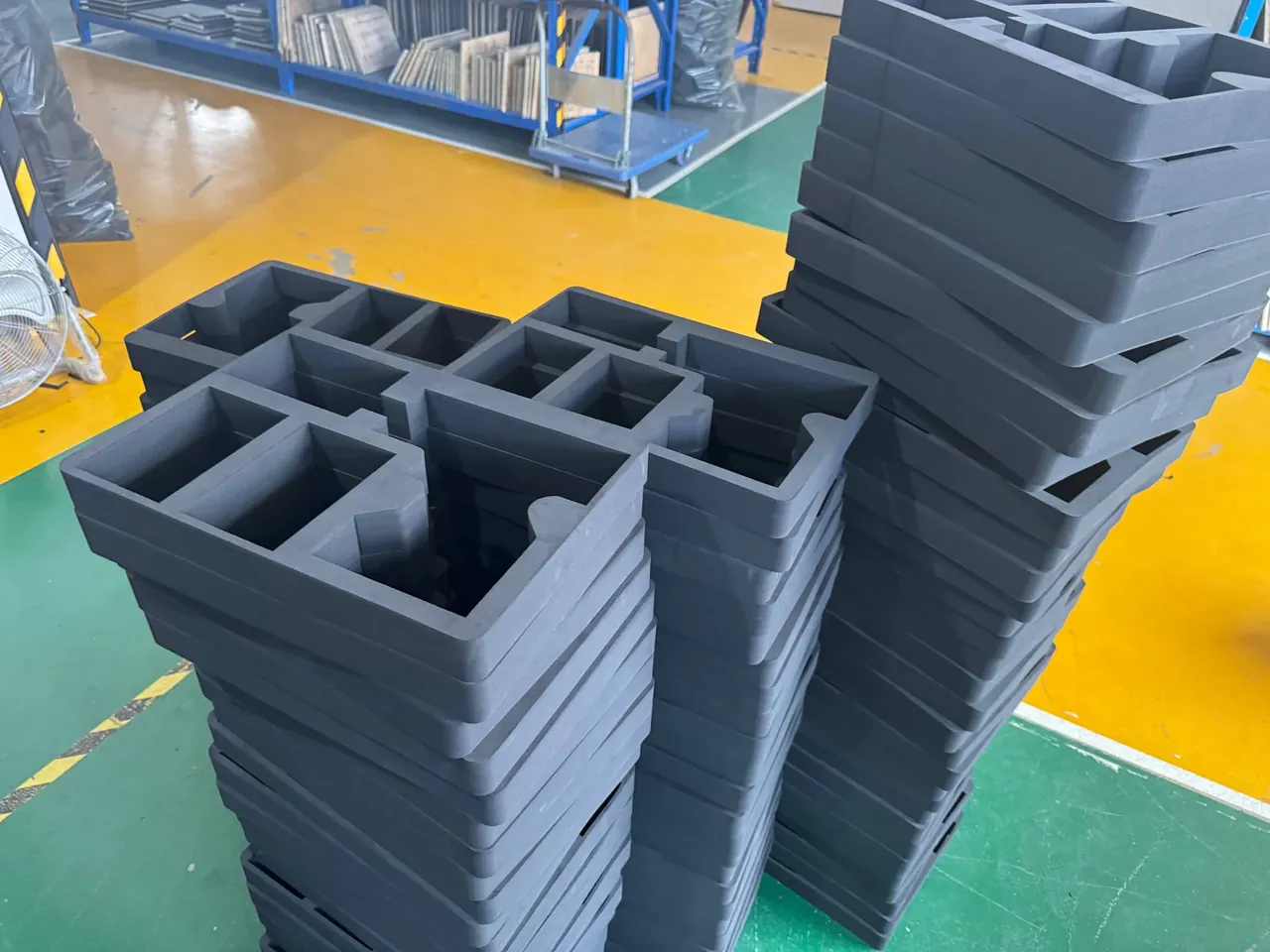
Quick answer: Choosing a foam cutting method is a volume decision before it is a tolerance decision. Under fifty pieces CNC wins, past five thousand a die wins. Accuracy only earns a premium where foam meets a hard shell.
Table of contents
- Three Variables Behind a Quote
- Banding by Order Size
- Switching Cost: Three Days Against Seven
- A 1,200-Piece Cost Comparison
- Lead Time, Rework Rate and Acceptance
- FAQ
1. Three Variables Behind a Quote
A first enquiry usually bundles three questions: can you hold the drawing, what does a part cost, how soon can you ship. In foam cutting, each is set by a different part of the shop.
Volume decides whether tooling can spread. Geometry eliminates processes before price is discussed. Fit decides whether tolerance matters: a liner that finds its own position inside a case works at ±0.6 mm.
2. Banding by Order Size
Below fifty pieces tooling is irrelevant; a die costs more than thirty CNC samples.
Between fifty and five hundred the answer is mixed. Simple outlines can be die cut at a per-piece premium; anything with a pocket goes to CNC, where delivery matters more than price.
Above five hundred the die amortises, adding a few jiao per part across a thousand. Above five thousand, negotiate layout instead of process: two-up dies, nested rows, less edge trim.
| Order size | Method | Unit cost | Lead time |
|---|---|---|---|
| Under 50 pcs | CNC | 9–16 yuan | 3–5 days |
| 50–500 pcs | Mostly CNC | 5–9 yuan | 5–8 days |
| 500–5000 pcs | Die cutting | 2.2–3.2 yuan | 10–14 days |
| Over 5000 pcs | Multi-cavity die | 1.5–2.4 yuan | 14–20 days |
3. Switching Cost: Three Days Against Seven
A CNC sample takes three days: program, trial cut, three first articles, dispatch. A die takes seven, the extra four spent building the board and proving it over two trials.
Revisions diverge. An outline change is twenty minutes and a scrapped sheet on CNC; on a die it is four hours of pulling rule.
Amortisation is division. A 420 yuan die over 1,200 parts adds 0.35 yuan; over 200 parts it adds 2.1, more than the material.
Rework counts too. A die dulls after about 8,000 strokes; CNC fails at the vacuum when a sheet warps; a wire drifts as the wire thins.
4. A 1,200-Piece Cost Comparison
The part is a 300 by 250 by 40 mm pad with R10 corners and no holes, in 25 kg per cubic metre EPE. All three methods can make it.
Material runs 1.40 to 1.55 yuan at 18 yuan per kilogramme. At 60 yuan an hour for machine and operator, a die press makes 110 parts, a wire 80, and CNC roughly 140 seconds each.
| Cost item | Die | CNC | Hot wire |
|---|---|---|---|
| Tooling or template | 420 | 0 | 180 |
| Material, 1,200 pcs | 1,680 | 1,860 | 1,740 |
| Machine and labour | 660 | 2,760 | 900 |
| Trimming | 144 | 300 | 216 |
| Total | 2,904 | 4,920 | 3,036 |
| Unit | 2.42 | 4.10 | 2.53 |
At 1,200 pieces the die beats the wire by 132 yuan, under five percent, and holds corners and holes the wire cannot.
5. Lead Time, Rework Rate and Acceptance
Lead time splits into material, queue, cutting and finishing. A die is slow to start and fastest to run; a wire needs a new template for every shape.
Rework only means something per batch: die trouble clusters after a sharpening, CNC trouble is depth drift on warped sheet, wire trouble is kerf drift.
Put the checks in the order: three first articles measured in full, five parts per five hundred, wire gauge checked every two hundred.
| Method | Sample | Production, 1,200 | Rework | Changeover |
|---|---|---|---|---|
| Die | 7 days | 12 days | 0.8% | 4 hours |
| CNC | 3 days | 8 days | 0.3% | 20 minutes |
| Hot wire | 3 days | 6 days | 1.5% | 40 minutes |
Conclusion
Fix the order: volume sets the band, geometry removes what cannot be made, accuracy adjusts the price last. Reverse it and you pay double for a tolerance nothing needs, or save a few jiao and lose a week. Batch sets the tool, shape sets the machine, and that is how foam cutting should be compared.
This article discusses only the container (case body) side of specifications and design intent, and does not cover any handling, loading or use of the contents.
Related Reading
- Foam and sponge compared
- Foam lining layout
- Custom foam insert pricing
- Pick-and-pluck foam without a die
Related Products
- 8 Series — Gun Cases; Military Equipment Cases; Camera Equipment Cases; Drone Cases; Watch Cases; Knife Cases; First Aid Cases; Electronics Equipment Cases
- WL8-2812 PP Gun Case — model WL8-2812
- All protective cases and toolboxes: 7 series, 158 models