

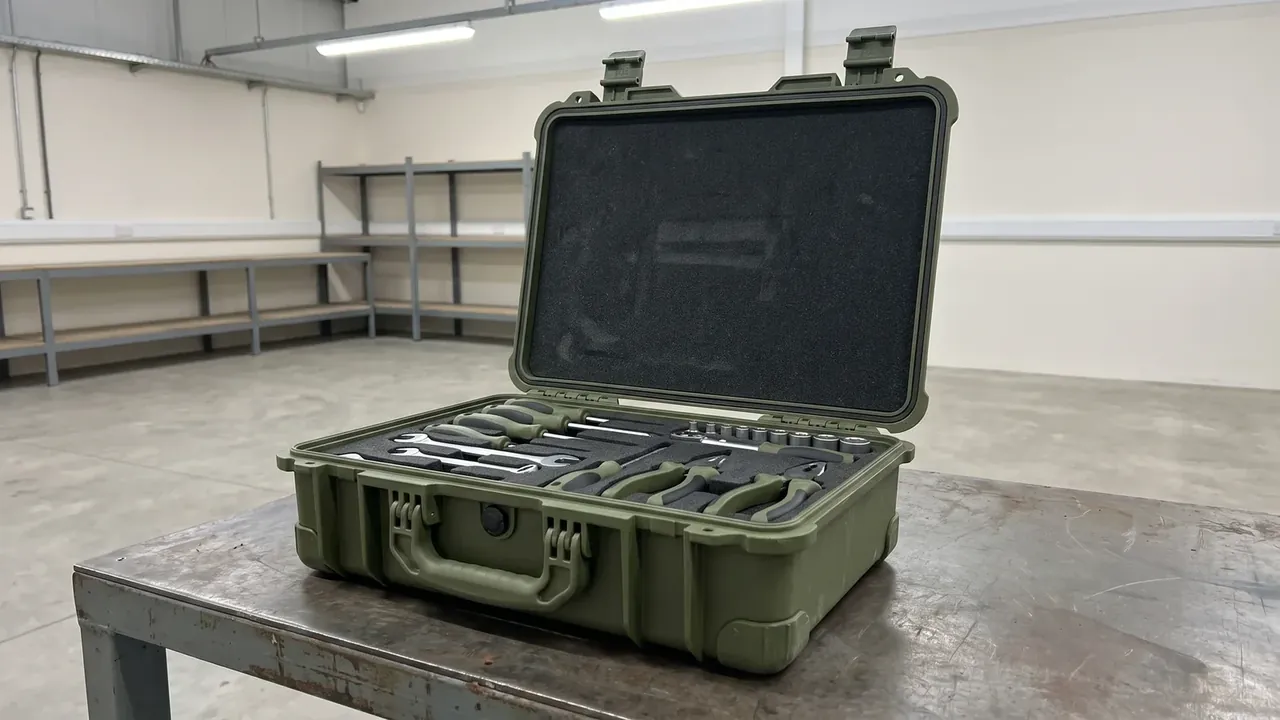
Quick answer: A tool box with dividers is specified by three numbers: 25 mm slot pitch, divider count one less than the number of tool families, and 5 kg per cell with 1.5 times headroom. More cells is not better: past a 2.5 to 1 aspect ratio, long tools tip dividers over.
Table of contents
- How a Tool Box with Dividers Zones a Tool Set
- Slot Pitch and Divider Thickness
- Divider Count and Cell Aspect Ratio
- Load per Cell and Divider Height
- Adjustable Versus Fixed Dividers
- FAQ
1. How a Tool Box with Dividers Zones a Tool Set
A tool box with dividers does not improve by cutting the interior finer. Cell count follows the number of tool families and the size band of the longest piece: one cell must swallow the longest wrench and still stop short bits rattling.
On the bench, a 24-piece socket set, six wrenches, four pliers and six screwdrivers cover 1.2 m and collapse into five piles: 180 mm for sockets, two 120 mm cells for wrenches, 120 mm for pliers, six 45 mm slots for drivers.
| Use case | Cells | Min width (mm) | Divider type |
|---|---|---|---|
| Electrician carry | 8 to 12 | 60 | adjustable slots |
| Bench station | 5 to 7 | 120 | moulded ribs |
| Field repair | 10 to 14 | 50 | two-way slots |
Hand width sets the minimum: a 50 mm cell will not take a glove.
2. Slot Pitch and Divider Thickness
Pitch is the hardest number: centre-to-centre distance between slots. Three values dominate: 25 mm, 12.5 mm and 50 mm. At 25 mm a 150 mm bay moves to 125 or 175, covering most wrench widths.
Halving pitch to 12.5 mm leaves 9 mm of material between slots, walls under 2 mm, and after a few dozen insertions the slot opens and the divider leans.
Stock matters as much. A 2.5 mm PP board with one ribbed face behaves like 3.0 mm flat stock at 10 percent less weight, while an unribbed board sags. Depth is 6 mm, slot width 0.3 mm over nominal.
3. Divider Count and Cell Aspect Ratio
Take a 500 mm interior: one cross divider makes two cells of 245 mm, three make four of 120 mm, five leave 80 mm where a hex key lies at an angle.
Divider count on a tool box with dividers is tied to aspect ratio, depth over clear width. At 300 mm deep and 120 mm wide the ratio is 2.5, the working limit; narrower and long items pivot, so the divider takes side thrust instead of separating.
Two-way layouts count by row and column: three by two needs two longitudinal dividers and one notched cross piece, added not multiplied.
4. Load per Cell and Divider Height
Cell load and case load are separate ratings. A 25 kg case rating belongs to the base and handle; a 5 kg cell rating belongs to the divider and slot wall. Use the lower number.
A 120 by 300 mm cell holding 5 kg, centre of mass 40 mm up, sees about 25 N sideways at 30 degrees of tilt, landing on under 40 mm² of slot face, which a 2.5 mm divider holds. An 8 kg crimper pushes mid-span deflection past 4 mm.
Divider height runs 60 to 75 percent of interior depth, so 90 mm deep gives 60 mm. Flush with the rim it presses the lid gasket; below 45 mm items tip.
5. Adjustable Versus Fixed Dividers
Adjustable slots are moulded with the body and boards sold separately, so zoning changes without touching the mould. The seam runs 0.5 to 1.0 mm, wide enough for thin shims to migrate.
Fixed dividers are moulded ribs in the same resin and shrink. They carry 8 kg per cell and close the seam to 0.2 mm, but one extra cell means cutting the mould at 800 to 2000 CNY.
A hybrid tool box with dividers keeps ribs in the main zone and slots near the rim, best amortised from 500 to 3000 pieces.
| Item | Adjustable | Moulded ribs | Hybrid |
|---|---|---|---|
| Load per cell (kg) | 5 | 8 | 6 |
| Layout change (CNY) | 0 | 800 to 2000 | 300 to 800 |
| Batch (pcs) | 50 to 5000 | 3000 and up | 500 to 3000 |
Ask whether slots are moulded in, whether dividers sell singly, and what pitch tolerance is held.
Conclusion
Three numbers decide a tool box with dividers: 25 mm pitch, one divider less than the number of tool families, and 5 kg per cell with 1.5 times headroom. Settle them at drawing stage and mould changes leave the budget. A tool box with dividers specified this way needs nothing but spare boards for two years.
This article discusses only the container (case body) side of specifications and design intent, and does not cover any handling, loading or use of the contents.
Related Reading
- How to zone a tool box organiser
- Three ways to divide a case interior
- How to choose a hardware tool box
- Common uses of hardware tool boxes
Related Products
- 8 Series — Gun Cases; Military Equipment Cases; Camera Equipment Cases; Drone Cases; Watch Cases; Knife Cases; First Aid Cases; Electronics Equipment Cases
- WL8-2812 PP Gun Case — model WL8-2812
- All protective cases and toolboxes: 7 series, 158 models