

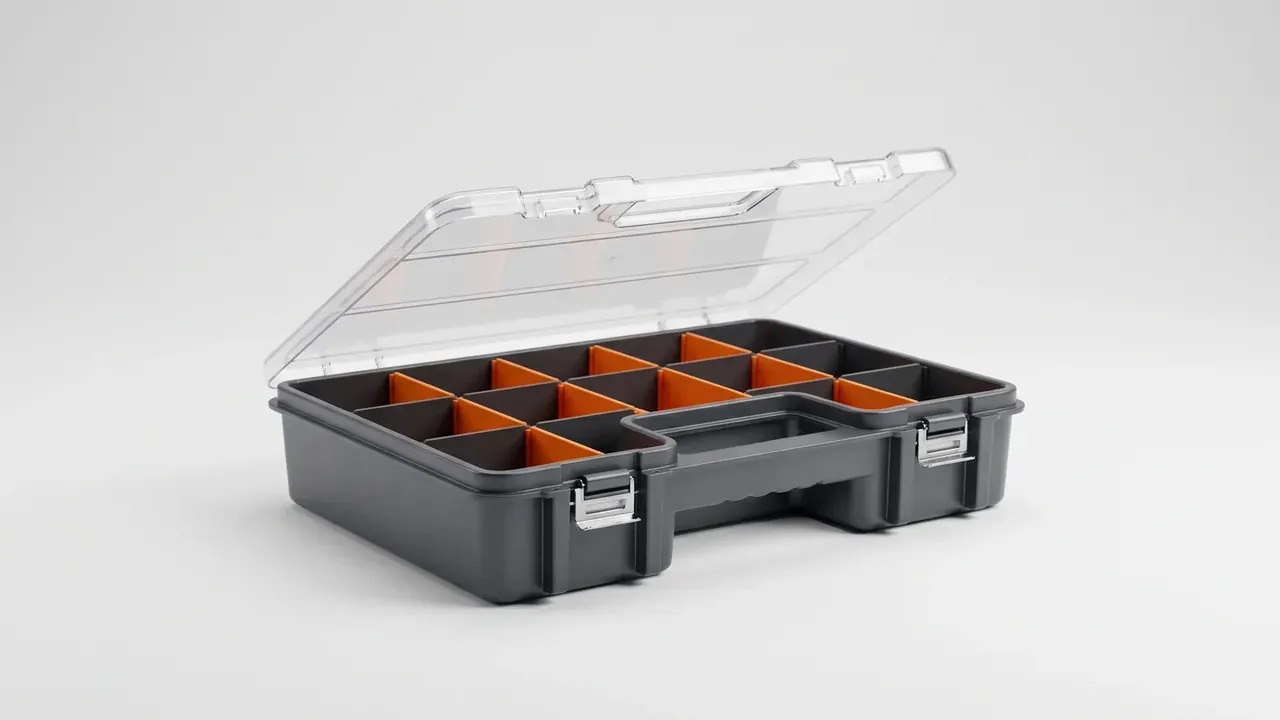
Quick answer: A tool box organizer is the internal structure that divides a case into fixed cells: walls, dividers and labels. It shortens every pick and return rather than adding capacity, because each tool holds one place and a missing item shows at a glance.
Table of contents
- Three structures a tool box organizer can take
- Cell size: working back from the largest item
- Labels: giving every cell an address
- Access order: heavy items near the handle
- What a specification check usually misses
- FAQ
1. Three structures a tool box organizer can take
A tool box organizer follows one of three routes: cell walls moulded with the shell, drop-in dividers in side-wall slots, or foam cut to each item. The difference is whether cells can change. Moulded cells cannot be misplaced; dividers rearrange in minutes, but lifting one panel erases a row; foam locates best and fits one shape.
Fixed mixes suit moulded cells, project mixes suit dividers, fragile items suit foam, recut when an item changes.
| Structure | Adjustable | Accuracy | Typical failure |
|---|---|---|---|
| Moulded cells | No | Medium | Cell base cracks |
| Drop-in dividers | Yes | Medium | Detent backs off |
| Foam cutouts | Recut only | High | Pockets collapse |
2. Cell size: working back from the largest item
Cells work back from the largest item. Measure it on three axes, add twice the clearance on each, and keep clearance at 5 to 10 mm: below 5 mm a hand cannot enter, above 10 mm the item knocks in transit.
Cells under 35 mm square or 40 mm deep stop thumb and forefinger entering together, while above 120 mm secondary stacking appears. Twelve cells in a 360 by 260 mm interior, four columns wide, give about 85 by 80 mm each; depth is the tallest item plus 10 mm.
3. Labels: giving every cell an address

Cells are hardware; labels are software. A working label is unique, durable and self-explanatory: a code such as A1 to D3, print that survives oil, wording a newcomer reads unaided.
Numbering runs by row and column, or by point: row numbering suits a fixed list where A1 never changes, point numbering suits inspection, where cell three matches checkpoint three.
Position fails more often than material. Inside a cell wall the label is hidden by the first item; on the floor it collects swarf. The top edge stays visible. Three colours is the limit.
4. Access order: heavy items near the handle
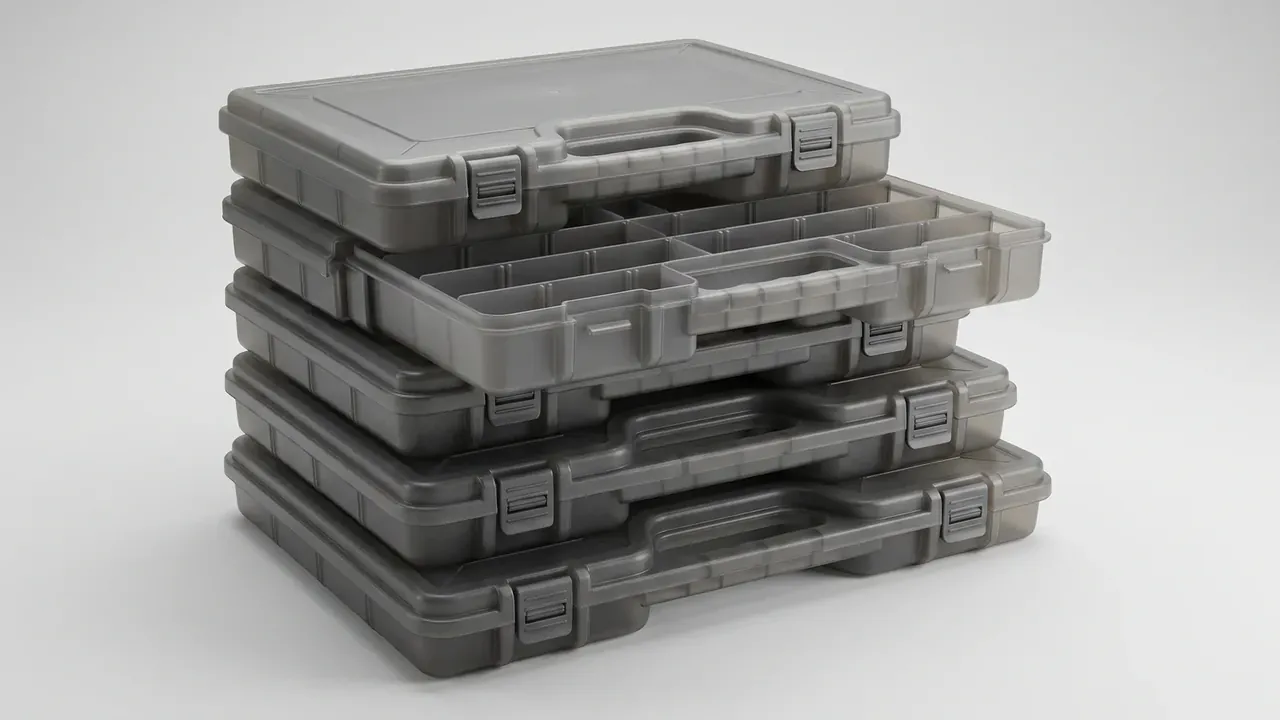
Layout affects the wrist, not capacity. Heavy items sit near the handle, frequent items at the front edge, long items along the long side.
Lid angle belongs in the same sum: a rear hinge stops near 95 degrees and hides the rear cells, so a full view needs 100 to 110 degrees. One layer is the limit.
Return matters as much as retrieval: a 2 mm radius on cell edges and a 1 degree floor fall let an item settle unaided.
5. What a specification check usually misses

Wall thickness runs 1.5 to 2.0 mm. Below 1.5 mm walls bulge under side load; above 2.5 mm a twelve-cell box gains weight for nothing. The divider detent should click audibly; one that rubs backs out.
Corners matter: square cells trap swarf, while R3 blows clear with an air gun. Lid interference is skipped most often, since ribs and mounts intrude above the cells. A latch over hard items also lifts the lid face and leaves the seal uncompressed.
| Check | Target | Consequence if missed |
|---|---|---|
| Cell wall thickness | 1.5–2.0 mm | Side bulge, base cracks |
| Divider detent | Audible click | Cells migrate |
| Cell floor radius | R3 or more | Swarf traps |
| Lid clearance | 10 mm or more | Lid lifts, latches fail |
| Loaded weight | 15 kg or less | Handle and walls loaded |
Conclusion
The value of a tool box organizer is not cutting space into pieces but turning access into a reflex: cells fix the size, labels the address, order the movement. With all three, a twelve-cell box gives a thirty-second pick and return.
This article covers container-side specifications and design implications only, not the handling, loading or use of the contents.
Related Reading
- Tool Cases: Hardware Tool Storage & Transport Protection
- Tool box internal compartment design
- Modular internal layout for tool boxes
- Organizer box versus tool box
Related Products
- 8 Series — Gun Cases; Military Equipment Cases; Camera Equipment Cases; Drone Cases; Watch Cases; Knife Cases; First Aid Cases; Electronics Equipment Cases
- WL8-2812 PP Gun Case — model WL8-2812
- All protective cases and toolboxes: 7 series, 158 models