

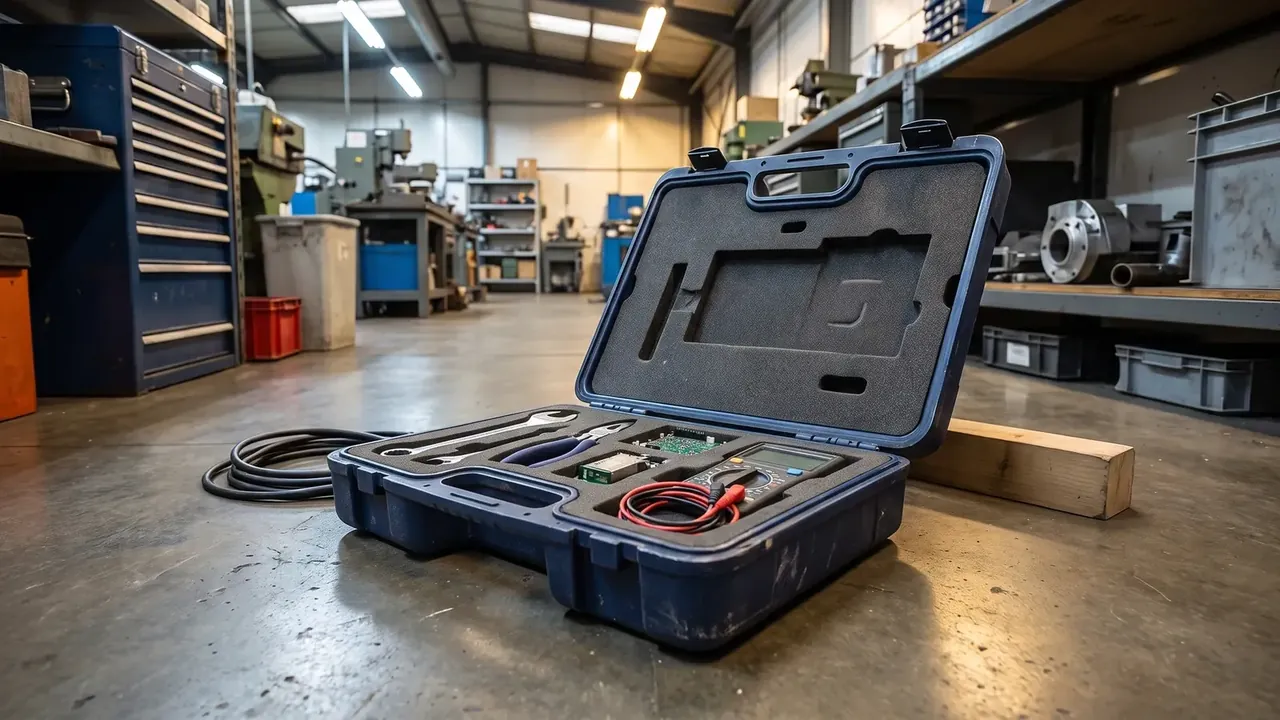
Quick answer: A tool roll earns its place in four settings — machine repair, route inspection, field service and precision assembly — wherever tools must be laid out in a fixed order. Length and loop pitch come first, mounting next, fabric last.
Table of contents
- Which Work Scenarios a Tool Roll Shows Up In
- Roll Body Configuration for Repair and Inspection
- Mounting a Tool Roll for Field Work and Vehicles
- Dividers and Fabric for Precision Workstations
- Choosing a Configuration by Scenario
- FAQ
1. Which Work Scenarios a Tool Roll Shows Up In
A job stalls when tools cannot be laid out in the order they are used. Machine repair, route inspection, field service and precision assembly share one trait: a fixed sequence, not a big tool count.
Three dimensions separate them: unrolled length, elastic loops per row, rolled diameter. Length sets how many long-shank tools fit, loop count sets small-item density, diameter decides between a backpack pocket and a vehicle wall.
| Setting | Tool set | Unrolled | Loops | Rolled |
|---|---|---|---|---|
| Machine repair | 8 hex keys, 6 wrenches | 620 mm | 14 | 78 mm |
| Route inspection | 5 drivers, feeler gauge | 480 mm | 10 | 62 mm |
| Field service | 3 pliers, leads, ties | 540 mm | 12 | 70 mm |
| Precision assembly | Tweezers, ceramic drivers | 400 mm | 16 | 55 mm |
2. Roll Body Configuration for Repair and Inspection
Machine repair is the hardest wear case. A 1680D flame-retardant nylon face with PVC backing wipes clean and lies flat on a machine table without curling; stitching runs at 3.5 mm pitch.
Loop pitch is where most rolls go wrong. At 25 mm a 6 mm hex key and a 13 mm wrench share a row; at 18 mm the wrench will not enter, at 32 mm small bits rattle. Double-layer elastic springs back after 2,000 insertions.
Inspection inverts this: fewer long slots, one clear window pocket on 20 mm hook-and-loop. Empty weight stays under 0.9 kg, loaded under 4.5 kg, or an hour on one shoulder drags the roll down.
3. Mounting a Tool Roll for Field Work and Vehicles
Field service takes the roll out of the workshop, so the strap gives way to mounting points. A cargo wall bracket takes M6 bolts at 6 N·m with 30 mm washers; without one, the hole slots out in two months.
| Mounting point | Fastener | Torque | Roll weight | Watch out for |
|---|---|---|---|---|
| Seat back | Webbing clip | None | Up to 3 kg | Side airbag zone |
| Cargo wall | M6 bolt, washer | 6 N·m | Up to 6 kg | Washer 30 mm minimum |
| Inside tailgate | Magnet, webbing | None | Up to 2 kg | Wear patch at hinge |
A 25 mm reflective strip on the outer centreline catches headlights at night. Keep it off the fold line, where 300 folds crack it white.
A closed cargo box reaches 65 °C in summer, so the face is rated to 80 °C; at minus 20 °C it must stay flexible or split on the first roll.
4. Dividers and Fabric for Precision Workstations
Precision assembly pushes the other way: no scratches, no lint, no charge. The face becomes 600D polyester with conductive yarn, surface resistance below 1×10⁹ ohm, and the thread is conductive too, or every needle hole insulates.
Dividers are heat-pressed, not stitched. An 8 mm heat-sealed bar leaves no thread ridge to scrape plating; a stitched bar leaves a 2 mm hard edge that polishes through first. Tweezers get a 12 mm angled slot.
5. Choosing a Configuration by Scenario
Order matters more than any single number: length from the scenario, pitch from the thickest tool, mounting from how the roll travels.
| Step | Decide | Basis | Typical value |
|---|---|---|---|
| 1 | Unrolled length | Longest handle plus 40 mm | 400–620 mm |
| 2 | Loop pitch | Thickest shaft plus 6 mm | 18–32 mm |
| 3 | Rolled diameter | Width of the pocket | 55–78 mm |
Prototype three rolls at once — nominal, 3 mm looser pitch, 40 mm shorter — and leave them on the workstation for a week. Two numbers decide: seconds to draw the most-used tool, and whether it closes without fouling.
Conclusion
A tool roll is not about carrying more; it fixes the order of use. Length and pitch first, mounting and fabric after, and the tool roll stops being the item at the back of a drawer.
This article discusses only the container (case body) side of specifications and design intent, and does not cover any handling, loading or use of the contents.
Related Reading
- What a tool roll is and how it stores tools
- Where a rolling tool case fits
- Configuring a mechanic tool pouch
- Fixing a vehicle tool case in place
Related Products
- 8 Series — Gun Cases; Military Equipment Cases; Camera Equipment Cases; Drone Cases; Watch Cases; Knife Cases; First Aid Cases; Electronics Equipment Cases
- WL8-2812 PP Gun Case — model WL8-2812
- All protective cases and toolboxes: 7 series, 158 models