

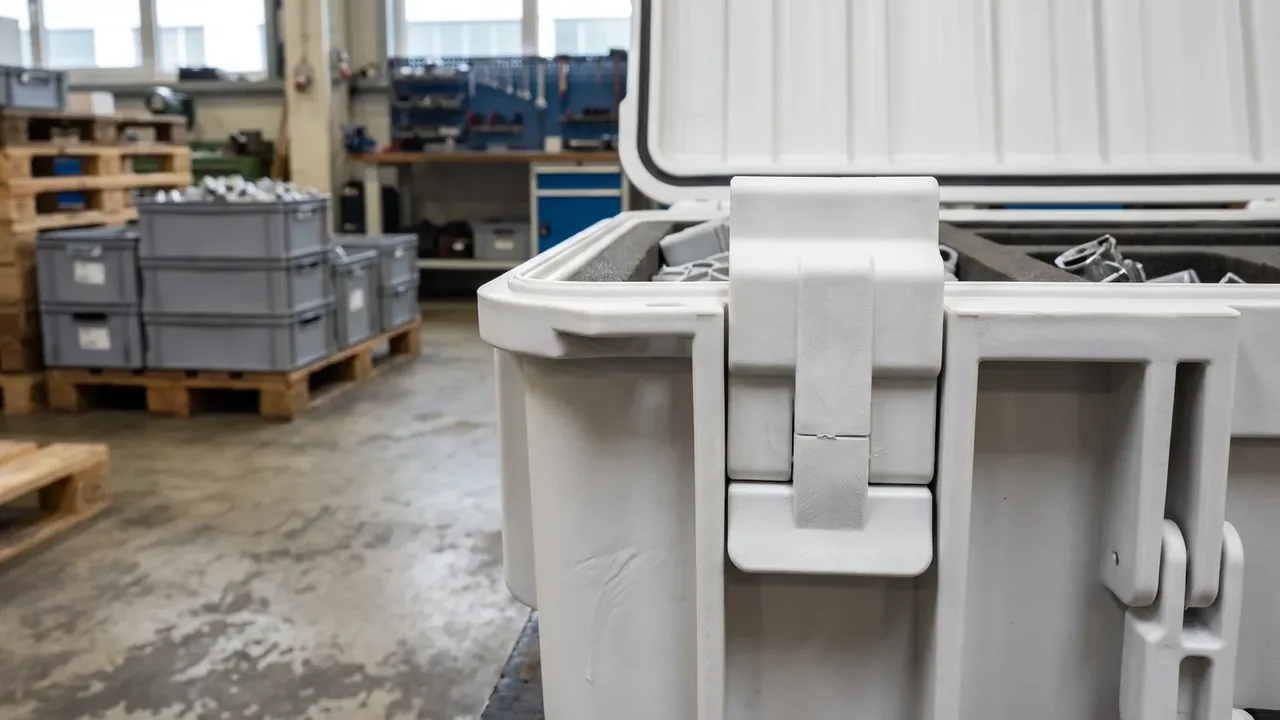
Quick answer: A Transit Case is not accepted by opening the lid at goods-in. Five gates cover incoming material, first article, dimensions, seal and dust, stacking and drop, each with its own sample size and pass threshold.
Table of contents
- The Five Inspection Gates for a Transit Case
- Incoming Material and First-Article Checks
- Dimensions and Wall Thickness Sampling
- Seal and Dust Testing: Vacuum, Spray, Powder
- Stacking and Drop: Load, Cycles, Verdicts
- FAQ
1. The Five Inspection Gates for a Transit Case
A Transit Case is accepted at five gates, not at the loading dock. Resin lot changes show up as colour and melt index drift, mould wear as lid offset, and low torque on the third drop.
| Gate | Timing | Sample | Criteria |
|---|---|---|---|
| Incoming | each lot | 3 bags | MFI 8±1.5, 48 h spray |
| First article | first shot | 3 units | dimensions, wall points, vacuum |
| In-process | every 2 h | 1 per cavity | flash, lid offset, latch force |
| Pre-shipment | before packing | level II | AQL 2.5, fatal zero |
| Goods-in | after unloading | 2 per pallet | marking, reports, stack state |
In-process is the gate most often dropped. Lid offset usually passes the first article and fails by shot 3,000, so sample by band: 8 units under 500, 20 above 2,000. Each gate needs a named signatory.
2. Incoming Material and First-Article Checks
Incoming covers resin, gasket and hardware. Recyclate above 20% costs falling-dart impact, gaskets are taken at Shore A 55±5, and latches must pass 48 hours of salt spray without white rust.
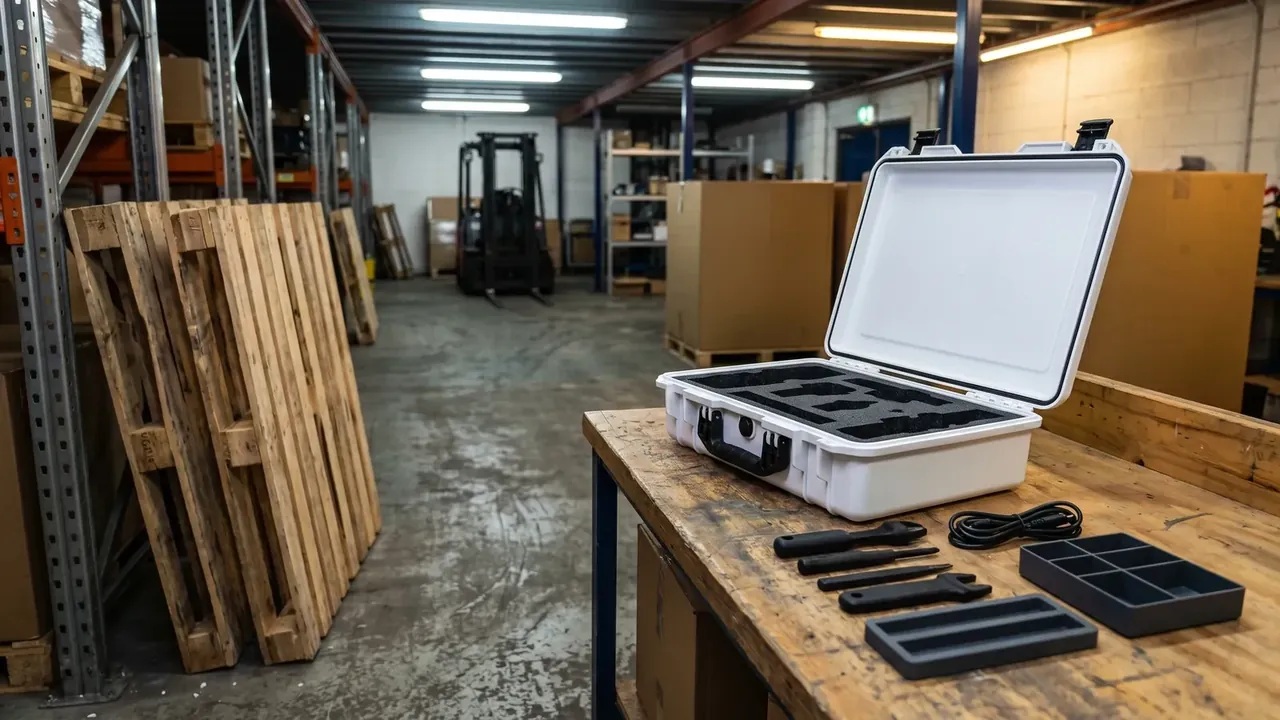
The first article is the largest single check: three units, full dimensions, eight wall points, one vacuum run, one sectioned to read weld-line position and stress whitening. Record measured values rather than the word pass.
Two failures stop the tool for review; that clause belongs in the contract annex.
3. Dimensions and Wall Thickness Sampling
Outside dimensions take a caliper, internal ones a tape and square, since radiused corners leave jaws unseated.
| Item | Gauge | Tolerance | Frequency |
|---|---|---|---|
| Outside L/W/H | caliper | ±2.0 mm | 5 per lot |
| Internal | tape, square | ±1.5 mm | 5 per lot |
| Wall | ultrasonic | 3.2±0.25 mm | 8 points per unit |
| Lid offset | feeler | ≤0.8 mm | every unit |
| Base flatness | plate, feeler | ≤1.0 mm | 3 per lot |
Wall thickness needs ultrasound, eight points a unit: at 3.2 mm nominal the spread runs 2.95 to 3.45 mm, and anything under 2.9 mm cracks first on a drop. Flatness beyond 1.0 mm rocks the fourth layer; a handle boss under 4.5 mm whitens under load.
4. Seal and Dust Testing: Vacuum, Spray, Powder
Sealing is graded airtight, watertight, dust-tight. Air tightness pulls to −30 kPa for 60 seconds and accepts a 0.5 kPa decay; leaks sit at the gasket joint and hinge boss.
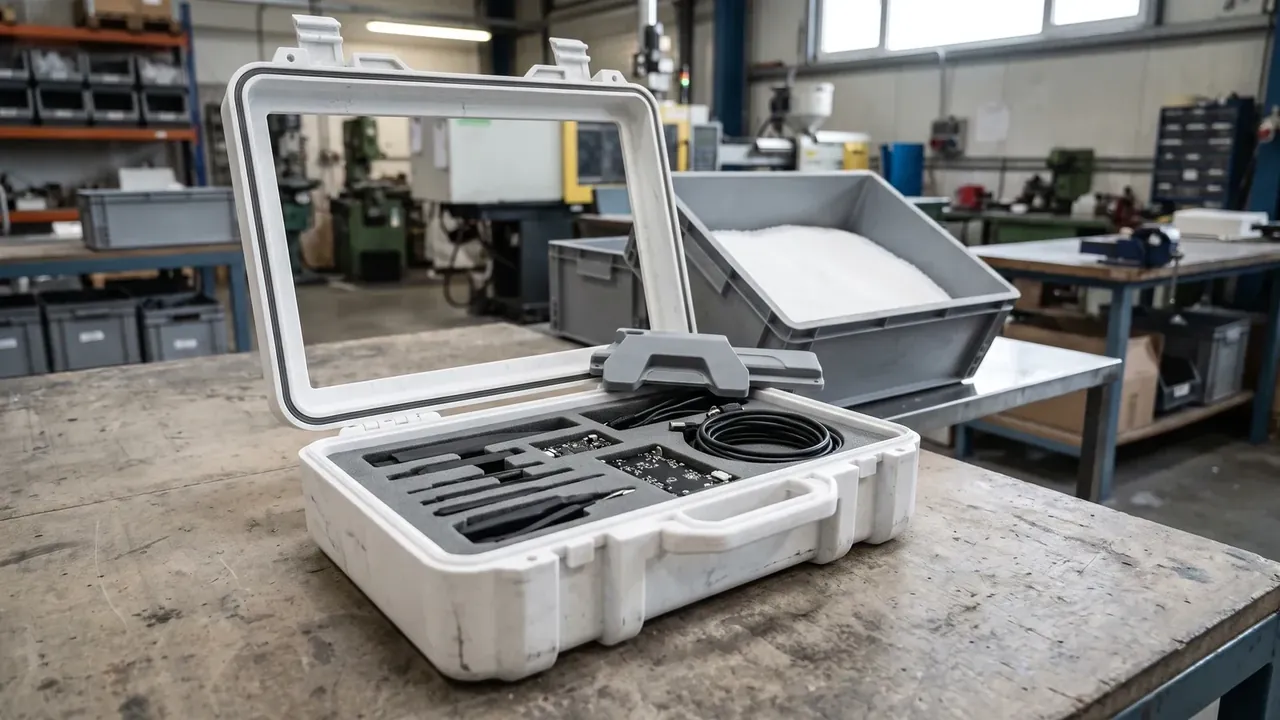
Water follows IPX5 at 6.3 mm and 12.5 litres per minute for three minutes, paper inside staying dry. Dust follows IP6X: 2 kg of talc, eight hours of cycling, −20 kPa inside, no powder on the cavity afterwards.
Dust rigs are costly, so volume lots run vacuum only: a Transit Case that holds vacuum keeps talc out. Gasket compression stays at 30% to 40%, and closing gap within 0.3 mm.
5. Stacking and Drop: Load, Cycles, Verdicts
Both tests destroy the sample, so both run at first-article stage: 1.6 times rated load over four layers for 24 hours, then 2.0 mm of allowed mid-wall deflection.
| Test | Condition | Verdict |
|---|---|---|
| Static stack | 4 layers, 1.6× load, 24 h | ≤2.0 mm, no crack |
| Vibration | 3–100 Hz, 30 min | latch closed, screws tight |
| Free drop | 1.2 m, 5 faces 1 edge | no crack, latch works |
| Latch fatigue | 500 cycles | force drop ≤20% |
| Handle load | 2× load, 10 min | no permanent set |
Drop order is corner, edge, face: a corner concentrates energy, so a crack there means a radius too small. 1.2 m covers manual carry.
Verdicts are graded, never phrased as pass. Seal failure, latch release and shell cracking are fatal and reject the lot; offset beyond 0.8 mm is major at AQL 1.0.
Conclusion
A standard is worth what its gauges, numbers and signatures are worth. Incoming checks the blend, the first article the measured values, sealing the decay, stacking and drop the deflection.
Trace batches to mould and shift and acceptance stops being a one-off act; that is what makes a Transit Case standard enforceable.
This article discusses only the container (case body) side of specifications and design intent, and does not cover any handling, loading or use of the contents.
Related Reading
- How a Transit Case is built
- Seal ratings and how to verify them
- Where the dust protection boundary sits
- How acceptance criteria differ by industry
Related Products
- 8 Series — Gun Cases; Military Equipment Cases; Camera Equipment Cases; Drone Cases; Watch Cases; Knife Cases; First Aid Cases; Electronics Equipment Cases
- WL8-2812 PP Gun Case — model WL8-2812
- All protective cases and toolboxes: 7 series, 158 models