

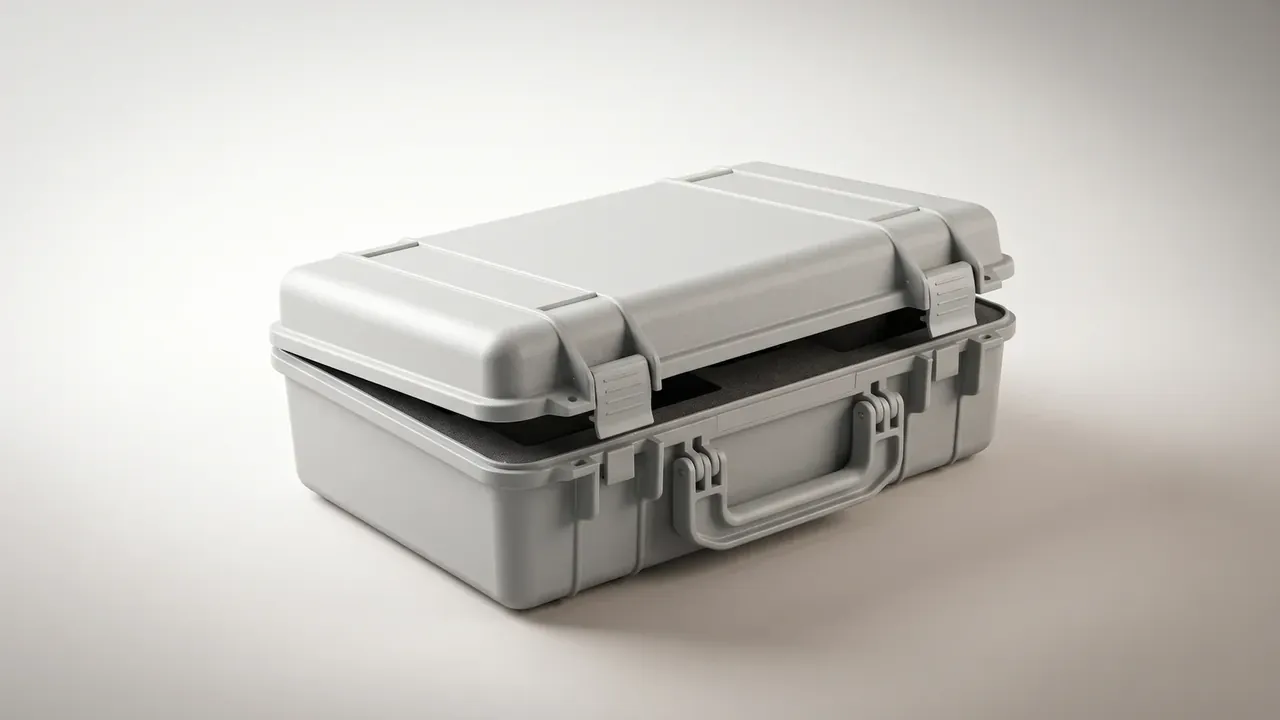
Quick answer: A dustproof case is judged not by how hard the lid shuts but against a particle spectrum: coarse grains are stopped by geometry, fine ones ride the air and need a compressed seal or a filter. Settle size, pressure and frequency first; the IP number means little without them.
Table of contents
- What a dustproof case is: three gates
- Particle size: which band is hardest to stop
- Sealing faces: the joint is the main door
- Filtration and breathing: where pressure escapes
- Ranking the three gates, and upkeep
- FAQ
1. What a dustproof case is: three gates
The goal is not zero ingress but holding the dust mass entering the cavity below a threshold. IEC 60529 sets the criteria: IP5X allows a little dust without affecting operation, IP6X requires no visible deposit. The same shell, tested with or without vacuum, sits one grade apart.
Three gates do the work: gap geometry, seal compression and air exchange. The order cannot be reversed: an open gap makes a tight face pointless.
A dustproof case is often confused with a waterproof one: liquid against talc. A 0.2 mm gap stops water by surface tension yet passes 20 μm dust.
2. Particle size: which band is hardest to stop
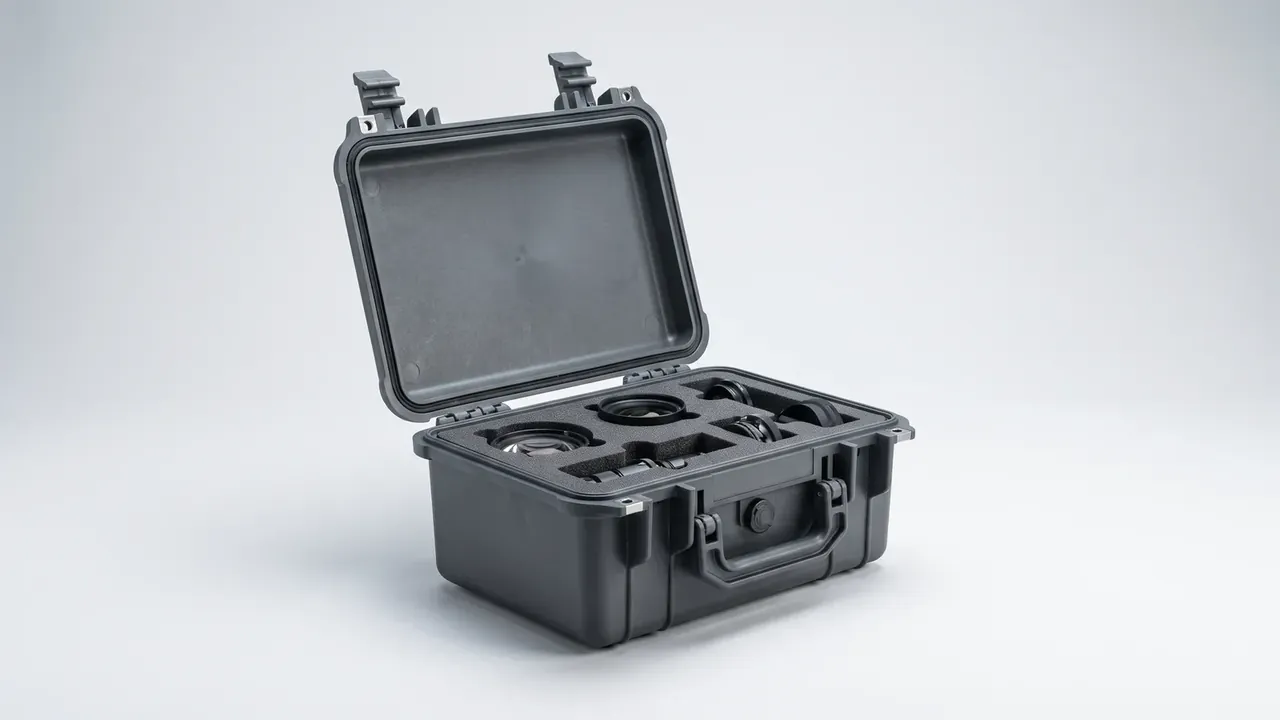
Dust is a spectrum: cement 5–50 μm, flour 10–100 μm, sand 50–500 μm, sawdust 100–1000 μm, fume 0.01–1 μm.
Movement decides ingress more than size. Above 50 μm gravity settles the grain on the seal; between 1 and 50 μm it follows the air through any gap; below 1 μm it stays suspended and only a filter stops it.
The opponent is the band that stays airborne. Ask what powder is on site, then discuss a rating.
| Dust | Size | Motion | Demand on the seal |
|---|---|---|---|
| Cement, lime | 5–50 μm | Rides the air | Above 25% compression |
| Sand | 50–500 μm | Settles, abrades | Hard face |
| Carbon black | 0.01–1 μm | Brownian | Filter required |
3. Sealing faces: the joint is the main door
The lid joint has the longest perimeter; latch holes, hinge bores, handle mounts and the valve port add the rest.
Four seal types cover this: a flat gasket at 15–25% compression, an O-ring at 20–30%, a lip seal that tightens with pressure, a double lip that scrapes dust.
The groove matters more than the rubber: 10–15% wider than the cord, deep enough for 25% compression, with a rounded floor. A parting-line burr over 0.1 mm presses a channel into the gasket, and that channel leaks.
A soft lid is the hidden leak: 0.3 mm of lift at mid-span is enough, and a 0.05 mm feeler finds it.
4. Filtration and breathing: where pressure escapes
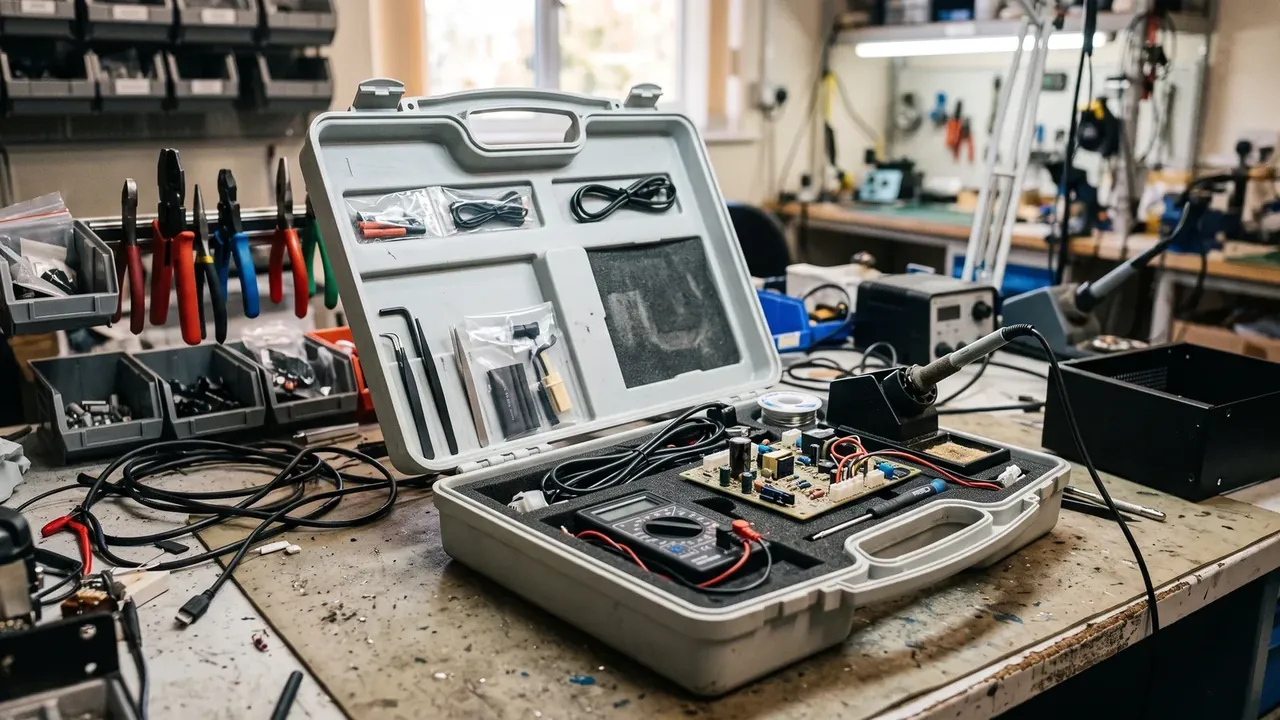
A 40 K swing at 101 kPa creates about 13 kPa, enough to push air through the weakest gap and carry dust.
A one-way valve opens outward but its seat fails once powder sticks. A vent membrane of expanded PTFE, with 0.1–1 μm pores, passes 100–1000 millilitres per minute per square centimetre and arrests 99% of 0.3 μm particles.
Keep them apart: valve on the top face, membrane on the side. A clogged membrane shifts the load back to the seal, so it is a service part.
5. Ranking the three gates, and upkeep
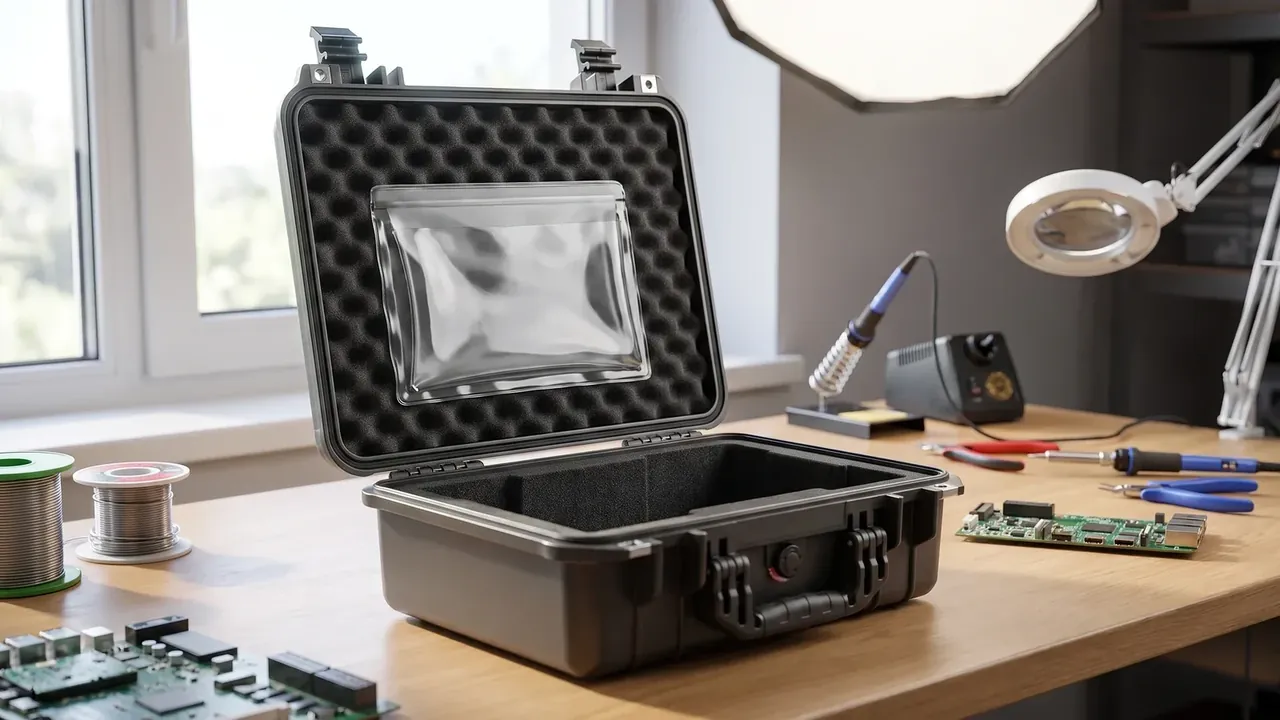
Close the gap, compress the face, then manage airflow. Gaps are cheapest: move a parting line, add a baffle, blind a latch hole. More compression needs a deeper groove.
Upkeep is wipe and replace: wipe the face before every close, since one grain of sand cuts a groove; grease thin, or it collects dust. Where dust lands tells you why.
| Symptom | Cause | Fix |
|---|---|---|
| Dust along the lower wall | Low compression | Deeper groove |
| Dust around latches | Open holes | Blind caps |
| Even film everywhere | Breathing | Add a membrane |
Conclusion
A dustproof case is three gates working together: geometry for coarse grains, compression for the suspended band, relief for airflow. Ask about all three, and the dustproof case earns its price.
This article covers container-side specifications and design implications only, not the handling, loading or use of the contents.
Related Reading
- Seal strip compression and ageing
- Dustproof design for outdoor cases
- How a pressure equalisation valve works
- Gasket and O-ring material selection
Related Products
- 8 Series — Gun Cases; Military Equipment Cases; Camera Equipment Cases; Drone Cases; Watch Cases; Knife Cases; First Aid Cases; Electronics Equipment Cases
- WL8-2812 PP Gun Case — model WL8-2812
- All protective cases and toolboxes: 7 series, 158 models