

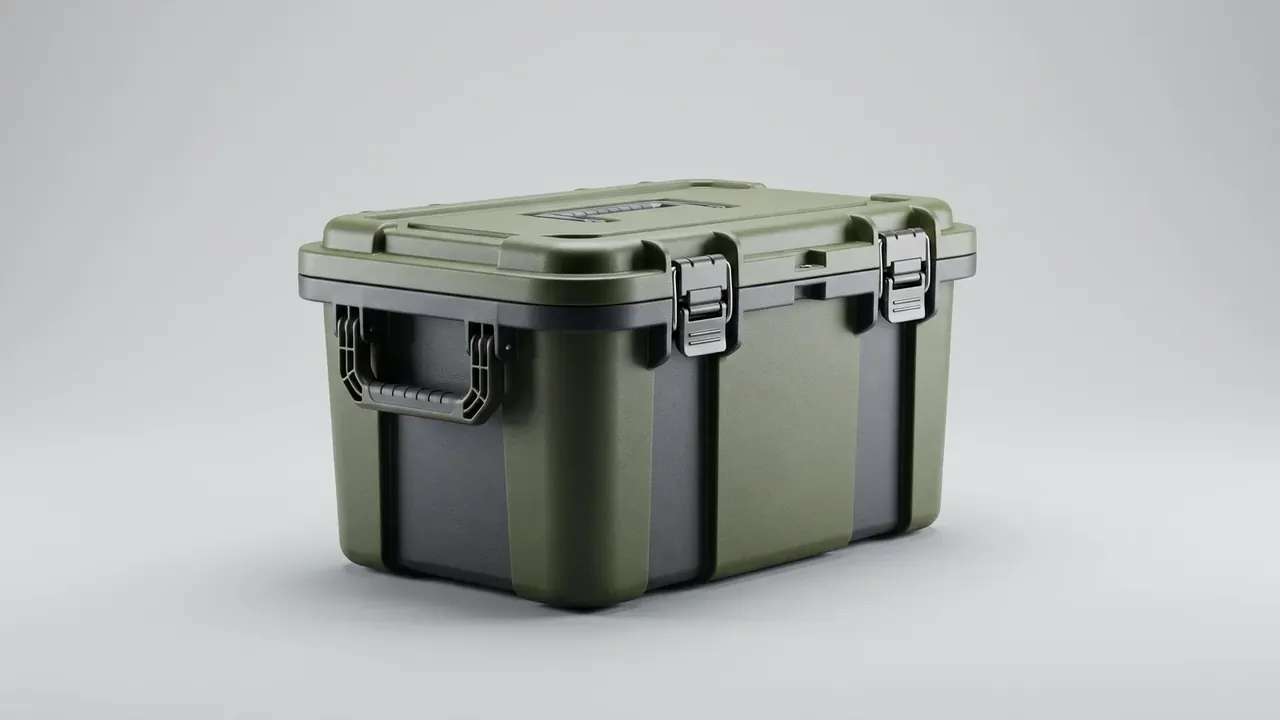
Quick answer: A transport box is selected by pallet module, wall thickness, drop test and handle load, with colour last. The pallet module is the step most often skipped, and a box that misses it is handled twice at every stop.
Table of contents
- How to choose a transport box: five checks in order
- External dimensions: fit the pallet module first
- Wall thickness and tare weight: what the bottom layer carries
- Drop and temperature: test both extremes
- Handles, latches and marking
- FAQ
1. How to choose a transport box: five checks in order
A transport box is defined by movement, not storage: it is forklifted and stacked far more often than opened. Work backwards from those moves — pallet fit, empty weight, one fall.
Reverse that order and the cost is specific. Buying on shape brings unribbed corners that bow at five high; buying on price loses the ribs that survive the first corner drop.
| Check | Decide first | Typical | If wrong |
|---|---|---|---|
| Pallet module | pallet fit | 600×400 mm, four per layer | 200 mm lost |
| Wall and tare | stack height | 5.5 mm side, 7.2 kg | walls bow |
| Drop and temperature | lowest service temperature | 1.2 m at −18 °C | corner cracks |
| Handle and latch | loaded weight | 30 kg static | rivets pull |
| Colour and marking | last | 5 mm characters | number wears |
One item is usually forgotten: the shut line. Above 1.5 mm the upper box settles into the lid recess and the stack rocks; below 0.5 mm the latch will not close in the cold.
2. External dimensions: fit the pallet module first
The outside of a transport box is set by the pallet: a 1200×1000 mm pallet takes four boxes of 600×400 mm per layer with 200 mm for film, while a 500×400 mm base fits six flush to the edge.
Five layers of a 320 mm box is twenty units; on a 150 mm pallet the load stands 1750 mm, inside the 1800 mm beam height of most racking. At 360 mm it reaches 1950 mm and stays on the floor.
| Base | Per layer | Five layers | Clearance |
|---|---|---|---|
| 600×400 | 4 | 20 | 200 mm |
| 500×400 | 6 | 30 | almost none |
| 400×300 | 9 | 45 | 140 mm |
3. Wall thickness and tare weight: what the bottom layer carries
Thickness follows the stack. One loaded transport box weighs 28 kg, so at five high the bottom unit carries 112 kg on its lid. Design to 336 kg held for 24 hours, with the lid centre deflecting no more than 2 mm.
A rotomoulded body at 5.5 mm sides and 6.5 mm base splits thick where it carries load and thin where tare matters. Injection moulding of the same volume runs 2.8 mm over a rib grid at 4.6 kg, 2.6 kg lighter and 52 kg per pallet. Three base ribs at 120 mm centres bridge the pallet boards.
4. Drop and temperature: test both extremes
Most drop tests run warm, empty and once; all three flatter the result. The real event is a box sliding off a tail lift on a winter morning.
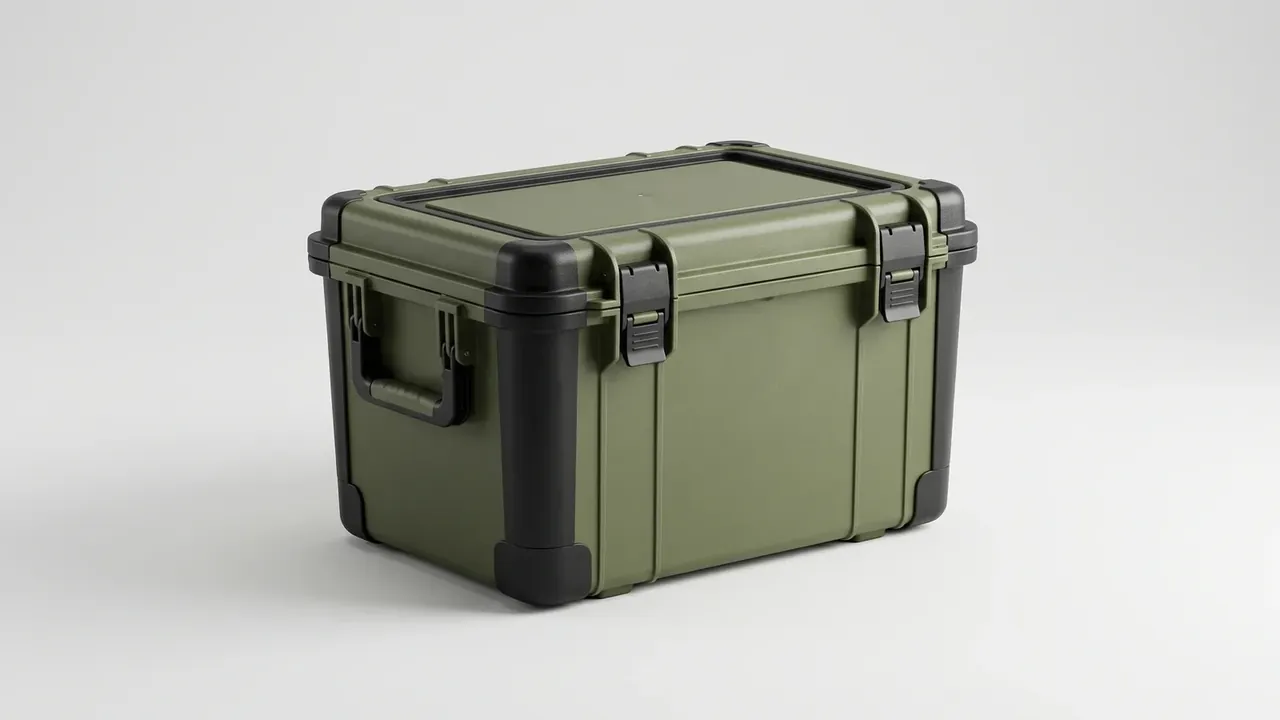
Condition at −18 °C for four hours, drop a corner 1.2 m onto concrete within 90 seconds, then repeat at 1.5 m warm. Judge a through-crack, a released latch and a shut line past 2 mm.
Heat needs the same rigour: four hours at +55 °C cuts modulus by thirty percent, so 112 kg deflects the lid twice as far.
5. Handles, latches and marking
The handle carries the most concentrated load. Thirty kilograms for an hour with 3 mm of set, and 15 kg through 5000 cycles without a loose rivet, is the line.
Latches measure 60 to 90 N to open, workable in gloves, with under fifteen percent clamp loss after 2000 cycles. Below that they release themselves; above it someone finds a pry bar.
Moulded characters 5 mm high wear with the box; ink-jet codes belong on a flat rib face. Acceptance is fifty alcohol wipes and a readable batch.
Conclusion
The sequence: base size to the pallet module, wall thickness from the stack, drop and compression cold and hot, handle and latch sized to the load. Count how many fit on a pallet first, because those numbers decide whether a transport box earns its place.
This article discusses only the container (case body) side of specifications and design intent, and does not cover any handling, loading or use of the contents.
Related Reading
- How transport and storage duties split
- The case side of export packaging
- Pallet loading and case marking
- Storage and stacking in the warehouse
Related Products
- 8 Series — Gun Cases; Military Equipment Cases; Camera Equipment Cases; Drone Cases; Watch Cases; Knife Cases; First Aid Cases; Electronics Equipment Cases
- WL8-2812 PP Gun Case — model WL8-2812
- All protective cases and toolboxes: 7 series, 158 models