

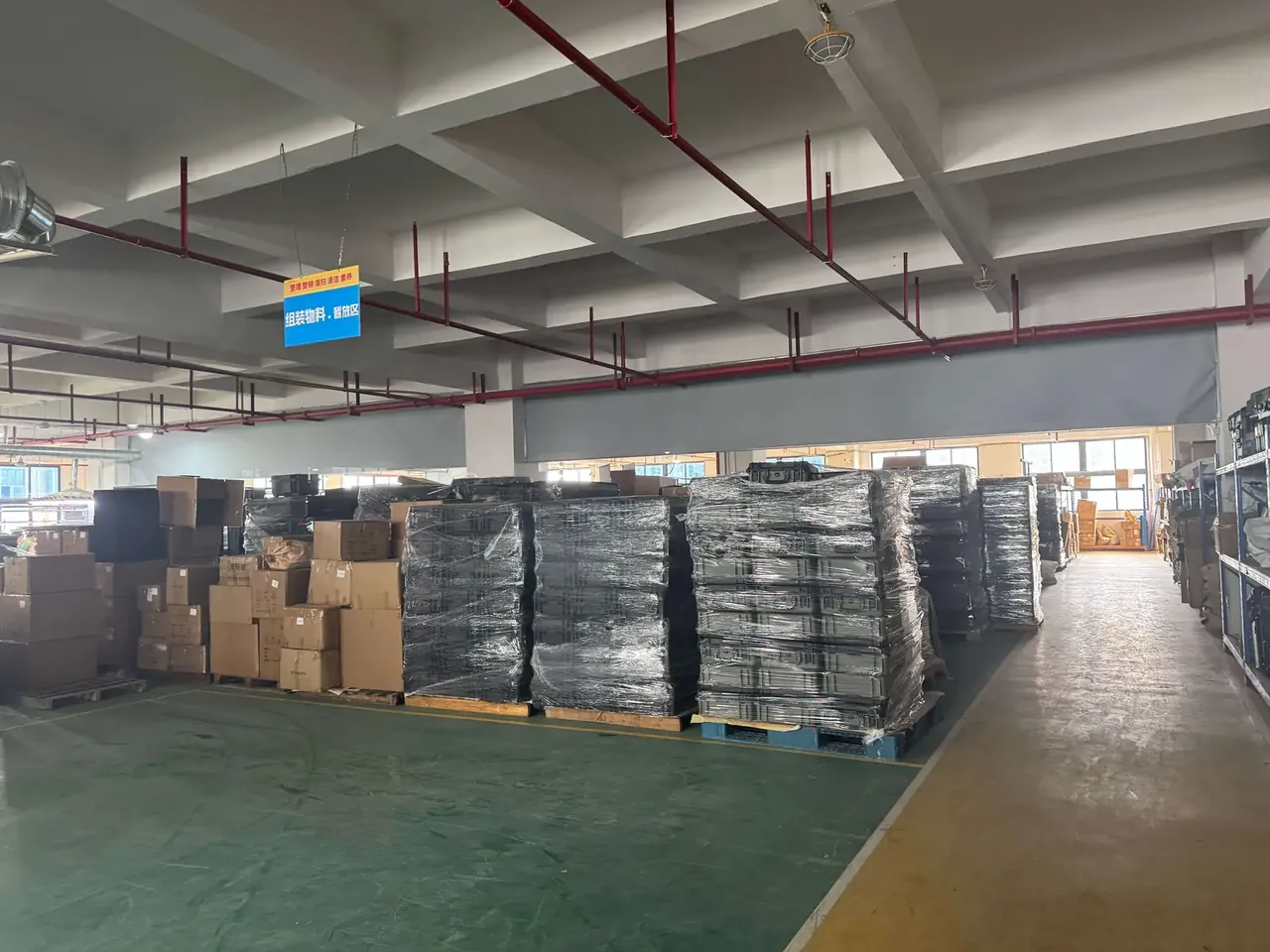
Quick answer: Case Warehouse Storage is planned from the pallet outward. A 600 x 400 x 340 mm case fits four per layer on a 1200 x 800 mm pallet; five layers give 1850 mm and 146 kg. A 500 kg dynamic rating covers it, and a counterbalance truck needs a 3.2 m right-angle aisle.
Table of contents
- Three Numbers First: Layers, Height, Floor Load
- Pallet Size and Rating
- Aisle Width and Turning Radius
- ABC Zoning and Dispatch Distance
- Wrap, Labels and Monthly Checks
- FAQ
1. Three Numbers First: Layers, Height, Floor Load
Case Warehouse Storage starts with one pallet. A 600 x 400 x 340 mm case at 6.2 kg fits four per layer on a 1200 x 800 mm pallet, so five layers hold twenty.
Height is case height times layers plus a 150 mm pallet, giving 1850 mm. Manual reach stops near 1700 mm, and above it a pick stretches from 40 to 70 seconds.
Floor load runs at 152 kg per square metre from a 146 kg pallet, inside a 3000 kg per square metre slab; the real check is the 900 kg through one wheel.
| Parameter | Value |
|---|---|
| Cases per layer | 4 |
| Layers | 5 |
| Cases per pallet | 20 |
| Goods per pallet | 124 kg |
| Load height | 1850 mm |
| Pallet gross | 146 kg |
2. Pallet Size and Rating
In Case Warehouse Storage the pallet follows the case footprint. Four cases use only 1200 x 800 of a 1200 x 1000 deck; a 1200 x 800 pallet fills completely and adds a fifth more stock per bin.
Depth costs. A shallow pallet on 1000 mm racking sits 200 mm short at the face, drivers judge the gap by eye, and beams take dents in six months.
Rate the worst case: five layers need 200 kg dynamic, but a second pallet on top passes 300 kg static through four corner blocks, and damp wood loses a fifth.
| Size (mm) | Cases | Efficiency | Dynamic |
|---|---|---|---|
| 1200 x 800 | 4 | 100% | 500 kg |
| 1200 x 1000 | 4 | 80% | 1000 kg |
| 1200 x 1200 | 6 | 96% | 1200 kg |
| 1400 x 1200 | 6 | 86% | 1500 kg |
3. Aisle Width and Turning Radius
A right-angle aisle measures turning radius plus fork length plus 150 mm. A 1.5 tonne counterbalance turns in 1950 mm, giving 3.2 m; a reach truck turns in 1650 mm, needing 2.9 m.
In Case Warehouse Storage the usual failure is an aisle wide on paper and eaten by the load. The stack face stands 100 mm off a 100 mm line, leaving 2.8 m from a 3.0 m line.
Chamfer inside corners at 1.5 m and repaint the yellow line every three months.
| Truck | Radius (mm) | Right angle (mm) |
|---|---|---|
| Counterbalance 1.5 t | 1950 | 3200 |
| Reach truck 1.5 t | 1650 | 2900 |
| Stand-on stacker | 1450 | 2750 |
| Hand pallet truck | 1350 | 2000 |
4. ABC Zoning and Dispatch Distance
In Case Warehouse Storage, location value decays with distance. Class A sits within 15 m of the dispatch door, B within 30 m, C within 45 m. A truck averages 1.7 m per second indoors, so a 30 m round trip costs 35 seconds.
At 60 pallets a day with A taking 60 percent, moving that block from 45 m to 15 m saves about 36 minutes a shift.
| Zone | Turnover | Distance | Bins |
|---|---|---|---|
| A | 7 days or less | 15 m | 30% |
| B | 8 to 30 days | 30 m | 40% |
| C | Over 30 days | 45 m | 25% |
| Inspection | Variable | Receiving | 5% |
5. Wrap, Labels and Monthly Checks
Case Warehouse Storage relies on film for restraint, not dust. Use 500 mm film at 23 microns, three turns at the deck and two at the top, with 50 percent overlap.
Labels face the aisle at 1200 to 1500 mm: product, case count, gross weight, date.
Monthly checks cover a stack past 1850 mm, film loose in a full turn, and a pallet foot split beyond 100 mm, leaving the stack on film alone.
Conclusion
Case Warehouse Storage runs on one chain of numbers: fill the pallet from the case footprint, cap the stack at five layers and 1850 mm, size the aisle at 3.2 m, then place bins at 15, 30 and 45 m by turnover. Keep the stack face 100 mm off the yellow line and scrap a pallet foot split past 100 mm, and floor area turns into usable bins. That is what Case Warehouse Storage planning is for.
This article discusses only the container (case body) side of specifications and design intent, and does not cover any handling, loading or use of the contents.
Related Reading
- Five hard rules for case warehouse storage
- Stackability and pallet planning
- How a stack carries load
- Precautions for shipping and loading
Related Products
- 8 Series — Gun Cases; Military Equipment Cases; Camera Equipment Cases; Drone Cases; Watch Cases; Knife Cases; First Aid Cases; Electronics Equipment Cases
- WL8-2812 PP Gun Case — model WL8-2812
- All protective cases and toolboxes: 7 series, 158 models