

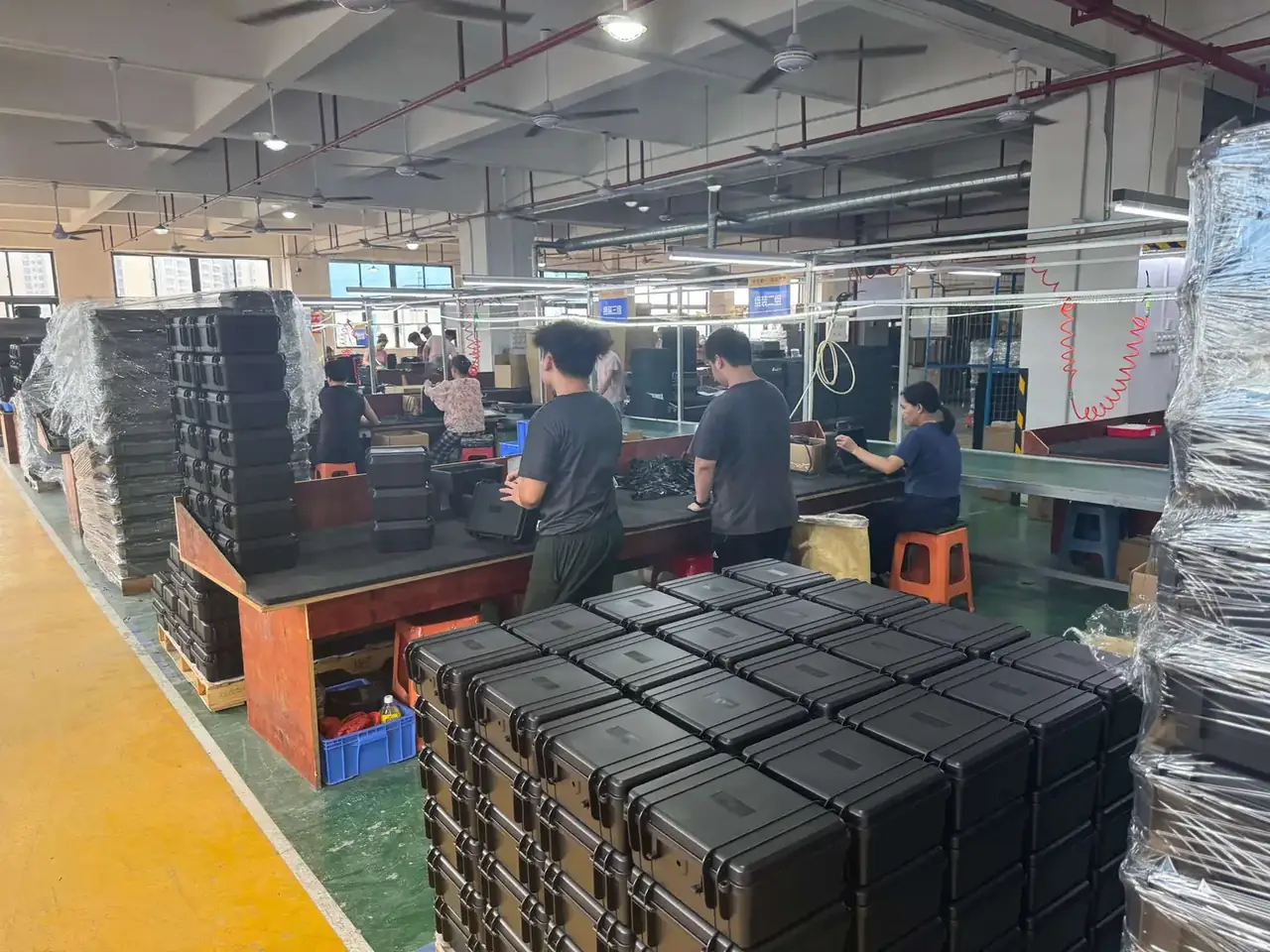
Quick answer: Travel case production inspection runs by damage: rolling first, handle fatigue second, drop last. Rolling wears the tread, fatigue loosens the joints, a drop cracks the shell, so it goes last to keep earlier readings clean.
Table of contents
- Where Travel Case Production Inspection Starts
- Rolling Test: Load, Track and Distance
- Drop Test: One Corner, Three Edges, Six Faces
- Handle Fatigue: 3,000 Cycles and Sway Growth
- Sampling, Limits and Records
- FAQ
1. Where Travel Case Production Inspection Starts
The last stage of travel case production is inspection, which separates good units from bad. The tests run in order of damage left behind: the drop cracks shells, rolling only wears tread, fatigue only loosens joints. Drop first and every later reading is contaminated.
Samples condition 24 hours at 23 plus or minus 2 C and 50 percent humidity, where a cold shell cracks 30 percent longer. Three samples from one batch are measured first for weight, wheel height spread, handle sway and minimum wall.
| Test | Equipment | Setting | Pass |
|---|---|---|---|
| Rolling | Drum tester | 18 kg, 4 km/h, 32 km | Tread wear 2 mm max |
| Drop | Rig on concrete | Empty, 0.9 m, ten points | No crack, latches shut |
| Fatigue | Reciprocating rig | 3,000 cycles, 50 N side load | Sway growth 2 mm max |
2. Rolling Test: Load, Track and Distance
Rolling mimics airport floors and pavements. Load is the rated capacity: an 18 kg case carries 18 kg of weights, centre of gravity a third of the way up. The drum turns at 4 km/h with a 25 mm cleat every 2 m, and the run is 32 km, roughly one long-haul check-in plus two transfers.
Three readings decide it: tread loss under 2 mm, no axle play, no bend in the handle. A PU wheel going from 50 to 48 mm over 32 km is normal; down to 46 mm means soft compound. Stop every 8 km and touch the wheel: above 60 C points to dry bearings or an off-centre bracket.
3. Drop Test: One Corner, Three Edges, Six Faces
The drop test is destructive, so it closes the sequence. The empty sample hits ten points, one corner, three edges and six faces, from 0.9 m onto a 100 mm concrete slab. The corner is hardest, since energy converges on three faces, and the first crack almost always starts there.
Grades run three ways: no crack, latches closed and handle straight passes; a crack under 20 mm with latches still closing is a concession; a through crack or sprung latch fails. Corner first, then edges, then faces, because damage from one point changes how the next loads. A cold subgroup sits at minus 18 C for four hours, then drops a corner within 30 seconds, where PC cracks can double.
4. Handle Fatigue: 3,000 Cycles and Sway Growth
Fatigue runs 3,000 cycles at 30 per minute, full extension to full retraction, 100 minutes per case. The clamp grips the handle and applies 50 N sideways, imitating a walking wrist.
Judge the growth, not the absolute number. Measure sway at full extension before and after: a rise of 2 mm or less passes, with the total staying under 8 mm. Assembly already caps sway at 8 mm, so 3,000 cycles may consume only 2 mm of that margin. Failures usually start with clearance sitting at the 0.25 mm ceiling.
Three modes appear: clearance opens and sway exceeds the limit, the majority; the detent ball wears and the handle slides back; bracket bolts loosen and the tube tilts. All cluster after 1,500 cycles, so 3,000 is the floor for catching them.
5. Sampling, Limits and Records
For lots of 501 to 1,200 units, level II draws 80 samples for appearance and function, and three go to the destructive tests. Acceptance is zero for critical defects, AQL 1.5 for major and 4.0 for minor; one failure sends the lot to full inspection.
| Lot size | Sample | Critical | Major | Minor |
|---|---|---|---|---|
| 281–500 | 50 | 0 | 2 | 5 |
| 501–1,200 | 80 | 0 | 3 | 7 |
A separated handle or a sprung latch is critical and rejects the lot; a crack over 20 mm or a loose bracket is major and doubles sampling. Keep the data sheet, rig curve and sample photos; three samples stay 12 months to trace complaints. Nine disputes in ten settle on those records.
Conclusion
The value of the three tests is the order, not the pass rate: rolling wears tread, fatigue loosens joints, the drop cracks the shell last, so damage stays attributable. Sway is read against an 8 mm ceiling, and 3,000 cycles may eat only 2 mm. Fix sequence, limits and samples, and travel case production inspection answers the same twice.
This article discusses only the container (case body) side of specifications and design intent, and does not cover any handling, loading or use of the contents.
Related Reading
- How to set sampling ratios before shipment
- AQL acceptance rules for custom case orders
- Stacking and load test criteria for cases
- Recording incoming batch inspections
Related Products
- 8 Series — Gun Cases; Military Equipment Cases; Camera Equipment Cases; Drone Cases; Watch Cases; Knife Cases; First Aid Cases; Electronics Equipment Cases
- WL8-2812 PP Gun Case — model WL8-2812
- All protective cases and toolboxes: 7 series, 158 models