

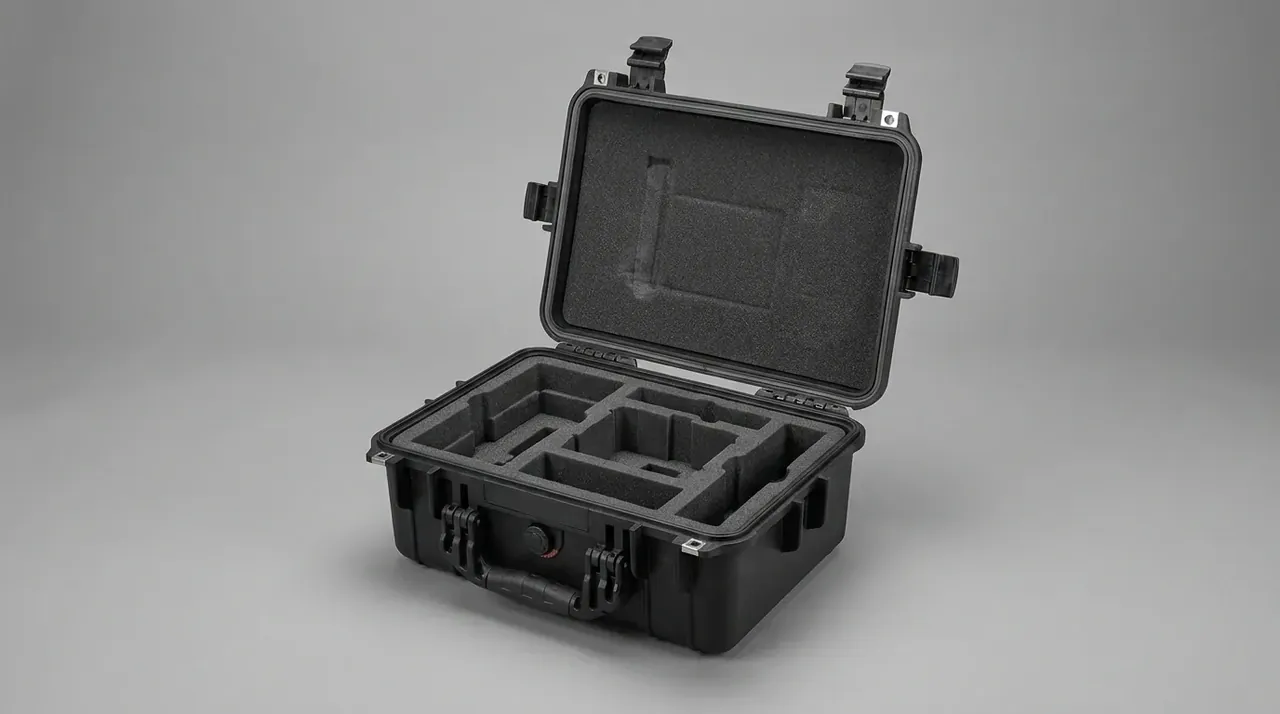
Quick answer: A tunnel inspection case clears three fixed dimensions: 1200 mm clear width, an 800 mm hatch and a 0.9 m radius, which sets the 500×350×200 mm shell.
Table of contents
- Three Fixed Dimensions Behind the Shell
- The 800 mm Hatch and the 150 mm Margin
- Carrying Position Through a 0.9 m Turn
- The 3 m Ladder and the 14 kg Switch Point
- FAQ
1. Three Fixed Dimensions Behind the Shell
A utility tunnel walkway is drawn at 1200 mm structural clear width. A cable bracket reaches 250 mm out from one wall, so the floor a boot can land on is 950 mm. The tunnel inspection case is built at 500×350×200 mm; held against the stomach it takes 350 mm and leaves 300 mm at each side.
Length is the tighter axis. One patrol covers 2.5 km in 90 minutes, 27.8 m per minute, slow because every joint gets a stop, with the shell in hand throughout.
| Passage dimension mm | Method of passage | Time min |
|---|---|---|
| 1200 (structural clear width) | Two-handed carry against the stomach | 0.5 |
| 800×800 (access hatch) | Level pass, 500 mm edge first, 150 mm each side | 2.5 |
| 900 (inner corner radius) | Swap hands, load swings outside the body | 1.5 |
| 950 (clear span between brackets) | One hand at the side, shell against the leg | 0.8 |
Time collects at hatches and corners. Six hatches and 14 corners on a 2.5 km route come to 36 minutes, four tenths of the patrol.
2. The 800 mm Hatch and the 150 mm Margin
The hatch is 800×800 mm. Fed in square with the 500 mm edge, the case leaves 150 mm at each side. That margin belongs to hands: a thin glove pushes knuckles about 70 mm past the handle, so two hands claim 140 mm. Lose 20 mm and the shell must be spun half a turn in mid air.
Angling buys no width. The 500×200 mm section carries a 538 mm diagonal and occupies 533 mm at 30°, 33 mm more than a square pass. What it buys is contact: the bottom edge lands on the sill and the shell slides, saving 200 mm of arm reach.
Standing the tunnel inspection case on end drops the footprint to 350 mm and raises the margin to 225 mm, at the price of a centre of gravity 250 mm up, too high for one hand to hold 14 kg. That pass takes two people and 40 s more, plus 13.7 J for the 100 mm threshold.
3. Carrying Position Through a 0.9 m Turn
The 0.9 m radius describes the inside corner, not the space a person needs to turn. The outer corner of the shell sits 610 mm from the body centre line, the diagonal of the 500×350 mm section. With half a 450 mm shoulder width, body plus load need 835 mm against 950 mm of clear span, leaving 115 mm.
Under 150 mm of margin a hand swap is forced. The tunnel inspection case moves outside the body, the outer arm clamps the 350 mm edge, and the load turns with the torso, so the swept radius falls from 610 mm to 350 mm. A second on a straight run becomes 90 s at a corner.
| Carrying position | Width occupied mm | One-hand hold min |
|---|---|---|
| Level against the stomach | 350 | 25 |
| One hand at the side, shell at the leg | 500 | 8 |
| On one shoulder | 350 | 90 |
| Angled through the hatch | 533 | 1 |
Every position that lasts stays at or under 350 mm of occupied width; the 500 mm carry is spent in 8 minutes.
Wet floors drop friction to 0.4. Dragging 14 kg needs 0.4×14×9.8≈55 N, while one hand holds about 40 N at the web, and the missing 15 N is why a tunnel inspection case is not dragged.
Corners hide one more dimension: at 105° the lid rear edge swings 130 mm past the shell and meets the inner bracket upright, so the hinge stops at 100°.
4. The 3 m Ladder and the 14 kg Switch Point
The ladder is 3 m, 12 rungs, 250 mm treads. One hand takes the rail and one takes the case, with the shell in front of the knees, where 150 mm of swing tips a person backwards. One position survives: one shoulder, a 40 mm strap, shell flat on the back.
14 kg divides two bearers from one. Two people take 7 kg each on flat ground and walk the full 2.5 km; at the ladder foot the second has nowhere to stand. The empty tunnel inspection case weighs 5.2 kg, the load 8.8 kg, and the 14 kg total sits on that line.
Ninety minutes under 14 kg puts 137 N through one shoulder, three times the standing load. The side against the shell runs 2 °C warmer and the strap slips after 40 minutes, so the shoulder changes twice per patrol at 8 s each. A 12 mm radius back panel lifts contact from 30 cm² to 55 cm² and drops pressure from 46 kPa to 25 kPa.
Both lamps follow that position: one on the forehead, one magnetic unit in the lid.
Conclusion
The shell of a tunnel inspection case is derived forward from 1200 mm of clear width, an 800×800 mm hatch and a 0.9 m radius, not from capacity. At 500×350×200 mm it keeps 300 mm in the straight run, 150 mm at the hatch and 115 mm at a corner, and those numbers produce three carrying positions. Carry them into a specification review and the tape measure stays in the van.
Related Reading
- Dust and vibration in metro tunnel construction cases
- Protecting tunnel boring machine parts in transit
- Handle angle and grip load
Related Products
- 8 Series — Gun Cases; Military Equipment Cases; Camera Equipment Cases; Drone Cases; Watch Cases; Knife Cases; First Aid Cases; Electronics Equipment Cases
- WL8-2812 PP Gun Case — model WL8-2812
- All protective cases and toolboxes: 7 series, 158 models