

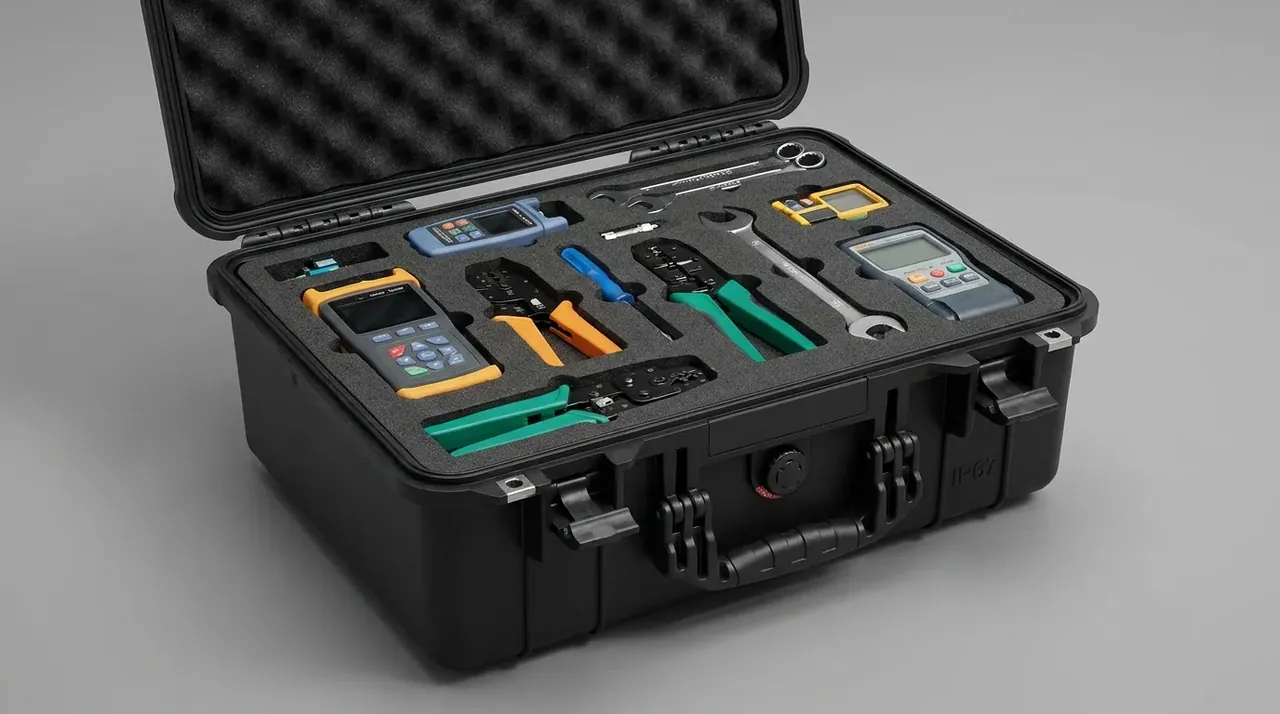
Quick answer: A metro tunnel case meets 45 mg/m³ of dust at the shotcrete face and 1.2 m/s² on the wagon, so IP6X joints and 12 mm pads decide how long it lasts.
Table of contents
- The dust ledger at the face
- IP5X versus IP6X in talcum powder
- Three ways dust gets in
- Vibration from erection and breaking
- Wagon fixing and pad choice
- FAQ
1. The dust ledger at the face
Twenty minutes into a shotcrete shift, a metro tunnel case carries 0.5 mm of powder on its inner walls. That layer matches 45 mg/m³ at the face, five times the 8 mg/m³ of the shield drive, and each lid opening pulls powder in rather than letting it settle outside.
The face median is 12 μm and 38% sits below 5 μm, fine enough to pass a 0.2 mm joint and the pores of a breather membrane. Shield cuttings are coarser at 20 μm and more abrasive, wearing hinge and latch pins first.
| Face | Dust load | Median | Content |
|---|---|---|---|
| Shotcrete | 45 mg/m³ | 12 μm | Cement |
| Segment erection | 15 mg/m³ | 18 μm | Concrete chips |
| Duct outlet | 12 mg/m³ | 8 μm | Mixed fines |
| Shield drive | 8 mg/m³ | 20 μm | Rock dust |
The duct outlet is the finest: at 8 μm the powder barely settles, so a case 3 m downwind picks up a visible joint layer in two days.
2. IP5X versus IP6X in talcum powder
Both ratings use talcum at 2 kg/m³ for 8 h. The difference is one thing: whether the enclosure is evacuated to 2 kPa below ambient. IP5X allows a little dust in without affecting operation, IP6X demands none, and that 200 mm water column separates them by an order of magnitude.
Split by duty: instruments and gas detectors go IP6X, because a dusty lens drifts, while spanners and pry bars do fine at IP5X. A 120-case line runs 3 to 7.
Weigh the residue. The criterion is 1 g/m² on the inner floor, and anything above means a leaking joint or a blinded membrane. A 0.01 g balance and a filter paper beat a visual check.
Compression below 20% fails the vacuum test again, so the strip is measured every 500 h.
3. Three ways dust gets in
Dust enters three ways: the lid joint, the latch holes and the breather valve. The valve is forgotten most, because it is open by design.
The joint criterion is 0.15 mm; above it, 8 μm powder rides the airflow of a closing lid straight in. A double lip beats a single: the outer stops coarse dust, the inner stops fines, and a 1.5 mm cavity drops the drive pressure.
Latch holes come second. A 4 mm bore runs into the latch cavity, where dust packs the spring. A 0.3 g silicone plug costs nothing, yet six cases in ten have lost theirs.
The valve costs most. Its ePTFE membrane has 0.2 μm pores and passes 0.8 L/min to equalise pressure from temperature swings. Once cement skins over it, a case in sun builds 4 kPa, past the 3.5 kPa cracking pressure, and the valve turns into an intake. Mount it 150 mm off the ground with a dust cap.
A joint leaks continuously, a latch hole only when the lid opens, a valve only once blinded, and then badly. Site counts put them at six, two and a half, and one and a half in ten.
4. Vibration from erection and breaking
Segment erection is sustained: 0.3 g from 5 to 50 Hz, 6 min per ring and 8 rings a shift. Breaking is impact: 12 m/s² peak at 18 to 35 Hz for 40 min. Wagon travel is 1.2 m/s² random, the lightest load but the longest exposure.

Resonance breaks cases, not peak. A first mode inside 18 to 35 Hz means 40 min of the case shaking itself, screws loosening first. A 4 mm wall measures 78 Hz and clears the band; a 3 mm wall sits at 52 Hz with 17 Hz of margin.
Judge by relative movement: at 1.2 m/s² the case should shift no more than 0.4 mm against the deck, or foam pockets rub and tool faces show bright marks.
| Condition | Level | Frequency | Duration | Guard |
|---|---|---|---|---|
| Segment erection | 0.3 g | 5–50 Hz | 6 min per ring | Bolt loosening |
| Breaking | 12 m/s² | 18–35 Hz | 40 min | Resonance |
| Wagon travel | 1.2 m/s² | 2–80 Hz | Whole shift | Slip |
5. Wagon fixing and pad choice
Four M10 bolts at 45 N·m with nylon-insert nuts hold the case. An 8.8 bolt clamps about 18 kN, so four give 72 kN against a 60 kg loaded case, a factor above 100.
Pads are EPDM at 60 Shore A, 12 mm thick, compressed 15%, which puts the system at 9 Hz for roughly 78% isolation. At 70 Shore A the natural frequency rises to 12 Hz and isolation falls to 62%.
Never cover the whole base: four 60 mm × 60 mm pads at the corners let the ribs bear on the deck, so the pads isolate rather than carry. A full sheet crushes one edge and leaves the other hanging.
Re-torque every 200 h and change the membrane every 500 h.
Conclusion
Dust and vibration land on different numbers, so treat them separately. On the dust side three figures matter: 45 mg/m³ at the face, 0.15 mm at the joint and 0.2 μm at the membrane, the first two deciding whether powder enters and the third whether the escape route blocks itself. On the vibration side, breaking runs 18 to 35 Hz against a 78 Hz first mode, and 43 Hz of gap is what counts as margin. Give IP6X to instruments and IP5X to tools, put 12 mm EPDM pads at the corners rather than across the base, log the 45 N·m re-torque at 200 h, and the configuration holds for a whole section. Drop the wall to 3 mm to save 1.8 kg and the mode falls to 52 Hz, so the saving comes back as a monthly re-torque.
| Item | Site configuration | Criterion |
|---|---|---|
| Dust | IP6X shell, double-lip joint, valve cap | Under 1 g/m² after 8 h talcum |
| Vibration | 12 mm EPDM pads, 4 × M10 at 45 N·m | Under 0.4 mm shift at 1.2 m/s² |
| Upkeep | Re-torque at 200 h, membrane at 500 h | Joint within 0.15 mm |
This article discusses container-side specifications and design implications only, and does not cover any handling, loading or use of the contents.
Related Reading
- Rail transit equipment case handling
- Case protection for metro ventilation plant
- Case selection for railway signalling
- Metrology box series on site
Related Products
- 8 Series — Gun Cases; Military Equipment Cases; Camera Equipment Cases; Drone Cases; Watch Cases; Knife Cases; First Aid Cases; Electronics Equipment Cases
- WL8-2812 PP Gun Case — model WL8-2812
- All protective cases and toolboxes: 7 series, 158 models