

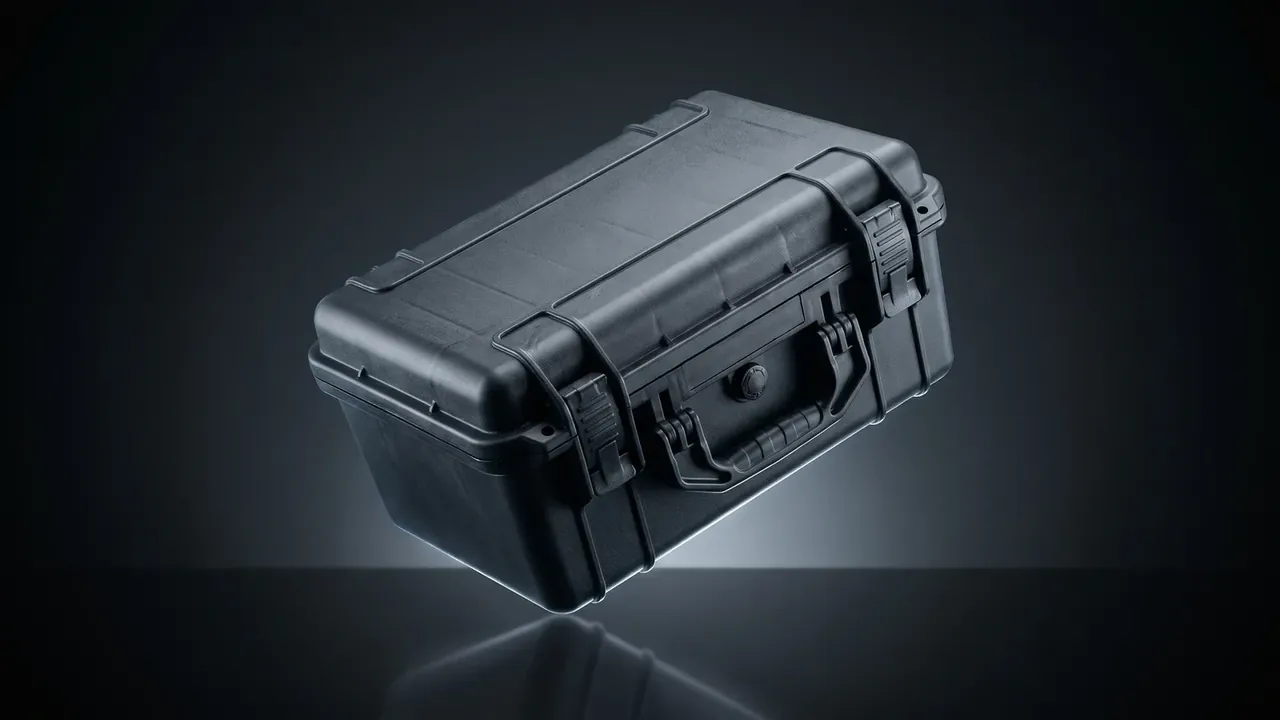
Quick answer: Acceptance of a watertight hard plastic carrying case rests on six measured items: handle attachment, latch cycling, lid warpage, gasket compression, salt spray and drop. Each needs a method, a limit and a sampling rule.
Table of contents
- Where Acceptance of a Watertight Hard Plastic Carrying Case Begins
- How Handle-to-Body Strength Is Measured
- Latch Life and Lid Flatness Limits
- Gasket Compression and Hardware Salt Spray
- Drop Tests, Appearance and Sampling Rules
- FAQ
1. Where Acceptance of a Watertight Hard Plastic Carrying Case Begins
Split the checklist into appearance, dimensions, function and endurance; their limits differ by an order of magnitude.
A loaded case hangs almost entirely from the handle and two hinge pins, and the lid stays shut on gasket compression alone. Acceptance of a watertight hard plastic carrying case therefore concentrates on those joints and on lid flatness.
| Item | Method | Limit |
|---|---|---|
| Colour | D65, colorimeter | 1.5 or less |
| Lid warpage | Plate, feeler gauge | 1.5 mm or less |
| Latch force | Force gauge, centre | 60 to 110 N |
| Gasket | Blade, imprint paper | 0.05 mm blade blocked |
| Handle pull | Tensile machine | 300 N, one minute |
| Drop | Corner, edge, face | 1.2 m, no leak |
2. How Handle-to-Body Strength Is Measured
Handle pull on a watertight hard plastic carrying case is 300 N held 60 seconds, straight up, the line through the grip centre. The clamp must span the load-bearing middle; a short grip records the fixture instead. Repeat at 50 degrees Celsius, where polypropylene loses yield strength.
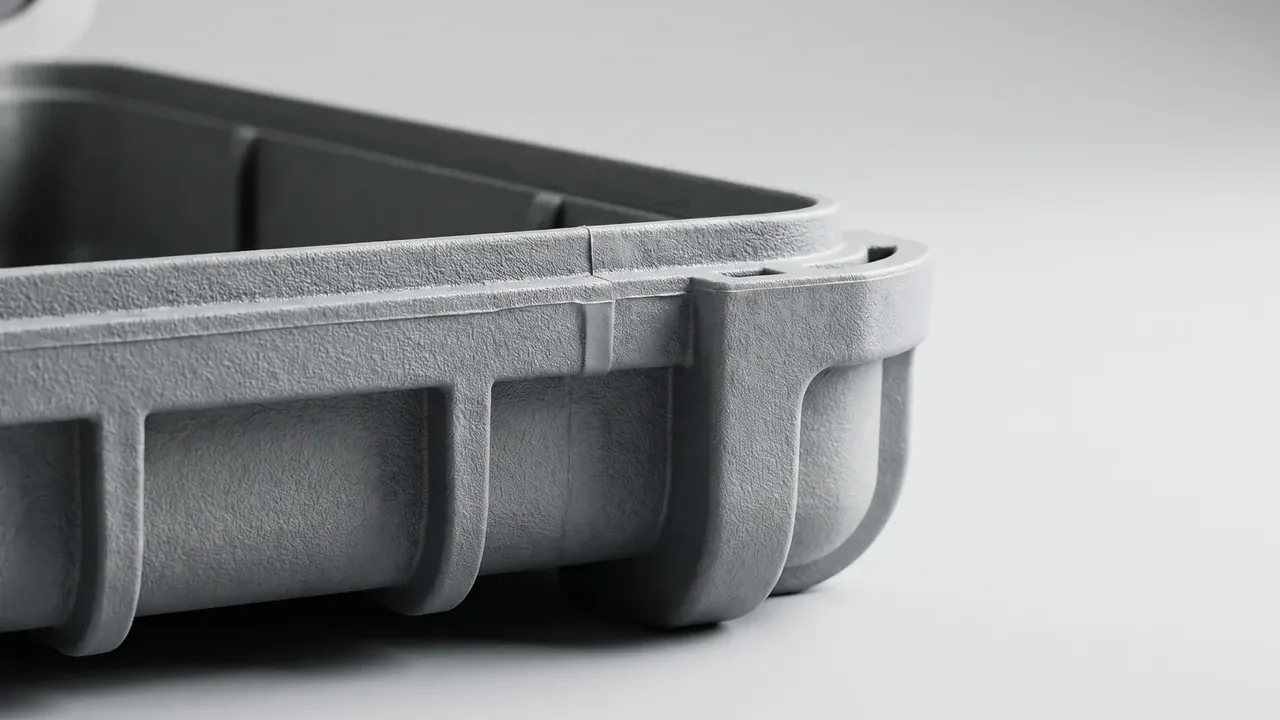
Pass requires no whitening at the handle root, no axial movement of either hinge pin, and residual set under 2 mm after 24 hours.
Cyclic lifting runs 1.2 times the rated payload at 30 lifts per minute to 5000 cycles, then repeats half the static load.
3. Latch Life and Lid Flatness Limits
Latch cycles on a watertight hard plastic carrying case run 3000 times at 20 openings per minute, to full travel. Pass means no crack, no loosened pin, and under 20 percent loss of closing force, starting from 60 to 110 N.
Lid flatness comes off a plate and feeler gauge: lid free, three points per edge and both diagonals, largest gap is warpage, limit 1.5 mm. An arched middle loses gasket contact.
Probe the perimeter every 100 mm with a 0.05 mm blade once latched, failing any entry past 5 mm.
4. Gasket Compression and Hardware Salt Spray
Gasket fit reads fastest with imprint paper: pressure-sensitive strip in the groove, lid latched, ten minutes, then measure imprint width. Target 30 to 50 percent compression with under 15 percent spread, or it leaks or takes a permanent set.
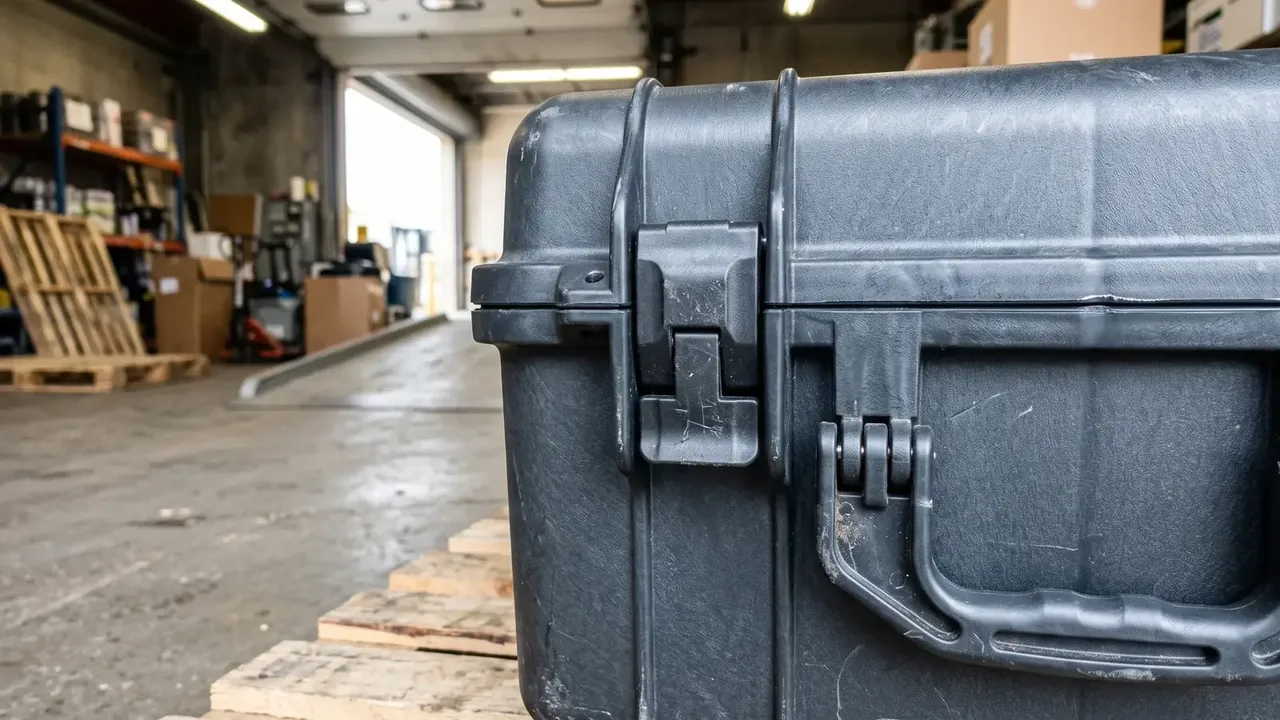
Salt spray covers latch springs, hinge pins and the valve insert: 48 hours neutral, 96 for outdoor storage. Corroded area stays under 5 percent, and the latch must still close one-handed. Stainless is not exempt.
Bake at 60 degrees Celsius for 72 hours, freeze at minus 20 for 24, then latch at once: a gasket hardened past latching fails.
5. Drop Tests, Appearance and Sampling Rules
Drop a watertight hard plastic carrying case on a corner, an edge and a face, from 1.2 m onto concrete. After each: no through crack, no latch sprung, the blade still blocked, 30 minutes of immersion dry.
Under D65, colour difference stays within 1.0 inside a lot and 1.5 against the sample; flow marks up to 3 mm and one 2 mm dent on a non-sealing face pass.
Sampling is level II, normal severity: critical at AQL 0.65, major at 1.5, minor at 4.0.
| Lot size | Sample | AQL 0.65 | AQL 1.5 | AQL 4.0 |
|---|---|---|---|---|
| 151 to 280 | 32 | 0 and 1 | 1 and 2 | 3 and 4 |
| 281 to 500 | 50 | 1 and 2 | 2 and 3 | 5 and 6 |
| 501 to 1200 | 80 | 1 and 2 | 3 and 4 | 7 and 8 |
A rejected lot is not sorted and resubmitted; it goes back whole, or it is screened and re-formed.
Conclusion
Six items with a method, a number and a rule behind each beat a shelf of instruments. Write them into the contract and the process window stops drifting. Fixed that way, acceptance of a watertight hard plastic carrying case is something a buyer can hold a supplier to.
This article discusses only the container (case body) side of specifications and design intent, and does not cover any handling, loading or use of the contents.
Related Reading
- Sealing grades and IP test conditions for waterproof hard cases
- How a hand-carry hard case carries load through its body
- How trial moulding confirms first-article fit
- Quality control points on a case assembly line
Related Products
- 8 Series — Gun Cases; Military Equipment Cases; Camera Equipment Cases; Drone Cases; Watch Cases; Knife Cases; First Aid Cases; Electronics Equipment Cases
- WL8-2812 PP Gun Case — model WL8-2812
- All protective cases and toolboxes: 7 series, 158 models