

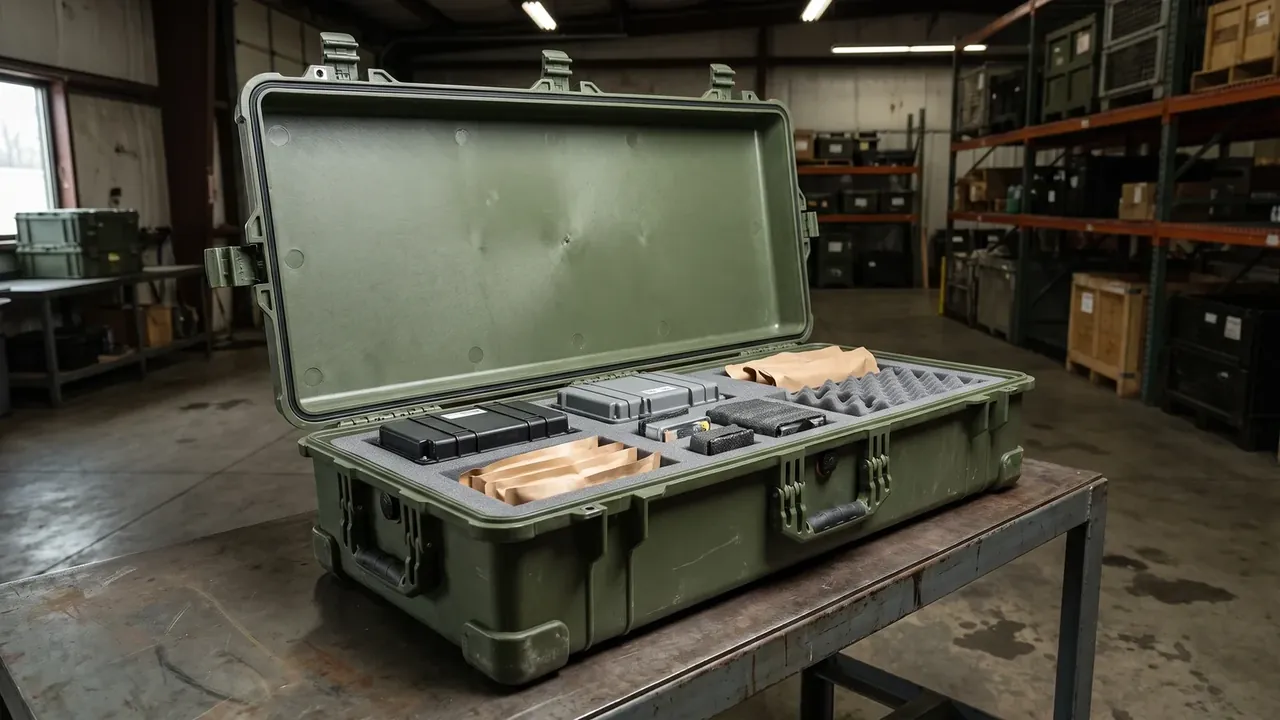
Quick answer: Judge an ABS Plastic Protective Case by stiffness, then surface, then colour: flexural modulus above 2100 MPa, Rockwell R105 to R112, under 3 mm lid deflection at 25 kg, and notched impact of 22 kJ/m² at 23 °C that falls to 8 to 10 at −20 °C.
Table of contents
- What an ABS Plastic Protective Case Must Settle First
- Hardness, Impact and the Conditions Behind Them
- Texture, Gloss and Colour Consistency
- Weatherability, UV Stabilisers and ASA
- Low-Temperature Impact and Latch Force
- FAQ
1. What an ABS Plastic Protective Case Must Settle First
Buyers open with colour and castors, which matter least. Stiffness decides whether the lid sags and a stack of three leaves a permanent set; surface decides whether two cartons from one run look alike.
Stiffness in an ABS Plastic Protective Case comes down to three numbers on a drawing: flexural modulus 2000 to 2400 MPa, Rockwell R105 to R112, walls 2.5 to 3.2 mm. Near-identical figures still feel different, because wall uniformity and rib placement dominate. Surface is a process question: 10 °C of mould temperature moves gloss three points, and regrind above 15 percent pushes lot colour difference to ΔE 1.5.
| Criterion | Number to demand | How to check |
|---|---|---|
| Stiffness | Modulus above 2100 MPa | 25 kg on the lid, measure deflection |
| Impact | 22 kJ/m² notched at 23 °C | 4 h at −20 °C, then drop |
| Surface | 0.04 mm grain, ΔE 1.0 within a lot | Two panels side by side in daylight |
2. Hardness, Impact and the Conditions Behind Them
Hardness is the most misused figure. A high Rockwell R says the surface resists scratching, not that the case survives a fall. Grades above R115 give up impact, sliding from 22 kJ/m² to about 12, and a knocked corner on an ABS Plastic Protective Case whitens at once.
Impact needs its conditions: Izod type A notch, 3.2 mm specimen, 23 °C, 24 hours conditioning. On a 6.4 mm specimen the same compound reads 30 percent higher. After four hours at −20 °C impact falls to 8 to 10 kJ/m², about 40 percent retention; at −30 °C the fracture turns from white to flat, which is brittle failure.
3. Texture, Gloss and Colour Consistency
Texture on an ABS Plastic Protective Case is etched into the cavity, not sprayed on. On the VDI 3400 scale, grade 21 is about 0.02 mm deep, grade 27 about 0.04 mm, grade 33 up to 0.08 mm. Deeper grain hides wider scratches; a polished face keeps fingerprints.
Grade 27 is the compromise for side panels: slight drag under the hand, clean release, good ink adhesion. Weld lines are what texture cannot hide, so gate position and 70 °C mould temperature decide whether the line fades or becomes a deliberate 0.3 mm groove.
| Surface | Mould work | Depth | Hides scratches |
|---|---|---|---|
| High gloss | Polished to Ra 0.02 µm | none | poorly |
| Fine grain | VDI 21 etch | about 0.02 mm | fair |
| Medium grain | VDI 27 etch | about 0.04 mm | good |
| Coarse grain | VDI 33 etch | about 0.08 mm | very good |
4. Weatherability, UV Stabilisers and ASA
The butadiene phase carries double bonds, and double bonds are where ultraviolet enters. Facing south, an ABS Plastic Protective Case yellows to ΔE 4 to 5 in six months at about 70 percent impact retention, then chalks at a year.
Stabilisation pushes the curve outward rather than removing it: 0.3 to 0.5 percent hindered amine with 2 to 3 percent rutile titanium dioxide holds ΔE under 2 after 1000 hours of xenon arc. ASA, with no double bonds in the backbone, holds ΔE ≤3 after 2000 hours at 15 to 25 percent more cost.
5. Low-Temperature Impact and Latch Force
Cold arrives earlier than sunlight. At −20 °C retention is about 40 percent, at −30 °C only 20 percent, and a corner-first drop cracks the shell. A latch designed at 25 to 35 N needs over 45 N once the gasket stiffens, which is unworkable in gloves.
The hinge is the forgotten part: a moulded living hinge survives 5000 warm cycles and about 800 at −20 °C. Below −25 °C, a blend with 20 percent polycarbonate lifts −30 °C impact to 10 kJ/m², but needs 260 °C melt.
Conclusion
The decision comes down to four numbers: flexural modulus, notched impact with its retention curve, texture depth with colour difference, latch force. Put all four in the drawing and the acceptance clause. An ABS Plastic Protective Case specified this way stacks three high without sagging and still opens bare-handed at −20 °C.
This article discusses only the container (case body) side of specifications and design intent, and does not cover any handling, loading or use of the contents.
Related Reading
- PP versus ABS: toughness and surface compared
- How an injection moulded case is formed
- Choosing a case size range
- Mould texture and maintenance
Related Products
- 8 Series — Gun Cases; Military Equipment Cases; Camera Equipment Cases; Drone Cases; Watch Cases; Knife Cases; First Aid Cases; Electronics Equipment Cases
- WL8-2812 PP Gun Case — model WL8-2812
- All protective cases and toolboxes: 7 series, 158 models